TL;DR
Unified customer data delivers three compounding capabilities: a complete customer profile that enables accurate segmentation and attribution, RFM-driven behavioral segmentation that powers precision targeting, and ML-powered churn prediction that shifts retention from reactive to proactive. Together, they transform omnichannel strategy from generic and reactive to precise and predictive.
The previous blog identified how omnichannel brands operate with critical gaps. Data silos prevent brand recognition across channels. Offline attribution remains invisible to digital strategies. Repeat purchase rates stay low because segmentation remains generic. Acquisition spending balloons because retention signals are buried across disconnected systems.
These are not separate problems. They all flow from one root: fragmented customer data. And they all close through one shift, applied across three distinct capabilities. Unified customer data does not solve problems by adding more tools. It solves them by changing how systems see customers. From fragmented records spread across channels to one complete profile. From generic segmentation built on guesses to precision built on actual behaviour. From reactive responses that arrive too late to predictive actions that arrive in time.
What makes this shift possible is recognition. Once systems can see each customer as one person instead of five, everything that follows becomes intelligent rather than approximate.
Solution 1: The Unified Profile Enables Both Segmentation and Attribution
When customer data lives in separate systems, a fundamental gap emerges. A shopper who browses a website, abandons an app, purchases in-store, and engages via email becomes five different customer records. The email platform sees one profile. The ecommerce platform sees another. The store system sees a third. No single system recognizes these are the same person.
Identity resolution closes this gap by connecting the customer across systems. A loyalty ID links to an email in the CRM, which connects to a phone number from a store purchase, which connects to a device identifier from an app session. Not guesses. Direct connections. The outcome is one unified profile containing the complete history of that customer’s interactions across every channel.
The moment this unified view exists, pattern becomes visible. A marketer can see that this customer visited on Monday, abandoned on Tuesday, engaged on Wednesday, and purchased on Thursday. It can see that another customer took six months across three channels before converting. It can see which customers move fluidly between online and offline, and which prefer one channel entirely. These patterns were always in the data. The systems simply could not see them because they were fragmented.
This visibility transforms segmentation. Instead of sending the same message to everyone in a broad segment, a marketer can now build segments from actual customer behaviour. A high-value repeat customer deserves a retention message built specifically for them. A price-sensitive customer deserves a different message. A customer showing early repeat signals deserves a third message entirely. Each is built from observed pattern, not assumption.
This same unified view also enables attribution. An INFORMS (Institute for Operations Research and the Management Sciences) study found that 84% of the sales impact from online advertising occurs offline. Yet without unified data, brands measure only the digital portion, misallocating budget away from what actually drives conversion.
Unified data solves this by connecting offline store transactions to online campaign data. That same customer who saw a paid ad, visited the website, and purchased in-store now appears as one journey: paid media drove consideration, the website enabled research, the store closed the transaction. Attribution becomes accurate. Returns on every marketing dollar become measurable on actual revenue, not just digital metrics. Budget allocation stops flowing to “what looks good on dashboards” and starts flowing to what actually drove conversion.
Solution 2: Recognizing Best Customers Enables Strategic Growth
Once systems see complete customer journeys, segmentation becomes possible. But possibility is not action. The next question is operational: how do you translate customer data history into intelligent, executable segments?
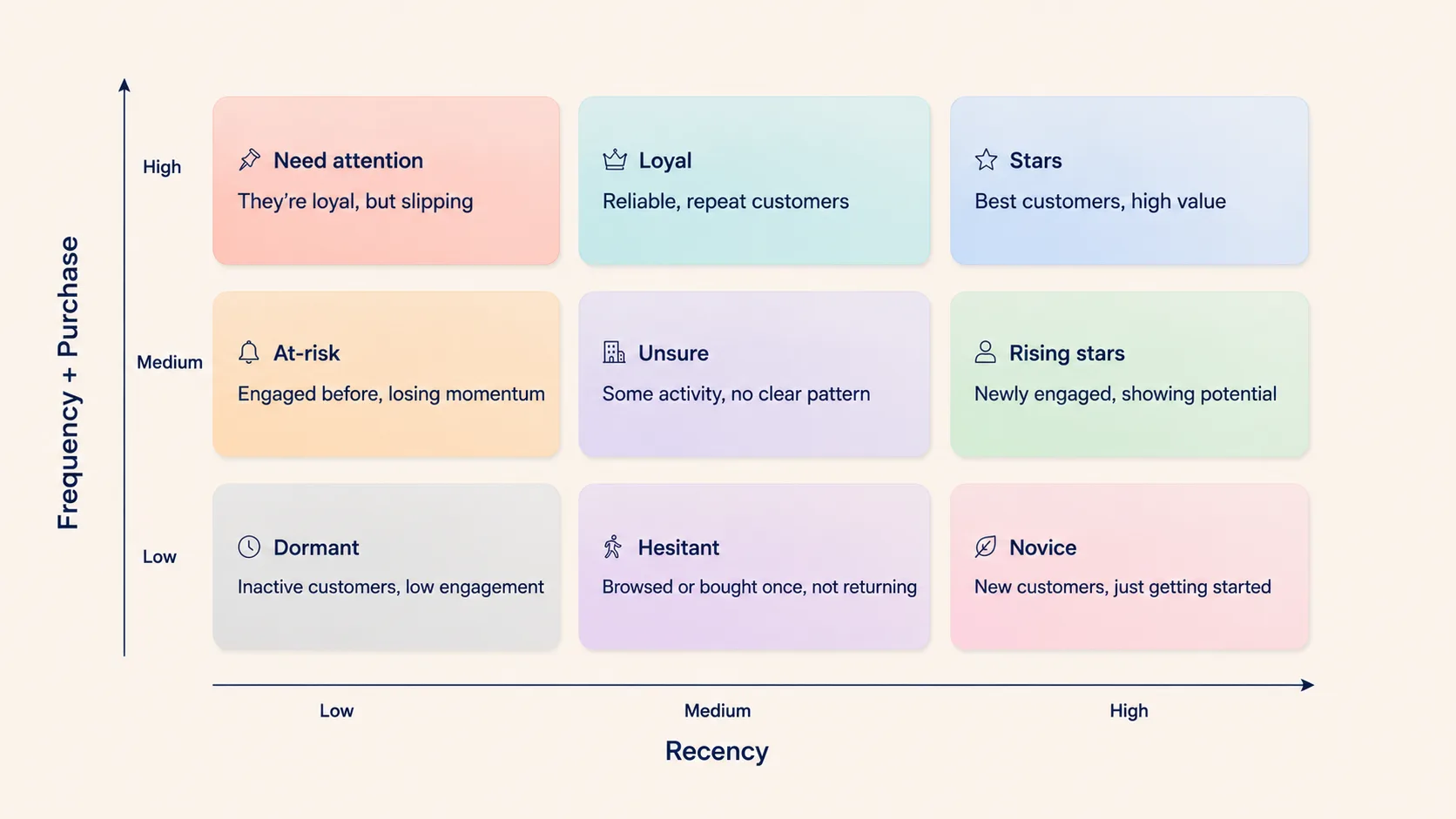
This is where RFM (Recency, Frequency, Monetary) models enter. Building on the unified data foundation, the Customer Engagement layer adds RFM as the practical tool that turns data history into actionable segments. You define the target, a category, a subscription, a cart value, and the recency and frequency filters around it, and the system takes it from there. It ranks every customer against all three dimensions at once and sorts them into clear behavioral tiers: Loyal, Rising stars, At-risk, Dormant, and more. Nobody is manually reviewing purchase histories to guess who’s about to churn or who’s ready for another purchase. The system reads the pattern across the base and returns it as a ready segment, built exactly to the criteria you set.
Marks & Spencer demonstrated what happens when this actionable segmentation becomes strategic. Using unified customer data and RFM-driven segments, they recognized that their customer base was not homogeneous but multiple distinct types with different spending patterns. Some customers were highly budget-conscious. Others had higher spending capacity. Rather than sending one retention message to everyone, they built distinct messages for distinct customer types. Budget-conscious customers received messaging emphasizing value and occasion-relevance. Higher-spending customers received messaging focused on premium positioning and exclusivity. Each message spoke to the actual customer type receiving it, built from unified data that revealed who they were and what they had already shown they valued.
The result was measurable. Within three months, this approach drove 13% higher revenue by increasing wallet share per customer segment. This is what precision targeting looks like when built on unified customer data and RFM segmentation: every message reaches the right customer with the right message because you are not guessing at who they are. You are reading their actual behaviour and acting on it strategically.
Solution 3: Behavioral Prediction Enables Proactive Retention
Pattern recognition, as powerful as it is, remains reactive. It identifies what has already happened. Churn prediction is different. It anticipates what will happen, identifying risk before it becomes defection.
This is where unified customer data meets machine learning. Rather than waiting for obvious signals of churn to appear, ML models read dozens of behavioral indicators simultaneously, weighted against each customer’s unique history and patterns observed across the broader base. The model produces an assessment of churn likelihood before the customer has actually left. A customer showing certain behavioral indicators resembles patterns historically preceding churn. Another customer showing different indicators resembles them differently. The accuracy is higher because the model reads actual behaviour comprehensively, not waiting for a single threshold to be crossed.
Once churn risk is identified early, intervention strategy changes fundamentally. Rather than running broad reactivation campaigns for customers who have already lapsed, retention becomes proactive and strategic. A high-value customer showing early churn signals receives a personalized, relationship-focused message designed to prevent them from leaving. A price-sensitive customer showing spending decline gets a calibrated offer. A customer whose engagement has migrated to a different channel gets re-engagement in that channel. Channel, message, timing, and offer are all determined by the specific risk pattern identified before the customer leaves.
This strategic precision also rebalances marketing economics. Reactivation campaigns, those aimed at winning back customers who have already lapsed, cost several times what proactive retention costs. If churn patterns can be identified early, a smaller, timely intervention prevents a larger, far more expensive recovery campaign later. The retention budget becomes visible and measurable in ways it was not before. Retention shifts from secondary tactic to primary strategy because the data proves its ROI.
Budget allocation follows. Acquisition spending becomes rationalized. Retention spending becomes central. Customer lifetime value improves not because customers are more valuable, but because fewer of them are lost before that value compounds.
How These Three Build on Each Other
Recognition enables segmentation. Segmentation enables precision targeting. Targeting built on unified data that shows who customers actually are delivers results at scale. That precision drives conversion higher, engagement costs lower, lifetime value longer.
The previous blog identified where operational gaps exist in omnichannel brands. This piece showed what closes those gaps. Each solution is distinct, but they are not separate. They flow from one foundation and compound into one outcome: an omnichannel brand that knows its customers completely and acts on that knowledge strategically.
The shift from fragmented systems to unified intelligence is not just a technology upgrade. It is a shift in how omnichannel strategy is built: from reactive and generic to proactive and precise, from hoping customers return to knowing when they will and acting before they leave.
This is where sustainable omnichannel growth lives.
Final Take:
Unified customer data is not a reporting upgrade. It is a strategic shift. It moves omnichannel brands from operating in partial darkness with fragmented records to seeing customers completely and acting on that knowledge strategically. Recognition enables segmentation. Segmentation enables precision. Precision drives measurable growth. The shift is not about having more data. It is about systems that finally see the whole customer instead of five different pieces.