TL;DR
Fragmented customer data across channels costs omnichannel brands in four ways: invisible customers, unmeasured offline revenue, lost repeat purchases, and misallocated acquisition budgets. Unified customer data is the foundation that fixes all four.
According to Forrester research, 74% of enterprises say they want to be data-driven, but only 29% successfully connect analytics insights to action.¹ That gap is fragmentation. Retail has become fragmented by default. It started as a store with a counter and a salesperson who knew every regular by name, trust built over years in person. Then came the leap online: a full ecommerce website followed by an app. From there, it grew one bolt-on at a time: an ecom platform for sales, an email tool for reach, an ad channel for traffic, a loyalty system for retention, and eventually a separate analytics layer just for the app. Each addition made sense on its own. Together, they left the customer scattered across disconnected records, dashboards reporting conflicting numbers, and most revenue happening in channels the marketing stack can’t even see.
The business impact of this fragmentation is compounding quietly. It shows up not in a single crisis moment but across four distinct cost centers: wasted technology budgets, misallocated marketing spend, lost repeat customers, and missed attribution entirely. For omnichannel retail leaders, these four pain points reveal why unified customer data has stopped being optional and become foundational to sustainable growth.
Data Silos Make It Impossible to Identify Your Best Customers
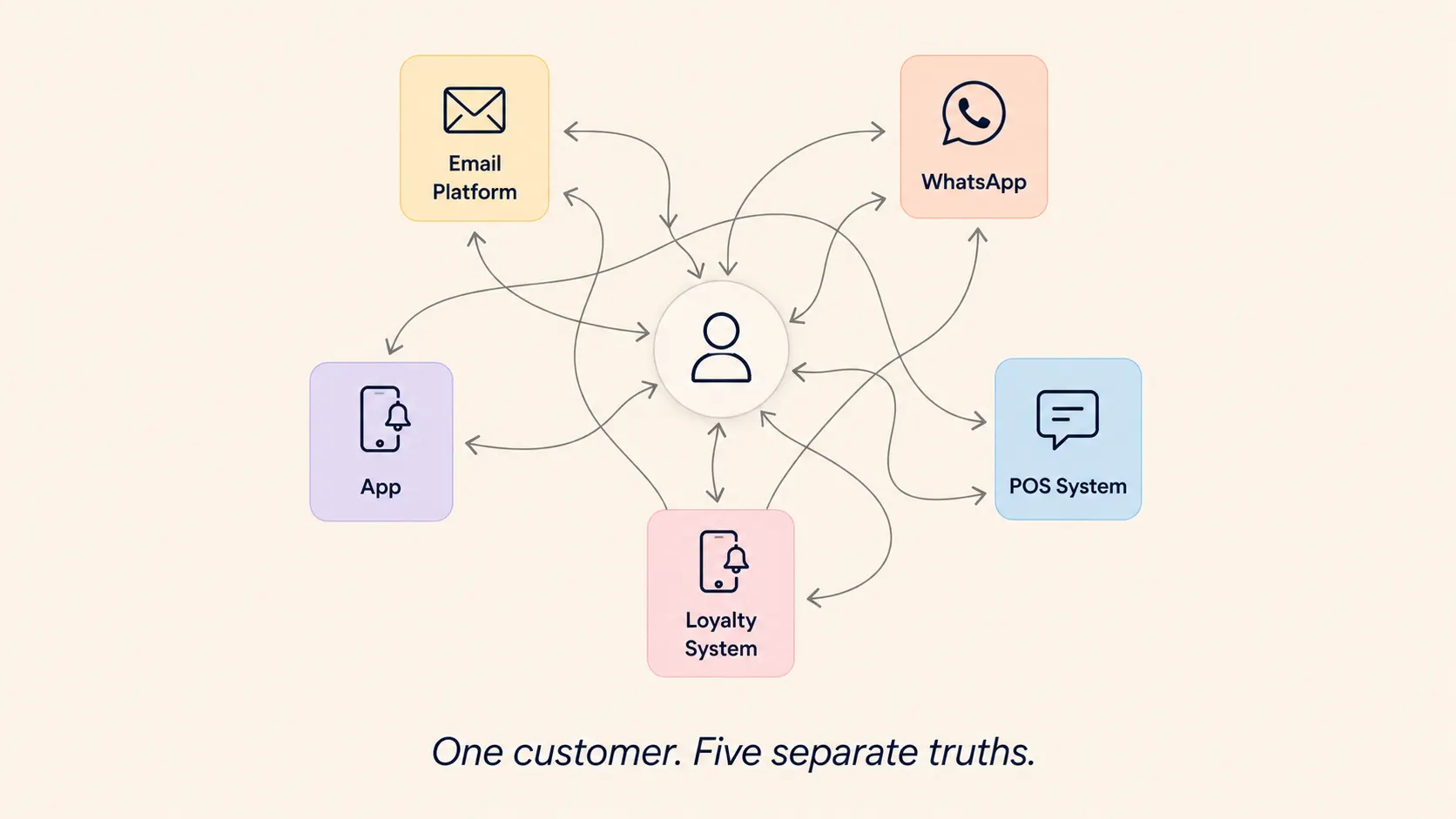
The first cost of fragmentation is visibility. When customer data lives in separate systems, no single record exists for an individual customer. A shopper who browses the website, abandons a cart, subscribes to SMS, makes a purchase online, and returns an item in a physical store becomes five different customer records. The email platform sees one profile. The ecommerce platform sees another. The loyalty system sees a third. The POS system sees a fourth. The app analytics tool sees a fifth.
This fragmentation creates a crisis of recognition. Marketing teams cannot see the full customer journey when serving shoppers in-store or online. Simultaneously, customers expect personalized interactions. The gap between what customers want and what fragmented systems can deliver is enormous. Brands cannot deliver the experience customers demand because they cannot see the customer. Without unified data, segmentation becomes guesswork. Which customers are worth investing in for retention? Which are one-time bargain hunters unlikely to return? Which segments have the highest lifetime value? These questions cannot be answered across disconnected systems.
For omnichannel brands specifically, this creates a direct revenue impact. Personalization campaigns built on incomplete or fragmented data show lower conversion rates than campaigns built on comprehensive customer profiles. Marketing teams spend time manually syncing data between systems, updating customer records, and correcting duplicate profiles instead of building campaigns. The organizational cost compounds. Teams operate on different versions of customer truth, alignment becomes difficult, and time-to-campaign slows.
Offline and Online Data Cannot Be Connected
For marketers, the measurement problem is fundamental: systems are built to track only what they can track digitally. The moment a customer interacts with a physical store or makes a purchase offline, the digital tracking chain breaks.
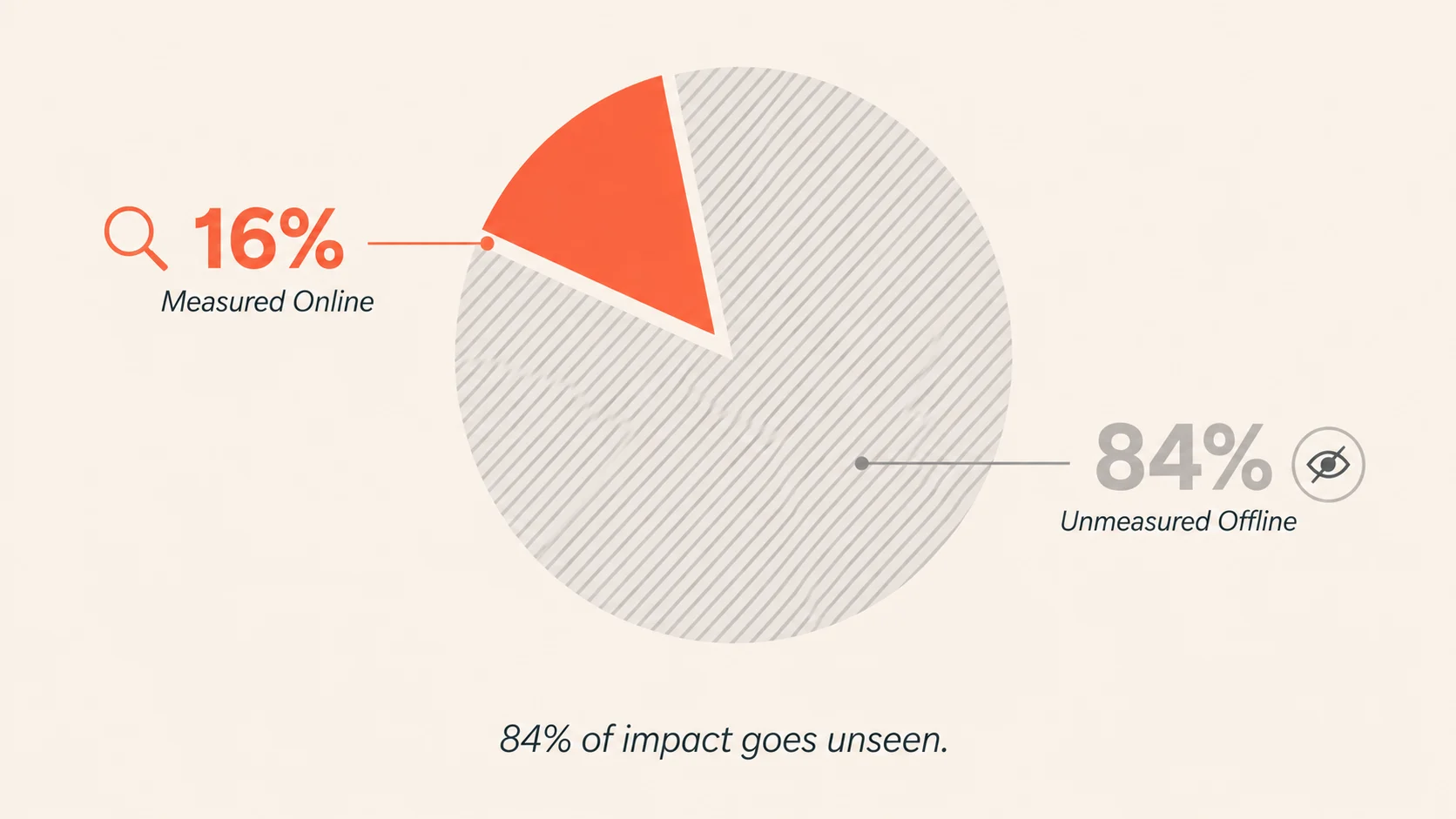
This creates a dangerous blind spot. An INFORMS(Institute for Operations Research and the Management Sciences) field experiment found that 84%² of the total sales impact from online advertising occurs offline, in stores and through retail partners. Yet when brands analyze their marketing performance, they measure only the 16% that happens in digital channels. The result is systematic budget misallocation. Campaigns that are actually driving customers into physical stores appear unsuccessful on digital dashboards. Campaigns that look successful based on online metrics might be harvesting clicks from already-decided buyers. Without the ability to connect offline purchases back to digital campaigns, budget flows toward whatever looks good on screen, not toward what actually drives revenue.
For retail brands with multiple locations, this gap is especially costly. When a digital ad drives foot traffic to a store, that attribution is invisible. Marketing teams cannot see that a customer saw a Facebook ad on Monday, browsed the website on Tuesday, and purchased in-store on Wednesday. These journeys become invisible. This is the standard customer journey in modern retail. Yet most brands have no system to measure it.
Low Repeat Purchase Rates Stem from Inability to Segment and Personalize
Research from McKinsey and Segment found that 78%³ of consumers report higher likelihood of repeat purchases from businesses that personalize their experience. Yet fragmented data makes personalization at scale impossible. For many categories, the problem is not product quality or delivery experience. It is visibility. Brands cannot segment customers intelligently without unified data, and they cannot personalize without segmentation.
Imagine a brand has a customer who spent $500 in their first month across transactions: offline in a store, on the web, and on the app. Without unified data, this customer may not exist in actionable segments. The email platform might see only the email engagement. The app platform might know only about the push click. The ecommerce platform might know only about the cart abandonment. There is no single system to recognize this user as one customer who has been transacting across multiple brand entities. This fragmentation creates a critical gap: without data unification, high-value customers remain invisible to retention and personalization strategies.
Segmentation powered by unified data enables intelligent targeting: identifying which customers are likely to churn and engaging them proactively, recognizing when a customer is ready for a cross-sell or upsell, timing replenishment messages for consumable categories to match natural purchase cycles, and suppressing discount-sensitive customers from full-price campaigns. Without this capability, retail brands resort to generic campaigns. They send the same “come back and shop” email to all inactive customers rather than a churn-prevention message to high-value customers and a win-back offer to bargain hunters. The result is lower conversion rates, wasted email sends, and higher costs per repeat purchase.
High Marketing Spend on Acquisition Grows Unchecked Because Retention Is Invisible
Customer acquisition costs have been rising consistently as advertising competition intensifies. Simultaneously, the cost to retain an existing customer remains flat or declines. According to Post Affiliate Pro’s analysis of Bain & Company research, acquiring a new customer costs 5 to 25 times more⁴ than retaining one, depending on industry and business model. Yet most retail budgets allocate disproportionately toward acquisition and minimize retention spending.
This imbalance persists because retention at scale is invisible without unified data. Brands cannot accurately predict which customers are at risk of churn. They cannot identify the cohorts most likely to repurchase. They cannot measure the true cost and ROI of retention campaigns because customer data is fragmented across platforms. The result is that retention strategies fail not because the concept is flawed but because the data infrastructure to execute them does not exist.
The math of this misallocation is striking. Modest increases in customer retention can lift profits significantly. Yet brands cannot achieve these improvements because they cannot segment cohorts, predict churn, or track the incremental impact of retention spend. They default to acquisition because acquisition metrics are visible, attributable, and measurable in their ad platforms. Retention metrics are buried across multiple systems.
For omnichannel retailers, this creates a second-order problem. Brands lose a meaningful percentage of their customer base each quarter due to passive churn. Rather than address the root cause with data-driven retention programs, they increase acquisition budgets to offset the loss. Marketing spend grows without corresponding revenue growth. The unit economics deteriorate. Growth becomes acquisition-dependent, which is expensive and unsustainable.
The Common Thread
These four pain points appear to be separate problems. Data silos feel like a technology issue. Attribution gaps feel like a measurement problem. Low repeat rates feel like a product or retention strategy issue. High acquisition spend feels like a budget allocation problem. But they all trace back to the same missing foundation: a single, unified view of the customer that every system, every team, and every business decision can answer to.
Fragmented data creates fragmented teams, conflicting reports, and inefficient spending. A unified customer view creates the opposite. It provides one source of truth for who the customer is, what they have purchased, what they prefer, when they are likely to buy again, and which channels reach them most effectively. With unified customer data, marketers can segment intelligently, personalize at scale, measure attribution accurately across channels, and allocate marketing budget to the highest-impact channels and cohorts.
This foundation is not a reporting layer or a dashboard. It is the underlying architecture that makes effective marketing possible. Without it, marketers operate in partial darkness, making decisions based on incomplete information. With it, they see the full picture.
The next piece in this series explores what unified customer data actually is, how it is built, and the mechanics that make it work.
Final Take:
Omnichannel retailers operate across disconnected systems that leave customers fragmented across five or more profiles. This fragmentation creates four compounding business costs: data silos prevent personalization, offline-to-online attribution gaps cause budget misallocation, inability to segment kills repeat purchase rates, and hidden churn forces wasteful acquisition spending. These pain points reveal why unified customer data has become essential for sustainable retail growth.
Sources
¹ Forrester. “Think You Want To Be Data-Driven? Insight Is The New Data.” Blog post by Ted Schadler, March 2016. Analysis of enterprise data analytics capability based on research into business satisfaction with analytics investments. https://www.forrester.com/blogs/16-03-09-think_you_want_to_be_data_driven_insight_is_the_new_data/
² LiftLab. “Online-to-Offline Attribution Gap: Why 84% of Ad Impact Goes Unmeasured.” https://liftlab.com/blog/online-to-offline-attribution-gap/
³ McKinsey. “The Value of Getting Personalization Right—Or Wrong—Is Multiplying.” Next in Personalization 2021 Report, November 2021. https://www.mckinsey.com/capabilities/growth-marketing-and-sales/our-insights/the-value-of-getting-personalization-right-or-wrong-is-multiplying
⁴ Post Affiliate Pro. “Why Customer Retention Costs 5x Less Than Acquisition.” https://www.postaffiliatepro.com/blog/why-customer-retention-costs-5x-less-than-acquisition/