





TL;DR
“By the time a jewellery customer visits your store or app, most of the deciding has already happened. The real purchase window opens weeks earlier, triggered by a life event your platform cannot see. This piece explores why that makes jewellery unlike any other retail category, why campaigns are structurally too slow to reach that window, and how Netcore’s agentic AI closes the gap before it even forms.”
Closing the four leaks in your funnel still assumes something: that you’re reacting to a customer who has already shown up. But in jewellery retail, showing up is the last step, not the first. The real recovery starts earlier with product-specific features built to catch revenue before it leaks. Now that you’ve seen these features, here’s how Agentic AI bridges the key gap jewellery brands face and how you can get ahead with these capabilities.
In most retail categories, intent announces itself before the purchase does. A customer browses, lingers, adds to cart, comes back, the signal builds in plain sight, and your job is mostly to catch it. In fashion, a search is the first signal. In grocery, purchase rhythms repeat on a cycle predictable enough to act on. In electronics, a launch date manufactures the moment of intent. Across every one of these categories, you mostly need to be ready.
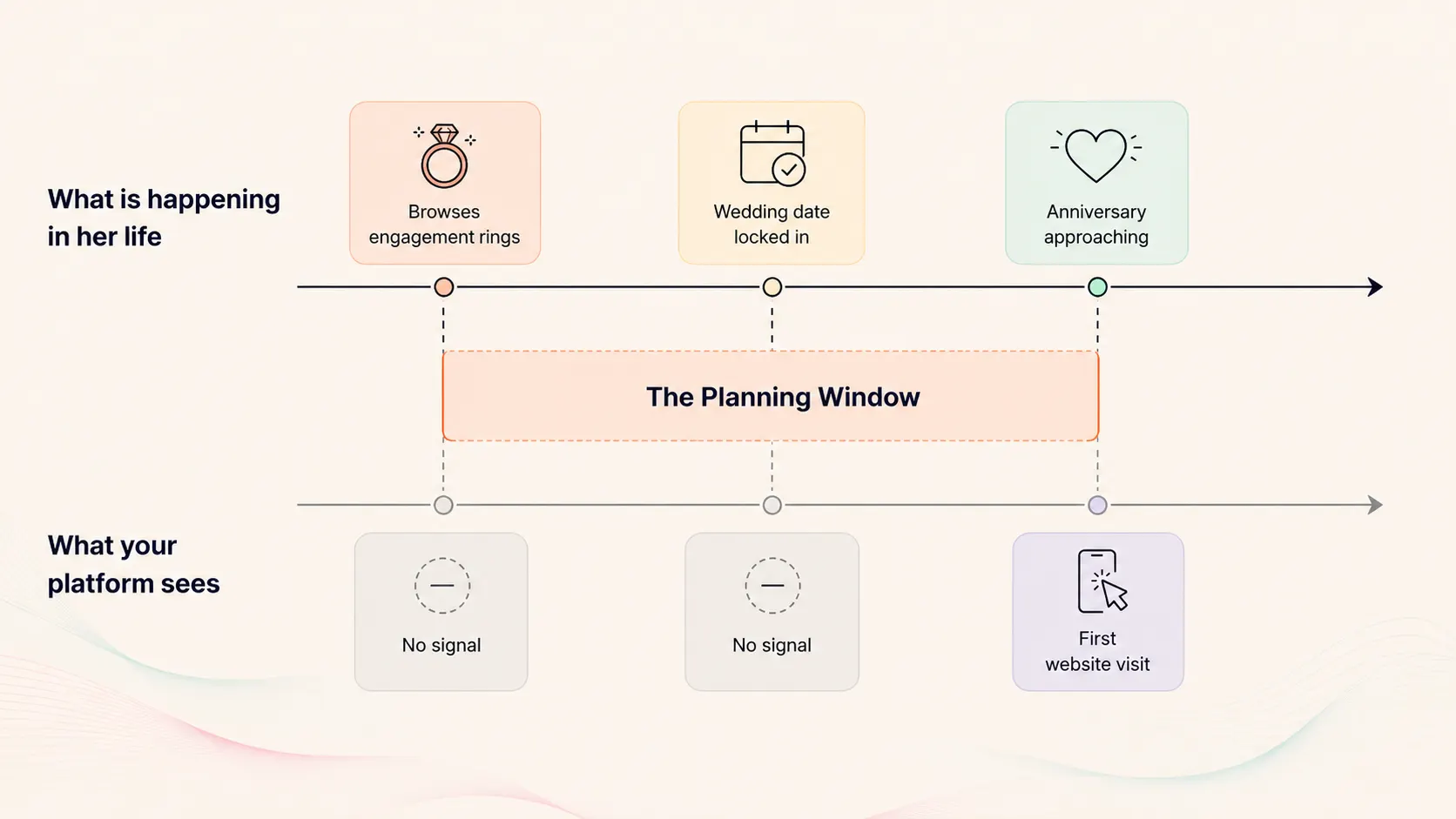
Jewellery breaks this pattern entirely. The decision begins somewhere your platform cannot see, a proposal being quietly planned, a wedding date just locked in, an anniversary approaching. There is no search, no browse, no launch date to watch for, because the trigger is a life event unfolding entirely offline. By the time that customer opens your app or walks into your store, the exploring is over. The decision is already 70% made. You cannot watch that intent take shape. You can only be positioned to catch it the instant it surfaces or lose it to whoever does.
The Customer Is Already Telling You Something
The planning window is invisible. It is not silent.
It leaves traces, and those traces sit inside data you already hold. Jewellery purchases map to life stages that repeat on fairly predictable cycles, which makes past behaviour an unusually strong predictor of what comes next. A customer who bought bridal jewellery is heading toward an anniversary milestone in eleven to twelve months. A customer who has browsed engagement rings across several sessions is likely in the early stages of planning a proposal. A customer who bought investment gold last festive season is a strong candidate to re-enter that window this year.
None of this is guesswork. These are patterns, sitting quietly inside your transaction history unused, while the same customers keep receiving a generic new collection email that has nothing to do with where each customer actually is.
The data was never missing. It was just never read this way.
What It Costs to Miss the Window
Missing the planning window rarely means losing a sale outright. More often, it means losing that sale to whoever reached the customer first.
A customer who is already 70% decided before actively browsing is not going to spend weeks weighing five brands. The purchase goes to whoever makes the customer feel understood and confident early, while the decision is still being shaped. Whoever earns a place inside the planning window effectively owns the purchase. Everyone else is left competing for whatever intent is left over, fighting harder for a shrinking share of a decision that has already been made.
This is a strategic question, not a tactical one. It means the real competitive battleground in jewellery has quietly moved upstream, away from the storefront and into the weeks before a customer even considers it shopping. A brand that keeps polishing its website and store experience while ignoring this earlier window is optimising a stage the customer may have already left. The growth teams worth watching aren’t asking how to convert better once someone arrives. They’re asking how to know before the customer does.
Why Campaigns Cannot Close This Gap
A campaign is built after a marketer decides it’s time to act. It fires at a segment. It waits for results. By the time that loop completes, most customers’ planning windows have already opened and quietly closed.
This isn’t a quality problem; a well-designed campaign can still arrive too late, because campaigns are reactive by design, and the planning window calls for something proactive. What you need is a system that is always watching, always learning, always deciding, for every customer individually, in real time, without waiting for a human to notice the moment and press go.
The problem was never campaign execution. It was that campaigns wait, and the planning window doesn’t.
The Four Leaks, Closed Before They Open
The first piece in this series walked through the four moments where jewellery brands lose revenue, and the last one showed how the right technology recovers each once it is already happening: an abandoned cart, channels that contradicted each other, a search that failed, a post-purchase silence. Every one of those fixes was a reaction, built to catch the leak after it opened.
Netcore’s agent collective closes the same four gaps earlier, often before there’s a cart to abandon, a search to fail, or an invoice to send.
“The customer came from your ad, added to cart and vanished.” Closed before checkout. In the previous piece, this leak was recovered with behaviour-triggered messaging after the customer reached the payment page and left. Agentic AI moves the intervention upstream. The Insight Agent reads the customer’s return visits and dwell time against historical purchase patterns and flags that a planning window is open, often days before anything is added to a cart. The Decisioning Agent then decides the individual next best action, which channel, which message, with or without an incentive, for that customer specifically, not for a segment. The Scheduler Agent decides when: the moment the customer is statistically most likely to open it, not the next scheduled campaign slot. By the time the customer reaches checkout, the right message may already have arrived.
“Three tools, three calendars, one confused customer.” Closed before the contradiction happens. The previous piece fixed this with suppression logic and orchestration, cleaning up the mess after two channels had already spoken past each other. Agentic AI prevents the mess from forming. The Content Agent generates the campaign copy, tone and offer from a single prompt and adapts it automatically for each channel’s format, so WhatsApp, email and push are never independently briefed and never drift. The Co-Marketer acts as a maker-checker, reviewing what every agent produces for accuracy and brand consistency before anything is sent. Consistency stops being a rule you enforce after the fact and becomes the default the system starts from.
“Forty thousand pieces in the catalogue. The customer saw twenty of the wrong ones.” Closed before the customer has to search at all. The previous piece solved this at the point of search: AI-powered results and a “Complete the Look” widget once the customer was actively typing into the search bar. The Shopping Agent meets the customer earlier than that. It engages conversationally the moment a category page opens, proposing filters dynamically based on what the customer is asking for, purity, weight, occasion, budget, rather than waiting for a perfectly constructed query. It answers the nuanced questions a search bar never could (“is this suitable as an anniversary gift under a certain weight”) and proactively re-engages the customer who goes idle on a product page instead of allowing a quiet exit. Brands using it have seen 60-70% better interaction than search alone and 12 to 20% improved add to cart rates. Paired with the Audience Agent, which builds each customer into a precise, propensity-ranked segment from over 500 behavioural signals, discovery stops depending on the customer knowing the right words to type.
“The customer bought. You went quiet.” Closed before the thirty days even begin. The previous piece fixed this with a scheduled Day 3/7/14/21 post-purchase journey, built once and set to run. Agentic AI starts a step earlier. The Insight Agent already knows, from the category and price point of the purchase just completed, roughly when the next window opens, an anniversary in eleven to twelve months, a matching set opportunity in weeks. The Audience Agent and Decisioning Agent use that to pre-position the next journey the moment this transaction closes, so the brand isn’t waiting for a marketer to build the next campaign when the window reopens. The relationship compounds instead of resetting to zero every time.
One Customer, Two Ways
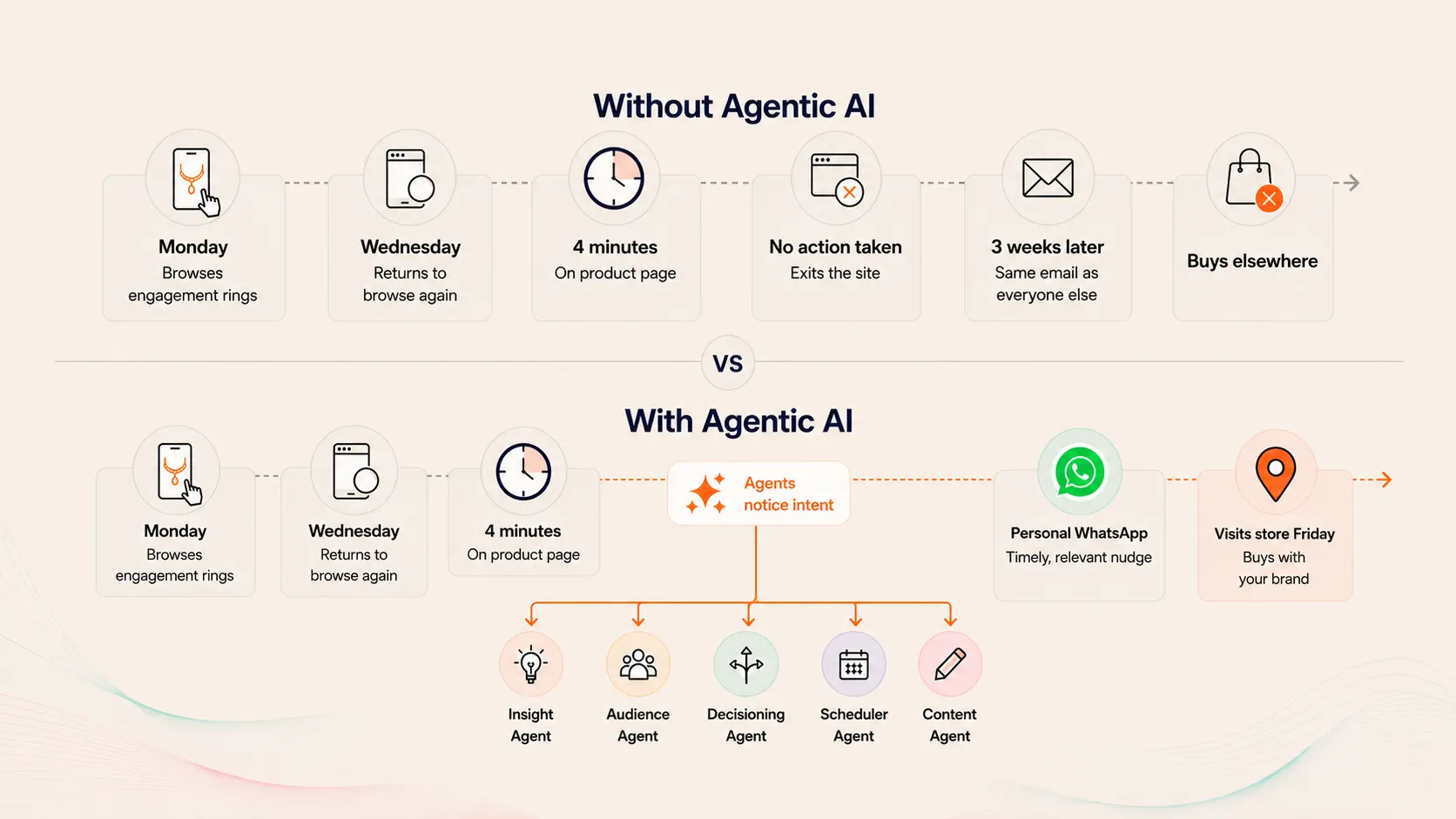
Without agentic AI: A customer visits the 22K gold bangle category on Monday. Returns Wednesday. Spends four minutes on one product page, checking weight and purity, and does not add to cart. Nothing happens. There is no abandoned cart flow, the cart stage was never reached. No one notices the pattern across the two visits. Three weeks later, the same generic new collection email arrives, identical to everyone else’s. The bangle gets bought somewhere else.
With agentic AI: Same customer, same two visits. This time, when the product page visit stretches on, the Shopping Agent proactively checks in, asking if the shopping is for a specific occasion or budget, and the customer mentions an anniversary. The Insight Agent flags the category and occasion signal. The Audience Agent places the customer in a high-intent, pre-purchase micro-segment. The Decisioning Agent determines the channel, WhatsApp, no discount, product detail and a nearby store locator, and the Scheduler Agent times it for when the customer is most likely to open it. The Content Agent has the message ready in the brand’s voice; the Co-Marketer checks it and sends. The customer visits the store on Friday.
No human made a single decision in that sequence. The difference wasn’t a better campaign. It was that something was built to keep watching, and to act the moment it saw enough.
Where the Evidence Already Exists
This isn’t hypothetical. Senco Gold & Diamonds didn’t build three separate campaigns for three customer types. The system identified three distinct purchase mindsets among its shoppers: offline buyers, DigiGold investors, online shoppers, automatically. Each received a different message, through a different channel, with a different call to action, assembled and sent without a marketer manually building each path. During Akshaya Tritiya alone, this drove 2X conversions and 5,000 store visits, with a 26% repeat purchase rate sustained across the year.
PROOF: Senco Gold & Diamonds’ agent-led orchestration turned three shopper mindsets into three distinct journeys, no manual campaign-building required. Full story link.
Knowing Sooner
In every other retail category, the customer comes to you when ready. In jewellery, the customer has often been ready for weeks before you knew. Closing the four leaks from earlier in this series keeps you from losing the customer who has already arrived. The agent collective closes the same four gaps before that, not by reacting a little faster than before, but by knowing sooner than the customer expects you to.
What that is worth depends on your traffic, your average order value, and how much demand is currently slipping through. Put your own numbers into the Jewellery ROI Calculator and see what closing these gaps could add to your revenue.
Curious about what else Netcore’s Agentic AI can do? Explore the full capabilities here.
Final Take:
The jewellery purchase does not begin with a search or a browse. It begins with a life event, a proposal, a wedding, a milestone, that unfolds completely offline, long before any signal appears on your radar. By the time the customer arrives, the decision is already most of the way made.
That window, the weeks before intent becomes visible, is where the real competitive advantage lives. Campaigns cannot reach it because they are built to react, not to anticipate. What closes it is a system that reads past behaviour to predict when the next window opens, builds precise intent signals for each individual, and decides the right channel and message automatically, without waiting for a human to act.
The brands pulling ahead in jewellery are not reacting faster. They are simply knowing sooner.

