





TL;DR
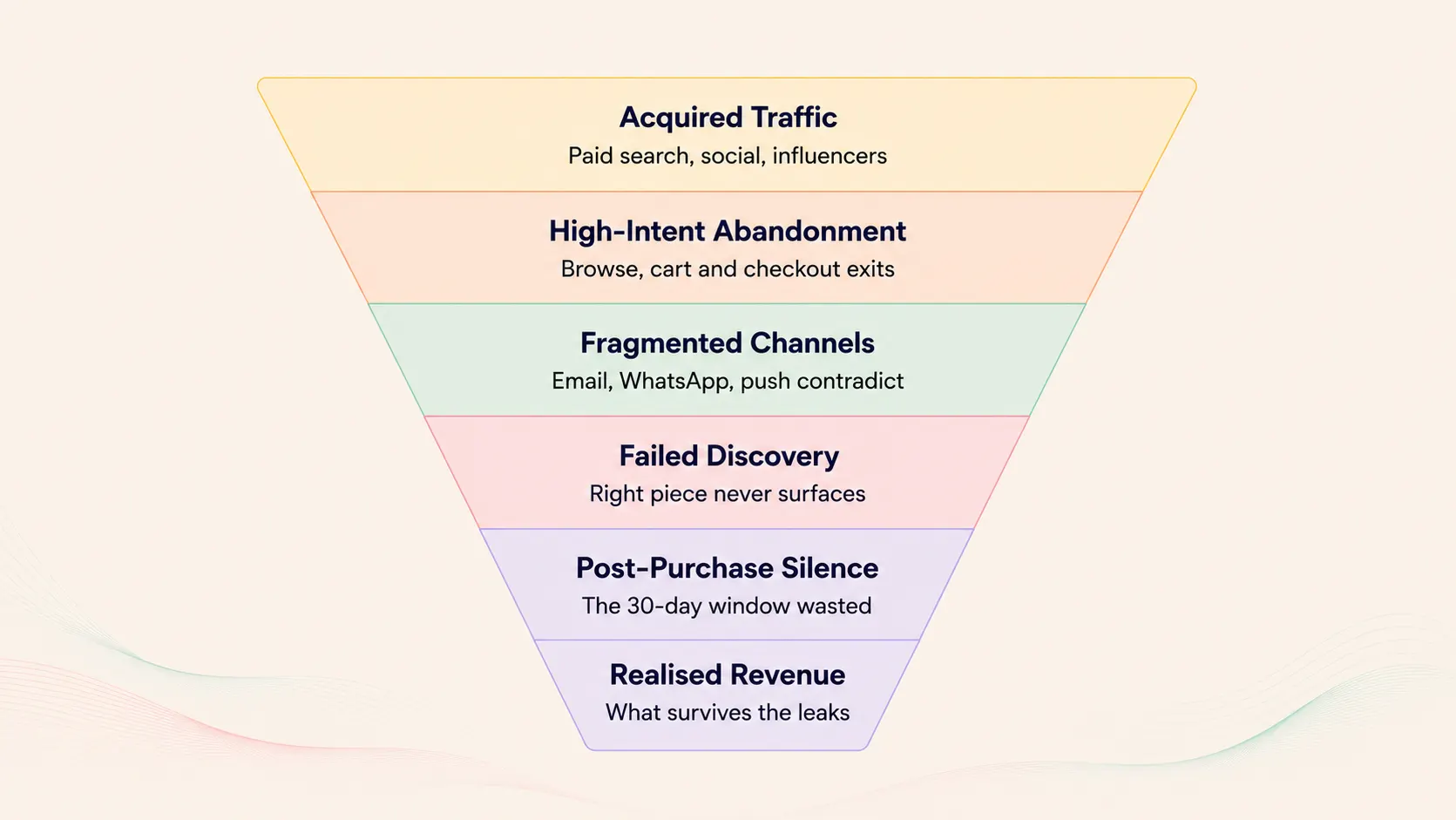
“The previous piece broke down the four stages where jewellery brands quietly leak revenue they already earned: high-intent abandonment, contradicting channels, failed discovery, and post-purchase silence. This piece is the other half. It maps a specific, proven fix to each gap, from behaviour-led recovery to the thirty days after purchase, with results from the brands already doing it.”
The four leaks share one root: engagement that is generic where jewellery demands specificity, fragmented where it needs coordination, and absent at the moments of highest intent. Which means closing them is not four separate projects. It is one shift, from engagement that broadcasts to engagement that reads behaviour and responds to it, applied at four different moments in the journey. Here is what that looks like at each one.
1. The Fix: Read the Deliberation, Then Respond to It
For the customer who filled the cart and left mid-deliberation, the fix begins with a simple principle: the behaviour already tells you where the decision stands, so the response should be built from it. Recovery that works in jewellery is not one reminder sent to everyone who abandoned that week. It is a journey that reads how long the deliberation ran, how often the customer returned and what stage the visit reached, and answers each pattern differently. The goal is never to interrupt the decision. It is to make the decision easier: reassure the customer on the piece, keep it within reach, and be present the moment the customer is ready.
WHAT RECOVERING THIS REVENUE LOOKS LIKE
- Behaviour-triggered recovery that distinguishes a thirty-second bounce from a four-visit checkout exit. The first may need nothing at all; the second deserves a considered, well-timed response, because that customer is days into a meaningful decision.
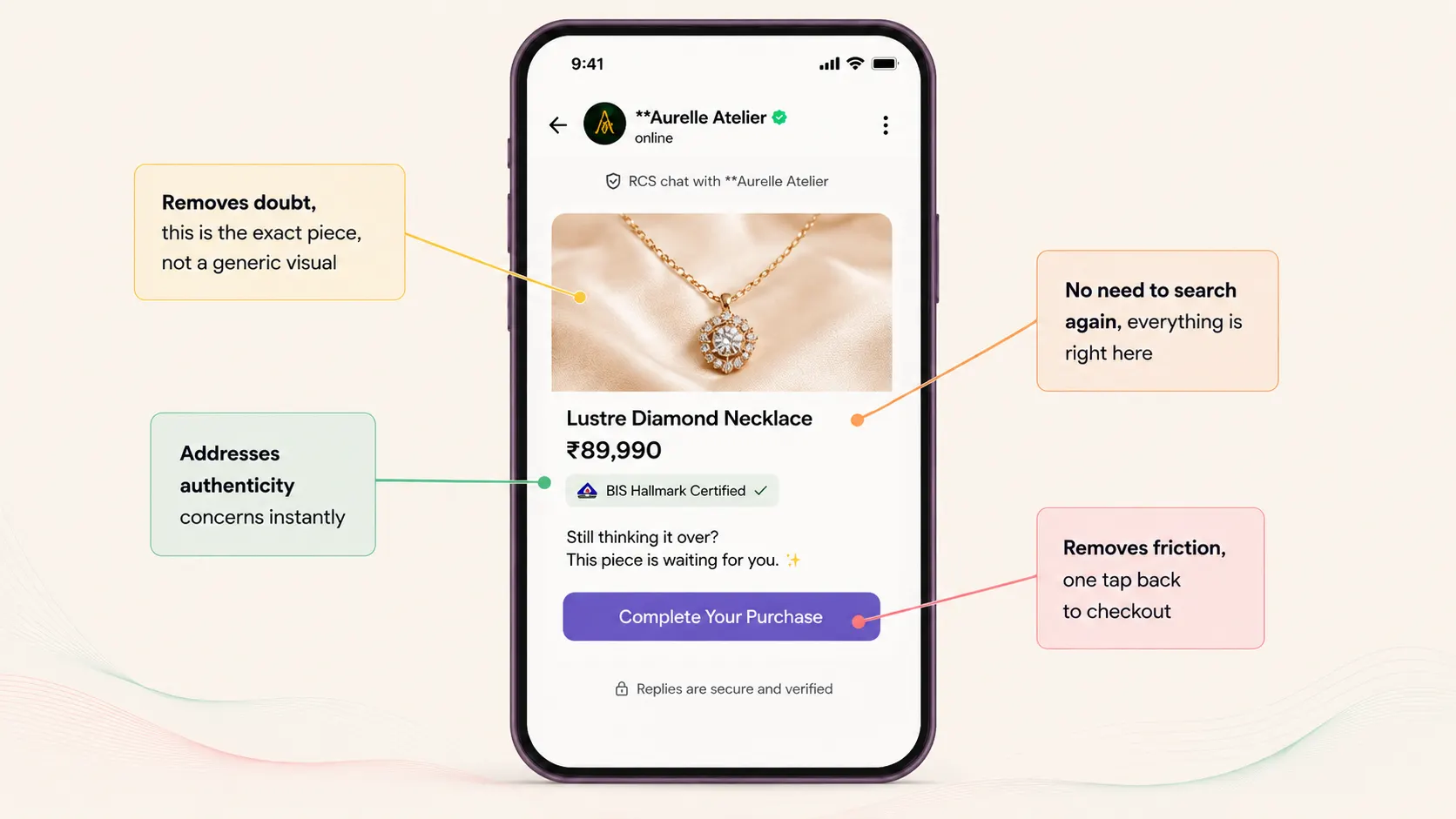
- A personalised cart reminder built around the exact piece the customer was considering, its image, its details, its story, not a generic “you left something behind”. The message should feel like a continuation of the deliberation, not an interruption of it.
- WhatsApp recovery for high-AOV abandonment. When the cart runs into serious value, the conversation belongs on the channel personal enough to carry it, where a question about the piece can be asked and answered.
- Social proof prompts, such as how many people are viewing the piece now, build gentle urgency without reaching for a discount, protecting both margin and brand.
- Rich, product-specific RCS for checkout exits, closing the trust gap at the exact moment it opens, with the piece, the assurance and the path back to payment in one message.
PROOF: GRT Jewellers built targeted cart-abandonment and product-view recovery journeys: 8.5% digital revenue uplift, 6X ROI. Full story here.
2. The Fix: One Customer, One Conversation, Every Channel
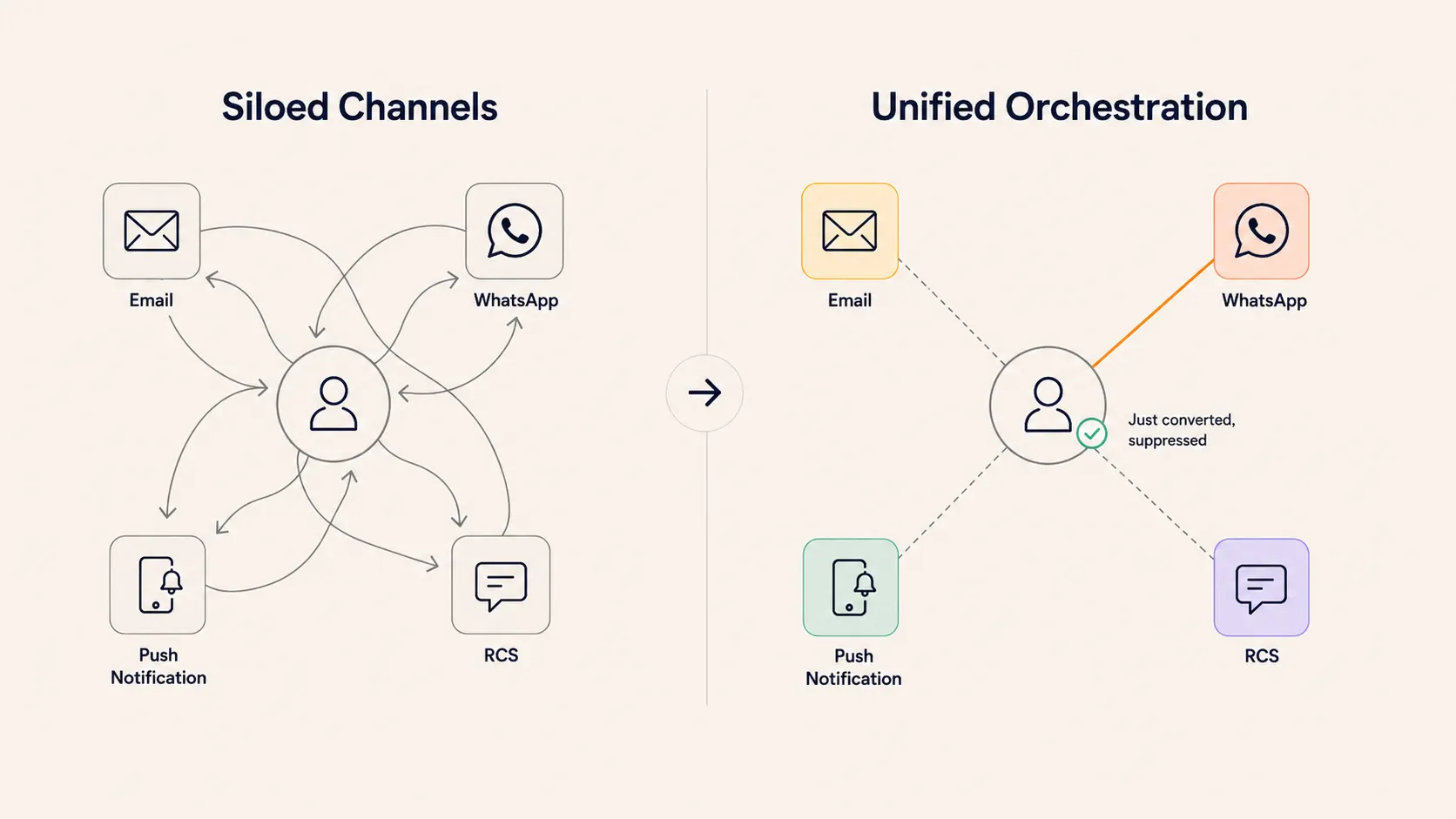
For the customer hearing three versions of the same campaign from three disconnected tools, the fix is structural, not creative. No amount of better copy repairs channels that cannot see each other. What repairs it is a single foundation underneath all of them, so that every message knows what was already sent, opened and bought. Once that foundation exists, the channels stop competing for the customer’s attention and start taking turns earning it.
WHAT COORDINATED ENGAGEMENT LOOKS LIKE
- A unified customer view across email, WhatsApp, push, RCS and onsite, built on one profile per customer, so every channel draws from the same history instead of its own fragment of it.
- Journey orchestration that picks the right channel for each moment rather than four channels competing for the same attention, escalating from a quiet push to a personal WhatsApp only when the moment justifies it.
- Suppression logic that drops a customer from a campaign the moment the purchase happens, so the customer never again sees a promotion for a piece already bought on Monday.
- Consistent messaging: one campaign, one offer, one tone, expressed natively per channel instead of four independent briefs that happen to share a product.
The effect compounds quietly. Frequency drops while relevance rises, unsubscribes slow, and the brand starts sounding like one entity with one memory, which in a high-consideration category is precisely what trust is made of.
PROOF: Senco Gold & Diamonds unified push, WhatsApp and RCS within one journey, delivering coordinated communication at scale. Full story link.
3. The Fix: Make Forty Thousand Pieces Feel Like a Shortlist
For the customer who searched, scrolled and gave up while the right piece sat unseen in the catalogue, the fix is discovery that understands jewellery the way the customer does. Depth stops being a liability the moment search and merchandising can read the category’s own language.
WHAT EFFORTLESS DISCOVERY LOOKS LIKE
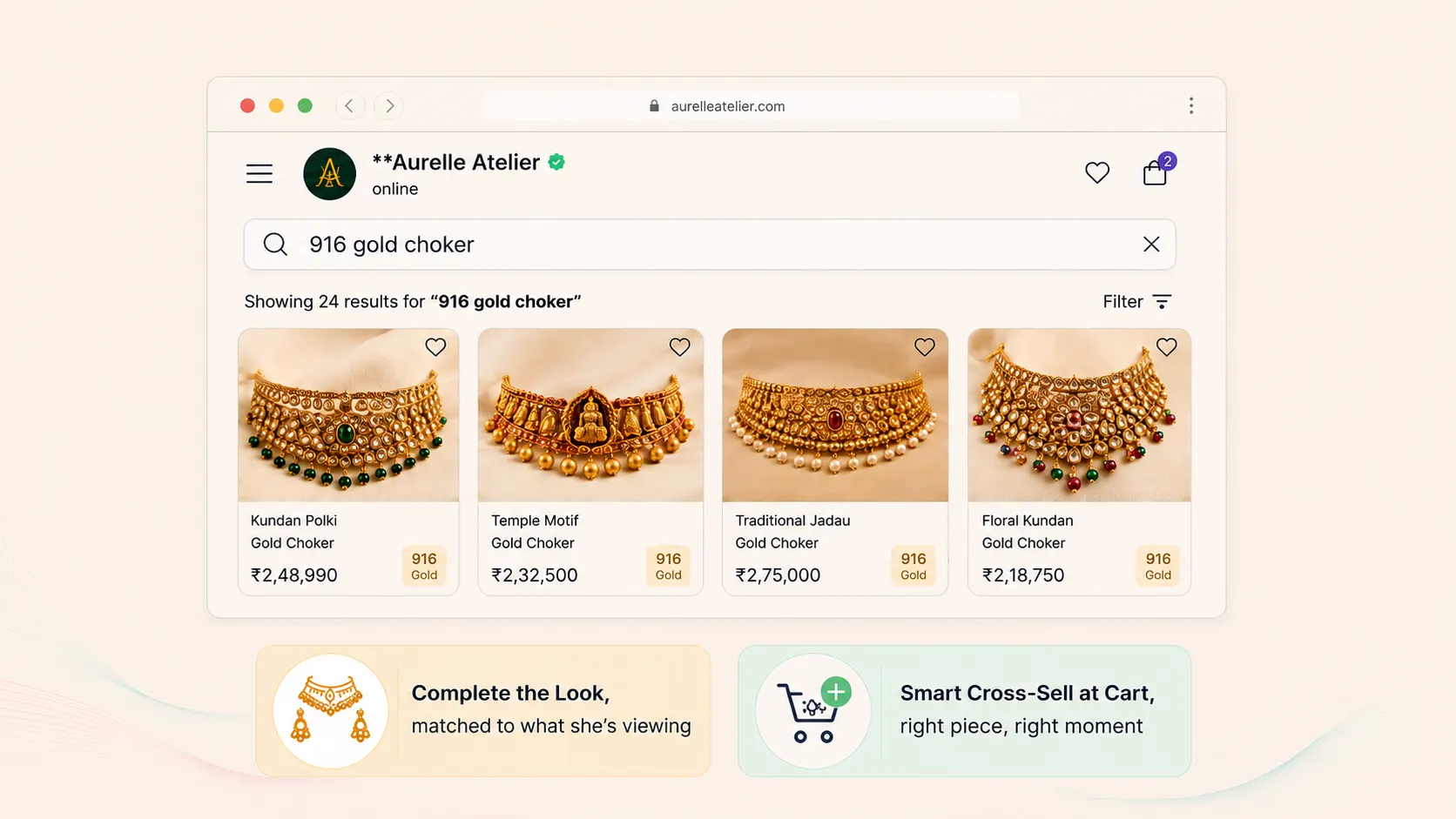
- AI-powered search that understands jewellery attributes, gold purity, weight, occasion, values like 916, 18K and 999, and surfaces the right results instantly without demanding an exact-match query.
- Smart merchandising that re-ranks results by what is trending, converting and relevant to each individual customer, so the order of the page is earned by behaviour, not set by a manual sort.
- A “Complete the Look” widget that matches complementary pieces to what the customer is viewing now, the earrings for the necklace, the band for the ring, instead of generic bestsellers.
- A cross-sell nudge at cart, personalised to category and price, surfacing the matching piece at the one moment the customer is most open to it.
This is where jewellery’s structural advantage shows. Complementary pieces are not an upsell bolted on; they mirror how the products are worn and gifted: a necklace and its earrings, a chain and a pendant, an engagement ring and the band that follows. Discovery that understands this does not just convert the session, it grows the order.
PROOF: SK Jewellery saw a 22% CVR uplift and 38.23% AOV increase once search understood jewellery attributes. Full story here.
4. The Fix: Use the Thirty Days That Matter Most
For the customer who bought, received an invoice and then heard nothing until the next festive blast, the fix is a post-purchase journey that begins the moment the transaction closes, while satisfaction is fresh and trust is at its peak. Not a promotional sequence, a relationship sequence, one that adapts as it runs so engagement on Day 7 reshapes what happens on Day 14. If the craftsmanship story gets opened, the journey leans into content. If the complementary category gets browsed, it leans into the next piece. The sequence follows the customer, not a calendar.
WHAT USING THE POST-PURCHASE WINDOW LOOKS LIKE
- Day 3: A WhatsApp note on the craftsmanship behind the piece. Not a promotion, a story that deepens the connection to the purchase and the brand that made it.
- Day 7: A push introducing a complementary category. A necklace surfaces pendants; a bangle surfaces bracelets, guided by what was actually purchased.
- Day 14: An RCS loyalty invitation that rewards the trust the customer has just shown, extended now, while goodwill is at its peak, not in month three when it has faded.
- Day 21: A referral nudge. A customer fresh off a great experience is the most credible advocate a brand will ever have, and most brands never ask.
Run consistently, this is also the quiet answer to dormancy. A base that is engaged in the thirty days after every purchase never gets the chance to become a reactivation problem a decade later.
PROOF: Senco Gold & Diamonds’ always-on journey automation drove a 26% repeat-purchase rate. Full story here.
The Revenue Comes Back the Same Way It Left
None of these four fixes is exotic, and none demands reinventing how a brand markets. Each one replaces a generic response with a specific one, a fragmented message with a coordinated one, and silence with presence at the moments of highest intent. The brands that win in jewellery are not the ones with the most traffic; they are the ones that stop hard-won demand leaking away after it arrives.
If you want to go deeper than these four fixes, we have put the full framework, benchmarks, and campaign blueprints into the Jewellery Growth Playbook. It covers the entire journey from first touch to repeat purchase, with plays you can lift and run as is.
But closing these four leaks still assumes you’re reacting to a customer who has already shown up. See how Netcore helps jewellery brands automate and hyper-personalize engagement at scale with AI, reaching the customer before the search even begins. The next piece breaks down exactly what that looks like.
Final take
Each of the four gaps has a fix that is already proven in this category. Deliberation answered with behaviour-led recovery instead of a generic nudge. Fragmented channels replaced by one customer view, orchestrated journeys and suppression that respects what the customer already did. A deep catalogue made navigable by search that speaks of jewellery, merchandising that learns, and cross-sell that mirrors how pieces are actually worn. And the thirty days after purchase, treated as the beginning of the relationship rather than the end of the transaction.
The pattern across all four is the same: read the behaviour, respond specifically, stay coordinated, be present. The revenue was always there. This is how it comes back.

