


Weighing Salesforce Marketing Cloud (SFMC) vs Netcore.ai? For a martech or SaaS leader, this is less a feature showdown than a call on operating models: who runs campaigns, how fast data becomes action, and what the stack really costs. Think of this guide as the background check before the first date.
Salesforce Marketing Cloud (Agentforce Marketing) is a multi-cloud automation platform built to work closely with Salesforce CRM, typically evaluated for connected CRM workflows, multi-team governance, and deep scripting flexibility.
Netcore.ai is a unified engagement platform combining CDP, journeys, analytics, and AI, typically evaluated for marketer-led, omnichannel execution across email, WhatsApp, push, SMS, and RCS.
Below, we line them up on journeys, channels, AI, analytics, security, pricing, time to value, and fit, so you can swipe right on the platform that suits your team.
At a glance (Netcore.ai vs Salesforce Marketing Cloud)
| Salesforce Marketing Cloud (Agentforce Marketing) | Netcore.ai | |
|---|---|---|
| Best for | Large and mid-market enterprises, B2B and B2C, often multi-brand or multi-region and already standardized on Salesforce. | Mid-market to enterprise B2B consumer brands in ecommerce, fintech, travel and apps, running journeys across email, web, app and messaging. |
| Primary buying trigger | Marketing has to run inside our Salesforce ecosystem. | Marketers need to move faster without waiting on consultants or developers. |
| Architecture | Modular suite: separate channel-specific studios, with real-time capabilities added through other products. | Unified stack: data, journeys, channels, AI, and product experience in one place. |
| Ease of Use | Developer-heavy: customization typically needs SQL and AMPscript skills. | No-code, marketer-friendly. |
| Typical time to value | 6-12 months with full implementation; standard implementations reported at 8-20 weeks | Standard integration typically 30 – 45 days |
| Pricing model | Tiered editions, with add-ons. | Outcome-linked, tied to performance. |
What are the main differences between Netcore.ai and Salesforce Marketing Cloud?
Netcore.ai and Salesforce Marketing Cloud are both powerhouses for enterprise customer engagement, but they run on completely different engines. Here are 7 differences that explain most of what follows.
1. Data Architecture & Processing
Salesforce Marketing Cloud handles large, siloed enterprise datasets across business units and regions, especially with Data Cloud, and Data Extensions plus SQL give precise control over complex data. However, advanced segmentation typically requires SQL queries and developers to manage the tables. Netcore.ai uses an event-native architecture, allowing standard campaigns to run without SQL or complex data joins, in a unified, real-time experience.
2. Omnichannel Depth
Salesforce Marketing Cloud runs channels through separate studios and builders: Email Studio for email, Mobile Studio for SMS and app push, Advertising Studio for ad audiences, Journey Builder for orchestration, and Automation Studio for scheduled data and send workflows; availability, such as WhatsApp via Unified Messaging, depends on edition. Netcore.ai orchestrates email, SMS, RCS, WhatsApp, push, in-app, and on-site messaging in one journey, with no-code AMP and 50B+ emails delivered monthly.
3. Journey Orchestration
Salesforce Marketing Cloud’s Journey Builder handles multi-step, event-triggered journeys and large scheduled sends well. Still, AI decisioning needs eligible editions and Data 360 setup, and event-triggered flows in Next run in about 15 minutes, which can miss fast-moving intent. Netcore.ai supports event, segment, and merchandising triggers with AI Path Optimizer, responding to SDK events, app clicks, and API triggers in under 3 seconds.
4. Agentic AI
Salesforce Marketing Cloud’s Einstein and Agentforce draft briefs, segments, content, and flows, and a Marketing Goals Agent to run campaigns toward set goals was announced in a pilot in June 2026, while purchase and churn scoring still needs Data 360 Model Builder and analyst support. Netcore.ai’s Co-Marketer coordinates Audience, Content, Insight, Scheduler, and Decisioning agents, with 31+ built-in propensity models that activate directly in campaigns.
5. Implementation
Salesforce Marketing Cloud standard implementations are reported at 8-20 weeks, with full value in 6-12 months, as data engineers and architects map Data Extensions before launch. Netcore.ai migration and go-live typically take 30-45 days, using simple SDKs and standard APIs with no custom data schemas.
6. Total Cost of Ownership (TCO)
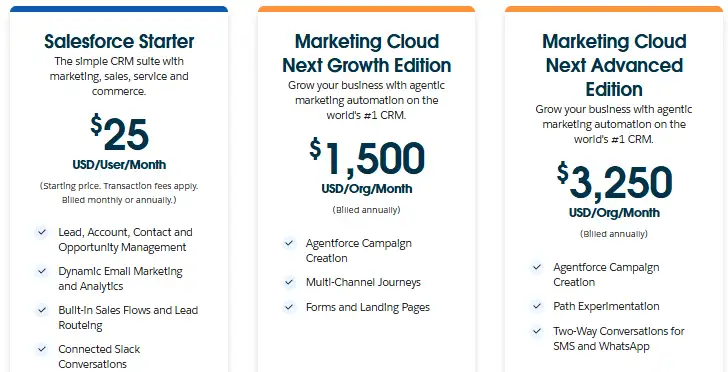
Salesforce Marketing Cloud is sold in tiered editions, with prices from about $1,250 per month (Engagement Pro) to $3,250 per month (Next Advanced) before add-ons such as Data Cloud, Personalization, and Einstein, and programs commonly rely on certified admins, consultants, or integrators for build and change management, which makes total cost harder to forecast. Netcore.ai uses an outcome-linked model, 70% fixed and 30% performance-linked variable, with channels and AI agents in one model.
7. Ease of Use
Salesforce Marketing Cloud offers a familiar interface for existing Salesforce admins, along with role-based access across business units and Trailhead training and community resources. Still, beginners and non-technical teams often find it complex, with a steep learning curve that calls for training. Netcore.ai’s marketer-friendly interface is built for non-technical teams, who can handle routine changes without raising IT tickets.
A worked example: A customer searches for a route in an app, abandons their cart, and leaves.
- In Salesforce Marketing Cloud: Resolving this requires orchestrating data across Data Extensions, triggering the alert via Mobile Studio, and plugging in premium Data Cloud or Personalization modules for real-time recommendations.
- In Netcore.ai: The event, the segment, the product recommendation, the WhatsApp/push message, and the revenue report all run natively inside a single platform.
Where the distinction matters most
- Choose Salesforce Marketing Cloud if CRM-connected workflows, role-based governance across multiple business units, or a large certified-partner ecosystem are non-negotiable.
- Choose Netcore.ai if your priority is a unified platform for omnichannel engagement, CDP, analytics, and personalization. Marketers can run campaigns independently, use Funnel, Cohort, RFM, and propensity analytics without complex data-modeling projects, and operate with lower overhead.
Feature-by-feature comparison
The table below summarizes our feature research. Feature availability varies by edition, region, and contract, so use it as a shortlist guide and validate with each vendor.
| Capability | Salesforce Marketing Cloud (Agentforce Marketing) | Netcore.ai | What this means for buyers |
|---|---|---|---|
| Journey Orchestration | Journey Builder is tied closely to Sales and Service Cloud. Event-triggered flows in Next run in about 15 minutes; Path Optimizer tests up to 10 paths. | One canvas with event, segment, and merchandising triggers that fire in under 3 seconds. Path Optimizer keeps shifting traffic to the best branch. | Evaluate how easily teams can build, optimize, and analyze journeys, with AI-driven insights to identify improvement opportunities. |
| Channel Coverage | Channels span studios and editions. WhatsApp runs through Unified Messaging (Enterprise/Unlimited); RCS needs an add-on. | 9 channels on one customer journey, including email, SMS, WhatsApp, push, and RCS, with no-code AMP email. | Compare channel coverage, edition dependencies, and the ability to orchestrate multiple channels within a single journey. |
| Segmentation | Rule-based segments refresh every 10 minutes to 24 hours. RFM and affinity segments are limited and typically custom-built. | RFM, behavioral, affinity and propensity segments refresh automatically. Audience Agent builds segments from plain language. | Compare audience build speed, predictive targeting and activation time |
| Personalization | AMPscript, SSJS and merge fields. Live data typically needs Code Resources or developer-built solutions. | Liquid tags, dynamic blocks and Content Fetch for live data, without code. Preferred Channel picks the best channel per customer. | Weigh channel coverage against the technical effort to personalize |
| Predictive AI | Einstein Engagement Scoring is available. Purchase and churn models need Data 360 Model Builder, and LTV prediction is typically a custom build. | 31+ propensity models (9 BFSI-specific), App Churn Management, Predictive CLTV and Predictive Segments, ready to use. | Assess which predictions are ready to use versus needing data science |
| Agentic AI | Agentforce agents cover campaign creation, decisioning, and content. Newer agents were announced in pilot, and usage is metered with caps. | Co-Marketer coordinates Audience, Content, Decisioning, Scheduler, and Insight agents, with an MCP server. | Evaluate how effectively AI agents work together to automate marketing workflows and turn insights into action. |
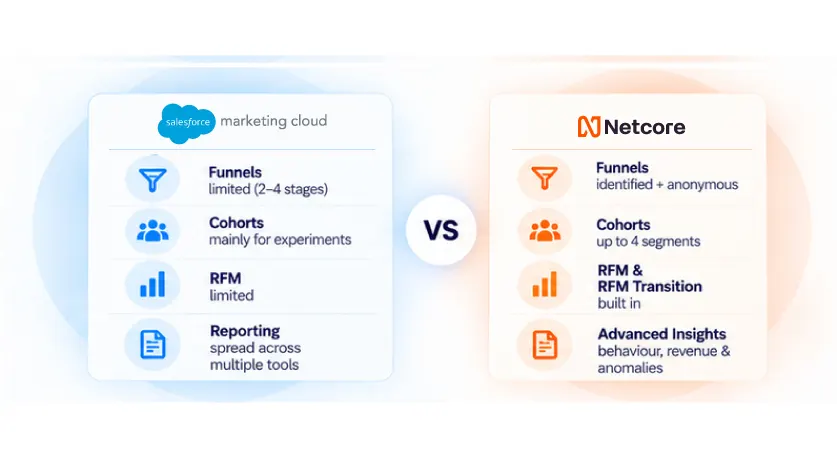
| Analytics and Reporting | Reporting is spread across Next dashboards, Personalization, Data 360, and Tableau. Funnel, cohort, and RFM analysis are limited. | Funnel, cohort, RFM, RFM transition, and user-path analysis are built in. | Compare analytics depth, attribution capabilities, and reliance on additional products or custom development. |
| Compliance & Security | Regional residency via Customer Regions and Hyperforce; some Einstein processing may occur outside the region. Shield and Field-Level Encryption are paid. | GDPR DPA, ISO 27001, BYOK, SSO, 2FA, RBAC, PII masking and tokenization. | Validate data residency and how AI processes your data |
A feature list only tells part of the story. Salesforce Marketing Cloud tends to bring deeper CRM connection and enterprise governance, while Netcore.ai tends to make unified, marketer-led execution across channels easier to run.
Here is what those differences mean for your team’s day-to-day marketing work.
Compare Salesforce Journey Builder vs. Netcore.ai Journey Orchestration in 2026
Both platforms offer a visual canvas for multi-step, behavior-driven journeys. The differences show up in how journeys start, how fast they run, and how much optimization is automatic.
Salesforce Marketing Cloud. Journey Builder is a visual canvas tied closely to Sales Cloud and Service Cloud, with flow control, testing, and AI features that vary by edition and data thresholds.
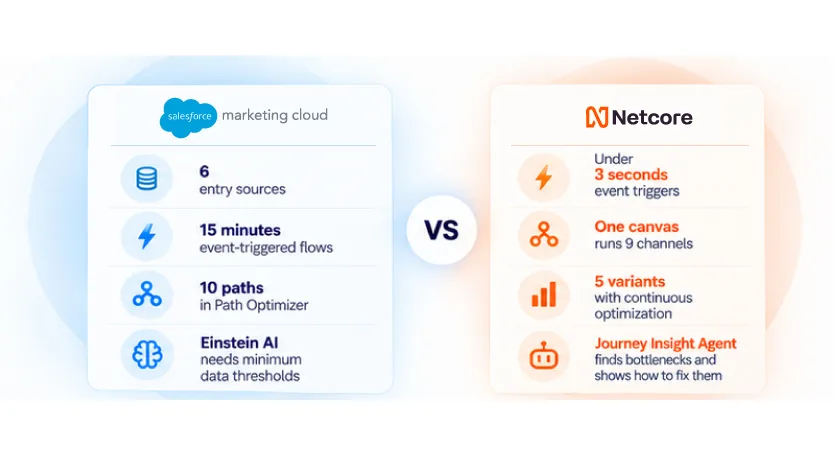
- 6 entry sources, including Data Extension, API Event, and CloudPages.
- Event-triggered flows in Next run in about 15 minutes.
- Path Optimizer tests up to 10 paths and picks a winner.
- Einstein features need minimum data thresholds.
Netcore.ai. One journey canvas covers triggers, lifecycle logic, and channels, and journeys keep improving automatically after the test.
- Event triggers fire in under 3 seconds across 4 trigger types.
- One canvas runs 9 channels, including email, SMS, WhatsApp, push, and RCS, in the same journey.
- Path Optimizer tests up to 5 variants and keeps shifting traffic toward the conversion goal.
- Journey Insight Agent automatically finds journey bottlenecks, explains why customers drop off, and shows how to fix them to lift revenue.
The bottom line: Salesforce Marketing Cloud fits journeys that must plug into CRM records and span business units. Netcore.ai fits behavior-triggered journeys that fire in seconds and keep improving inside one canvas.
Salesforce Marketing Cloud vs. Netcore.ai: Omnichannel Customer Engagement & Email Deliverability
Both platforms cover email and messaging channels. The differences show up in how channels are packaged, how much email work is no-code, and how much deliverability setup your team owns.
Salesforce Marketing Cloud. Channels are spread across products and editions, so what you get depends on the edition you buy.
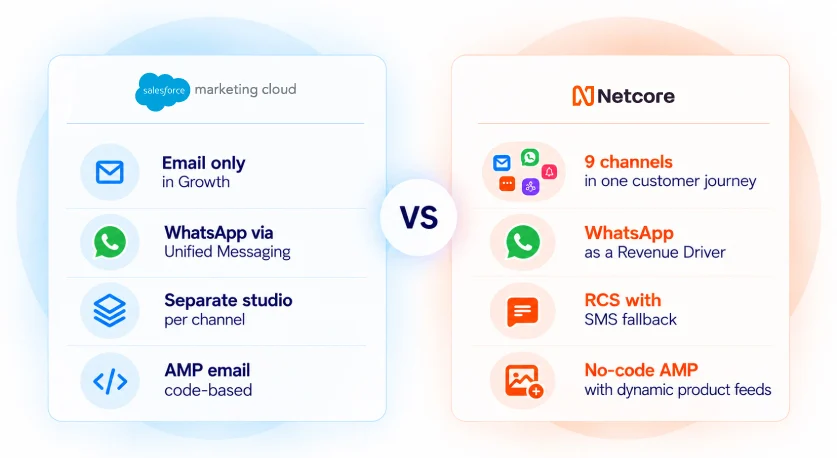
- Next Growth includes Email; mobile app messaging arrives in Advanced.
- WhatsApp runs through Unified Messaging; RCS needs an add-on.
- Each channel has its own separate studio to work in.
- AMP email is code-based and needs Pro edition or higher.
Netcore.ai. One customer engagement canvas runs email and every other channel in the same journey, with more of the email work handled without code.
- 9 channels on one canvas, including email, SMS, WhatsApp, push, and RCS.
- WhatsApp carousel with 2-10 cards, plus live data through Content Fetch.
- RCS includes SMS fallback and automatic SMS-over-RCS upgrade.
- No-code AMP editor and dynamic product feeds that refresh inside recurring emails.
The bottom line: Salesforce Marketing Cloud suits teams comfortable assembling channels across studios and editions, with code-based AMP, add-ons such as RCS and developer support along the way. Netcore.ai suits teams that want email, WhatsApp, RCS, and push on one canvas, with no-code AMP and fewer developer or add-on dependencies.
Compare Salesforce Marketing Cloud vs. Netcore.ai in terms of Segmentation & Personalization
Both platforms build rule-based segments and personalize content. The differences show up in how much is packaged for marketers, how fresh segments are, and how much code personalization needs.
Salesforce Marketing Cloud. Segmentation scales well, but RFM, affinity, and live-data personalization typically need extra setup.
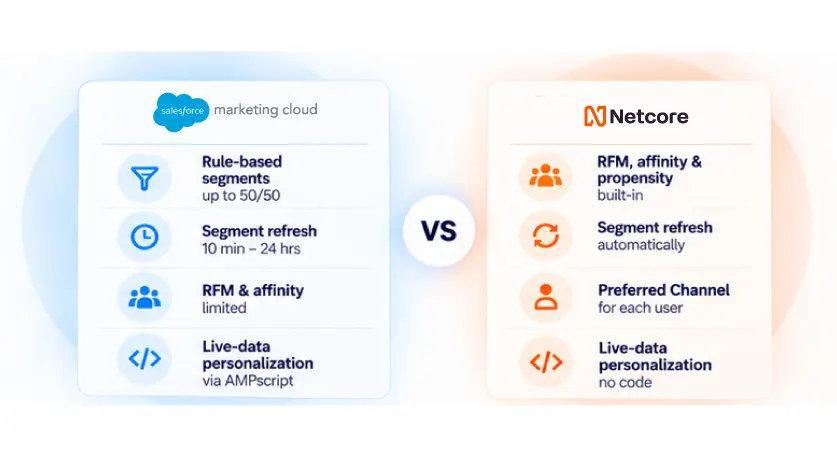
- Rule-based segments with up to 50 Include and 50 Exclude filters.
- Segment refresh runs from 10 minutes to 24 hours.
- RFM and affinity segmentation are limited and typically custom-built.
- AMPscript and Code Resources power live-data personalization.
Netcore.ai. Segmentation and personalization are built in, so marketers can run them without code.
- RFM (9 segments), behavioral, affinity, and propensity audiences, plus plain-language segment building with Audience Agent.
- Segments refresh automatically, with manual refresh on demand.
- Preferred Channel picks the best channel for each customer.
- Liquid tags and Content Fetch personalize with live data, no code.
On the website, web messages support exit-intent, scroll, and page-view triggers, with frequency caps by session, day, and campaign.
The bottom line: Salesforce Marketing Cloud suits teams that can invest in SQL, AMPscript, and custom RFM builds to get precise, CRM-fed segmentation. Netcore.ai suits teams that want RFM, affinity, propensity, and channel-level personalization ready out of the box, with no-code Liquid personalization and fewer developer dependencies.
Salesforce Agentforce vs Netcore predictive and agentic AI capabilities comparison
Both vendors are investing heavily in AI. The differences show up in how much is ready to use, how much needs custom modelling, and how far agents carry work from insight to action.
Salesforce Marketing Cloud. Einstein offers engagement scoring, but purchase, churn, and LTV prediction typically need custom modelling.
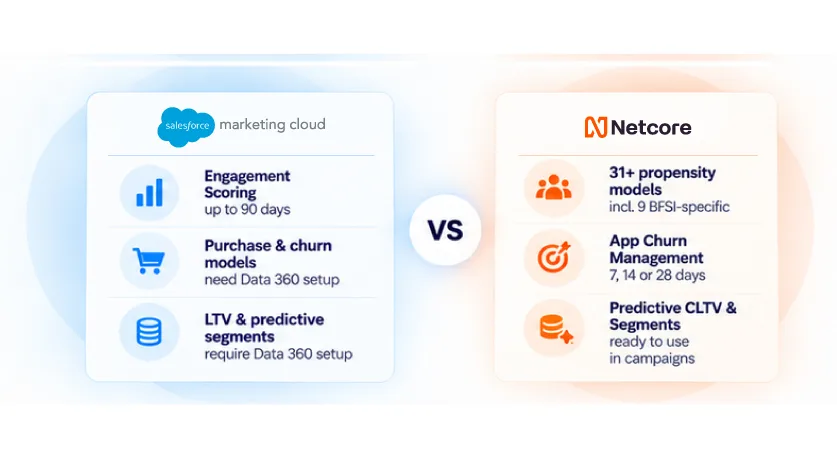
- Einstein Engagement Scoring uses up to 90 days of history.
- Purchase propensity and custom churn models need Data 360 Model Builder.
- Out-of-the-box LTV prediction and predictive segments are limited.
Netcore.ai. Predictive models are built in, so marketers can use them in campaigns without custom modelling.
- 31+ propensity models, including 9 BFSI-specific, with audiences scored High, Medium, or Low.
- App Churn Management predicts inactivity over 7, 14, or 28 days.
- Predictive CLTV and Predictive Segments can be used in campaigns right away.
| Agent capability | Salesforce Marketing Cloud (Agentforce Marketing) | Netcore.ai |
|---|---|---|
| Decisioning Agent | Journey Decisioning Agent sorts subscribers into journeys; needs Engagement+ and Flex Credits. | Decisioning Agent routes traffic to the highest-converting branch in real time, based on live clicks or conversions. |
| Scheduler Agent | Einstein send-time optimization covers when to send, for email and MobilePush. | Scheduler Agent calculates send time and channel together across email, app push, and WhatsApp. |
| Content generation | Agentic Content is capped at 30 generations and 10 images per org monthly. | Content Agent starts from 100+ templates or a text prompt, backed by Brand Kit and an AI Trust Layer. |
| Insights | Agentforce summarizes campaign performance, and campaign insights review only the first flow. | Campaign Insight Agent and Journey Insight Agent find drop-offs down to the node, explain why, and rank fixes by impact. |
| Segmentation | Einstein Segment Creation creates an initial segment from a plain-language description, which can then be refined and sized. | Audience Agent builds and refines goal-based segments conversationally. |
| Shopping | Commerce Shopper Agent sits in Commerce Cloud, while Buyer Engagement Agent handles email and web chat in Next. | Unbxd Shopping Agent is trained on catalog, content, and business rules, and is sold separately. |
| External AI / MCP connectivity | Campaign management is exposed through MCP tools. | An MCP server connects Co-Marketer with Claude, ChatGPT, and Cursor, so external AI assistants can work with Netcore.ai marketing workflows. |
The bottom line: Salesforce Marketing Cloud’s predictive and agentic AI depends on Data 360 modelling, higher editions, and metered credits. Netcore.ai offers propensity and CLTV models ready to use, plus a Co-Marketer that coordinates audience, content, decisioning, scheduling and insight agents in one place.
How do Salesforce Marketing Cloud and Netcore.ai differ in terms of Analytics & Reporting?
Both platforms report on campaigns and journeys. The differences show up in how many tools you need for a full picture, and how much advanced analysis is packaged for marketers.
Salesforce Marketing Cloud. Reporting is broad but spread across Next dashboards, Personalization, Data 360, and Tableau, so several advanced analyses need additional products or configuration.
- Funnel analysis is limited in Next; Personalization funnels support 2-4 stages.
- Cohorts are mainly used as experiment groups, with limited retention-cohort analysis.
- RFM and RFM-transition analysis are limited and typically custom-built.
- Next offers 14 reporting types; Agentforce insights are limited to the first flow.
Netcore.ai. Funnel, cohort, RFM, and user path analysis are built in, with no analyst or data-modelling project.
- Funnels across identified and anonymous users, lists, and segments, with step-to-step conversion.
- Cohort comparison of up to 4 segments, plus RFM with 9 segments and RFM transitions.
- User Path Analysis across 2-15 steps shows progression and drop-off.
- Behaviour Dashboard compares up to 5 events, Revenue Dashboard tracks goal revenue, and Co-Marketer Insights monitors data and explains anomalies.
The bottom line: Salesforce Marketing Cloud reporting is broad but distributed across several products, and advanced analyses typically need extra configuration. Netcore.ai combines funnel, cohort, RFM, behavior, trends, and user-path analysis in one platform, with drill-downs and scheduled reporting.
Salesforce vs. Netcore.ai: Data Security, Privacy, & Compliance
Both vendors hold the major certifications. The differences show up in how encryption and key control are packaged, where data is hosted, and how much privacy tooling is included versus bought separately.
Salesforce Marketing Cloud. Certifications are strong, but the more advanced controls are add-ons or need extra setup.
- ISO 27001/27017/27018, SOC reports, and HITRUST for Marketing Cloud Engagement.
- Field-Level Encryption and Tokenized Sending protect sensitive fields.
- Advanced encryption and access logging need Shield, a paid security add-on.
- Encrypted fields can limit features such as segmenting on them.
Data is hosted in Customer Regions, with EU data stored in Germany and Hyperforce regions including India, Japan, and Canada, though some Einstein features may process data outside the region.
Netcore.ai. Certifications and privacy controls sit in the core platform, backed by a public Trust Center.
- ISO/IEC 27001:2022, SOC 2 Type II, GDPR, CCPA, and HIPAA.
- BYOK, SSO, 2FA, and role-based access control.
- PII masking and tokenization, with audit logging.
- A DPDP Act compliance document and a data localization audit report.
Hosting runs on AWS, Google Cloud, ST Telemedia Global Data Centres and Iron Mountain, and the Trust Center lists sub-processors, reports and policies.
The bottom line: Salesforce Marketing Cloud adds encryption and key control through paid add-ons such as Shield, and some AI processing may sit outside your region. Netcore.ai lists BYOK, MFA, audit logging, and PII masking in the platform, with security documentation available through its Trust Center.
How easy is it to integrate Salesforce Marketing Cloud vs. Netcore.ai with Shopify, your CDP, and CRM?
Both platforms connect to e-commerce stores and the wider martech stack. The differences show up in how many steps each connection takes, and whether it is built-in, beta, or supplied by a third party.
Salesforce Marketing Cloud. Integration is strongest inside the Salesforce ecosystem, while e-commerce platforms such as Shopify typically connect through third-party connectors.
- Shopify via Data 360 connector (beta) or third-party connectors into Data Extensions.
- Magento, BigCommerce, and WooCommerce via third-party connectors.
- Marketing Cloud Connect for Sales and Service Cloud, plus the Interactions SDK.
- REST/SOAP APIs and nightly SFTP files for other tools.
Netcore.ai. Integrations are built around SDKs and e-commerce platforms, with a marketplace-certified Shopify plugin.
- Shopify two-way plugin with real-time catalog sync.
- Magento, XML and CSV feeds share one catalog setup.
- Tealium, Segment and GTM, plus SDKs for Android, iOS and web.
- BigQuery, Amazon S3, Google Cloud Storage, Salesforce, Mixpanel and SFTP.
The bottom line: Salesforce Marketing Cloud is strongest when the stack is Salesforce-first, and e-commerce data typically arrives through third-party connectors, SFTP, or APIs. Netcore.ai connects to Shopify with a certified plugin and real-time catalog sync, and adds SDKs and common data tools for the rest of the stack.
Which platform has a better user interface and lower learning curve: Netcore or Salesforce?
| G2 category | Salesforce Marketing Cloud (Agentforce Marketing) | Netcore.ai |
|---|---|---|
| Meets Requirements | 8.2 | 8.7 |
| Ease of Use | 7.6 | 8.9 |
| Ease of Setup | 7.3 | 8.7 |
| Ease of Admin | 7.8 | 8.9 |
| Quality of Support | 7.7 | 9.0 |
| Has the product been a good partner in doing business? | 8.0 | 9.1 |
| Product Direction (% positive) | 7.5 | 9.5 |
Netcore.ai’s higher usability scores likely reflect a lighter day-to-day workload for marketers. Salesforce Marketing Cloud scores lower on ease of use, setup, and admin, which fits a platform built to serve many teams, products, and permission layers.
Still, review scores are a starting point, not a verdict. Test both platforms hands-on with the team that will run them.
Salesforce Marketing Cloud vs Netcore pricing and total cost of ownership in 2026
Both platforms price by plan and scope, not just by seats. The differences show up in how many line items make up the bill, how much of the fee is tied to results, and how long it takes to see value.
Salesforce Marketing Cloud. Pricing is per org per month on annual contracts, and exact pricing comes from your Salesforce account representative.
Source: https://www.salesforce.com/in/marketing/pricing/
- Add-ons cost extra: Personalization at $8,000 and Loyalty Management at $20,000 per org per month, and Marketing Intelligence at $10,000 per user per month.
- Existing customers renew into “+” editions, per org per month: Account Engagement+ at $1,250, Engagement+ at $2,000, Intelligence+ at $11,000 and Personalization+ at $15,000.
- Premier Success costs 30% of net license fees and adds expert guidance, health checks, and 24/7 help for critical issues.
- Standard implementations take about 8-20 weeks, with full value in 6-12 months.
Netcore.ai. Pricing is custom, built on monthly tracked users, with the channels included and part of the fee tied to results.
- Two plans, Growth and Enterprise, with 9 channels in every plan.
- AI agents and predictive intelligence are available as capability packs.
- 30% of the platform fee is tied to your business KPIs.
- Standard implementation typically takes 30-45 days, with $0-cost migration.
- Enterprise adds a dedicated growth engineer, guided onboarding, and quarterly business reviews.
Can we use Salesforce Marketing Cloud and Netcore.ai together?
Yes. Netcore.ai does not have to replace Salesforce. Many enterprises have invested heavily in Salesforce, and moving away can be slow and disruptive, so they keep it for CRM data, customer records, and existing journeys, and add Netcore.ai for faster, real-time, personalized customer engagement.
Where Netcore.ai fits alongside Salesforce
- Real-time triggers: Salesforce supplies the customer context, and Netcore.ai spots a cart abandonment and sends a push, WhatsApp, or in-app message right away.
- A richer customer view: Salesforce’s CRM and offline data combine with Netcore.ai’s website, app, and campaign behavior.
- Journeys: Salesforce journeys keep running existing campaigns, and Netcore.ai steps in when real-time engagement is needed.
- Web and app experiences: Salesforce keeps sending email, while Netcore.ai personalizes the website and app with recommendations, in-app messages, and nudges.
How data flows between Salesforce Marketing Cloud and Netcore.ai
Netcore.ai’s bi-directional Salesforce sync connector moves data both ways, so engagement runs as a closed loop.
- Salesforce to Netcore.ai: customer and CRM data, audiences and journey triggers.
- Netcore.ai to Salesforce: campaign interactions, engagement data, and customer responses.
Salesforce Marketing Cloud vs. Netcore.ai: Which Platform Should You Shortlist in 2026?
The right shortlist depends on where your customer data lives, who runs campaigns day to day, which channels carry your revenue, and how quickly you need results.
Salesforce Marketing Cloud tends to fit enterprises and B2B SaaS teams that run a sales-led pipeline on Salesforce CRM, govern multiple business units, and have admins or partners to run a multi-product stack.
Netcore.ai tends to fit mid-market brands and enterprises that want marketer-led speed, especially email-first, web-heavy, mobile-first, or app and WhatsApp programs, product-led activation, and lean teams with fewer developer dependencies.
The most reliable next step is a side-by-side pilot. Build one real journey in each platform you are considering, then compare setup effort, launch time, team productivity, reporting, and revenue impact. If you want to see how Netcore.ai handles your own journeys, request a Netcore.ai demo.


