In sneaker and streetwear culture, brand equity is built on authenticity, community, collaboration, and cultural relevance. But as customer bases grow, authenticity alone does not guarantee sustained revenue growth.
The challenge is knowing that a customer browsing limited-edition drops has very different intent from someone shopping for running shoes. A frequent buyer behaves differently from a customer who has not purchased in six months. And a customer interested in retro silhouettes may respond very differently from one drawn to streetwear collaborations.
For a community-first sneaker and streetwear boutique, the opportunity was clear: make personalization more precise without making marketing operations more complex.
The brand had already been running email and WhatsApp marketing for more than a year and was generating solid results. Rather than rebuilding its marketing foundation, it wanted to understand how much more value it could unlock by making its customer segments more intelligent.
By combining behavioral automation, AI-driven affinity segmentation, experimentation, and RFM-based retention, the brand generated:
- 6X higher revenue through retention marketing
- 75% higher open rates from AI-driven affinity-based email segmentation
- 67% of WhatsApp campaign revenue from affinity-based segments
- 3% email click-through rate, outperforming premium-brand benchmarks
Here’s how the brand turned segmentation into a scalable growth engine.
The Challenge: When Manual Segmentation Hits Its Ceiling
The brand had customer data. It had marketing channels. And it had an established email and WhatsApp program.
What it needed was a scalable way to turn that information into dynamic, high-intent audiences.
Traditional segmentation often starts with manually defined rules: customers who purchased in the last 90 days, customers who spent above a certain amount, or customers interested in a particular category.
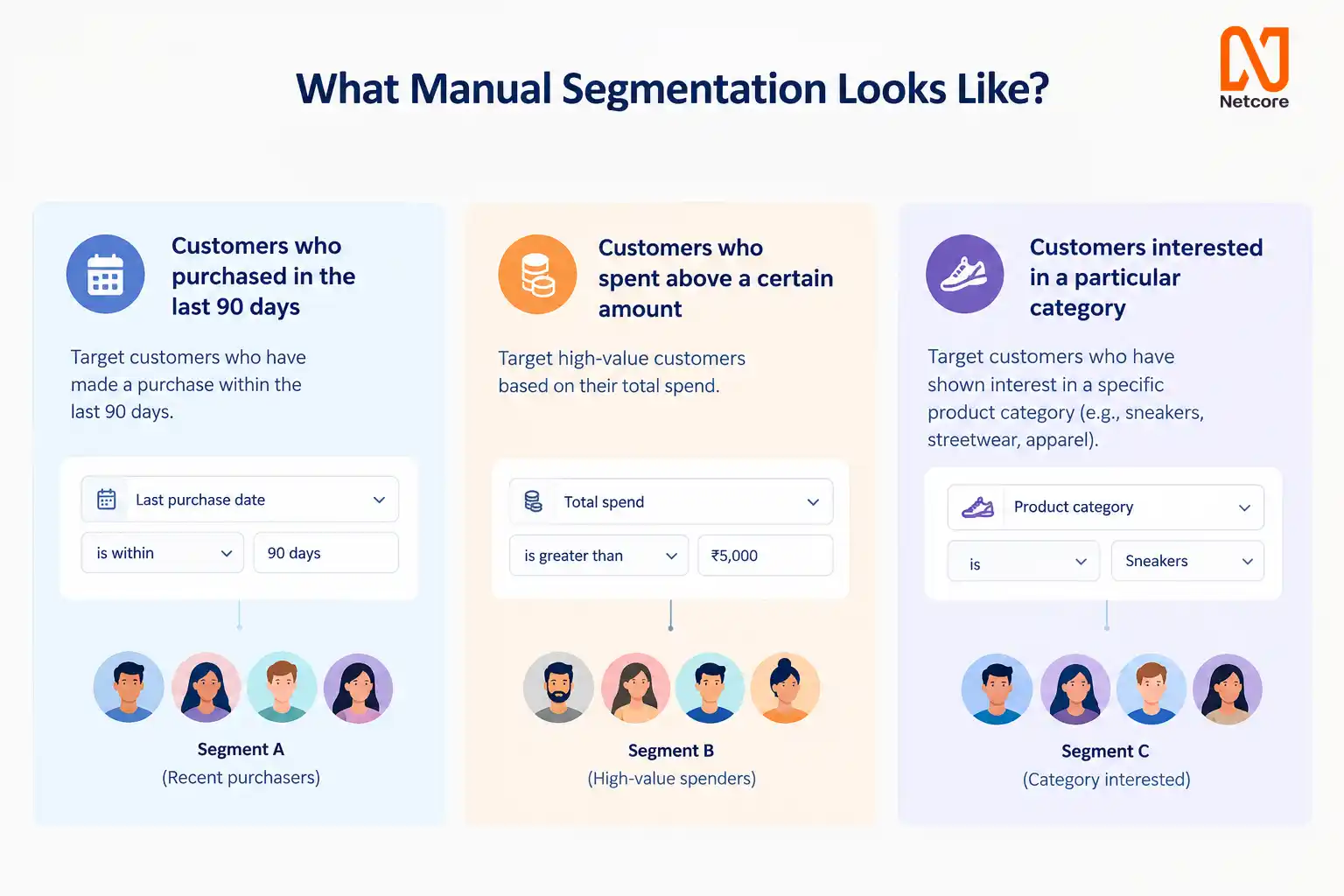
These rules can work at a smaller scale. But sneaker and streetwear audiences are rarely static.
A customer might browse Nike one week, explore retro silhouettes the next, purchase a limited-edition collaboration, and then develop an interest in running shoes several months later.
Manually maintained segments struggle to keep up with those changes.
As the audience grows, the operational burden grows with it. Marketing teams have to define rules, build lists, validate audiences, update segments, manage overlapping conditions, and repeat the process for every campaign.
This creates a fundamental trade-off:
The more granular personalization becomes, the more manual work it takes to maintain.
The brand identified four priorities:
- Increase marketing automation and operational efficiency
- Build more defined customer segments
- Deliver deeper personalization
- Strengthen retention and repeat revenue
This wasn’t a martech rescue project. It was a precision upgrade, using the existing marketing foundation to extract more value from its customer base.
The Strategy: Building a More Intelligent Personalization Engine
The brand approached personalization across four connected layers:
Automation → Affinity → Personalization → Retention
Each layer addressed a different part of the customer lifecycle while making the overall engagement engine more responsive.
1. Automation: Responding to Customer Intent
The first layer was behavior-triggered automation.
The brand implemented automated journeys for critical lifecycle moments, including:
- Welcome programs
- Cart abandonment
- Product-view abandonment
These journeys operated across email and WhatsApp, allowing communication to respond to what customers actually did rather than relying entirely on a campaign calendar.
A first-time browser could receive different communication from a returning customer. Someone abandoning a specific product could be re-engaged based on that interaction rather than receiving a generic promotional message. This was possible with the Decisioning Agent, that could map the right message to the right audience segment.
Automation created the foundation.
But the next question was more important:
Could the audiences entering those journeys become more intelligent?
2. AI-Driven Affinity Segmentation: Moving Beyond Rules
The biggest shift came from replacing increasingly manual audience selection with AI-based affinity segmentation.
Instead of relying solely on predefined rules, the brand used behavioral signals, browsing patterns, purchase history, and product preferences to identify what different customer groups were actually interested in.
This allowed the brand to create more precise audiences around interests such as:
- Limited-edition drops
- High-top silhouettes
- Running shoes
- Retro styles
- Streetwear collaborations
The difference was strategic as the marketing team could now ask:
“What are our customers showing interest in right now?”
For a culture-led brand, this distinction matters. Sneaker communities are not homogeneous. Their interests are shaped by product category, style, brand affinity, collection behavior, and cultural moments.
AI-powered affinity segmentation helped the brand recognize these micro-communities and bring that understanding into its marketing.
3. Personalization: Turning Better Segments Into Better Experiences
Better audiences only create value when the communication that follows is equally relevant.
The brand therefore combined its new segmentation approach with systematic experimentation across subject lines and CTAs.
A/B testing helped identify what resonated with different audiences, while improvements in deliverability helped ensure that those messages reached customers effectively.
This created a continuous personalization loop:
Identify affinity → Personalize message → Test response → Learn → Refine
Segmentation was no longer a one-time audience-building exercise. It became part of an ongoing optimization process.
4. Retention: Using RFM to Identify Customer Value
The final layer focused on retention.
The brand combined Recency, Frequency, and Monetary (RFM) analysis with email engagement to classify customers into value tiers such as “Star” and “Loyal.”
This gave marketers a structured way to understand the relationship each customer had with the brand. It was possible with the Insight Agent.
A high-value customer showing signs of declining engagement could be treated differently from a newly acquired customer. Similarly, customers with strong purchase frequency could receive different retention strategies from customers with lower engagement.
The shift was significant: Retention moved from reacting to churn to identifying signals of future value, and potential disengagement.
The Impact On Customer Journeys?
The strategy came together through automated journeys that responded to customer behavior across critical touchpoints.
A new customer could enter a welcome journey designed to establish the relationship.
A shopper browsing a product could receive a product-view abandonment message if they left without purchasing.
A customer who added a product to their cart but didn’t complete checkout could enter a cart abandonment journey.
And as customers continued interacting with the brand, affinity and RFM-based segmentation could inform how they were engaged going forward.
The key difference was that these experiences did not require marketers to manually rebuild audiences every time customer behavior changed.
The technology handled the complexity of audience identification and journey activation, allowing the marketing team to focus on the differences that mattered commercially.
The Results: Segmentation Translated Into Revenue
The impact was visible across both engagement and revenue metrics.
- 6X Higher revenue generated through retention marketing.
- 75% Higher open rate from AI-driven affinity-based email segmentation.
- 67% Of total WhatsApp campaign revenue generated by affinity-based segments.
The significance wasn’t any single metric. The improvement appeared across the funnel, from email engagement and WhatsApp revenue to retention performance.
That consistency points to a broader shift: the brand wasn’t simply optimizing individual campaigns. It was improving the targeting model behind its campaigns.
Why AI Segmentation Changes the Economics of Personalization
For most brands, the value of personalization is easy to understand.
The harder question is whether personalization can scale without creating an equivalent increase in operational complexity.
Consider a simple framework:
5 lifecycle stages × 6 product affinities × 4 engagement levels × 3 customer-value tiers = 360 potential audience combinations.
And that’s before adding geography, channel preference, brand affinity, browsing behavior, or campaign context.
No marketing team should have to manually maintain hundreds of audience definitions.
AI changes the economics by shifting segmentation from manually maintained lists to continuously informed audience intelligence.
The goal isn’t to remove marketers from segmentation.
It’s to let marketers focus on which customer differences matter commercially, while technology handles the complexity of operations from identifying and maintaining those audiences.
What Sneaker, Streetwear, and Culture-Led Brands Can Learn
1. Personalization should strengthen authenticity
Culture-first brands can worry that personalization will make communication feel overly commercial.
But when segmentation is built around genuine interests and affinities, personalization can make the brand more relevant without diluting its identity.
The objective isn’t to make everyone see the same message differently.
It’s to ensure different communities see communication that reflects what they actually care about.
2. Manual segmentation has a scalability ceiling
Rule-based audiences remain useful. But as customer behavior becomes more complex, manually maintained segments become harder to keep current.
AI-driven segmentation can surface behavioral patterns that are difficult to capture through static rules while keeping audiences closer to current customer behavior.
3. Retention deserves the same precision as acquisition
The customer who already knows and trusts the brand can represent a significant growth opportunity.
RFM and engagement-based segmentation give marketers a structured way to identify valuable customers, understand changing behavior, and create more relevant retention strategies.
The Broader Lesson
The strategic choice for sneaker, streetwear, and other culture-first brands isn’t between brand authenticity and data sophistication.
It’s between personalization that scales and personalization that becomes increasingly difficult to operate.
This brand already had the channels, customer data, and campaign foundation.
The breakthrough came from making that foundation more intelligent.
By moving beyond manual audience selection and combining AI-driven affinity segmentation, behavioral automation, experimentation, and retention intelligence, the brand created a marketing engine capable of adapting as customer interests changed.
The result was more than better segmentation.
It was a more efficient growth engine: more relevant audiences, faster execution, stronger engagement, and 6X higher retention revenue.
For brands built around communities and culture, that may be the real promise of AI-powered personalization: not making marketing less human, but making it precise enough to understand the humans behind the audience. Interested in taking your customer segmentation at this level of personalization? Talk to our experts.