Diwali Engagement Playbook is now


For global fashion and footwear brands, getting customers to notice a campaign is only half the battle. The bigger challenge is making every marketing interaction relevant enough to drive action.
With thousands of products, constantly changing collections, promotional offers, and diverse customer preferences, broad audience segmentation often falls short. A customer who loves one footwear category may have no interest in another. Some shoppers respond to discounts, while others are more likely to buy at full price. Treating them all alike can lead to irrelevant recommendations, wasted campaign spends, and missed revenue opportunities.
A global comfort-footwear brand faced a similar challenge. It wanted to make its retention marketing more effective by moving beyond traditional customer segments and delivering more relevant product promotions and offers.
Moving from broad segments to individual affinities
The brand’s marketing challenge was not simply reaching more customers, it was understanding what each customer was most likely to buy.
Instead of relying on broad segments, the brand adopted Netcore’s AI-powered affinity segmentation. Customer behavior was analyzed across attributes such as product category, color, and discount preference, helping marketers identify individual preferences at a much more granular level.
This enabled the brand to move from assumptions such as “customers who bought footwear are likely to buy footwear again” to more meaningful signals around what specific products and offers each shopper actually preferred.
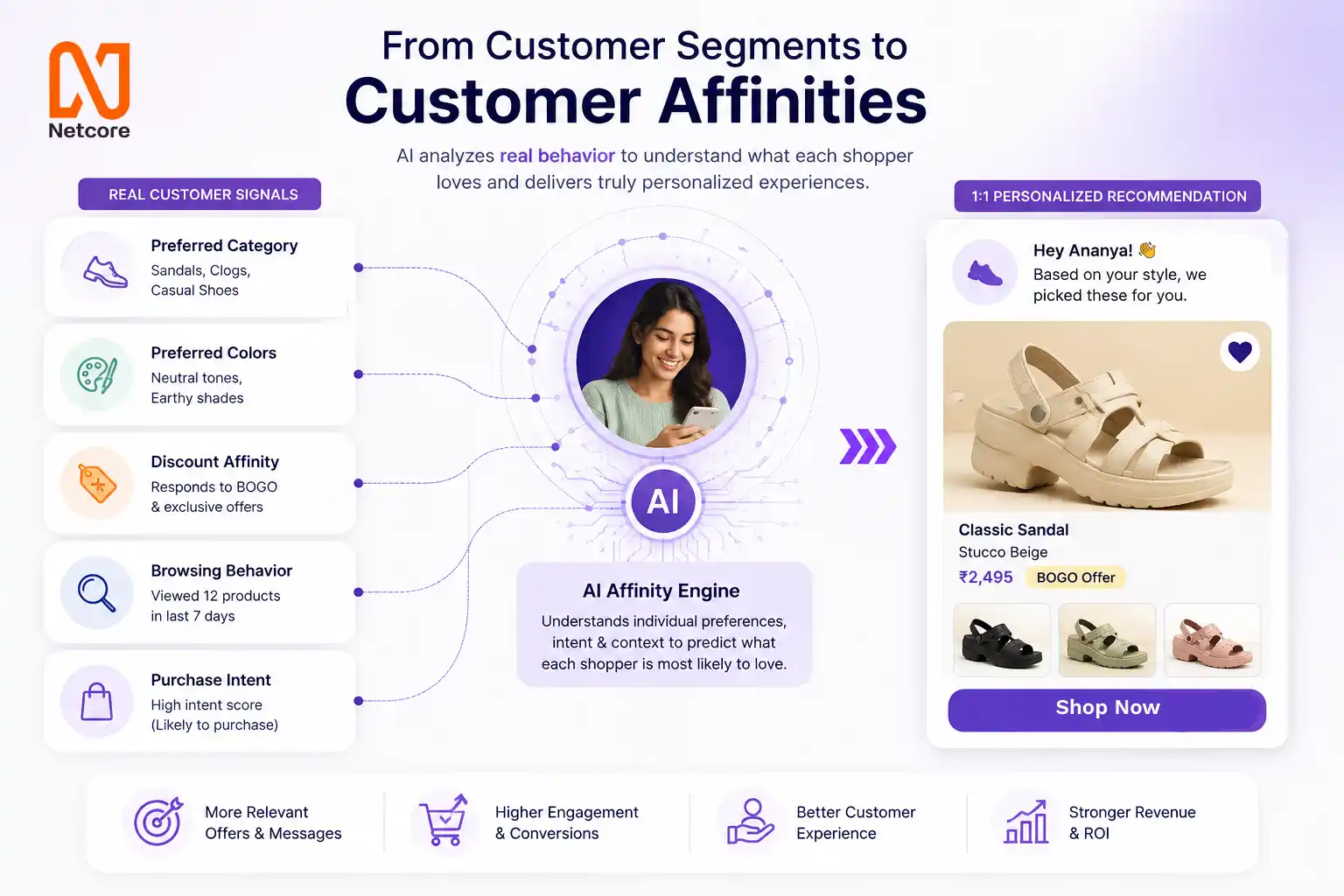
With AI-powered affinity segmentation, marketers can identify customers who are:
- Likely to Purchase
- Likely to Repurchase
- Likely to Churn
- Likely to Uninstall
- Likely to Unsubscribe
Each segment is classified as High, Medium, or Low propensity so that you can prioritize your outreach based on real conversion potential.
This unlocks more use cases targeted towards conversions like:
- Developing repurchase campaigns for customers with high repurchase likelihood
- Identifying at-risk app users with high uninstall propensity for re-engagement
- Sending targeted retention offers to customers with high churn propensity
- Building lookalike audiences based on users with high purchase propensity
And a lot more.
The more you use Netcore propensity segments, the smarter it gets. Campaign outcomes feed back into the models, automatically fine-tuning predictions and segment recommendations over time. Your targeting only gets better.
Turning personalization into action
The next step was to activate these insights across campaigns.
The brand delivered 1:1 product recommendations based on real customer behavior, rather than generic recommendations. During a BOGO sale, for example, high-intent users were targeted with category-level recommendations aligned with their demonstrated interests.
The result was a shift from campaign-centric marketing to customer-centric journeys, where the product, message, and offer could be tailored to individual affinities.
WhatsApp became an important activation channel. AI-based affinity segmentation helped the brand significantly improve campaign performance, generating an 18X ROI from WhatsApp campaigns, substantially outperforming its traditional segmentation approach.
Making Discounting Smarter & More Profitable
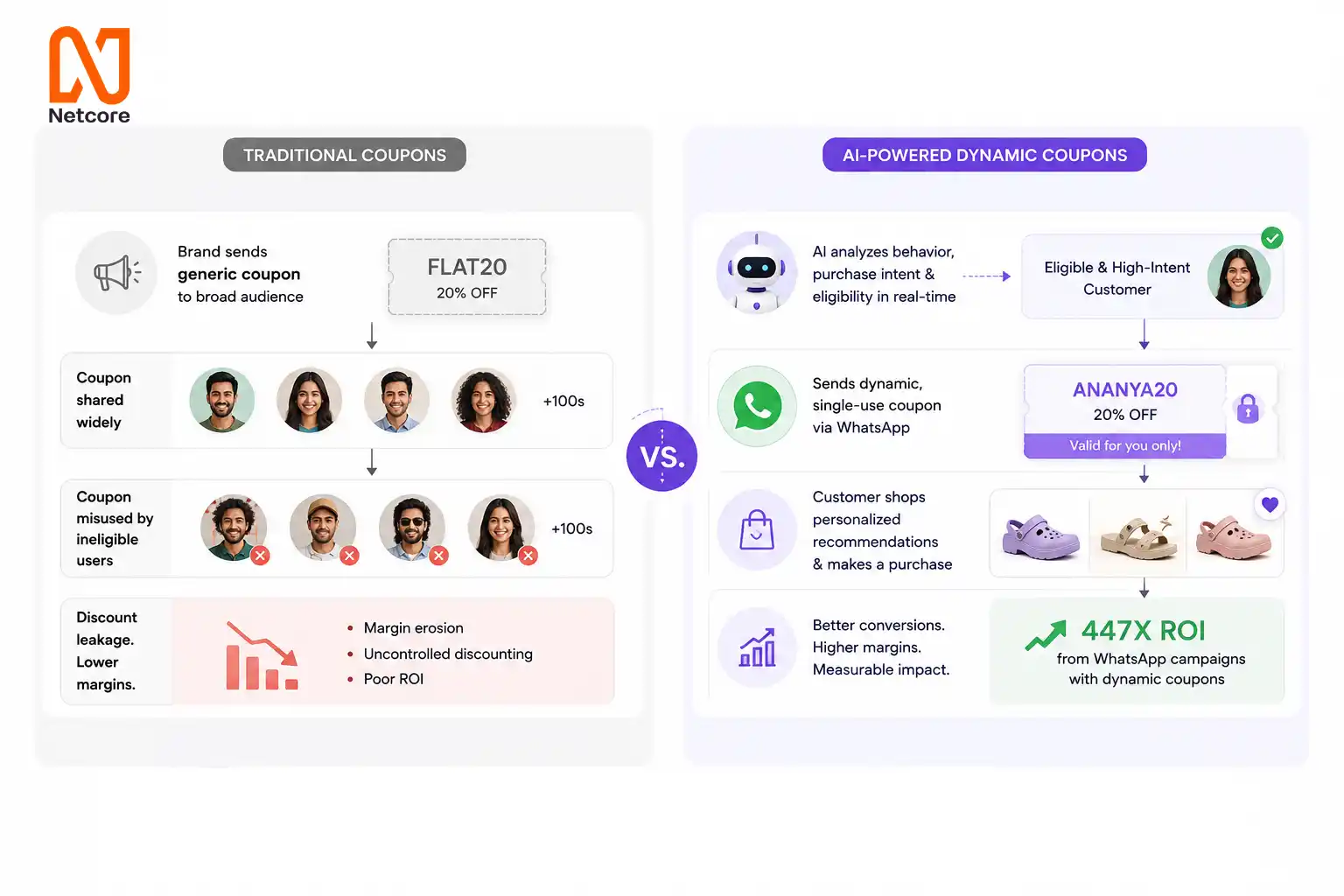
Applying personalization to even promotions helped in making profitable revenue from campaigns.
Discount campaigns can create another challenge for fashion and footwear brands: while coupons can accelerate purchases, generic or reusable codes can lead to misuse and unnecessary discounting.
The brand addressed this by introducing dynamic, single-use coupon codes with Netcore for selected customers. These codes could reward full-price buyers while reducing the risk of coupon misuse.
The approach delivered a remarkable 447X ROI from WhatsApp campaigns involving dynamic coupon codes. Real-time integration between the CRM and campaign platform enabled seamless delivery of these personalized codes.
Measuring Impact of Personalization that Moved Revenue
The combination of AI-led segmentation, behavioral recommendations, and personalized offers transformed the brand’s retention marketing approach.
Within just 15 days, the brand achieved 7X ROAS, demonstrating how granular personalization can translate customer intelligence into measurable commercial outcomes. More importantly, the brand moved beyond simply sending more campaigns. It created journeys based on individual customer affinities, purchase intent, and behavior, making every interaction more relevant.
Key Takeaway for Fashion and Footwear Marketers
In a category where customers have endless choices, differentiation cannot come only from products. The marketing experience itself needs to feel differentiated.
AI-powered personalization gives fashion and footwear brands a way to move beyond broad demographics and static segments toward individual-level relevance. By understanding what customers prefer, identifying when they are most likely to buy, and tailoring products and offers accordingly, brands can turn retention marketing into a stronger revenue engine.
The real opportunity isn’t to send more personalized campaigns. It’s to make every campaign more intelligently personalized.