Built from engagement patterns across India’s leading hotel groups, resorts, and vacation-ownership brands.
Your marketing team gets the rooms filled. Then the guest disappears until the next OTA search. Between the booking they made and the rebooking you never earned, revenue leaks at seven predictable points, and most hotels cannot even see six of them, because the data sits in silos. Netcore’s customer engagement platform closes those gaps by unifying every guest signal into one profile and acting on it across owned channels, from AMP email to WhatsApp to app push.
TL;DR
Hotels lose guest revenue at seven points across the lifecycle: anonymous browsers they never identify, abandoned bookings they never recover, PMS data marketing cannot reach, the in-stay window they never use, loyalty points that expire unredeemed, off-season occupancy left to manual campaigns, and post-stay feedback lost to low-response surveys. Each one is a platform gap, not a staffing gap. Netcore’s customer engagement platform closes them with a unified guest view, predictive intent qualification, and coordinated action across owned channels.Why Are Hotels Losing This Revenue in 2026?
Guests now research across a website, a mobile app, and two or three OTAs before they book, then vanish the moment the stay ends. The signals they leave are scattered across systems that do not talk to each other. Many hotel brands only began their martech journey recently, and the platforms they started with send messages without ever unifying who those messages reach.
Underneath sits the structural problem: legacy on-prem property management systems block the integrations that would connect offline stay data to online behaviour. So digital revenue lags despite heavy investment, and the guest relationship quietly transfers to whichever OTA closed the booking. Closing these leaks is not about sending more campaigns. It is about seeing the guest, then acting on what you see.
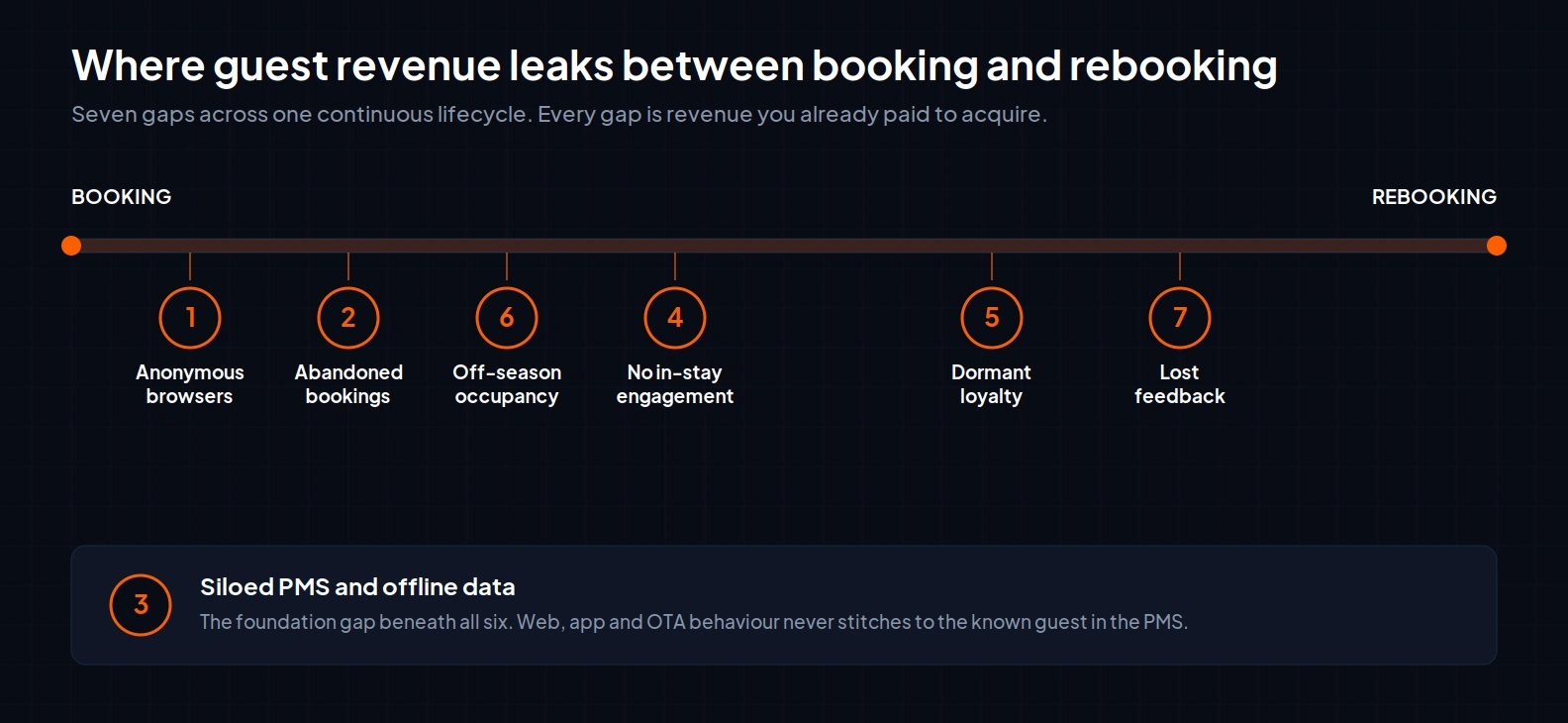
Seven revenue leaks across one continuous lifecycle. The siloed data foundation is the gap beneath the other six.
What Are the 7 Places Your Hotel Loses Guest Revenue?
1. Why Do Anonymous Browsers Leave Without a Trace?
A guest compares three of your properties, checks rates twice, and leaves without booking. You have no idea who they were. Most hotel sites treat every visitor as a first-timer, showing the same generic banner to a returning loyalty member and a cold prospect alike. The intent was there. The identity was not.
Where Netcore fits: Netcore’s Unified Customer View resolves identity across web, app, and OTA touchpoints and stitches anonymous browsers to known guest records. Returning visitors get nudged towards member rates and packages; unknown visitors enter an intent qualification track instead of a generic funnel.
2. Why Do Abandoned Bookings Never Come Back?
A guest selects a room, reaches payment, and drops. No follow-up reaches them, so they rebook on an OTA an hour later and you pay commission on a guest who was already yours. Abandoned bookings are the most recoverable revenue in hospitality, yet most brands run no recovery sequence at all.
Where Netcore fits: Netcore triggers a cross-channel recovery sequence within minutes, on WhatsApp and email, carrying the exact room and dates the guest left behind. Netcore’s preferred channels pick the right channel on which each guest is likely to respond, and Send Time Optimisation sends when they are most likely to open.
3. Why Can’t Your Marketing Team Reach Your PMS Data?
Your PMS knows every guest’s stay history, F&B spend, and room preference. Your marketing platform knows none of it. Legacy on-prem systems block third-party integrations, so the richest data you own never reaches a campaign. You market to guests as if you have never met them, because in your engagement stack, you never have.
Where Netcore fits: Netcore’s CDP ingests PMS and POS data through flexible connectors, whether API, SFTP, or scheduled batch, and folds stay history, spend, and preferences into a single guest view. Offline behaviour finally becomes an addressable audience for personalization and upsell.
4. Why Does the In-Stay Window Go Unused?
Between check-in and check-out, your guest is physically inside your revenue engine, and you say nothing. No upgrade nudge, no spa offer, no dining recommendation. The one window where a guest is most receptive to spending more is the one window most hotels leave completely silent. In-stay is hospitality’s largest untapped monetization surface.
Where Netcore fits: Netcore engages guests in real time during the stay through app push, WhatsApp, and RCS, with pre-arrival upgrade offers, in-stay dining and spa recommendations, and timely service nudges. Every message is triggered by the guest’s own profile and their stage in the stay.
5. Why Do Loyalty Points Expire Unredeemed?
Your loyalty members earn points they never redeem. They do not hear from you between stays, so the program that should drive repeat bookings sits dormant. Points expire, tiers lapse, and the member drifts back to booking on price. A loyalty program without automated engagement is a liability line, not a retention engine.
Where Netcore fits: Netcore uses predictive segmentation to spot members with expiring points, lapsing tiers, or a high propensity to return, then runs automated journeys: redemption nudges, tier-upgrade offers, and personalized packages built from past stays.
6. Why Is Off-Season Occupancy Left to Manual Campaigns?
Occupancy collapses in the off-season, so your team scrambles to blast discounts to the entire database. The guests most likely to travel off-peak get the same generic offer as everyone else, margins erode, and the property still underfills. Seasonality is predictable. Most hotels still manage it by hand, one broadcast at a time.
Where Netcore fits: Netcore builds predictive segments of guests likely to book in a given window and targets them with the right off-season offer. Send Time Optimisation and Path Optimizer decide when and on which channel each guest is reached, so demand is filled with precision rather than blanket discounting.
7. Why Is Post-Stay Feedback Lost to Low-Response Surveys?
You collect feedback with a manual survey days after checkout. Response rates are low, the data arrives too late to act on, and the guest has moved on. The moment to capture how a stay felt is while it is fresh, inside a channel the guest already opens, not in a form they will never fill.
Where Netcore fits: Netcore captures feedback inside the email itself with AMP interactive forms, so guests rate a stay and leave a review without leaving the inbox. Response rates rise, the signal arrives in time to recover a poor experience, and happy guests are routed straight to public reviews.
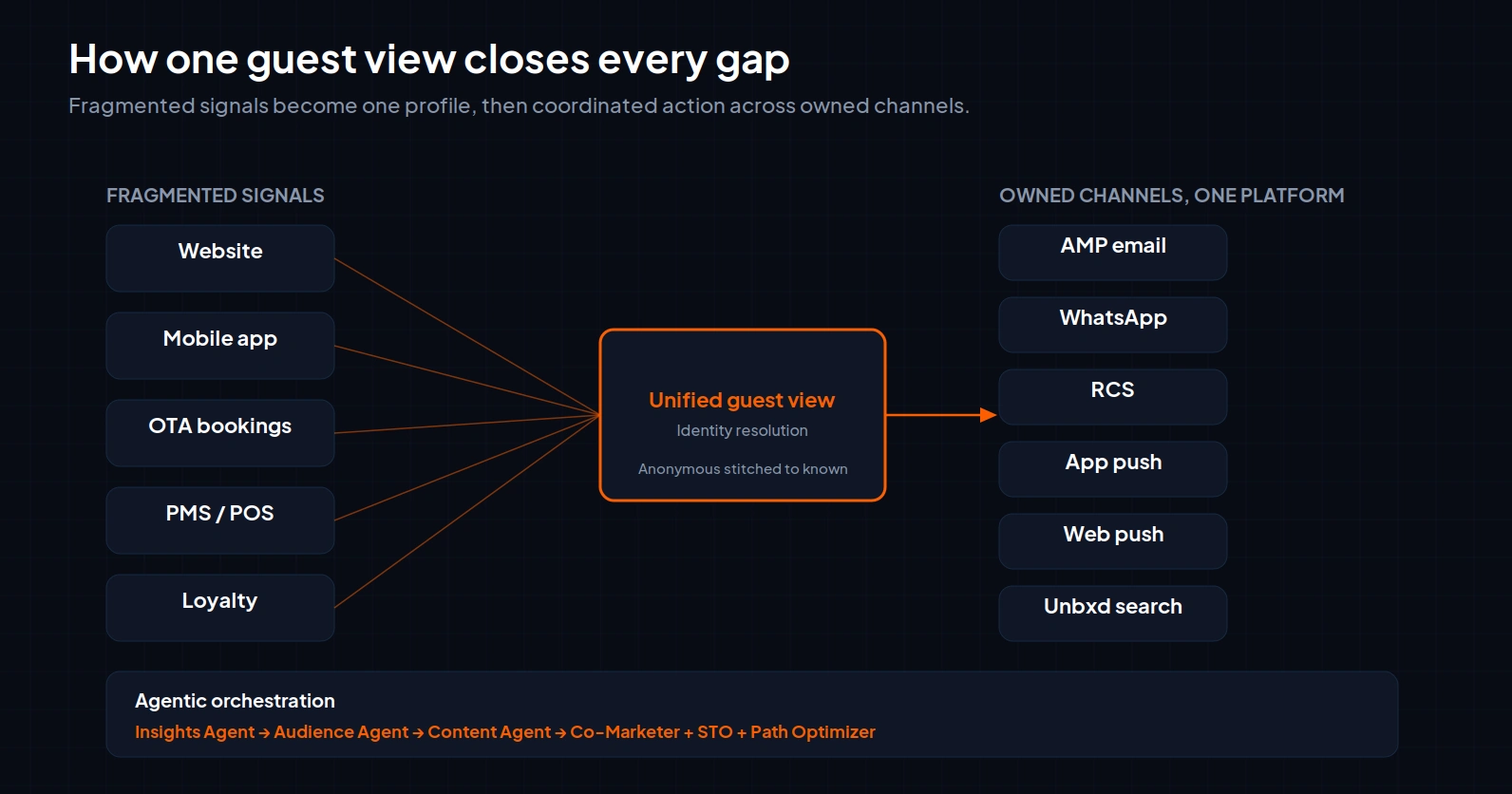
Fragmented guest signals resolve into one profile, then drive coordinated action across owned channels.
Final Take
- Six of the seven leaks are invisible until the data is unified. Start with the guest view and the rest become fixable.
- Every leak here is a platform gap, not a staffing gap. No amount of manual effort closes an anonymous-visitor or a siloed-PMS problem.
- The in-stay window and loyalty activation are the fastest revenue wins, because the guest is already yours. You are only failing to act.
- Owned channels matter. Coordinated action across email, WhatsApp, RCS, and push on one platform is what turns a unified profile into recovered revenue.