





MarTech migration is one of the most important and risky projects a marketing team can undertake. Whether you’re moving to a new customer engagement platform, replacing your CRM, consolidating multiple tools, or modernizing your data infrastructure, a poorly executed migration can disrupt campaigns, break customer journeys, and directly impact revenue.
The good news? Revenue loss during migration isn’t inevitable. With the right planning, governance, and execution framework, you can modernize your stack while maintaining business continuity.
Start With Business Goals, Not Technology
One of the most common mistakes organizations make is treating migration as a technical project rather than a business initiative.
Before evaluating platforms or mapping integrations, define why you’re migrating in the first place. Are you looking to improve personalization? Reduce operational complexity? Enable AI-powered marketing? Consolidate costs?
Clear objectives help teams make better decisions throughout the migration process and create measurable success criteria beyond simply “going live.”
Some key questions to answer include:
- What business problems are we solving?
- Which marketing capabilities are currently limited?
- How will success be measured six months after migration?
Audit Your Existing MarTech Ecosystem
Many organizations underestimate the complexity of their current stack. Over time, marketing teams build dozens of integrations, workflows, segments, reports, and customer journeys that may not be fully documented.
Before migration begins, conduct a complete audit of:
- Customer data sources
- CRM integrations
- Email and messaging workflows
- Analytics and attribution systems
- Loyalty and retention programs
- Personalization engines
This exercise often reveals redundant tools, outdated workflows, and unnecessary data that shouldn’t be migrated at all.
Clean Your Data Before Moving It
Migration is not the time to carry years of bad data into a new system.
Duplicate records, incomplete profiles, inconsistent field naming conventions, and outdated customer information can create major issues after launch.
A successful migration starts with a data-cleaning initiative that focuses on:
- Removing duplicate records
- Standardizing customer attributes
- Validating consent and preference data
- Archiving obsolete segments
- Fixing data quality issues
Clean data improves platform migration accuracy and helps teams realize value from the new platform much faster.
Prioritize Revenue-Critical Journeys
Not all campaigns have the same business impact.
Rather than migrating everything simultaneously, identify the customer journeys that directly influence revenue and retention.
These often include:
- Welcome journeys
- Cart abandonment campaigns
- Product recommendation flows
- Retention programs
- Loyalty communications
- Renewal campaigns
By prioritizing revenue-generating workflows first, you reduce the risk of business disruption and ensure critical customer experiences remain operational throughout the transition.
Avoid the “Big Bang” Migration Approach
Many migration failures occur because organizations attempt to move everything at once.
A phased migration strategy is significantly safer and easier to manage. Here’s how you make Martech migration easier and impactful.
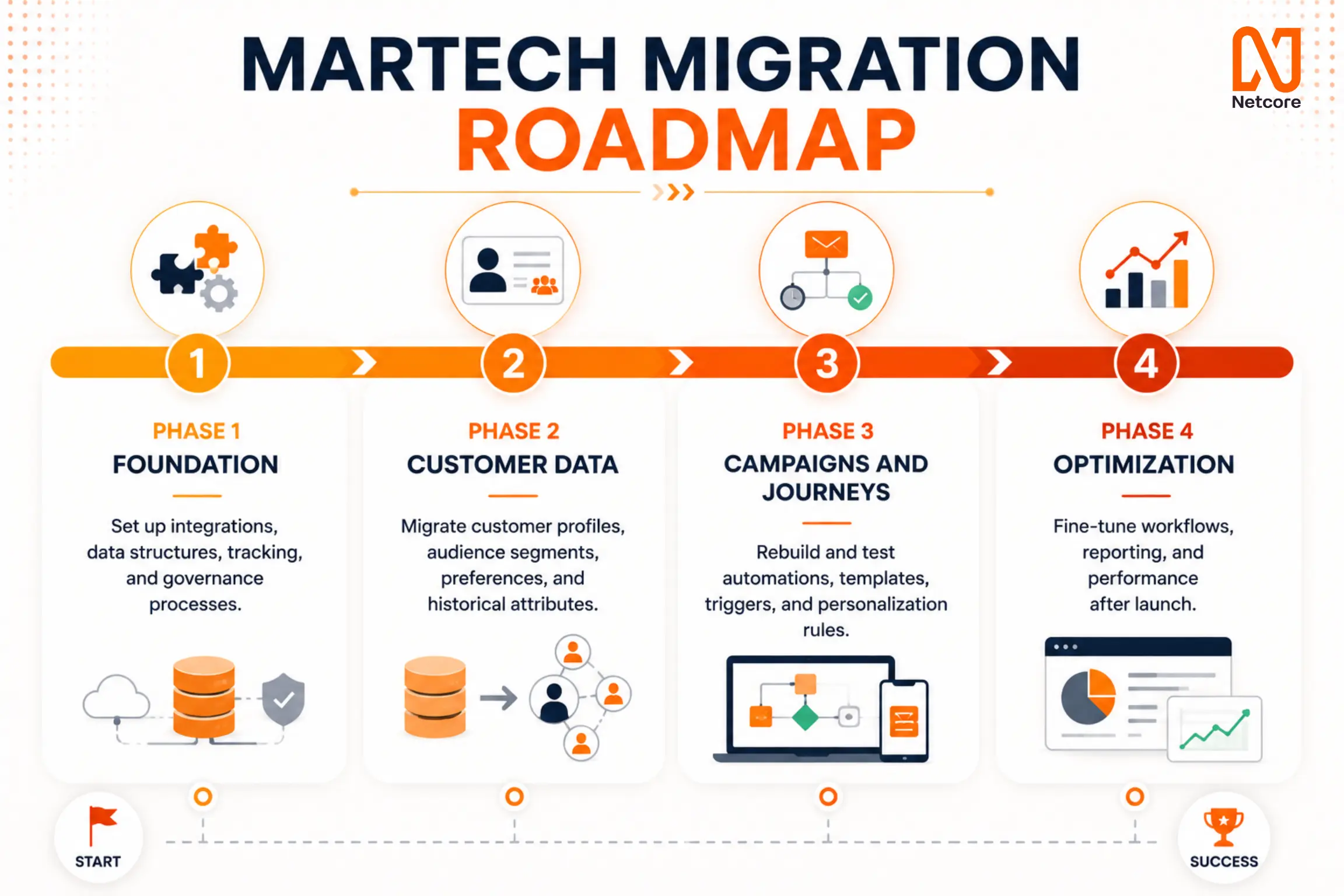
A typical migration roadmap includes:
Phase 1: Foundation
Set up integrations, data structures, tracking, and governance processes.
Phase 2: Customer Data
Migrate customer profiles, audience segments, preferences, and historical attributes.
Phase 3: Campaigns and Journeys
Rebuild and test automations, templates, triggers, and personalization rules.
Phase 4: Optimization
Fine-tune workflows, reporting, and performance after launch.
Breaking migration into phases allows teams to identify issues early and reduce operational risk.
Run Both Systems in Parallel
One of the most effective ways to protect revenue during migration is to operate both platforms simultaneously for a short period.
A parallel-run approach enables teams to:
- Compare campaign performance
- Validate data accuracy
- Verify integrations
- Identify customer journey gaps
- Resolve issues before full cutover
Rather than relying on assumptions, you gain confidence through real-world validation before making the final switch.
Test More Than You Think You Need To
Testing should extend far beyond technical validation.
A comprehensive migration testing plan should include:
- Data synchronization testing
- Integration testing
- Email and SMS delivery testing
- Personalization validation
- Trigger and automation testing
- Reporting accuracy checks
Every customer-facing experience should be reviewed before launch. A broken personalization rule or a failed automation can affect thousands of customers and lead to avoidable revenue loss.
Measure Business Outcomes After Go-Live
Migration success is not determined by whether the platform launches on schedule.
The real measure of success is business performance after migration.
Monitor metrics such as:
- Revenue per customer
- Conversion rates
- Customer retention
- Campaign engagement
- Deliverability rates
- Data accuracy
The goal isn’t simply to replace technology. It’s to create a stronger foundation for growth, personalization, and customer engagement. Learn more about, What a MarTech Migration Really Costs Enterprise Brands.
Final Take
Successful MarTech migrations don’t happen because teams move data from one platform to another. They succeed because organizations treat migration as a strategic business initiative with clear goals, clean data, phased execution, and rigorous testing.
If you’re planning a migration, focus on protecting revenue-critical customer journeys, validating performance before go-live, and measuring outcomes that matter to the business. The benchmarks and best practices outlined here can help you minimize risk and maximize the value of your next MarTech investment. Get in touch to experience a smooth Martech migration to Netcore.