





TL;DR
- MarTech migrations often fail not because of technology, but because of poor planning, data issues, and lack of stakeholder alignment.
- Common challenges include fragmented customer data, integration complexities, campaign downtime, compliance risks, team resistance to change, and difficulties measuring migration success.
- Many organizations underestimate the hidden costs of migration, including implementation effort, training, testing, and operational disruption.
- A successful migration requires clean data, cross-functional collaboration, phased testing, clear governance, and a structured rollout plan.
- Brands that treat migration as a business transformation, not just a platform switch, are more likely to achieve faster adoption, better customer experiences, and stronger ROI.
- With the right strategy and migration partner, enterprises can minimize risk, accelerate time-to-value, and unlock the full potential of their MarTech stack.
MarTech migration fails when leaders treat it as an IT data dump rather than a strategic revenue handover. To prevent campaign downtime and ROI drops, teams must master the transition to a single platform and replace disconnected tools with unified control. For a broader perspective on why this shift is necessary, explore our full MarTech Migration Guide.
Top Challenges in MarTech Migration (And How to Solve Them)
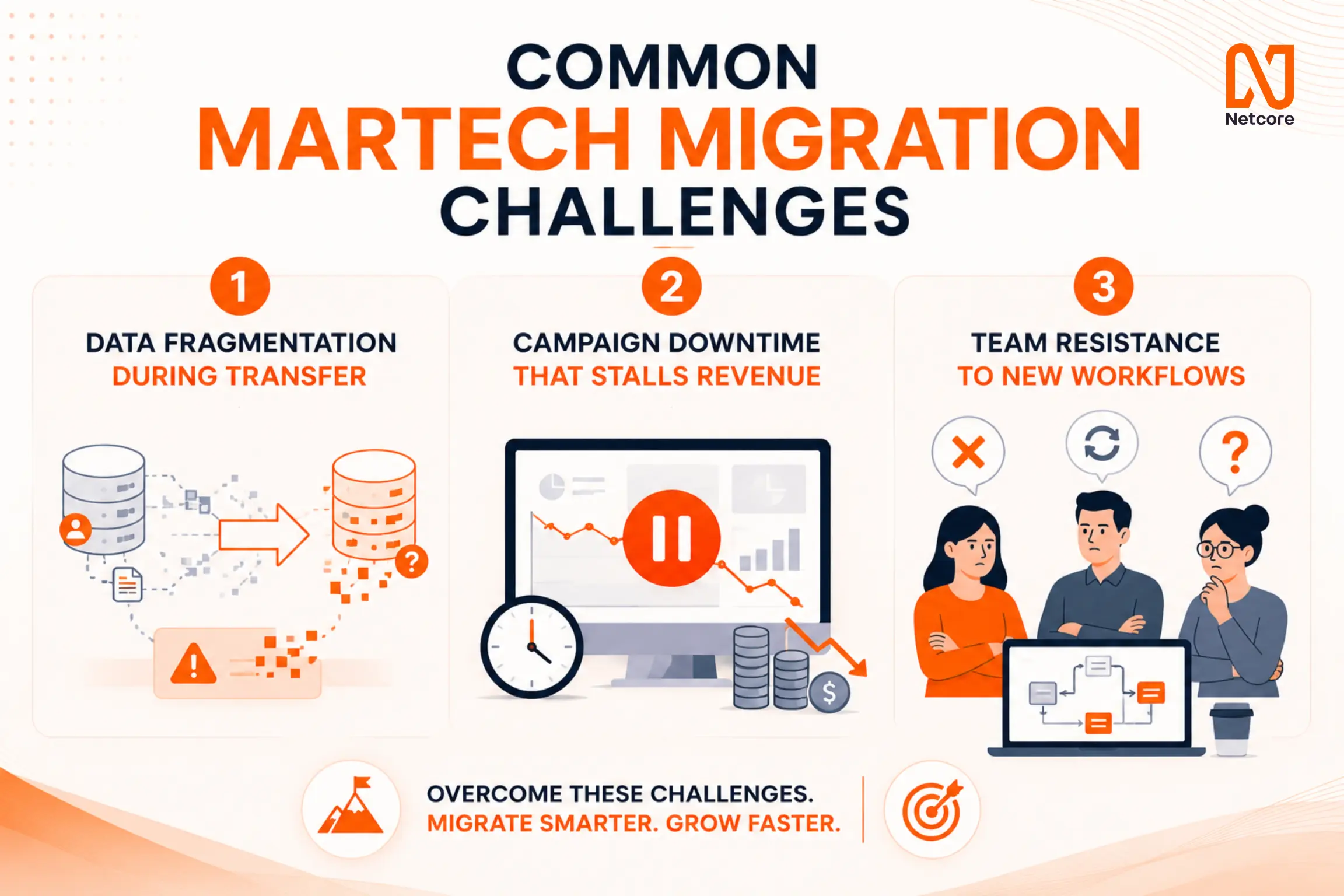
The three most common MarTech migration challenges are data fragmentation during transfer, campaign downtime that stalls revenue, and team resistance to new workflows. Solving these requires migrating to a unified platform with parallel execution phases, prioritizing data integrity, and replacing legacy rule-based systems with agentic AI in marketing.
Moving away from a fragmented marketing stack is not just a technology upgrade; it is a critical revenue event. When migrating to a unified platform, the stakes are entirely tied to campaign uptime and data continuity.
Many marketing leaders hear the promises of a new system, but immediately hit the reality of implementation anxiety. They understand the destination but fear the turbulence of the flight.
The top roadblocks typically fall into three buckets:
- Technical Hurdles: Breaking cross-channel customer profiles and losing historical engagement data.
- Operational Hurdles: Prolonged go-live times that freeze active campaigns and directly leak revenue.
- Cultural Hurdles: Teams struggling to adapt to modern workflows, clinging to manual, rule-based operations.
Overcoming Data Loss and Omnichannel Fragmentation
When transitioning platforms, the biggest technical fear is moving fragmented data without losing customer history. According to McKinsey, 47 percent of martech decision-makers cite stack complexity and integration challenges as their primary hurdles. Moving disjointed lists from Point A to Point B often breaks cross-channel profiles.
We consistently hear this anxiety from buyers trying to consolidate their stack. As one marketing leader told us, “I’m super keen about it, but I don’t know how to work it out with the existing systems that I have.” The solution is not a better integration tool; it is a unified Customer Data Platform (CDP) layer that serves as the single source of truth.
Instead of mapping complex APIs between five different vendors, migrating to a single native platform immediately creates a golden customer record. For example, when Ujjivan Small Finance Bank migrated to our omnichannel stack, they eliminated disconnected tools to unify regional language data. This shift to agentic, behavior-led engagement across channels ultimately drove a 200X ROI on their marketing spend.
Preventing Campaign Downtime and Execution Stalls
Operational downtime is the hidden cost of MarTech migration. If your revenue relies on daily omnichannel campaigns, any stall during vendor transition directly impacts the bottom line. Marketers are rightfully demanding to know: “How can we reduce the campaign go-live time?”
Legacy migrations force a hard stop, where teams freeze campaigns while IT figures out data mapping. The modern approach requires parallel execution. By running the legacy system and the new platform concurrently for a short period, you verify data accuracy without ever pausing your active customer outreach.
We see teams bogged down by manual processes, stating, “Currently, what we do, we code each email, and then we upload it that’s how we are doing it.” Migrating to a agentic marketing platform eliminates this friction instantly. When Leverage Edu moved to Netcore, they bypassed the slow segmentation that used to take hours on high-volume days. By leveraging our advanced agentic workflows, they prevented execution stalls and achieved a 270% uplift in community engagement.
Navigating Team Resistance and Skill Gaps
Even the most powerful unified platform will fail if the marketing team refuses to adopt it. The CMO Council notes that marketers face significant concerns regarding IT infrastructure, culture, and privacy limitations. Transitioning from manual, rules-based logic to autonomous, AI-driven systems requires a massive shift in mindset.
Your team wants proof that the new system will actually make their jobs easier. They ask granular questions like, “When you’re saying segmentation, are these classic ML models, or are these the new age agents that you have used to create segmentation?” They are ready for intelligent systems but need hands-on reassurance.
To bridge this skill gap, you must actively demonstrate the autonomous capabilities during onboarding. As one prospect recently requested, “I also want to see right now since we’re on the platform if you can showcase the agentic layer.” When teams see how agentic AI autonomously segments customer based on behaviour with Audience agent and Decisioning agent decides the next best action, the resistance drops and rapid adoption takes over.
Best Practices to Overcome Challenges
Successfully navigating a MarTech migration demands a rigid, business-case-driven roadmap. It is about mitigating risk and accelerating time-to-value. Check out the playbook for making Martech migration easier.
Here are the actionable steps to ensure campaign continuity.
1. Conduct a Thorough Audit
Before migrating, map out exactly what legacy data is required for retargeting and contact management. Do not migrate unnecessary clutter that dilutes your unified CDP.
2. Establish a Clear Roadmap
Outline defined milestones, realistic timelines, and specific dependencies. This ensures the project stays focused on revenue continuity and avoids unforeseen operational obstacles.
3. Bring in Outside Expertise
Utilize external consulting partners or customer success teams specializing in technology transitions to fill internal skill gaps. A proactive partner owns the KPIs alongside you.
4. Prepare for System Testing
Run legacy and new platforms concurrently for a short period to verify data accuracy and operational stability. When Buser executed this strategy with Netcore, they completely avoided downtime, curbed app uninstalls by 11%, and achieved a 71% ROI lift.
Final Take
MarTech migration fails not because the technology is flawed, but because the transition is treated as an IT data dump rather than a strategic revenue handover. A seamless transition requires a unified platform that prioritizes data integrity, prevents campaign downtime, and empowers teams with Agentic AI in marketing.
Ready to accelerate your onboarding? Learn how to achieve rapid time-to-value and secure early wins post-migration. Talk to us.