




TL;DR
- Both Netcore and Insider One are enterprise customer engagement platforms that offer omnichannel marketing, personalization, analytics, and AI-powered capabilities.
- Insider One is best known for web personalization, customer journey orchestration, and digital experience optimization.
- Netcore competes strongly with AI-powered product discovery, 1:1 product recommendations, native RFM intelligence, and advanced behavioral analytics that help brands drive conversions, retention, and customer lifetime value (CLV).
- Netcore’s AI capabilities extend beyond engagement to include search, merchandising, recommendation engines, predictive segmentation, and insight agents that turn customer data into revenue-generating actions.
- Brands looking to unify customer engagement and product discovery on a single platform can benefit from Netcore’s ability to personalize experiences across email, web, app, WhatsApp, and onsite journeys.
- If your focus is primarily web experience optimization, Insider One may be a strong fit. If your goal is to combine customer engagement, AI-driven product discovery, and revenue growth in one platform, Netcore is the more future-ready choice.
In the era of agentic intelligence, customer engagement platforms are no longer evaluated on channel coverage alone. The deciding factors are now: depth of analytics, real-time actionability, native intelligence, and whether the platform drives product experience or just sends campaigns.
Insider One is a credible, mature engagement platform with strong web-first capabilities and a polished personalization layer. It’s frequently rated highly for ease of use, customer support, and engagement. But review-led decisions hide a deeper question: does the platform actually move the needle on business outcomes, or does it stay confined to campaign execution?
Brands like Beyoung, and several others including major D2C and BFSI players, have already migrated from Insider One to Netcore, citing weak app tracking, limited journey orchestration, support inefficiencies, and the need for stronger AI recommendations.
This guide examines both platforms across architecture, analytics depth, AI capabilities, channel execution, and proven outcomes to help you decide which platform is right for your business in 2026.
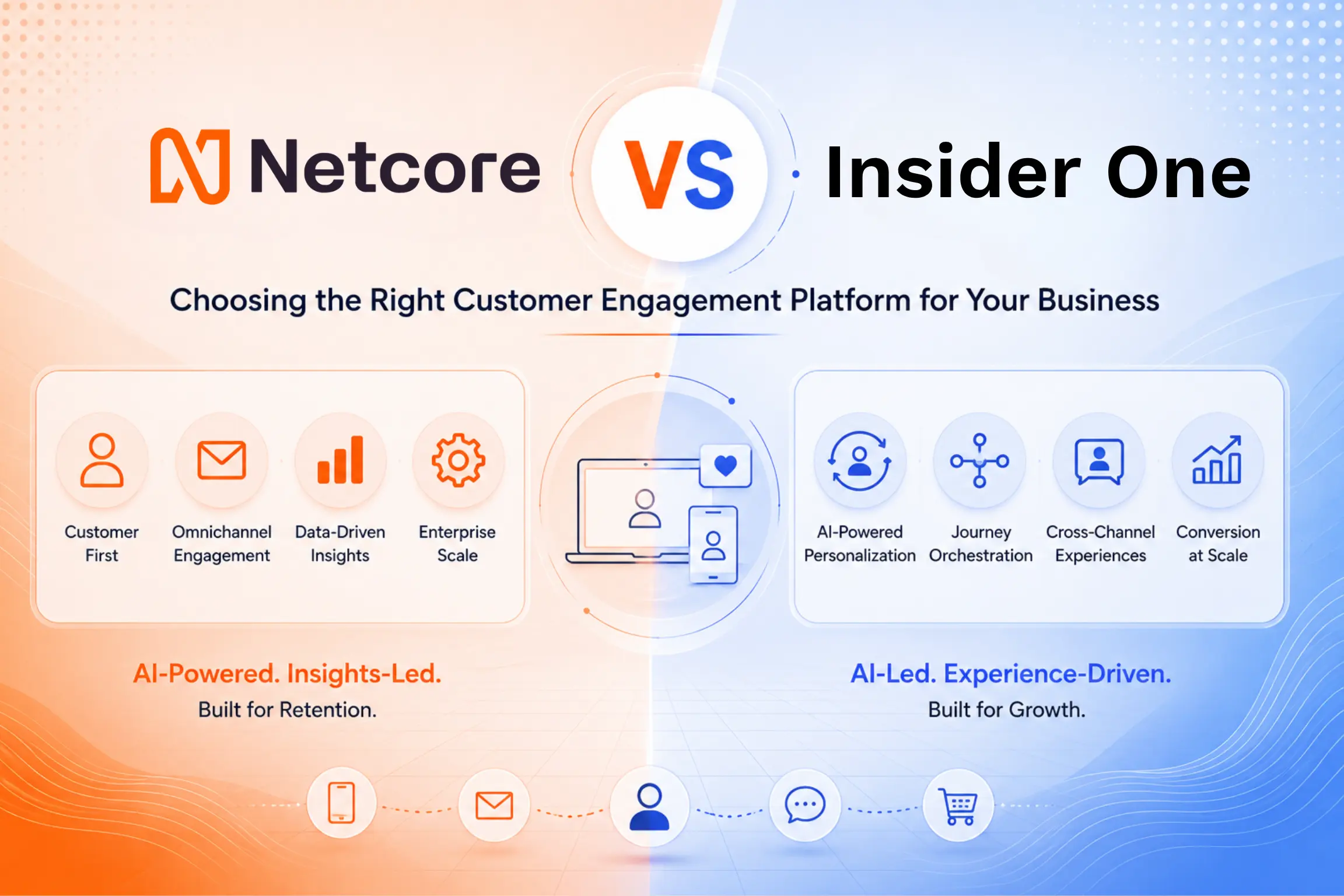
Why This Comparison Matters
Insider One is often rated highly for surface-level factors: ease of use, customer support, personalization & engagement. But beneath these review-friendly attributes, growing brands hit recurring gaps:
- Limited data depth & analytics capability that forces dependency on Mixpanel or Amplitude
- Lack of real-time actionability, insight and execution live in different systems
- Campaign-focused architecture, not product experience-driven
- Web-first design that lags on app engagement depth
- Walled-garden data architecture that restricts BigQuery and warehouse-first workflows
- Manual RFM segmentation with no automated transition tracking
- Either-or user path analysis (start OR end, not both)
- Limited AI maturity, Sirius AI offers prompts but lacks proven enterprise success stories
- Third-party email editor dependency (Stripo) with limited AMP capability
- Slower time-to-go-live due to standard enterprise onboarding cycles
While Insider One is strongly positioned for web-first engagement, Netcore delivers a more balanced engagement stack built for app-first, web-first, and true omnichannel brands. Here’s how the architectures compare.
Netcore Strengths
Netcore’s edge over Insider One comes from three things most platforms can’t easily replicate: a unified analytics engine where insight and activation live in the same workflow, agentic AI that’s purpose-built to drive measurable outcomes rather than just summarize data, and an open data architecture built for warehouse-native stacks.
Here’s where Netcore genuinely pulls ahead:
- Advanced analytics with native RFM intelligence. Netcore delivers a single source of truth where funnels, cohorts, and RFM transitions activate campaigns directly, no exports, no Mixpanel or Amplitude stitching. Marketers can drill down by affinity, attributes, technographics, and behavior in one view, then convert insights into segments and campaigns instantly. Unlike Insider’s standard funnel and cohort tracking, Netcore offers real-time funnel tracking with affinity drilldowns, funnel efficiency ratios, automated RFM user distribution, and segment transitions that auto-update when users shift from “Loyal” to “At Risk.” This is the difference between seeing what happened and acting on it in the same workflow.
- Built-in AI agents with proven enterprise outcomes. Both platforms offer agentic capabilities, but Netcore’s agents are backed by published customer success stories. Its specialized agents include Insights Agent for diagnostic intelligence (“why this happened”), Audience Agent for Segment-of-One propensity targeting, Content Agent for autonomous goal-driven content, Decisioning Agent for send-time and channel optimization, and Shopping Agent for conversational product discovery. Andaaz Fashion unlocked a 67% engagement uplift with Insights Agent; IGP achieved 3X engagement; Anveshan hit 13X WhatsApp ROI with Audience Agent’s Propensity Model. Insider’s Sirius AI offers prompt-based analytics, but functions more as a summarizer with no comparable enterprise proof points.
- Differentiated mobile-first engagement capabilities. Insider’s in-app capabilities are primarily campaign-driven, pop-ups, banners, basic nudges measured by open rates and CTR. Netcore combines campaign messaging with product-led experiences through Nudges, contextual lifecycle walkthroughs, audio tooltips, gamification, and feature-level A/B testing, all native.
- AI-powered product discovery. Netcore combines intelligent product discovery with AI-powered product recommendationsranked #1 in Forrester Wave: Commerce Search & Product Discovery, Q3 2025. Netcore extends affinity into a deeper behavioral intelligence layer, enabling category affinity prediction, real-time WYSI, WYG web personalization with “Navigate Mode” (live changes on the actual website, not simulated previews), and Hello Bar V2.0 with full real-time preview. Speed-to-go-live is ~30 minutes for JS integration, with first campaigns live in 3–5 days vs. Insider’s standard enterprise onboarding cycle.
- Open data architecture with native BigQuery integration. Insider treats data warehouses as external sources for marketing campaigns. Netcore treats them as the single source of truth. Native bidirectional BigQuery integration supports real-time event sync, push enriched data back into the warehouse, independent analytics team access, and scale to 100M+ records without slowdowns. Raw event data exports automatically to BigQuery, S3, or your data warehouse your data team owns the data, not just the marketing team. For warehouse-first stacks, this architectural difference is structural, not incremental.
- AMP-powered email built for interactive commerce. Insider relies on a third-party editor with limited AMP maturity. Netcore’s native email editor delivers strong AMP capabilities, forms, carts, surveys, calculators, and product carousels embedded directly inside the inbox. Ackermans recovers abandoned carts within email via AMP Magic Cart; HDFC Bank embedded its EVA chatbot inside AMP emails for a 6.5X increase in interactions. This transforms email from a communication channel into a conversion channel.
- Outcome-based pricing. Netcore has introduced outcome-based pricing that ties costs to measurable business results rather than just platform usage. The model splits 75% predictable fixed platform fee with a 25% variable performance fee tied to your KPIs, plus a 1% attributed GMV overachievement kicker, with transparent audit-ready attribution. If targets miss, the variable component flexes down. This is a meaningful shift from the “pay for access, figure out ROI yourself model most platforms still operate on.
- KPI-driven customer success. Verified Gartner reviewers describe Netcore’s team as “an extension of our own,” helping both on strategy and day-to-day execution. Every client is paired with a Customer Success Manager and Data Scientist working toward defined business outcomes, not just resolving support tickets. Migration brands consistently cite Insider’s support inefficiencies slowing execution at scale, particularly during complex campaign builds or technical integrations.
Netcore Limitations
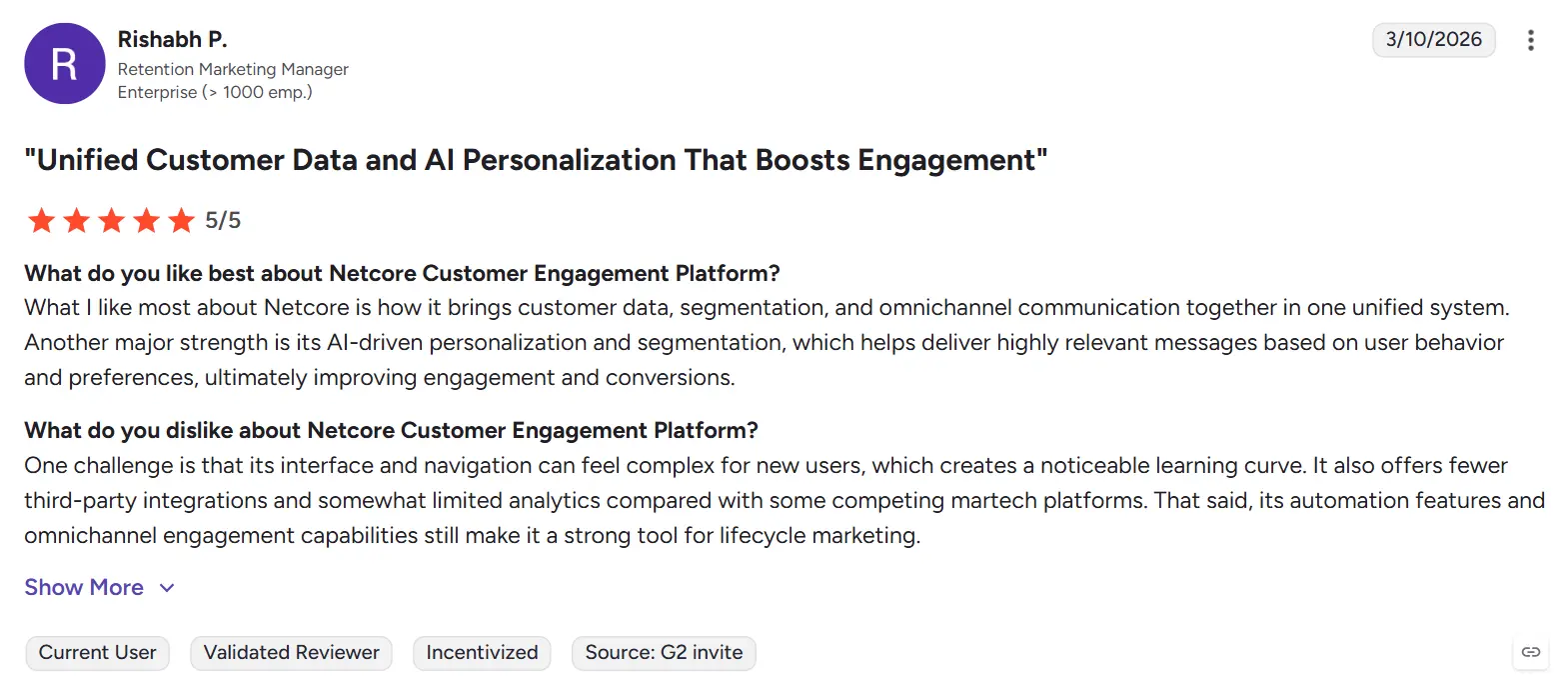
Netcore has genuine strengths, but it also has real gaps that buyers in this comparison need to go in with eyes open about.
Where Netcore falls short:
1. Best for Brands Ready to Use the Full Stack
Netcore is designed as a unified platform across analytics, engagement, personalization, AI agents, and BigQuery integration. If your team plans to use Netcore for only one capability (e.g., just email or just push), you’ll be paying for more platform than you’ll use. Brands that maximize ROI on Netcore are those committed to consolidating point solutions.
2. Ideal for Outcome-Driven Teams, Not Web-Only Brands
Netcore’s depth shines for brands with both app and web ecosystems, complex behavioral data, and a need for RFM intelligence. If your engagement strategy is purely web-first with minimal app focus, Insider’s mature web personalization suite may meet your needs without requiring Netcore’s broader capabilities.
3. Requires Foundational Data Readiness
Netcore’s AI agents and predictive segmentation scale with data quality and depth. Teams transitioning from event-light implementations may need 4–6 weeks of upfront instrumentation. Netcore helps with this, but it’s not automatic.
4. Best Suited for Teams Ready to Evolve Beyond Campaign-Only Marketing
Netcore is built for brands ready to embrace insight-to-action workflows, where funnels, cohorts, and RFM drive campaigns directly. If your operating model treats analytics and execution as separate disciplines, Netcore’s unified approach may feel unfamiliar at first.
Insider One Strengths
Insider One has genuine areas of capability that work well for specific use cases:
1. Mature Web-First Engagement Suite
Insider’s web personalization, drag-and-drop editor with template library, and Smart Recommender are well-designed for web-first brands. For e-commerce companies focused predominantly on browser-based experiences, Insider’s web capabilities are robust.
2. Strong Personalization Engine
Insider’s recommendation engine with 20+ strategies, brand affinity segmentation within CDP, and Sirius AI for content assistance work well for brands focused on personalization use cases.
3. Polished UX and Ease of Use
Insider is consistently rated highly for ease of use and intuitive UX. For teams prioritizing rapid adoption with minimal training, the platform delivers a clean experience.
4. Established Customer Support Ratings
Insider receives strong reviews for customer support quality, particularly for mid-market accounts.
5. Sirius AI for Content and Analytics
Insider’s Sirius AI provides prompt-based content creation, personalization, and analytics summaries. For teams with simple AI needs, this offers a starting point.
Insider One Limitations
Based on the deck’s competitive analysis, migration stories, and direct customer feedback:
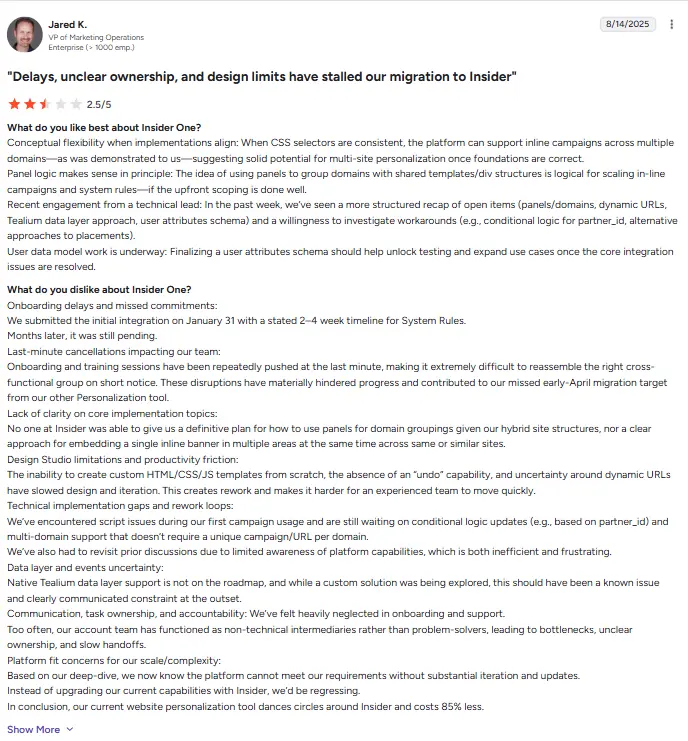
1. Limited Data Depth & Analytics Capability
Insider’s analytics often rely on external tools (Mixpanel, Amplitude) for advanced cohort analysis and behavioral intelligence. This creates a “stitching” problem, data lives in multiple systems, and insights require cross-tool correlation.
2. Lack of Real-Time Actionability
Insights and activation are separated. You can see drop-offs in a funnel, but you can’t act on them in one click. Campaigns require manual segment creation outside the analytics workflow.
3. Campaign-Focused, Not Product Experience-Driven
Insider’s in-app capabilities focus on campaign overlays (pop-ups, banners, basic nudges). Success is measured by open rates and CTR, not by retention, usage, or CLV.
4. Either-Or User Path Analysis
Insider’s user paths analyze either Start Step OR End Step, not both combined. You can view 1–10 steps maximum. This limits understanding of complete user journeys and conversion paths.
5. Manual RFM Segmentation
Insider has no native RFM distribution view. Transitions need to be manually defined based on rules with events and attributes. There’s no auto-update of segment movements.
6. Walled Garden Data Architecture
Insider’s data ingress is primarily from its own ecosystem. Egress is restricted, raw event data is hard to extract for data science teams or BI tools.
Critical scenarios where Insider falls short:
- Real-time event sync from BigQuery → delayed/batched
- Pushing enriched data back to warehouse → limited
- Independent data team queries → data is siloed
- Scaling to 100M+ records → gets slow/costly
- Switching tools without losing historical data → data locked in
7. Limited Conversational Push Interactions
Insider has limited support for advanced conversational push (reply on notifications, advanced rich media). For brands using push as an engagement channel beyond basic alerts, this is a gap.
8. Third-Party Email Editor Dependency
Insider relies on third-party editor with limited AMP email maturity. For brands using email as an interactive commerce channel, this limits the ability to embed forms, carts, surveys, and actions inside the inbox.
9. Sirius AI Lacks Proven Success Stories
While Insider markets Sirius AI prominently, it functions primarily as a summarizer with limited published enterprise success stories. Netcore’s AI agents have proven case studies (Andaaz 67%, IGP 3X, Anveshan 13X ROI).
10. Standard Enterprise Onboarding Cycle
Insider follows a standard enterprise onboarding timeline. Netcore’s JS integration completes in ~30 minutes, with first campaigns live within 3–5 days post-integration.
11. Smart Recommender Limited to 20+ Strategies
Insider’s Smart Recommender uses 20+ strategies. Netcore’s AI engine uses 50+ ML models and is rated #1 in Forrester Wave: Commerce Search & Product Discovery, Q3 2025.
12. Web-First Bias, Weaker App Tracking
Multiple migration brands cite weak app tracking and data visibility as a primary reason for moving from Insider to Netcore. For app-first brands, this is a structural limitation.
13. Support Inefficiencies at Scale
While reviews highlight strong support, migration brands cite support inefficiencies slowing execution at enterprise scale, particularly during complex campaign builds or technical integrations.
14. Limited Journey Orchestration
Migration brands cite limited journey orchestration capabilities as a factor in switching. Insider’s flexibility in journey design comes with usability trade-offs, leading to higher dependency on documentation and customer support.
Netcore vs Insider One: Head-to-Head Feature Comparison
| Capability | Netcore | Insider One |
|---|---|---|
| Analytics Architecture | Single source of truth with embedded actionability | Powerful but complex; often relies on Mixpanel or Amplitude |
| Funnel Analytics | Real-time analysis with affinity drill-downs, unique users, and total conversions | Standard drop-off and conversion tracking |
| Cohort Analysis | Built-in cohorts with heatmaps and direct activation | Basic cohort analysis; often requires external tools |
| RFM Intelligence | Native RFM distribution with auto-updating transitions | No native RFM; manual segmentation required |
| Trend Analytics | Affinity drill-downs, multi-event slicing, and advanced sorting | Event analytics with parameter-level insights |
| Cross-Analysis | Funnels, cohorts, RFM, and behavioral analysis in one layer | Separate analytics modules |
| AI Agents | Insights Agent, Audience Agent, Content Agent, Shopping Agent | Sirius AI with limited publicly documented success stories |
| In-App Engagement | Campaign-led and product-led experiences focused on retention, usage, and CLV | Campaign-led engagement using pop-ups and banners |
| A/B Testing | Feature-level and campaign-level testing | Primarily campaign-level testing |
| Web Editor | Real-time WYSIWYG editor with Navigate Mode | Drag-and-drop editor with simulated preview |
| Email Editor | Native editor with strong AMP Email support and interactive commerce experiences | Third-party editor (Stripo) with limited AMP support |
| Push Notifications | Rich media, reply actions, and SmartPush delivering up to 40% lift | Limited conversational push capabilities |
| BigQuery Integration | Native, real-time, bi-directional integration | Available but campaign-centric and batch-based |
| Data Ingestion (Ingress) | Multi-source ingestion from CDPs, apps, warehouses, and APIs | Primarily optimized for Insider’s ecosystem |
Use Case Scenarios: Which Platform for Which Business?
Choose Netcore if:
- You need deep analytics with real-time actionability, funnels, cohorts, RFM, user paths all activate campaigns directly without exports.
- You’re an app-first or hybrid app+web brand. Netcore’s mobile-native architecture delivers stronger app tracking, in-app product experiences, and lifecycle nudges.
- You want native RFM intelligence, automated transitions, user distribution, and built-in activation.
- AI-driven outcomes matter, proven case studies with Insight Agent (Andaaz 67%), Audience Agent (Anveshan 13X), Shopping Agent, and Content Agent.
- You operate on a data warehouse-first stack, native BigQuery integration, two-way real-time sync, S3 export, and open data architecture.
- Email is a revenue channel, native AMP editor with interactive commerce (cart recovery, forms, surveys inside email).
- You want partnership pricing, outcome-linked model with skin in the game.
- You scale to 100M+ records, Netcore is built for enterprise data volumes without slowdown.
Real proof from Insider One migrations to Netcore:
- Beyoung: Migrated from Insider, saw 5X business glow-up. Used Netcore’s web push and WhatsApp abandonment triggers, reminder messages on low supply, and win-back triggers to reactivate dormant users.
- Crocs: 4X uplift in conversion using affinity-based segments.
- Pepe Jeans: 1.8x engagement lift, 12.8x ROI for a quarter using funnel efficiency + RFM segments + cohort intelligence.
- Oz Hair and Beauty: Personalized campaigns through brand affinity segmentation. From 20+ dropdowns to 1 intelligent input.
- Andaaz Fashion: 67% engagement uplift with Insight Agent.
- IGP: 3X engagement with Insight Agent (identified Wave 1 winning footer CTAs).
- Anveshan: 13X WhatsApp ROI with Audience Agent’s Propensity Model.
- Max Life Insurance: 6X CTR vs SMS, 45% read rate on RCS renewal campaigns.
- FabIndia: Double digital revenue, 9X ROI with AI-led omnichannel engagement.
- Shriram Finance: 130X revenue, 171X ROI from lifecycle orchestration and WhatsApp funnel recovery.
- Ackermans: Recovered abandoned carts with AMP Magic Cart inside email.
Other brands that migrated from Insider One cited:
- Weak app tracking and data visibility
- Limited journey orchestration capabilities
- Support inefficiencies slowing execution
Choose Insider One if:
- You’re a pure web-first brand with minimal app focus and no need for deep app analytics.
- Your personalization needs are template-driven, basic recommendations, pop-ups, banners.
- You don’t need warehouse-first data architecture, your data infrastructure is contained within campaign tools.
- AI-assisted (not autonomous) content creation is sufficient, you don’t require proven enterprise AI agent success stories.
- You’re comfortable with manual RFM segmentation and don’t need automated transition tracking.
- Standard SaaS pricing fits your model, you don’t need outcome-linked partnership pricing.
- Mixpanel or Amplitude is already in your stack, you accept additional analytics tooling for deeper insights.
Why Choose Netcore Over Insider One?
- Advanced funnel analytics with instant activation: Netcore goes beyond standard funnel tracking with real-time funnel analysis, affinity drill-downs, funnel efficiency ratios, and the ability to instantly convert funnel insights into targeted customer journeys and campaigns.
- Built-in cohort analytics: Netcore provides rich cohort heatmaps, week-over-week retention trends, and in-platform visualization, enabling marketers to analyze customer behavior and take immediate action without relying on external analytics tools.
- Real-time RFM intelligence: Netcore continuously tracks how customers move between RFM segments, helping marketers identify high-value, at-risk, or dormant users and automatically trigger personalized engagement based on these changes.
- Insights to action in one platform: Rather than exporting data for manual analysis, Netcore allows marketers to activate cohorts, launch nudges, trigger journeys, and build audiences directly from analytics, accelerating campaign execution and improving marketing agility.
- Unified analytics and engagement: By combining behavioral analytics, customer segmentation, personalization, and omnichannel orchestration in one platform, Netcore eliminates data silos and enables faster, more data-driven customer engagement.
What Makes Netcore the Best AI-Native Omnichannel Customer Engagement Platform?
Netcore combines Agentic AI, omnichannel engagement, real-time personalization, and customer intelligence in a single platform, enabling brands to deliver seamless experiences across Email, SMS, WhatsApp, RCS, Push, In-App, Web, and AI-powered Site Search. Its AI agents automate audience segmentation, content creation, campaign optimization, and decisioning, while predictive analytics, behavioral triggers, and product recommendations drive personalized customer journeys. With built-in analytics, enterprise-grade deliverability, revenue attribution, and managed migration support, Netcore helps businesses consolidate their MarTech stack, accelerate campaign execution, and drive higher conversions, retention, and long-term revenue growth.
Total Cost of Ownership (TCO)
While platform pricing is important, the true cost of ownership includes the additional tools, integrations, and operational effort required to execute and optimize campaigns. Netcore combines customer engagement, behavioral analytics, cohort analysis, RFM intelligence, AI-powered personalization, and omnichannel messaging in one platform, reducing dependency on external analytics and activation tools. This simplifies implementation, lowers integration and maintenance costs, enables faster campaign execution, and helps marketing teams achieve a higher return on investment with a unified, AI-native customer engagement platform.
Migrate to Netcore
Upgrade to Netcore with a zero-disruption migration managed by dedicated onboarding and customer success teams. Consolidate your customer engagement, analytics, personalization, and AI capabilities into one unified platform, eliminating fragmented tools and complex integrations. With built-in behavioral analytics, omnichannel orchestration, AI-powered personalization, enterprise-grade deliverability, and managed migration support, Netcore helps you go live faster, reduce operational overhead, and start delivering measurable improvements in customer engagement, retention, and revenue from day one.
Read the platform migration guide, which explains the complete process in detail.
Final Take
Both Insider One and Netcore offer strong omnichannel engagement, personalization, AI capabilities, and customer support. The difference lies in how well they scale and drive business outcomes.
Choose Insider One if your primary focus is web-first engagement, personalization, and standard analytics.
Choose Netcore if you want advanced analytics, native RFM intelligence, AI-powered decisioning, stronger in-app experiences, warehouse-native data architecture, and a platform built to actively drive retention, CLV, and revenue growth.
The real question isn’t which platform offers more features—it’s which platform can turn insights into action faster and help your marketing team drive measurable business outcomes.
Looking for a platform built for intelligence-led growth, not just campaign execution? Talk to us.