Enterprise companies spend significant time selecting a MarTech platform. They evaluate features, integrations, security, scalability, pricing, and vendor credentials. Yet one factor often receives less scrutiny during the buying process: what happens after the contract is signed?
That question matters more than it may appear.
For many enterprise brands, the platform onboarding is only the beginning of the difficult work. Teams must still determine how to structure customer data, design journeys, define triggers, prioritize audiences, coordinate channels, and translate platform capabilities into measurable business outcomes.
Traditional vendor support models are designed primarily to ensure that the technology works.
Enterprise brands, however, need help ensuring that the technology delivers results.
This difference, between platform support and outcome ownership, is becoming one of the most important gaps in enterprise MarTech.
The problem is not a lack of technology
Enterprise MarTech platforms have become increasingly sophisticated. Most offer extensive capabilities across customer data, segmentation, journey orchestration, analytics, personalization, and multichannel engagement.
But more capabilities do not necessarily make execution easier.
In fact, enterprise complexity often creates the opposite problem. A typical organization may have multiple customer data sources, business units, markets, internal technology teams, marketing teams, and external partners interacting with the same platform.
As a result, the question is rarely whether the platform can perform a particular function.
The harder question is: Who knows how the organization should use that function to improve a business outcome?
Consider a common scenario. A marketing team wants to improve repeat purchases. The platform can create audiences, process events, trigger journeys, and deliver campaigns across multiple channels.
But someone still needs to determine:
- Which customer behaviors should trigger intervention
- Which audience represents the highest opportunity
- What message should be delivered
- Which channel should be prioritized
- How frequently customers should be contacted
- Which metric should define success
The software can execute these decisions.
The enterprise team is often left to make them alone.
Four reasons enterprise MarTech support frequently falls short
1. Technical support is not the same as strategic expertise
Most vendor support teams are optimized for resolving technical issues.
A campaign fails to trigger. An API connection breaks. A dashboard behaves unexpectedly. A user encounters an error.
These problems can be logged, diagnosed, and resolved.
But enterprise teams frequently need answers to different questions:
Which events should trigger this journey?
Which customers should receive this campaign?
How can frequency be managed across channels?
Which journeys should be optimized to improve retention?
These are not software bugs. They are business and marketing decisions.
As a result, many brands encounter an expertise gap. The vendor understands the platform. The brand understands its business. But no one is consistently responsible for connecting the two.
That gap can become increasingly expensive as the scale and complexity of the organization increase.
2. The support model can become “pay to play”
Many enterprise technology vendors offer differentiated levels of support.
Faster response times, dedicated contacts, strategic consulting, and specialized assistance may be tied to premium service tiers or additional fees.
This creates a familiar dynamic: the more complex the organization’s needs become, the more it may need to spend simply to access the level of expertise required to operate the platform effectively.
Meanwhile, standard support may involve ticket queues, multiple handoffs, and teams with limited familiarity with the organization’s specific campaigns, data architecture, or commercial objectives.
The issue is not that ticket-based support is inherently ineffective.
It is that ticket-based support is reactive by design. Enterprise growth requires a more proactive model.
3. Enterprise data does not scale through integrations alone
Enterprise MarTech environments are rarely simple.
A platform may need to process millions of customer profiles and large volumes of behavioral and transactional data while connecting with ecommerce systems, CRMs, analytics platforms, internal applications, and regional technology stacks.
Vendors often highlight the number of integrations their platforms support.
But an integration is not the same as an architecture.
The critical question is whether the data can move, unify, and activate at the speed and scale required by the business.
When complexity increases, enterprise teams often find themselves responsible for resolving questions that extend beyond the vendor’s standard support remit:
- How should customer events be structured?
- Which data should be activated in real time?
- How should custom integrations behave?
- How can different systems maintain a consistent customer view?
- What happens when campaign requirements change?
Connecting systems with APIs is only the first step. Making the entire architecture work toward a marketing objective is significantly harder.
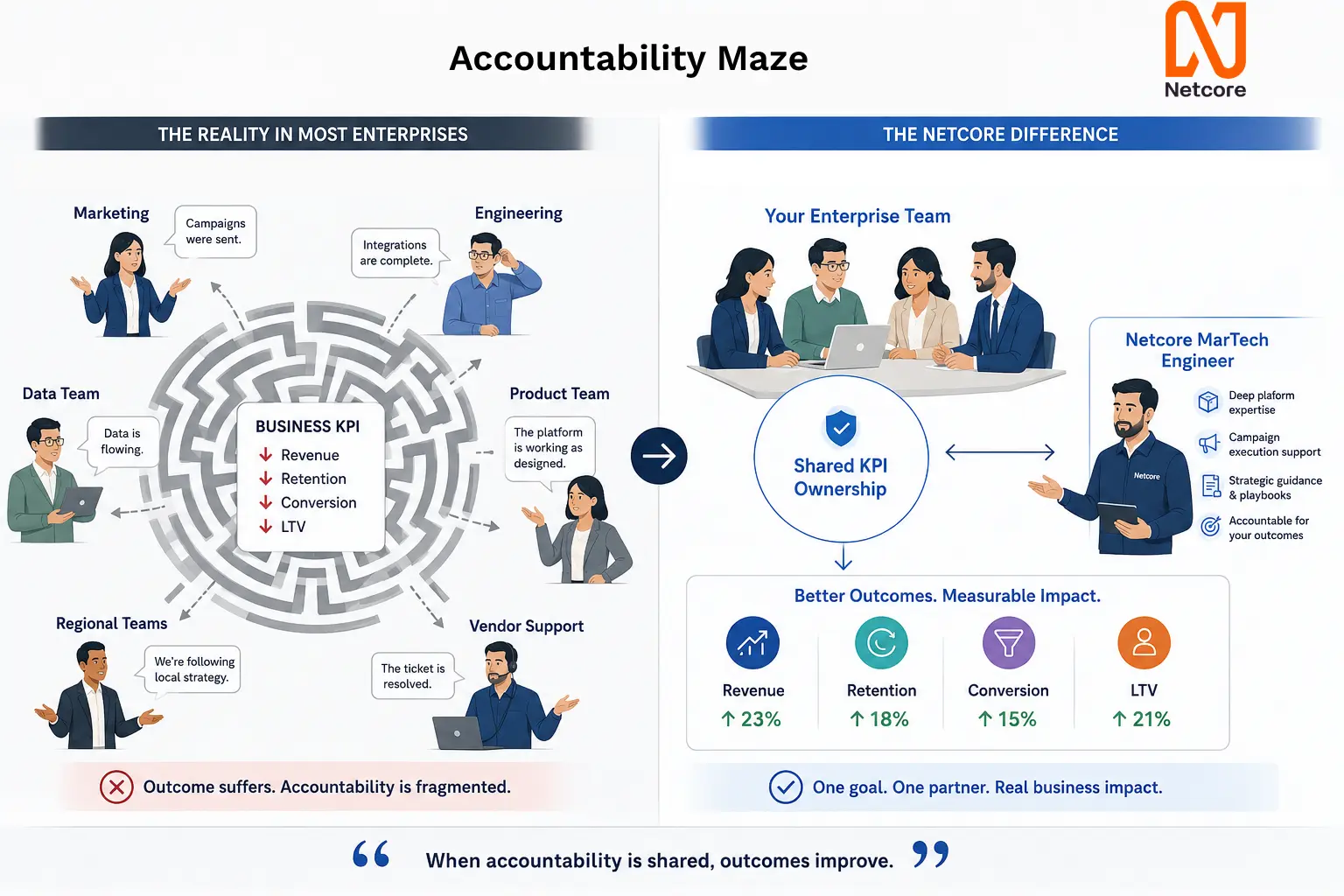
4. No one owns the outcome
Perhaps the most significant limitation of the traditional support model is the way accountability is divided.
The vendor may be responsible for:
- Platform availability
- Product functionality
- Technical support
- Service-level commitments
The enterprise is responsible for:
- Revenue
- Retention
- Conversion
- Customer engagement
- Lifetime value
Within a large organization, accountability can become fragmented further.
Marketing owns campaigns. Engineering owns integrations. Data teams own pipelines. Product teams own customer experiences. Regional teams own local execution.
Everyone may be doing their part.
Yet no individual, or vendor, may have ownership of whether the MarTech investment is producing the intended business outcome.
This is the central challenge.
Enterprise brands do not simply need better support. They need greater accountability for outcomes.
The enterprise support model needs to evolve
The traditional model follows a relatively straightforward sequence:
Something breaks → A ticket is raised → The vendor responds → The issue is resolved.
A growth-oriented model should look different:
Define the outcome → Build the strategy → Execute → Measure → Learn → Optimize.
The first model is centered on product performance.
The second is centered on business performance.
For enterprise leaders, this distinction should influence how MarTech vendors are evaluated.
The question should not only be:
How quickly will the vendor respond when something goes wrong?
It should also be:
Who will help us ensure the platform produces the outcomes we invested in?
Netcore’s approach is built around this second question.
How Netcore changes the enterprise MarTech support model
1. Focus on value, not simply implementation
For many technology implementations, going live is treated as the finish line.
Netcore treats it as the starting point.
The objective is to help brands begin realizing value in as fast as 45 days through a combination of structured onboarding, dedicated success teams, and strategic guidance.
This includes:
- Dedicated onboarding and success teams
- A proven onboarding checklist
- Strategic guidance from the beginning
- A structured approach to managing implementation complexity
- A focus on tangible business outcomes after go-live
The underlying principle is straightforward:
A successful implementation is not one where the platform is live. It is one where the platform is creating measurable value.
2. Make migration a managed transition, not a customer project
Migration is one of the biggest reasons enterprises delay switching MarTech platforms.
The risk is understandable. Customer journeys are live. Campaigns are running. Multiple teams depend on existing systems. A disruption can affect both revenue and customer experience.
Netcore addresses this through a done-for-you migration approach.
The team works with the enterprise to:
- Map existing campaigns, journeys, and lists
- Rebuild journeys on Netcore, including complex workflows
- Manage the transition rather than requiring customers to recreate everything independently
- Run platforms side by side during the migration
- Allow teams to compare performance before fully committing
Netcore also provides more than 100 ready-to-use platform integrations and reports a first-time integration success rate of 97%+.
The objective is to reduce the operational burden on internal marketing and engineering teams while maintaining continuity.
The enterprise should not have to choose between migrating and continuing to grow.
3. Replace the support queue with dedicated MarTech expertise
A ticketing system begins with a problem.
A dedicated MarTech Engineer begins with an understanding of the business.
Netcore provides brands with a named MarTech Engineer who works alongside their team beyond the initial onboarding process.
This person:
- Is dedicated to the engagement
- Works on campaigns from the first week
- Helps manage the migration workload
- Brings industry-specific playbooks and benchmarks
- Remains involved beyond the implementation phase
- Works against the same agreed business priorities as the brand
This model changes the relationship from transactional support to ongoing collaboration.
Instead of repeatedly explaining the business context to different support representatives, teams work with someone who understands their campaigns, data environment, and objectives.
4. Tie a portion of the commercial model to outcomes
Traditional software pricing is generally based on access.
The customer pays for features, usage, or capacity.
Netcore takes a different approach by tying 30% of its fee to the targets agreed at the beginning of the engagement.
Those targets can include business metrics such as:
- Revenue
- Cost per lead
- Retention
- Customer lifetime value
Performance is baselined before the engagement and reviewed during quarterly business reviews.
The model creates a meaningful shift in incentives.
The vendor’s success is not defined only by whether the customer continues to use the software. A portion of the commercial relationship is directly connected to whether agreed outcomes are achieved.
Netcore also positions its model as offering a fixed cost that can be 30–50% lower than managing multiple vendors in parallel.
The broader implication is important:
Technology providers should increasingly be evaluated not only on what their platforms can do, but also on how closely their incentives align with the customer’s success.
5. Add AI agents that can move from insight to execution
Enterprise teams face another challenge: the volume of decisions required to operate modern customer engagement programs.
Which audience should be targeted? What content should be used? Which channel is most appropriate? When should the message be delivered? What should change when performance declines?
Netcore’s agentic approach is designed to reduce this execution burden.
Six specialist agents focus on:
- Audience
- Content
- Scheduling
- Insights
- Decisioning
- Shopping
A Co-marketer coordinates these specialists toward the broader business objective.
The model is designed around a different workflow.
Rather than requiring teams to manually assemble every audience, campaign, and optimization:
The team defines the goal. The agents help determine how to achieve it.
Because the agents can operate across customer data and engagement channels, they can connect decisions that are traditionally managed through separate workflows.
Human oversight remains part of the process, with consent, privacy, and brand guardrails designed to ensure that automation operates within defined boundaries.
6. Remove the contract barrier to switching
Even when enterprises recognize that their existing platform is no longer the right fit, they may remain because their current contract still has months remaining.
Switching can mean paying two vendors simultaneously while also funding migration and implementation.
Netcore aims to reduce this barrier by offering to buy out the remaining portion of an existing contract.
The proposition includes:
- Coverage for the remaining agreement
- No need to pay two vendors during the transition
- $0 migration
- No setup fees
- No unexpected migration add-ons
The program is positioned for brands moving from platforms including MoEngage, Braze, Adobe, Salesforce, WebEngage, and SAP Emarsys.
The goal is to ensure that contract timing does not become the primary factor determining when a company can upgrade its MarTech infrastructure.
How GlobalPay moved from MarTech implementation to ongoing engagement partnership?
GlobalPay consolidated its customer engagement operations with Netcore, bringing customer data, real-time behavioural signals, CRM handoffs, and transactional and promotional messaging onto one platform. Netcore enabled behaviour-based journeys across email, SMS, WhatsApp, web, and app, while connecting customer activity directly to the Inside Sales team for follow-up.
More importantly, Netcore’s team worked alongside GlobalPay through the transformation, not just during implementation. As GlobalPay’s Niraj Shetty put it, “Great platforms help. Great people make it happen.”
What changed: Netcore moved beyond managing MarTech infrastructure to becoming an extension of GlobalPay’s customer engagement team, helping connect data, decisions, execution, and sales follow-up in one operating model.
Check out GlobalPay’s Success Story
How accountability makes a difference
The enterprise MarTech market has spent years competing on features.
But features are becoming easier to match.
The more meaningful differentiation may increasingly come from what happens after the platform is purchased.
Can the vendor help the enterprise navigate data complexity?
Can it manage migration without disrupting live campaigns?
Can it provide expertise that extends beyond technical support?
Can it help teams move faster from insight to execution?
And, most importantly, is the vendor willing to share accountability for the business outcome?
Netcore’s model is designed around answering those questions differently.
It combines:
- Managed migration
- Dedicated MarTech expertise
- Strategic guidance
- Outcome-linked commercial accountability
- AI agents that support execution and optimization
Key Takeaway
Enterprise brands should expect more from their MarTech partners than a functioning platform and a responsive support queue.
The challenge is no longer simply implementing technology.
It is turning increasingly complex technology into measurable growth.
That requires a different relationship between enterprise brands and their vendors, one built around continuity, expertise, execution, and shared accountability.
Because when the KPI matters, fixing the platform is only part of the job. Helping the enterprise move the number should be part of it too. Want to see how it works out for you? Talk to us.