Diwali Engagement Playbook is now


Your MarTech stack probably didn’t become complicated overnight.
You added an email platform for better deliverability, a separate tool for WhatsApp, another for customer data, another for journey orchestration, and perhaps more tools for analytics, personalization, and AI.
Each decision may have made sense individually. Together, they can create a system that is expensive to operate, difficult to integrate, and increasingly dependent on engineering teams.
The problem isn’t that your stack has too few features. It’s that too many systems sit between customer insight and marketing execution.
That is why more enterprises are looking beyond adding another point solution and considering consolidation.
The Hidden Cost of a Fragmented Stack
Multiple MarTech platforms create costs that don’t always appear on software invoices.
Customer data has to move between systems. Integrations need to be built and maintained. Marketers work across different interfaces. Engineers become responsible for campaign infrastructure. Reporting becomes fragmented across vendors.
The result is slower execution and greater operational overhead.
Even adding a new channel can mean another platform integration, another contract, and another system for your team to manage.
A consolidated platform changes that equation by bringing customer data, orchestration, channels, intelligence, and execution into one operating environment.
One Platform Instead of Multiple Vendors
Netcore brings Email, SMS, Push, WhatsApp, RCS, and Web together on a unified data layer.
Instead of stitching together separate channel providers and engagement platforms, teams can manage customer interactions from one ecosystem.
This creates a simpler path from:
Customer data → Decisioning → Journey → Channel → Measurement → Optimization
It also means fewer systems for marketing teams to operate and fewer integrations for technology teams to maintain.
But consolidation is only valuable if getting there doesn’t disrupt the business.
Migration Without the Usual Operational Risk
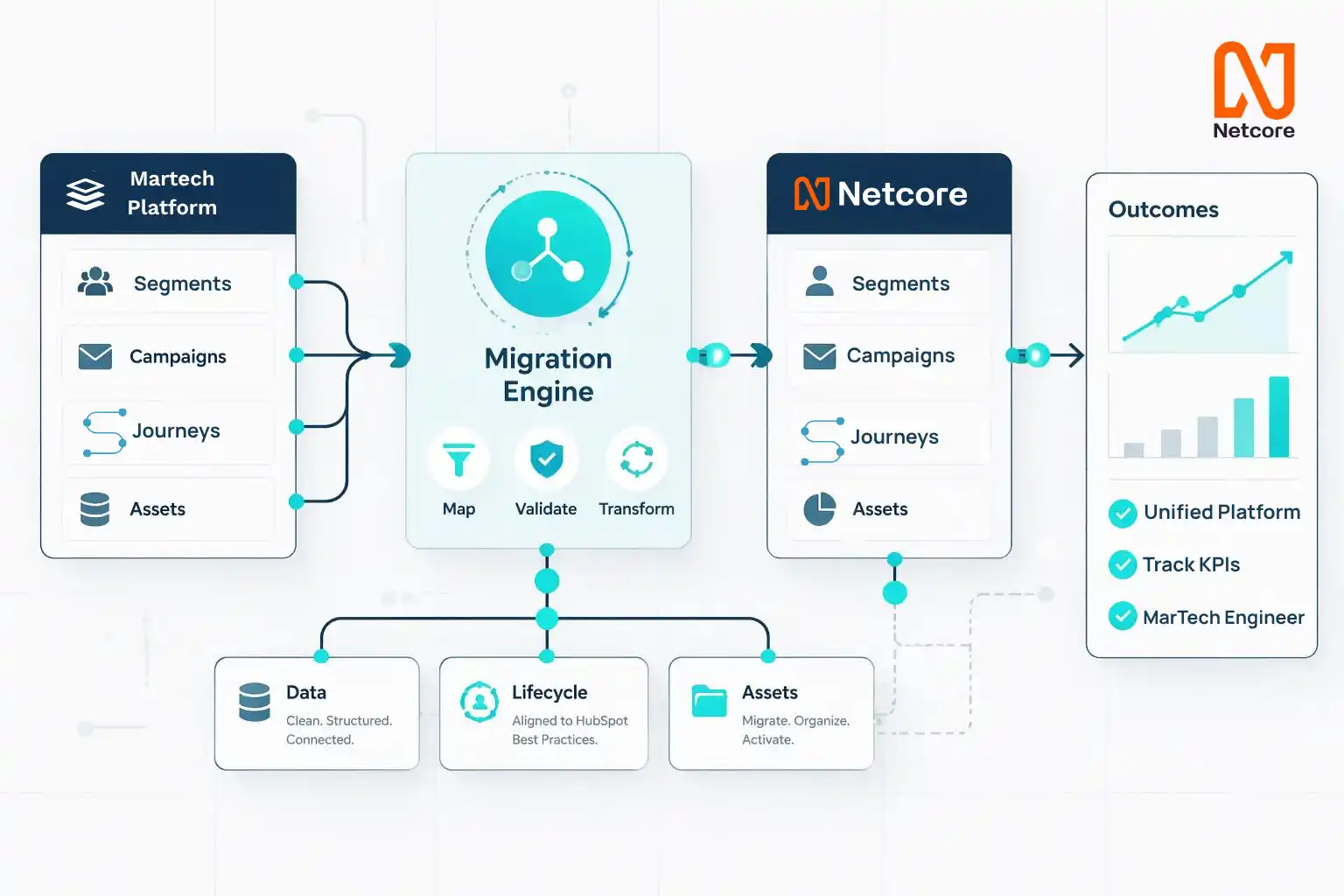
Migration is often the biggest reason enterprises delay replacing their existing MarTech stack.
Netcore approaches platform migration as an end-to-end managed process, with the objective of keeping existing systems live while the transition happens.
The process follows three phases:
Phase 1: Data and Events
User profiles, attributes, events, and relevant customer data are migrated and validated.
Phase 2: Campaigns and Journeys
Templates, campaigns, segments, triggers, and automated journeys are recreated. The approach has supported migrations involving 75+ automated journeys.
Phase 3: Customization and Optimization
Once the core migration is complete, teams can introduce custom requirements, optimize existing programs, and build new capabilities.
Netcore handles the heavy lifting across data, integrations, SDKs, channels, campaigns, and journeys, reducing the amount of engineering effort required from the customer.
From Months of Migration to Weeks
Large-scale migrations are often treated as lengthy transformation projects.
Netcore is designed to complete enterprise transitions in weeks rather than months, with the timeline established upfront.
A shorter migration window reduces internal resource requirements and allows teams to start realizing the value of the new platform sooner.
More importantly, the objective isn’t simply to replicate the old setup. Migration creates an opportunity to remove unnecessary complexity and build a cleaner operating model.
Support That Continues After Go-Live
Switching platforms doesn’t eliminate operational challenges. It changes who helps you solve them.
Netcore provides dedicated customer success and technical support, including access to a named MarTech Engineer who works alongside the marketing team.
The role goes beyond troubleshooting. The team can help build campaigns, interpret performance, identify opportunities, and optimize execution around business KPIs.
That creates a fundamentally different relationship from simply purchasing software and managing it independently.
A Different Approach to MarTech Economics
Fragmentation also affects the economics of your stack.
You may be paying multiple vendors, paying for inactive customer records, and carrying the internal cost of maintaining integrations.
Netcore offers flexible pricing models, including paying for messages sent rather than the entire customer base. Its outcome-oriented model also ties 30% of the fee to agreed KPIs, alongside claims of 30–50% lower fixed costs.
The objective is to align the cost of the platform more closely with the value it generates.
Add Agentic AI Without Adding Another Layer
AI shouldn’t become another disconnected tool your team has to operate.
Netcore brings seven specialized AI agents into the engagement platform, including the Decisioning Agent and Insights Agent.
These agents are designed to move marketing beyond AI-assisted recommendations toward autonomous execution, helping determine audiences, decisions, content, timing, and optimization within the same environment where campaigns run.
That means intelligence can sit directly inside the execution workflow rather than becoming another standalone application.
What About Your Existing Contract?
One of the most practical barriers to migration is often a contract that still has months left.
Netcore’s Contract Buyout removes that constraint for eligible customers, allowing businesses to consider switching based on business value rather than waiting for an existing agreement to expire.
Key Takeaway
Replacing a fragmented stack isn’t simply about reducing the number of vendors.
It is about reducing the distance between data, decisions, execution, and outcomes.
With Netcore, brands can consolidate channels, migrate existing programs with managed support, reduce engineering dependency, introduce agentic AI, and work with a partner that remains involved beyond implementation.
If your marketing team is spending more time connecting platforms than improving customer experiences, your stack may be working against your growth.
It may be time to stop stitching systems together, and start operating from one.