


Picture this: your bank sends a loan renewal reminder over WhatsApp, a fraud alert over SMS, and a personalised cross-sell offer over email – all within the same hour, to the same customer. Three different systems touched that customer’s mobile number and account details to make it happen. Under India’s Digital Personal Data Protection framework, every one of those hops now carries your liability as much as theirs.
The Digital Personal Data Protection Rules, 2025 were notified in November 2025, bringing the DPDP Act, 2023 into force in phases – starting with the Data Protection Board of India, moving to consent manager registration by November 2026, and reaching full penalty enforcement, with fines running up to ₹250 crore per violation, by May 2027. For CMOs, Heads of Digital, and VPs of Growth in banking, insurance, and fintech, that’s a MarTech architecture decision that has to be made now.

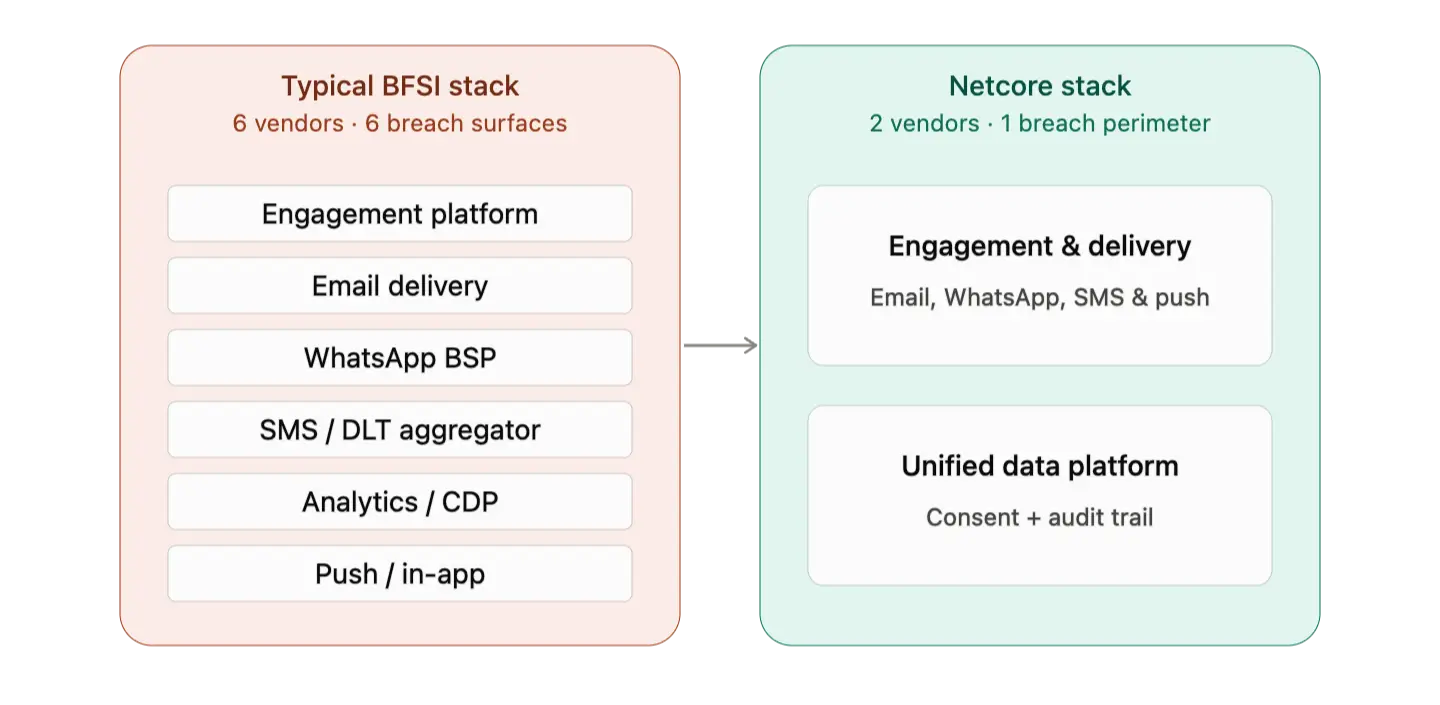
Because here’s the uncomfortable part: most BFSI marketing teams can name three vendors that touch their customer data. The real number, once you trace every sub-processor behind a single WhatsApp or SMS campaign, is closer to eight – your engagement platform, your email delivery provider, your WhatsApp BSP, your SMS/DLT aggregator, your analytics/CDP layer, your push and in-app vendor, and whatever sits behind each of them. Under DPDP, you, the Data Fiduciary, own the breach notification, the regulatory response, and the customer communication, no matter which link in that chain failed.
So the real question for banking leaders is how many vendors actually touch our customers’ data, and whether we can prove – message by message – that we’re honouring the trust they’ve placed in us. “Is our vendor DPDP-compliant?” is the smaller question sitting inside that one.
Let’s unpack what DPDP-compliant engagement really means for banks, and why Netcore is built to deliver it.
What does DPDP-compliant customer engagement actually mean?
DPDP-compliant customer engagement is the practice of running personalised, real-time banking communications – onboarding nudges, renewal reminders, fraud alerts, cross-sell offers – on an architecture that treats consent, data minimisation, and auditability as part of the campaign itself, built into how every message gets designed and sent.
Most banks already have a Data Protection Officer, a signed set of policies, and a live consent banner. That’s a necessary foundation, and on its own, an incomplete one. The gap that DPDP exposes is architectural: no one has mapped which vendors actually receive customer identifiers in a live campaign, or what their sub-processors do with that data once it leaves the building. When a breach happens – quite possibly at one of your vendors, or theirs, rather than at your own organisation – you still own the 72-hour notification window, the Data Protection Board response, and the customer-facing explanation.
Unlike a checkbox compliance audit, DPDP-compliant engagement is something customers can feel in every interaction: personalised, timely messages that never expose more of their data than necessary, and that can be permanently erased or explained on demand. That’s the standard Netcore is built to meet.
Hear from Netcore’s Chief Information and Security Officer on DPDP and its implications on Martech – View video
Key benefits of choosing a DPDP-compliant engagement partner
A. Boardroom-level confidence
A breach under DPDP quickly becomes a MarTech architecture problem that lands squarely on the CMO’s and CFO’s desk, well beyond the legal team. With penalties running up to ₹250 crore per violation, a public 72-hour notification window, and the very real question of whether campaigns can keep running mid-investigation, data protection has become a board-level risk line that sits alongside, and often above, the DPO’s report. Choosing a platform built for this from the ground up turns that risk into a decision you’ve already made well.
B. Personalisation without compromise
Compliance and personalisation are usually framed as a trade-off: mask the data and lose the relevance, or use the raw data and carry the risk. A well-designed engagement platform removes that trade-off entirely. Personalisation should run on tokenised profiles and click-stream behaviour rather than raw PII – so the right offer still reaches the right customer at the right moment, while the sensitive data underneath never has to leave your environment to make that happen.
C. Trust that compounds into retention
Trust in financial services still lags customer expectations – recent industry research puts overall trust in financial services at roughly 64% globally, near the bottom across sectors, even as customers expect ever more personalised service. That gap is a data-practice problem, one that better messaging alone won’t close. When a customer consents to hearing from their bank and that consent is honoured consistently, on the channel they chose, at a moment that feels earned rather than intrusive, it builds something advertising can’t buy: permission-based intimacy at scale. Banks that treat consent as the start of a relationship, rather than a legal hurdle, see that trust show up later as retention and lifetime value.
3 common challenges banks face on the road to DPDP compliance
Talk to any BFSI marketing or compliance team about their DPDP roadmap, and three challenges come up again and again – and they all trace back to the same root cause: how the MarTech stack is built, regardless of how well-intentioned the policy is.
1. Vendor sprawl turns one campaign into six breach surfaces
Imagine trying to secure a house with six different front doors, each with a different lock, a different key, and a different person holding a spare. That’s what a typical BFSI MarTech stack looks like today: a customer engagement platform, an email delivery provider, a WhatsApp BSP, an SMS/DLT aggregator, an analytics or CDP layer, and a separate push/in-app vendor – six vendor relationships, six Data Processing Agreements to keep current, six potential breach surfaces, and identifier sprawl across every one of them. Most DPAs only cover the direct vendor; the sub-processors behind them are rarely audited, yet the liability still travels back up to the bank.
2. Consent doesn’t travel with the customer across channels
Customers move fluidly between email, SMS, WhatsApp, and the app – but consent, all too often, doesn’t move with them. Under DPDP, banks need to know exactly when consent was given or withdrawn, on which channel, for which purpose, with a full audit trail sitting on a single customer view. Layer on the need to still send regulatory or transactional messages – a fraud alert, a KYC update – to customers who haven’t opted into marketing, and consent management stops being a settings toggle and becomes a genuine architecture problem.
3. Legacy retention and audit gaps outlast the campaign itself
Regulatory and audit requirements in banking often demand that communications remain reviewable for years rather than months – yet many engagement platforms default to short retention windows built for e-commerce rather than lending or insurance. Add in the everyday friction of exporting communication logs in regional languages, or tracing exactly which template triggered which message, and audit-readiness becomes a scramble instead of a standing capability. That’s the disjointed-experience problem showing up one layer below the customer, inside the compliance function itself.
5 ways Netcore builds compliance into every customer interaction
By now, the pattern is clear: DPDP compliance in banking gets won at the architecture layer, long before any policy document is signed. Here’s how Netcore approaches it.
1. Consolidate the stack to shrink the surface
The most effective way to shrink your breach surface is to reduce the number of vendors that ever touch a customer identifier in the first place. Instead of six or more point solutions each holding a slice of customer data, Netcore brings engagement and delivery – email, WhatsApp, SMS, push, in-app – together with journey orchestration and analytics under one integrated platform, alongside a unified customer data layer with consent management, a single customer record, and one audit trail. Fewer vendors means fewer DPAs to track, a single breach perimeter to defend, and one clean audit trail instead of a multi-party coordination exercise every time a regulator asks a question.
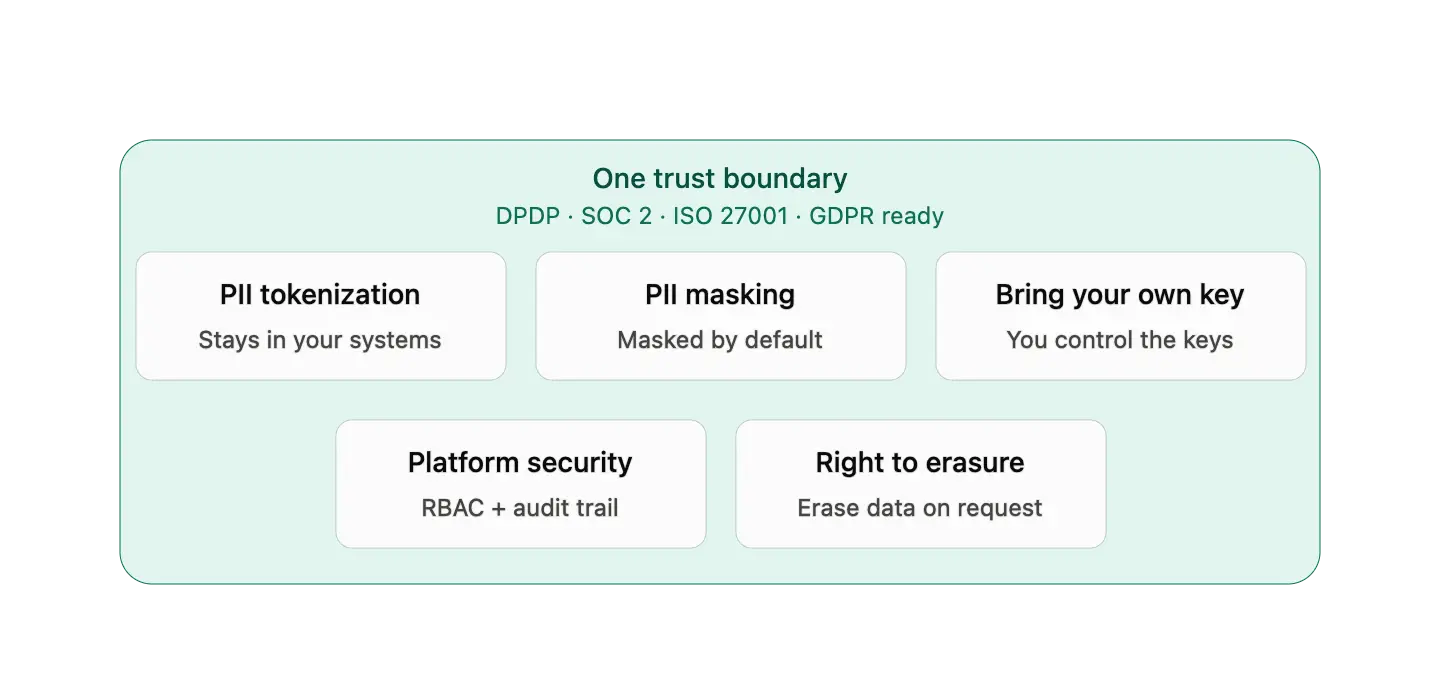
2. Keep PII tokenised, inside your environment
Netcore operates on secure tokens rather than raw customer data. Personalisation, segmentation, and journey orchestration all run without your customers’ real PII ever leaving your environment – so the platform can power hyper-relevant engagement while sensitive data stays fully in your hands.
3. Mask PII by default, even from your own teams
Not every internal user needs to see raw customer data to do their job. On Netcore, PII shows up masked by default, including for support teams, so information is hidden from anyone who doesn’t need access – reducing unnecessary exposure without slowing down day-to-day operations.
4. Retain control with Bring Your Own Key (BYOK) and enterprise-grade platform security
With BYOK, your encryption keys stay under your control, on your terms, meeting your organisation’s own security and compliance requirements rather than a vendor’s default. That sits alongside role-based access, approval workflows, and complete audit trails, so every action on the platform is governed, traceable, and accountable – the forensic-ready evidence trail regulators and boards both want to see.
5. Build in the Right to Erasure and data principal rights from day one
When a customer exercises their rights under DPDP, compliance can’t depend on a manual data-hunting exercise across multiple systems. Netcore supports permanent deletion of customer data on request, so data principal rights are built into the platform rather than bolted on after the fact.
One trust boundary. All of this sits inside what we call one trust boundary – Netcore is DPDP Compliant, SOC 2 Type II certified, ISO 27001 certified, GDPR Ready, and built on local data residency, so wherever your regulators sit, your architecture already meets them there.
Proof in production. It’s why more than 500 financial services brands – including HDFC Mutual Fund, ICICI Bank, Kotak Securities, Bajaj Markets, Equitas Small Finance Bank, and Axis Max Life, across banking, fintech, insurance, and digital financial services – run their customer engagement on Netcore. Shriram Finance, for one, used Netcore to run continuous, context-led journeys across app, SMS, and email and saw a 171x return on that engagement spend, without compromising on the compliance standards their business is held to.
Evaluate your DPDP exposure level now
Build trust and compliance together, on one AI-powered platform
Banks that keep treating personalisation and protection as opposite ends of a trade-off risk losing on both counts – disjointed experiences on one side, and mounting regulatory exposure on the other.
The good news is that you don’t have to choose. With PII tokenisation, PII masking, BYOK, enterprise platform security, and the right to erasure built into one platform – backed by DPDP, SOC 2, ISO 27001, and GDPR-ready credentials – Netcore lets you run personalised, agentic marketing-powered real-time banking engagement that your customers trust and your board can stand behind.
Ready to see how it works for your data, your regulators, and your customers? Book time with our banking and financial services experts today.
Let’s talk security: https://netcore.ai/request-demo/


