 Diwali Engagement Playbook is now


Your emails aren’t bouncing. They’re getting “delivered” and landing in Promotions, spam, or nowhere. That’s not a deliverability problem. It’s a Primary inbox placement problem. And it’s bleeding revenue as you read this.
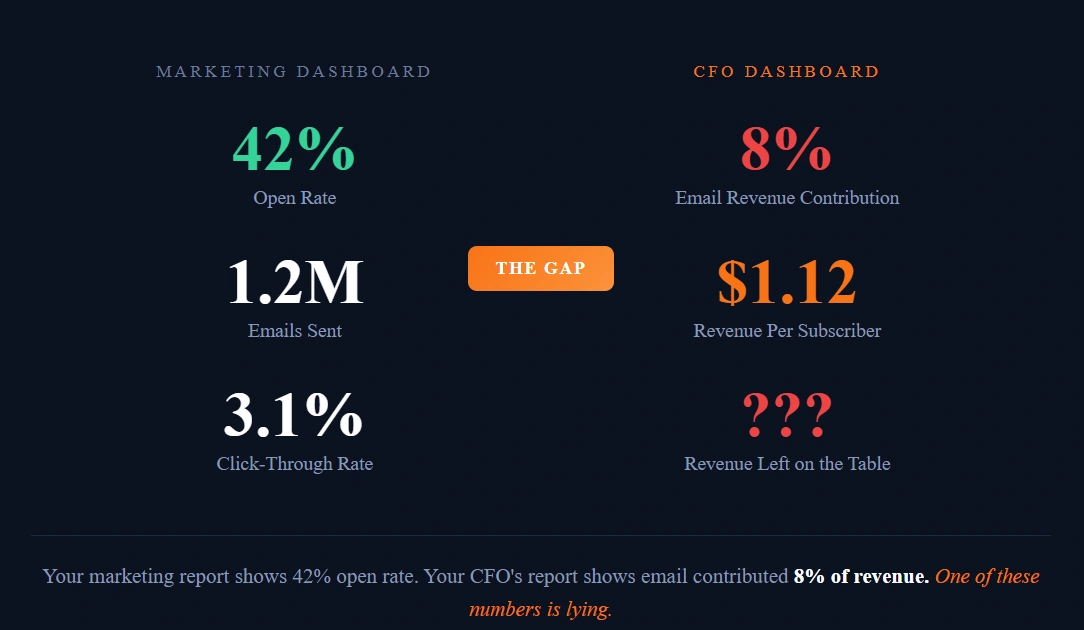
As you read this, your email programme is losing money.
Not because emails are bouncing. Not because your content is weak. Not because subscribers have opted out. Your emails are getting “delivered” your ESP confirms it, and then landing in the Promotions tab, in spam, or in a folder that no subscriber checks. They are marked as sent. They are counted in your campaign report. And they are generating zero revenue. Because “delivered to a server” and “seen by a subscriber” are not the same thing. The gap between those two is where your revenue disappears.
This is a Primary inbox placement problem. Not a deliverability problem. Not an open-rate problem. Your emails reach the server. They don’t reach the person. And the cost of that failure is double: you already paid to build the list, write the content, design the creative, and schedule the send. That money is spent. Then, because the email never landed, the customer goes dormant, and you pay again through retargeting to win them back. You’re paying to acquire a customer, failing to retain them through email, and then paying a second time to re-acquire them.
That’s not an optimisation gap. That’s an active, compounding loss, and it’s running right now.
The revenue bleeding from your unopened emails
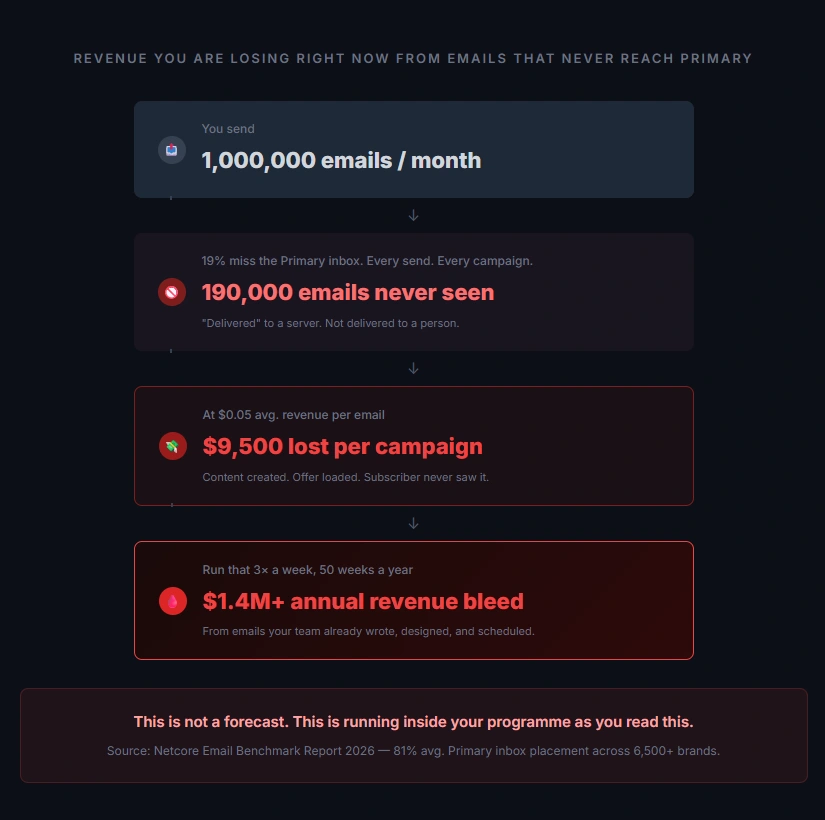
The average primary inbox placement rate across industries is 81%. That means a significant portion of every send across every campaign, every automation, every lifecycle flow lands somewhere the subscriber will never look. Promotions. Spam. A black hole. Your ESP reports those emails as “delivered.” They were. To a server. Not to a person.
This is invisible in your reporting. Open rates are calculated on delivered emails, not on emails that actually reached the Primary inbox. So your 42% open rate isn’t 42% of your list engaging – it’s 42% of the 81% that arrived. The denominator was already reduced before opens even entered the picture. You’re measuring performance on a number that’s already been cut by a fifth, and your dashboard doesn’t show it.
Now do the maths on your own programme.
That $1.4 million is not a new budget you need to find. It’s revenue your programme already spent the money to generate list building, content creation, campaign ops, offer strategy, design, QA, scheduling, and then lost at the last step because the email landed in Promotions or spam instead of the Primary inbox. The work was done. The money was spent. The subscriber never saw it.
And the loss doesn’t stop there. It doubles. The EBR 2026 quantifies the second hit as the re-acquisition tax. A brand spends
$18 to acquire a customer through paid. Email should retain that customer at roughly $1 per year. But when the email doesn’t reach Primary, the customer goes dormant. The brand pays $14 to retarget them. Total cost: $32 per customer instead of $19. That’s $13 per customer burned on a problem that didn’t need to exist. Across 100,000 customers, that’s $1.3 million in retargeting spend that a working email programme would have made unnecessary.
Two losses, compounding: the revenue from emails that were created, sent, and never seen — plus the paid budget spent re-acquiring the customers those emails should have retained. Both are running right now.
Where the chain breaks
Most email teams measure opens, clicks, and conversions. None of those metrics tells you whether the email reached the Primary inbox. And that is the only step that determines whether the rest of the chain fires at all.
Email revenue is a four-step chain. If Step 1 – landing in the Primary inbox – fails, Steps 2 through 4 are dead. No open. No click. No conversion. No revenue. The email exists in your send log and nowhere else.
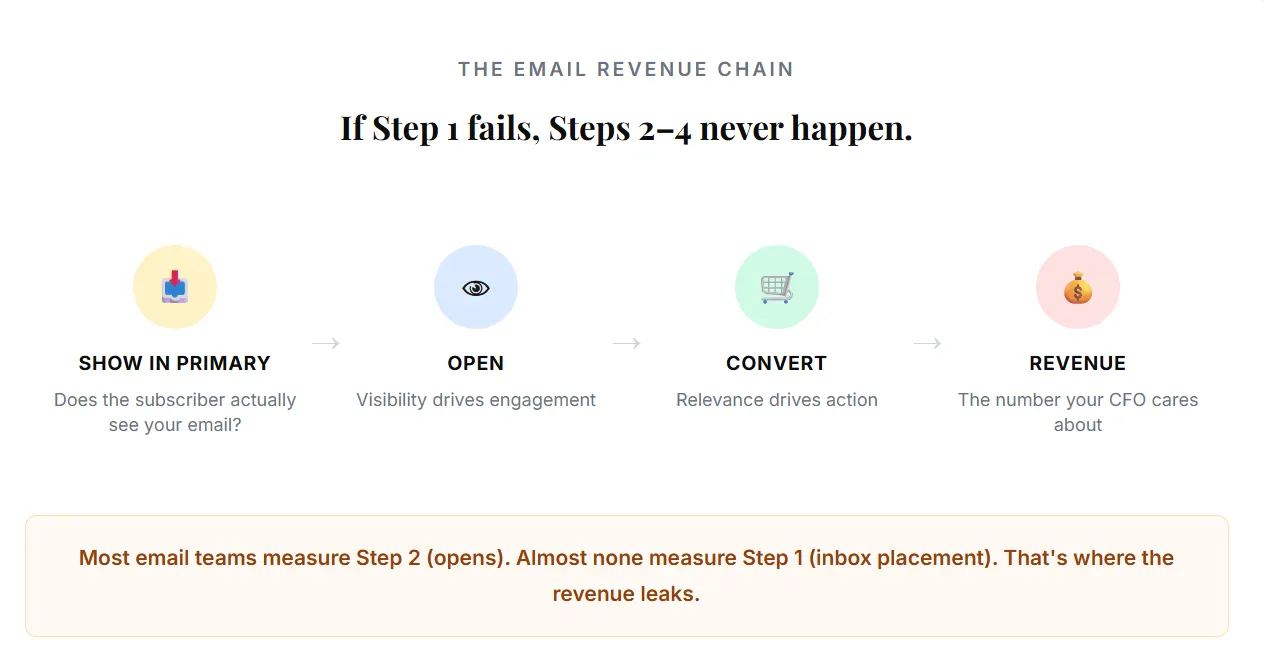
An email can be beautifully designed, perfectly timed, loaded with a relevant offer and it generates zero revenue if it doesn’t reach the Primary inbox. It sits in Promotions or spam with a 0% chance of converting. That’s the gap between what gets sent and what gets seen. And inbox placement isn’t a standard metric in most ESPs, which means this gap doesn’t show up in your reporting. The loss is real, ongoing, and invisible.
Top-performing ecommerce brands generate 30-40% of their total digital revenue from email. Some reach above 50%. The industry average sits far below that. The gap isn’t about how many emails you send or how good your creative is. It starts with whether those emails are actually reaching the people who are supposed to see them.
The upside when you fix the bleed
What the maths look like when you stop the bleed
Everything in this section is true, but only for emails that reach the Primary inbox. That’s the condition that makes email the highest-returning channel in your mix. Without inbox placement, every number below is theoretical. With it, they’re yours.
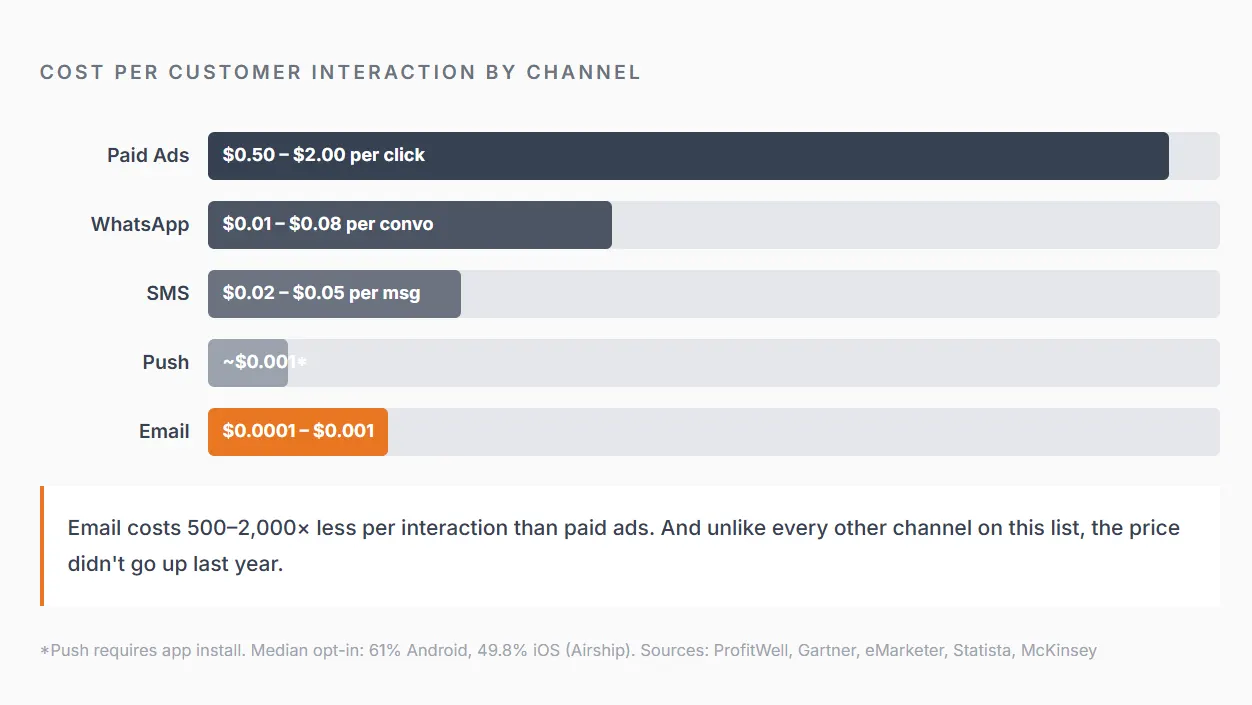
Start with cost. Every other channel brands depend on had a pricing event in 2025. Meta CPMs went up. Google CPCs climbed. WhatsApp introduced per-message fees. Customer acquisition costs have increased 20-30% year on year globally. Email had none of that — it’s still the cheapest customer interaction a brand can buy. But that cost advantage only counts when the email lands in Primary. An email in spam costs the same to send and returns nothing.
The return gap is even more dramatic. Litmus benchmarks show email returns $36–$42 for every $1 spent. Paid search returns about $2. Social returns $2.80. Display returns $1.35. But here’s the part that doesn’t get said enough: that $36–$42 is the return on emails that were seen. For the 19% that miss the Primary inbox, the return is $0 per $1 spent. Same cost, zero return. Every percentage point you recover in inbox placement moves dollars directly to the top line.
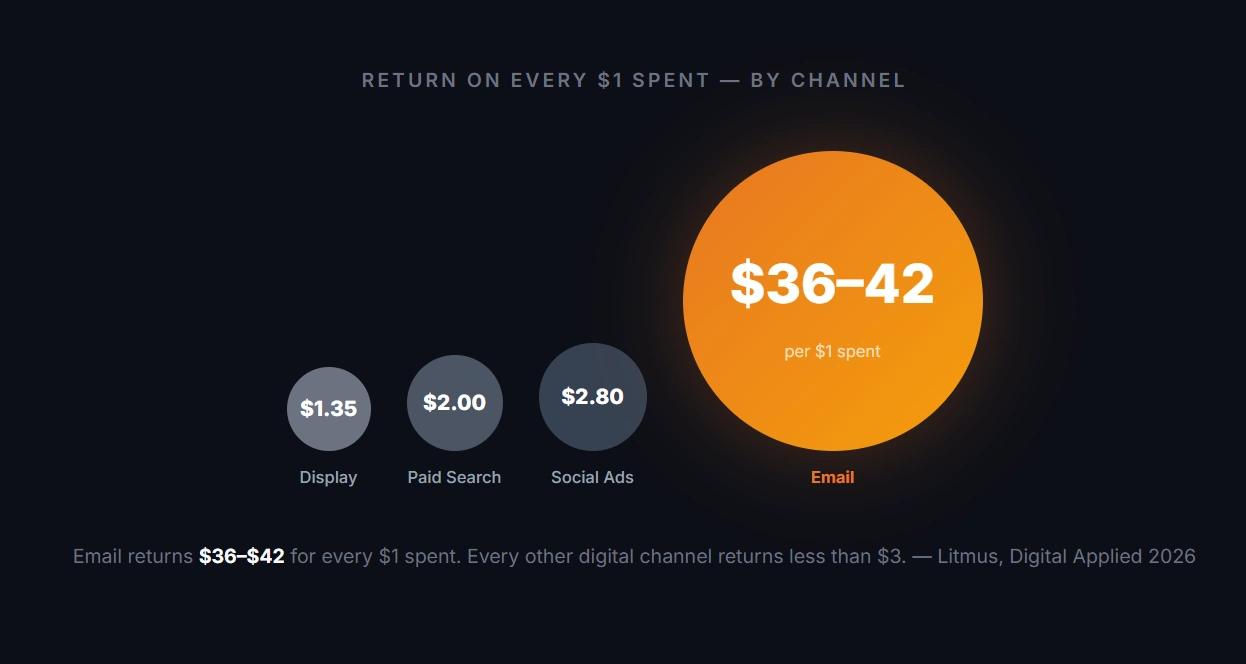
The channel isn’t the problem. Email’s reach (4.6 billion users), consumer preference (69% choose it for brand communications, per eMarketer), and cost structure are unmatched. The problem is that 19% of your programme’s output never reaches the place where all of that value gets captured: the Primary inbox. Fix placement, and the ROI that already exists in the channel starts showing up in your revenue.
Paid channels are a trap. Email is an engine.
Email is built to compound. The infrastructure cost is fixed. The marginal cost of every additional send approaches zero. Lifecycle flows cart abandonment, browse abandonment, post-purchase, win-back, and generate revenue on repeat without additional spend. The EBR 2026 data is clear: less than 5% of email sends generate more than 35% of online revenue. Automated emails deliver 10x higher click-through rates than broadcast.
But compounding only works when the email reaches the Primary inbox. A cart abandonment email that lands in Promotions doesn’t recover the cart. A win-back sequence that hits spam doesn’t win anyone back. A post-purchase flow that the subscriber never sees doesn’t drive repeat purchases. You’ve built the engine. Inbox placement is the fuel line. If 19% of your sends miss Primary, 19% of your lifecycle programme is running on empty every day, every flow, every automation.
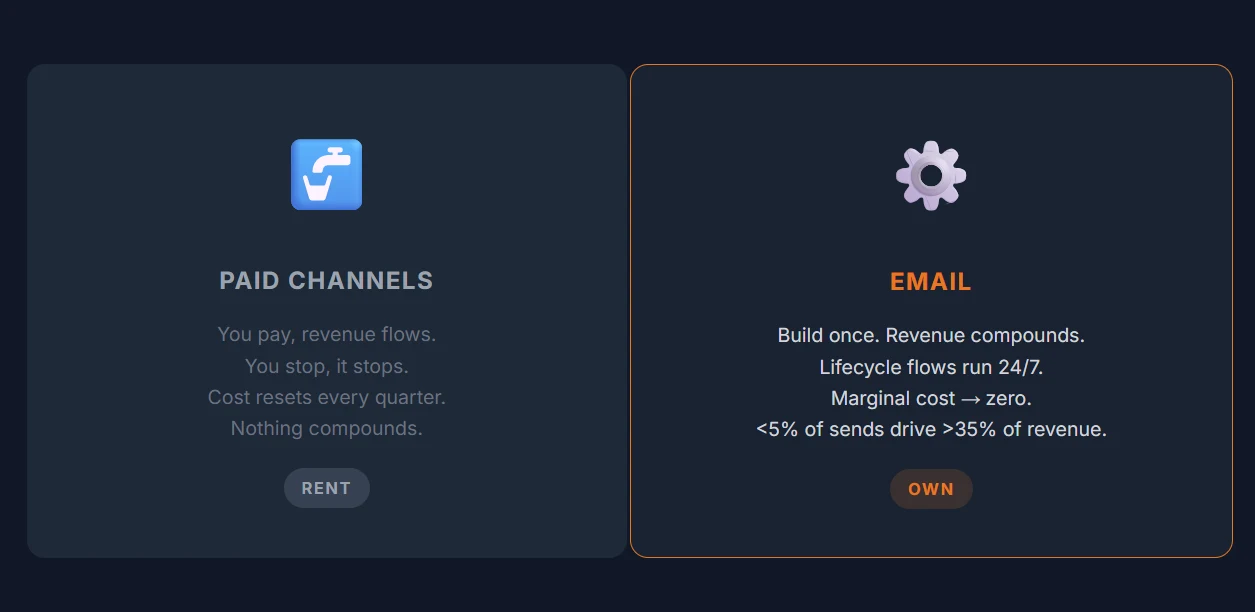
Your subscribers are yours. No platform can reprice access to them or throttle their visibility. That’s the structural advantage of email over every rented channel. But ownership without placement is an illusion. You own the list. You own the content. You own the infrastructure. And if 19% of your sends miss the Primary inbox, you don’t own the outcome. You’re running a retention engine with a leak in the fuel line, and the lost revenue compounds just as fast as the gains would.
65-75% of ecommerce revenue comes from repeat customers. Increasing retention by just 5% can increase profits by 25-95%. Email is the channel built for that job: lifecycle journeys, replenishment reminders, personalised recommendations, reactivation sequences. But every one of those flows depends on reaching the subscriber’s Primary inbox. A retention programme that misses Primary on 19% of sends is leaving 19% of its retention value on the table – not once, but on every send, every day, compounding.
The real question
The question for marketing leaders in 2026 isn’t whether email works. The data on that is settled.
It’s also not whether your programme is “good enough.” If you’re not measuring inbox placement, you don’t know the answer to that question. You’re looking at open rates on a denominator that’s already been quietly reduced by 19%, and your dashboard doesn’t flag it.
The real question is: how much revenue is bleeding out of the subscriber list you already own, right now, this week, from emails your team already wrote, designed, scheduled, and “delivered” that landed in Promotions or spam and were never seen by a single subscriber?
That gap between what email is delivering and what it could deliver, that’s not a future opportunity. It’s a present-tense loss. And the brands that close it first will compound the advantage every month after.
The Netcore Email Benchmark Report 2026 – built on 500 billion+ emails across 6,500+ brands in 40+ countries covers inbox placement rates, engagement benchmarks by industry, automation performance, and metrics you won’t find anywhere else. Talk to our team →

