Diwali Engagement Playbook is now


The 24-hour gap that’s costing you conversions
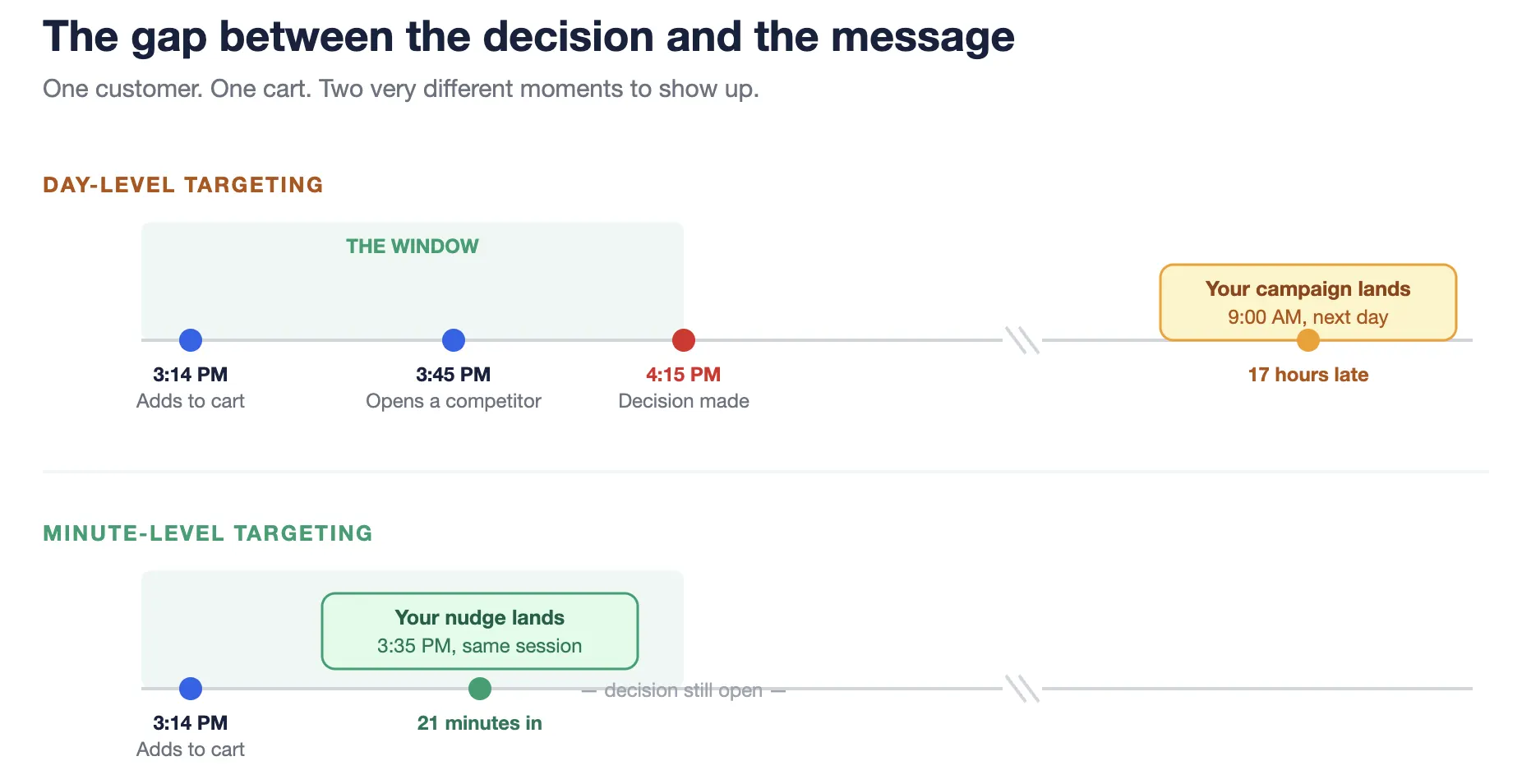
A customer adds a ₹12,000 pair of headphones to their cart at 3:14 PM. They hesitate. They open a competitor’s tab. By 3:45 PM, they’ve either bought from someone else or forgotten about it entirely.
Your campaign reaches them at 9 AM the next morning.
This is the gap most marketing teams have been quietly living with. Not because anyone chose it, but because the underlying data moved in day-sized blocks. “In the last 2 days.” “In the last 7 days.” You could see that something happened. You just couldn’t act while it was still happening.
The latest Journeys release closes that gap in four places: who you can reach, what you treat as intent, when you show up, and why your messages fail.
1. Catch people while the cart is still open
Cart abandonment recovery has a half-life. Reach someone 20 minutes after they abandon and you’re catching them mid-consideration. Reach them 20 hours later and you’re interrupting their commute to remind them about a decision they’ve already made.
The same is true almost everywhere. A user who dropped off at the KYC screen 15 minutes ago is still near their documents. A traveller who searched Mumbai–Goa an hour ago is still comparing fares. A learner who abandoned a course checkout this afternoon still remembers why they wanted it.
What you can now do
Build a segment of everyone who added to cart in the last 30 minutes and didn’t purchase, then trigger a flash-sale nudge while they’re still deciding. Build one for users who dropped off mid-application in the last 45 minutes and route them to a callback journey. Build one for anyone who viewed a fare in the last hour and hasn’t booked.
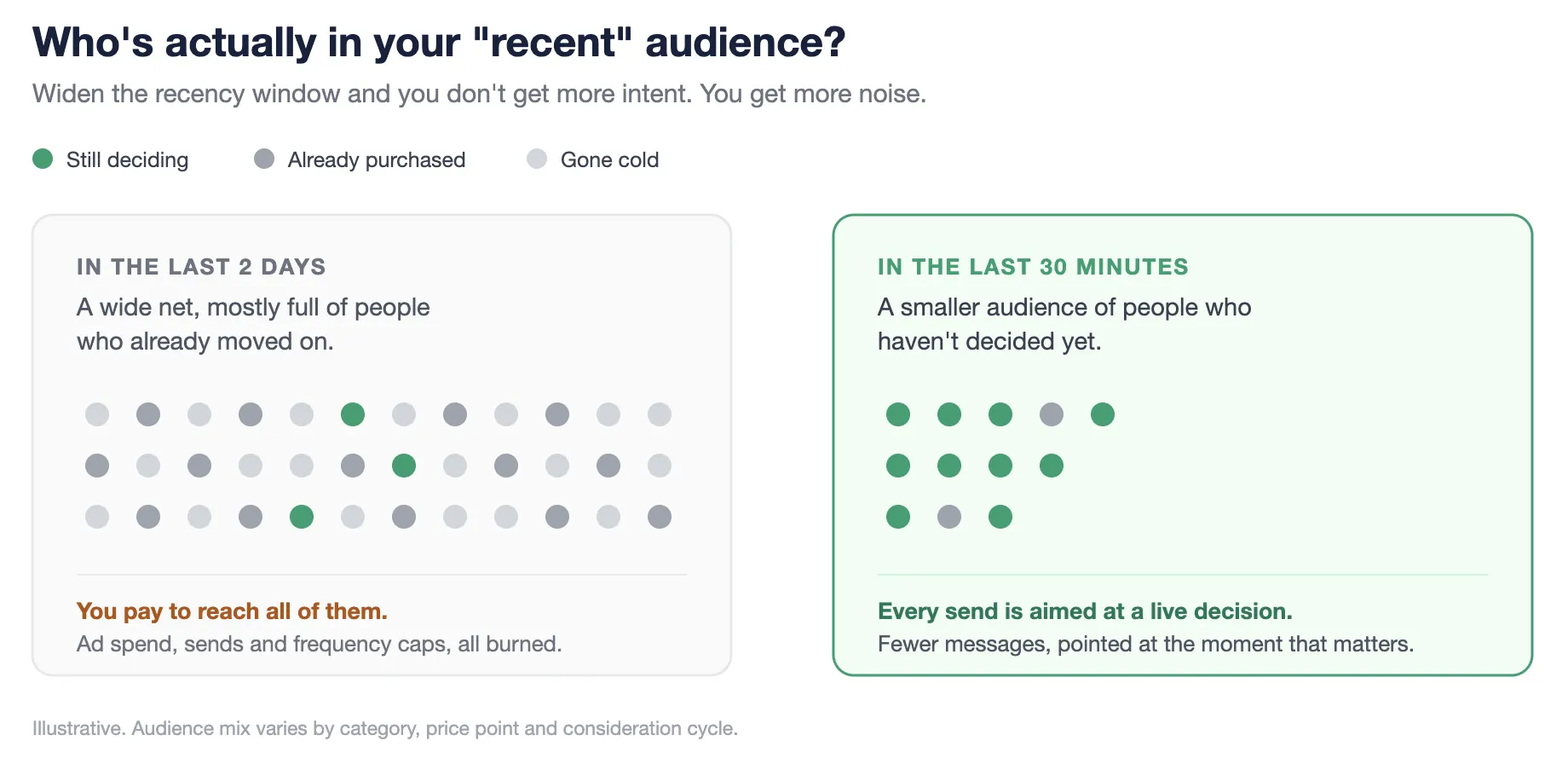
There’s also a quieter win here for your paid budgets. When you sync audiences to Meta or Google for retargeting, a 24-hour recency window means a meaningful share of that audience has already converted — you’re paying to re-acquire customers you already have. Hour and minute-level recency shrinks that waste.
And a third thing: you can finally see windows you couldn’t measure before. How many users drop off exactly 15 minutes after adding to cart? That was an unanswerable question. Now it’s a segment.
How it works
Recency operators — In the last, Not in the last, and In the forthcoming — now accept minutes and hours, not just days. This applies to both event-based and attribute-based conditions, so it works whether you’re filtering on what someone did or on what’s true about them.
2. Stop treating one click like intent
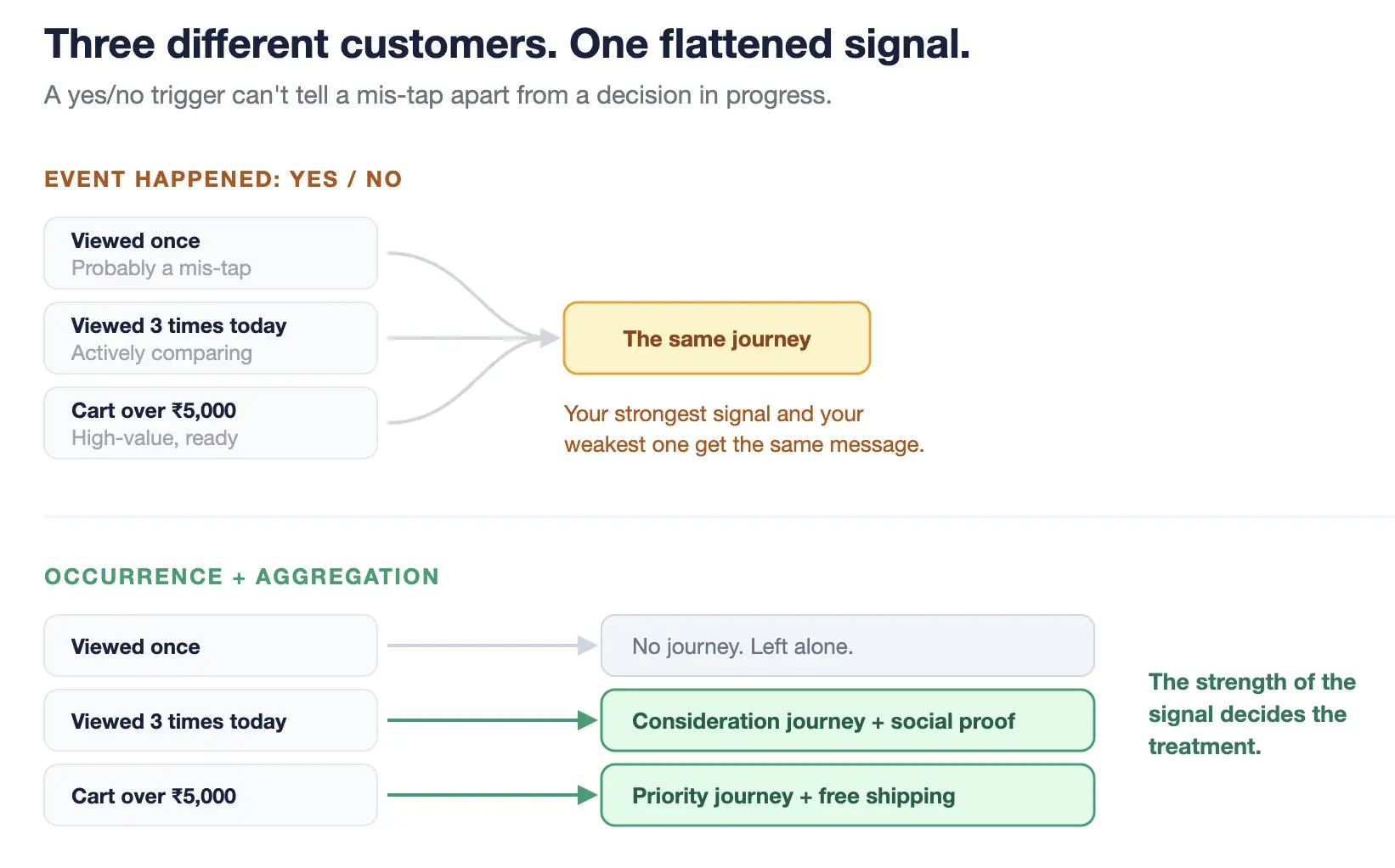
One product view is noise. It might be a mis-tap, a price check, a share from a friend. Three product views on the same category in an afternoon is a person deciding something.
Until now, journey entry could only ask a binary question: did this event happen, yes or no? So high-intent users and idle browsers walked into the same journey and got the same message. Your best signals were flattened into your weakest ones.
What you can now do
Trigger on the shape of the behaviour, not just its existence:
- A user who has viewed the same product 3 or more times today enters a consideration journey with social proof and a limited-time offer
- A user whose cart value has crossed ₹5,000 gets routed to free-shipping messaging or a concierge callback instead of a generic discount
- A user with two or more failed payment attempts in an hour gets an alternate-payment-method journey before they give up — and before you lose a completed transaction to a gateway hiccup
- A subscriber whose cumulative spend crosses a tier threshold is pulled into a loyalty upgrade journey the moment it happens, with nobody watching a dashboard
The pattern to notice: these are all your highest-value moments, and every one of them used to require either manual monitoring or a scheduled batch job that ran too late.
How it works
Journey entry conditions now support occurrence (how many times an event happened) and aggregation (a cumulative value crossing a threshold). Combined with faster segment refresh, journeys react to what a user is doing rather than to an hour-old snapshot of what they did.
3. Cut no-shows on appointments, flights, and live classes
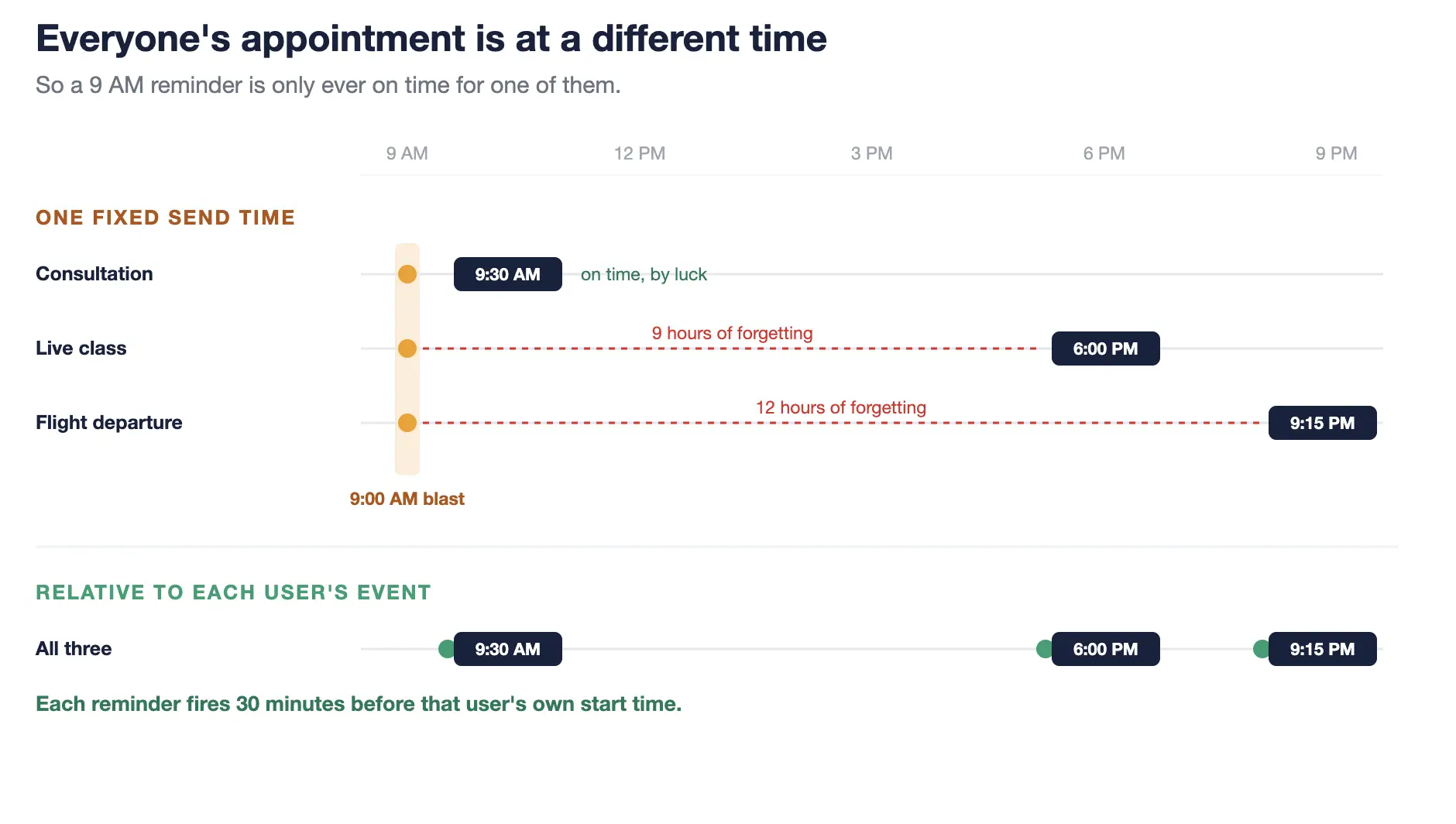
No-shows are one of the most expensive problems in any appointment-driven business, and the fix has always been well understood: remind people close to the time. The constraint was never the strategy. It was that “close to the time” wasn’t something the system could express.
A reminder that lands at 9 AM for a 6 PM slot is a reminder the customer has forgotten by lunch.
What you can now do
Hold a user in the journey and message them relative to their event time, not a fixed clock:
- Healthcare: 30 minutes before a consultation, with directions and doctor name
- Travel: 3 hours before departure, with web check-in link
- Edtech: 10 minutes before a live class starts, with the join link
- BFSI: 2 days before an EMI due date, then 2 hours before the auto-debit attempt
- Retail / logistics: 1 hour before a delivery window opens, so someone’s actually home
Every one of these is a case where the timing is the message. Send it early and it’s noise. Send it late and it’s an apology.
How it works
Journeys can hold a user in a dynamic wait state tied to a real timestamp carried on the event — appointment time, departure time, class start — and release them a defined interval before it. Built on the same minute and hour precision as the filtering above.
What ties these together
Four features, one shift.
Marketing automation has spent a long time being approximately timely. Segments refreshed overnight. Triggers fired on a schedule. Reminders went out in the morning because the morning was when the batch ran. Everyone built strategy around that constraint until it stopped feeling like a constraint.
This release moves the unit of time from the day to the minute — in how you segment, how you trigger, and how you time a message. The output isn’t just faster campaigns. It’s campaigns that respond to the customer in front of you right now, instead of the one your data remembers from yesterday.
Ready to try it? Start with the one segment you’ve always wished you could build. It’s probably possible now.