Diwali Engagement Playbook is now


TL;DR
- A successful holiday ecommerce strategy starts months before peak shopping events with demand forecasting, campaign planning, and inventory readiness.
- Deliver personalized shopping experiences across email, SMS, WhatsApp, push notifications, and your website to engage customers at every stage of the buying journey.
- Use AI-driven product recommendations, behavioral triggers, and cart recovery campaigns to maximize conversions during high-intent shopping periods.
- Create urgency with limited-time offers, exclusive deals, and festive promotions while maintaining a seamless checkout experience across devices.
- Track campaign performance in real time and optimize messaging, audience segments, and promotions throughout the holiday season to maximize revenue.
80% of Q4 ecommerce traffic is a commodity, but true revenue impact remains a rare discipline. Most enterprise brands fail during the holidays not because they lack visitors, but because fragmented tech stacks and rules-based automation cannot deliver the personalized, omnichannel experiences modern consumers demand. This is your definitive playbook for orchestrating a sophisticated holiday strategy that drives verifiable ROI and secures customer loyalty long after the seasonal freeze. Dive into the Ecommerce personalization guide that explains how to unlock exponential growth in ecommerce revenue.
The Q4 Stakes: Why Vanity Metrics Won’t Save Your Holiday Season
Vanity metrics like open rates and temporary traffic spikes obscure actual profitability. Success in Q4 requires shifting focus from top-of-funnel volume to measurable revenue impact, autonomous personalization, and unified customer data that directly increases customer lifetime value (CLTV).
During the holiday rush, it is perilously easy to confuse activity with achievement. Marketing dashboards light up with record-breaking email open rates, massive influxes of site visitors, and surging click-throughs. Yet, when January arrives, the CFO asks for the actual revenue generated, and the numbers often reveal a hollow victory. The margins were destroyed by aggressive discounting, and the acquired customers never return.
For many mid-market and enterprise directors, the fundamental tension of Q4 is this gap between perceived engagement and actual conversion. As one retail executive noted, “Major challenge is getting new customers. We are looking at how to generate leads more systematically.” But generating leads systematically requires more than just scaling ad spend; it requires an infrastructure built on outcome accountability. Every dollar spent on capturing a seasonal shopper must be justified by their propensity to convert and buy again.
This is where the standard ecommerce playbook falls apart. If your strategy relies on blasting your entire database with a 20% off coupon, you are training your customers to wait for price drops. You are sacrificing margin for a vanity metric. True holiday ecommerce success is measured by incremental revenue lift, the actual dollars generated that would not have existed without your specific intervention. This level of measurement demands a departure from isolated channel metrics and a pivot toward comprehensive cohort analysis and control groups.
The Ideal Timeline: When to Start Your Holiday Ecommerce Planning
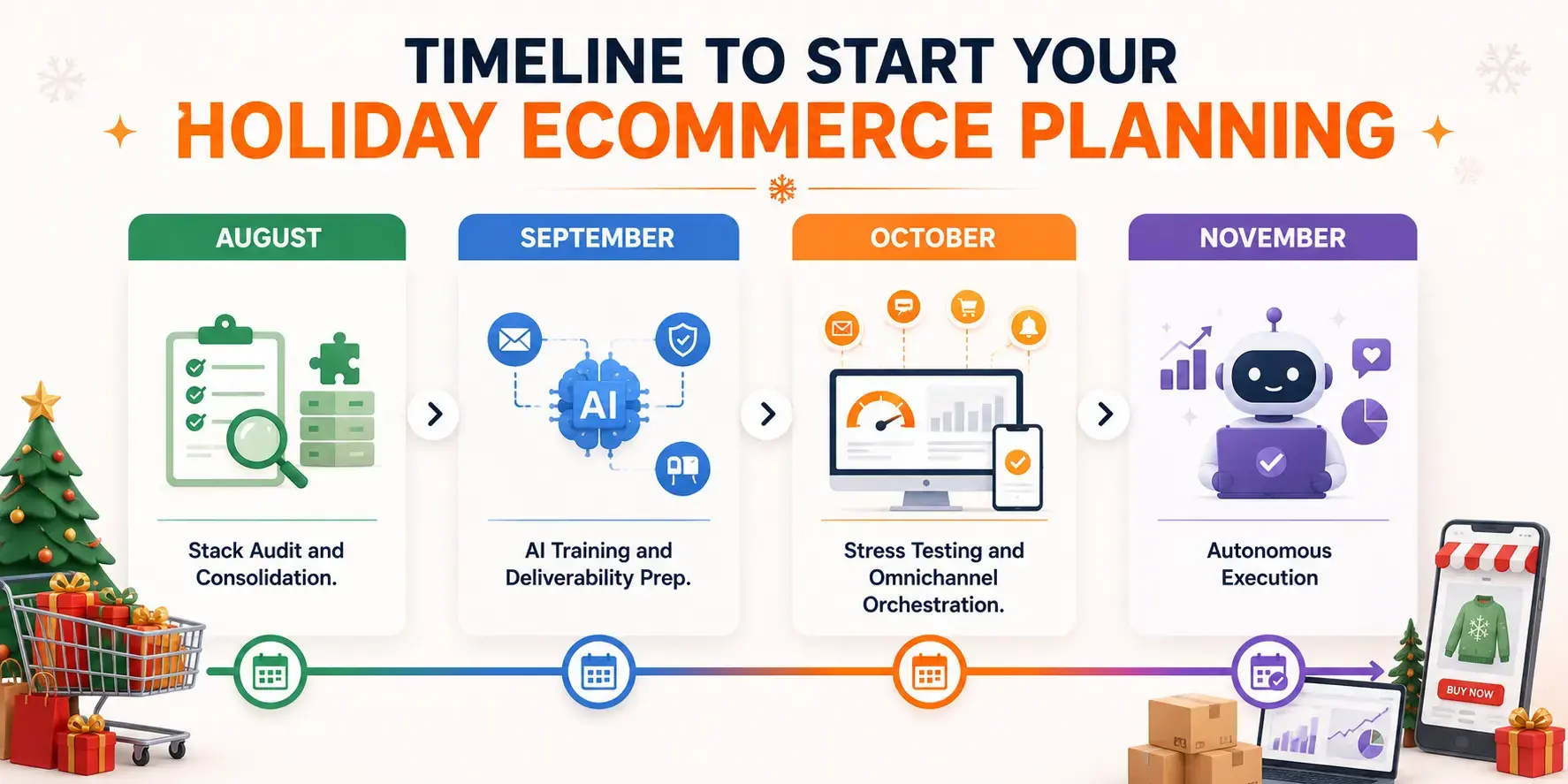
A profitable holiday season is won in July, not November. The sheer volume of data integration, creative testing, and server stress-testing required for a modern enterprise campaign cannot be executed in the weeks leading up to Black Friday. The timeline below is designed for brands operating at scale, where a single broken API or misaligned inventory feed can result in millions of dollars in lost revenue.
- August: Stack Audit and Consolidation – Identify data silos and redundant platforms. Consolidate your customer data platforms (CDP) and messaging tools into a single source of truth.
- September: AI Training and Deliverability Prep – Warm up your dedicated IPs and train your AI models on last year’s Q4 behavioral data. Establish your baseline deliverability metrics across email and SMS.
- October: Stress Testing and Omnichannel Orchestration – Finalize your cross-channel journeys. Conduct load testing on your servers and validate API connections with third-party logistics (3PL) providers.
- November: Autonomous Execution – Lock your tech stack. Shift from campaign building to real-time optimization, allowing agentic AI to handle dynamic product recommendations and send-time optimization.
This structured approach ensures your infrastructure can support the sophisticated personalization required during peak traffic. Rushing this timeline forces marketing teams into reactive, rules-based campaigns that fail to engage the modern consumer.
Consolidating Your MarTech Stack Before the Holiday Freeze
MarTech sprawl is the silent killer of Q4 margins. Over the past five years, enterprise brands have bolted on disparate point solutions for email, SMS, loyalty programs, and behavioral analytics. The result is a fragmented architecture where customer data sits in isolated silos. When Black Friday hits, these disconnected tools cannot communicate in real-time, resulting in duplicate messaging, broken customer journeys, and wasted ad spend. Read the guide to a record-breaking Black Friday.
| Capability | Fragmented MarTech Stack | Unified Platform Strategy |
| Data Synchronization | 24-48 hour delays; batch uploads | Real-time streaming via single CDP |
| Journey Orchestration | Siloed by channel; overlapping messages | Centralized decisioning engine |
| Attribution | Last-click channel bias; double-counting | Deterministic, multi-touch accountability |
Consolidation is not just an IT exercise in cost reduction; it is a strategic necessity for revenue growth. A unified platform provides a single control room for your entire customer lifecycle. It ensures that when a shopper views a product on your mobile app, that exact context instantly updates their email personalization and pauses any irrelevant SMS retargeting. You regain control over the narrative and the margin.
Omnichannel Orchestration: Connecting Email, SMS, and WhatsApp
Omnichannel marketing is widely treated as table stakes, yet the execution at the enterprise level remains deeply flawed. Most brands equate “omnichannel” with simply broadcasting the same promotional code across email, SMS, and push notifications simultaneously. This is not orchestration; this is cross-channel spam. True orchestration requires a central intelligence layer that understands not just what message to send, but which channel the individual user prefers in that exact micro-moment.
During Q4, customer attention is the scarcest resource. Reaching them requires sophisticated channel coordination. As one growth leader articulated, they are actively “Exploring how you can help us to streamline the leads, to reach all the customers on WhatsApp, and also in terms of marketing as well.” WhatsApp, SMS, and email serve entirely different psychological functions. Email is for high-fidelity visual storytelling and catalog browsing; SMS is for urgent, time-sensitive alerts like flash sales; WhatsApp provides a conversational, two-way concierge experience.
Furthermore, execution in these channels relies heavily on foundational technical health. You cannot orchestrate an email campaign if the messages land in spam. Deliverability must be fiercely protected. As one enterprise customer requested: “For the expert assistance from or a special someone who normally handles the email, but they can help us design the content and how the domain reputation can be maintained so that the mails are normally allowed to be inboxed.” Without stringent domain reputation management and primary inboxing strategies, your most sophisticated omnichannel journeys will fail at the first mile.
To master this level of cross-channel fluidity, dive into our comprehensive breakdown of omnichannel marketing examples.
AI Personalization at Scale: Moving Beyond Basic Segmentation
Basic segmentation, grouping buyers by demographics or past purchase categories, is completely insufficient for the complexities of holiday shopping. During Q4, user behavior radically diverges from the rest of the year. A loyal buyer of men’s athletic wear is suddenly searching for children’s toys and women’s jewelry. If your personalization engine relies on historical, rules-based segments, it will recommend running shoes to a user desperately trying to buy a gift for their spouse.
To capture revenue during this chaotic period, you need AI-native personalization that adapts in real-time to current session intent. The system must process micro-behaviors, dwell time on a product image, the sequence of category clicks, semantic search queries, and dynamically alter the site experience. One major retailer perfectly summarized this requirement: “We want AI-based semantic search; if a user types ‘gift for husband,’ the system should understand the intent and show relevant products.”
This level of personalization scales only when artificial intelligence handles the heavy lifting. Instead of marketers manually configuring product synonyms or building thousands of “if/then” rules, AI models autonomously identify high-propensity buyers and serve hyper-relevant content. This approach holds the personalization strategy accountable to actual conversion metrics. When the AI detects a high cart-abandonment risk, it doesn’t just trigger a generic “you left something behind” email; it dynamically injects the exact product, real-time inventory levels, and a margin-protected incentive tailored to that specific user’s price sensitivity.
Agentic AI: Autonomous Customer Experience During Peak Traffic
The next frontier in holiday ecommerce is the transition from predictive AI to Agentic AI. Predictive models tell you what a customer is likely to do; Agentic systems autonomously take action on that prediction without requiring a human to hit “send.” During the relentless peak traffic of Black Friday, human execution becomes a bottleneck. Your team cannot manually adjust send times, swap out out-of-stock items in live emails, or dynamically reroute messages based on carrier latency.
Agentic AI in marketing acts as an autonomous extension of your marketing team. If a user normally opens promotional messages at 6:00 PM on a Tuesday, the agentic system holds the communication until exactly that moment, optimizing for the highest probability of engagement. Retailers are actively seeking these advanced capabilities, asking, “Are any of your clients currently using this feature? Primary inboxing.” The answer lies in systems that intelligently throttle and route emails to ensure optimal placement.
By deploying autonomous customer experience agents, brands ensure that every interaction is dynamically optimized for revenue outcomes. The system learns in real-time, instantly suppressing ads for users who just purchased, and accelerating VIP offers to high-LTV segments showing exit intent. It removes the friction of manual execution, allowing your strategy to operate flawlessly at enterprise scale.
Scaling Logistics, Inventory, and Fulfillment for the Q4 Rush
The most brilliant AI-driven omnichannel campaign will ultimately fail if your supply chain collapses under the weight of its own success. Marketing and logistics can no longer operate in isolation. When you aggressively push a high-margin product through email and SMS, your fulfillment centers must have the capacity and accurate inventory data to deliver on that promise. Selling a product that is actually out of stock creates a customer service nightmare that destroys lifetime value.
Enterprise preparation requires stress-testing your entire operational infrastructure well before November. This means aligning your promotional calendar with your 3PL Service Level Agreements (SLAs), ensuring your servers can handle concurrent user spikes, and establishing real-time inventory syncs to dynamically pause ads the second a SKU sells out.
Post-purchase logistics, specifically the returns process, must be frictionless. A rigid, punitive return policy deters conversions during the gifting season. By integrating your logistics platform directly with your marketing stack, you can trigger proactive transactional updates via WhatsApp or SMS, turning potential anxiety over shipping delays into an automated, transparent customer experience that builds trust.
Measuring True ROI: How to Prove Your Campaign’s Revenue Impact
Accountability for outcomes is the defining characteristic of a mature ecommerce organization. As the holiday dust settles, leadership will demand proof that the massive Q4 marketing budget actually drove incremental growth. Relying on platform-reported attribution, where every tool claims 100% credit for a sale, will not survive a CFO’s audit. You must measure true revenue impact.
This requires implementing universal control groups, holding out a statistically significant segment of your audience from all holiday communications. By comparing the baseline organic purchase rate of the control group against your targeted cohorts, you calculate the absolute incremental lift generated by your campaigns. This separates the customers who bought because of your marketing from those who were going to buy anyway.
Furthermore, shift your KPIs away from top-line gross merchandise value (GMV) and toward Customer Acquisition Cost (CAC) against 90-day LTV. Did you acquire a highly profitable new segment, or did you simply bribe bargain hunters who will churn in January? By anchoring your strategy to rigorous, deterministic measurement, you secure the budget and internal trust required to scale next year’s operations.
Post-Holiday Retention: Turning Seasonal Buyers Into Q1 Loyalists
The Q4 rush is only the beginning of the revenue cycle. The critical failure point for most brands is treating post-holiday retention as an afterthought, starting their nurturing efforts in late January when the seasonal buyer has already gone cold. Effective retention is engineered during the initial purchase flow.
This requires understanding that not all buyers share the same intent. Enterprise brands often have complex models, balancing high-velocity consumer sales with longer B2B nurturing cycles. One enterprise client explained this exact edge case: “I saw most of your solutions; your solutions are great, but they are majorly more relevant to my own B2C segment. For me, my entire goal of email communication is not having them to buy anything immediately. Which is okay. Leads are more in the communication area.”
This distinction is vital for post-holiday strategy. Another leader at the same organization echoed this sentiment: “Your solutions are great, but they are majorly more relevant to my own B2C segment. I also have a B2B segment. For me, finding new customers is not the concern, but nurturing my existing customers is the major concern because there are too many big brands.”
To nurture these distinct segments, your Q1 strategy must immediately pivot from aggressive acquisition to intelligent lifecycle marketing. Launch automated replenishment campaigns for consumable goods. Deploy VIP loyalty triggers for high-AOV buyers. Utilize AI to predict the optimal “next best action” for each user, ensuring you protect your newly acquired customer base from competitor conquesting.
5 Holiday Ecommerce Sales Examples from real-world brands
Here are five strong, real-world examples demonstrating a different aspect of an effective holiday ecommerce strategy.
1. Amazon – Prime Day as a Mid-Year Holiday Shopping Event

Although not a traditional holiday, Prime Day has become one of the world’s biggest seasonal shopping events.
What they did
- Offered limited-time Lightning Deals.
- Used personalized product recommendations based on browsing and purchase history.
- Sent targeted email, app, and push notification reminders.
- Created urgency with countdown timers and deal expiration.
Key takeaway: Combine personalization with time-sensitive offers to drive impulse purchases.
2. Target – Black Friday Omnichannel Shopping
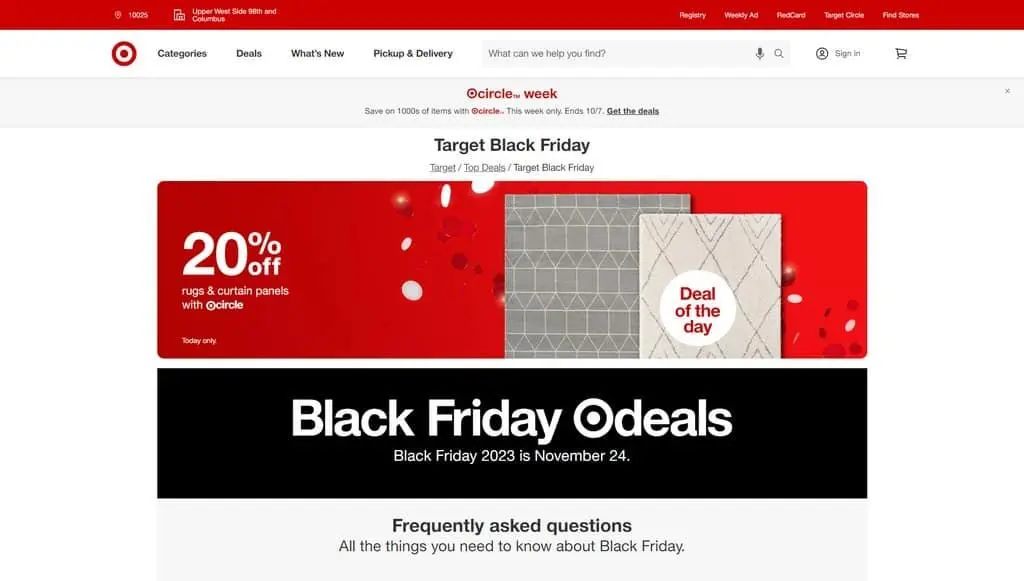
Target focuses on making holiday shopping seamless across online and offline channels.
What they did
- Enabled Buy Online, Pick Up In Store (BOPIS).
- Offered same-day delivery through Shipt.
- Highlighted personalized gift recommendations.
- Extended Black Friday deals over multiple weeks instead of a single day.
Key takeaway: Convenience can be just as important as discounts during the holiday season.
3. Sephora – Personalized Holiday Gift Guides

Sephora uses personalization extensively during the holiday season.
What they did
- Created curated gift guides by budget, recipient, and product category.
- Recommended products based on customer preferences and purchase history.
- Promoted loyalty rewards and exclusive holiday bundles.
- Used email and mobile app campaigns to drive repeat purchases.
Key takeaway: Personalized gift discovery reduces decision fatigue and increases average order value.
4. Nike – Holiday Member Exclusives
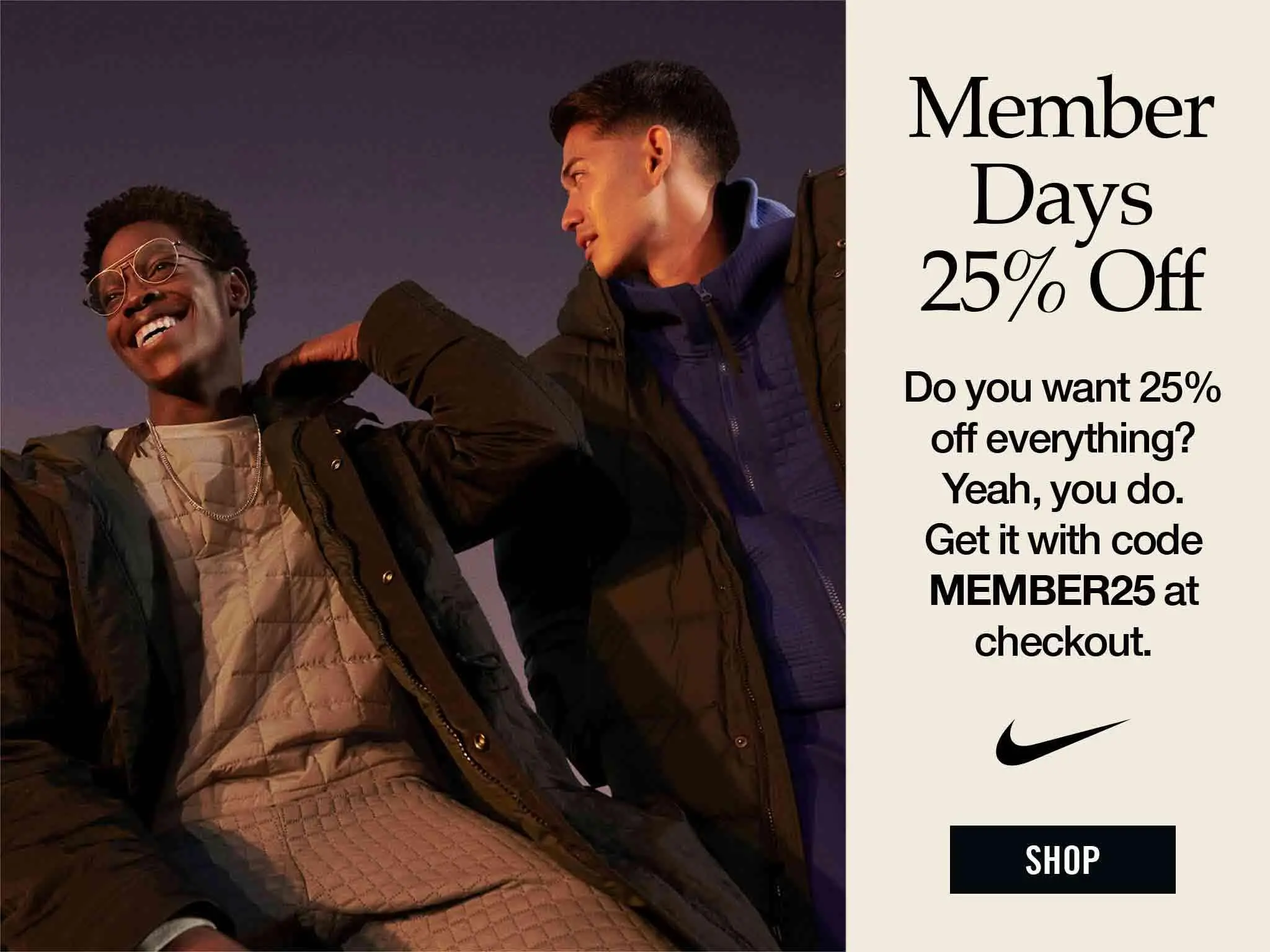
Nike leverages its membership ecosystem during holiday campaigns.
What they did
- Offered early access to holiday collections for members.
- Personalized product recommendations inside the Nike app.
- Sent behavior-based notifications for wish-listed and recently viewed products.
- Combined exclusive offers with limited-edition product launches.
Key takeaway: Reward loyal customers with exclusive access instead of relying solely on blanket discounts.
5. Starbucks – Holiday Rewards & Mobile Personalization
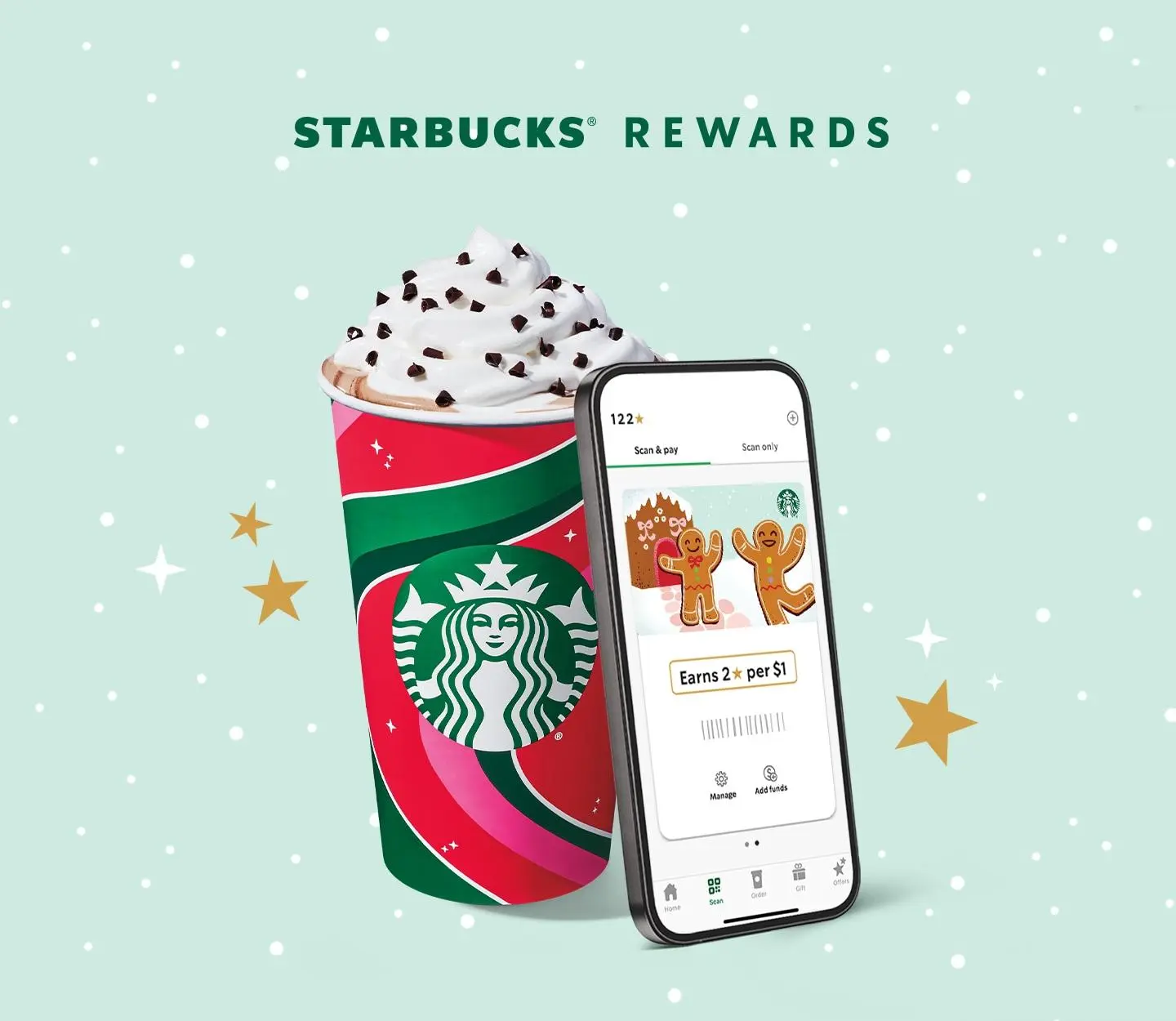
Starbucks uses its loyalty program and mobile app to increase holiday engagement.
What they did
- Launched festive beverages and limited-edition products.
- Delivered personalized offers through the Starbucks Rewards app.
- Awarded bonus loyalty stars for holiday purchases.
- Used seasonal messaging and gamified promotions to encourage repeat visits.
Key takeaway: Loyalty programs combined with personalized incentives help increase purchase frequency during peak seasons.
The Ultimate Holiday Readiness Checklist
Executing an enterprise-grade holiday strategy requires flawless operational discipline. Use this outcome-focused checklist to validate your technical and strategic readiness before peak traffic begins:
- Data Unification: Have you audited your MarTech stack to ensure a single, real-time customer view without 24-hour batch delays?
- Deliverability Baselines: Are your dedicated IPs warmed up, and do you have active domain monitoring to guarantee primary inbox placement?
- Integrate Agentic Marketing Layer: Is your AI model fully trained on last year’s Q4 behavioral data to execute real-time, intent-based personalization?
- Omnichannel Routing: Do your automated journeys suppress emails if a customer has already converted via SMS or WhatsApp?
- Logistics Sync: Is your fulfillment software deeply integrated with your marketing platform to dynamically pause campaigns for out-of-stock SKUs?
- Measurement Architecture: Have you established universal control groups to measure true incremental revenue lift, rather than relying on last-click attribution?
- Retention Journeys: Are your Q1 post-purchase nurturing journeys built, tested, and ready to trigger the moment a holiday order is delivered?
If you cannot confidently check every box, your margins remain vulnerable to MarTech fragmentation and manual execution errors.
Final Take
The fundamental truth of holiday ecommerce is that traffic is a commodity, but conversion and retention are a discipline. By replacing disjointed tools with unified, AI-native orchestration, enterprise marketers can stop settling for vanity metrics and start driving undeniable, measurable revenue outcomes.
Ready to orchestrate a more profitable Q4? Discover how outcome-driven personalization can transform your holiday campaigns. Talk to us.