Why pouring more into the top of the funnel won’t fix a store that loses its best shoppers after the click, and what changes when discovery and retention run as one.
TL;DR
Ecommerce teams keep answering flat sales with more acquisition: more spend, more traffic, more sends, because acquisition is the number everyone watches. But the money isn’t leaking at the top of the funnel. It’s leaking after the click, in two quiet places. The shopper who searched or browsed for exactly what they wanted and couldn’t be helped to find it. And the shopper who bought once and then heard nothing worth coming back for. Both are the same failure in different clothes: a store sitting on what the shopper already told it, and acting on none of it. This piece breaks down where the leak actually is, why more traffic makes it worse rather than better, and what changes when a brand treats the whole journey as one profile instead of a set of disconnected tools.
The problem
Every ecommerce growth plan starts the same way: get more people in. More budget, more traffic, more names on the list every month. It feels like progress because it’s easy to measure. The acquisition line goes up, and the dashboard looks healthy.
Then look at the revenue line. It barely moves. More spend, more sessions, and the number that actually pays the bills sits almost exactly where it did last quarter. It’s easy to read that as a plateau, a temporary flattening the next campaign will fix. It isn’t. It’s a slow loss wearing the mask of stability. You’re paying more each month to stay in the same place, which means the cost of winning a customer keeps climbing while the value you get back per visitor keeps thinning. Growth bought this way stops the instant you stop paying for it.
The strange part is how rarely this leak shows up where anyone is looking. Acquisition cost is tracked, reported and defended in every marketing review. What almost no one watches with the same rigour is what happens to a visitor after they land: whether the store actually helped them find the thing they came for, whether the intent they showed was ever acted on, whether the second purchase was pursued or simply left to chance. A brand can look completely healthy on traffic and new-customer growth while quietly losing the shoppers it worked hardest to bring in, because the metric everyone is watching was never the one that mattered.
So before signing off on the next increase at the top of the funnel, the honest question isn’t how to acquire faster. It’s where all that traffic actually goes once it arrives.
It isn’t the creative, the price, or the send volume
The usual suspects get blamed first. The creative is tired. The discount wasn’t deep enough. The season is soft. The inbox rules changed again. Some of that is even true. But a brand can fix every one of those and still watch the revenue line refuse to move, because none of them is where the money is leaving.
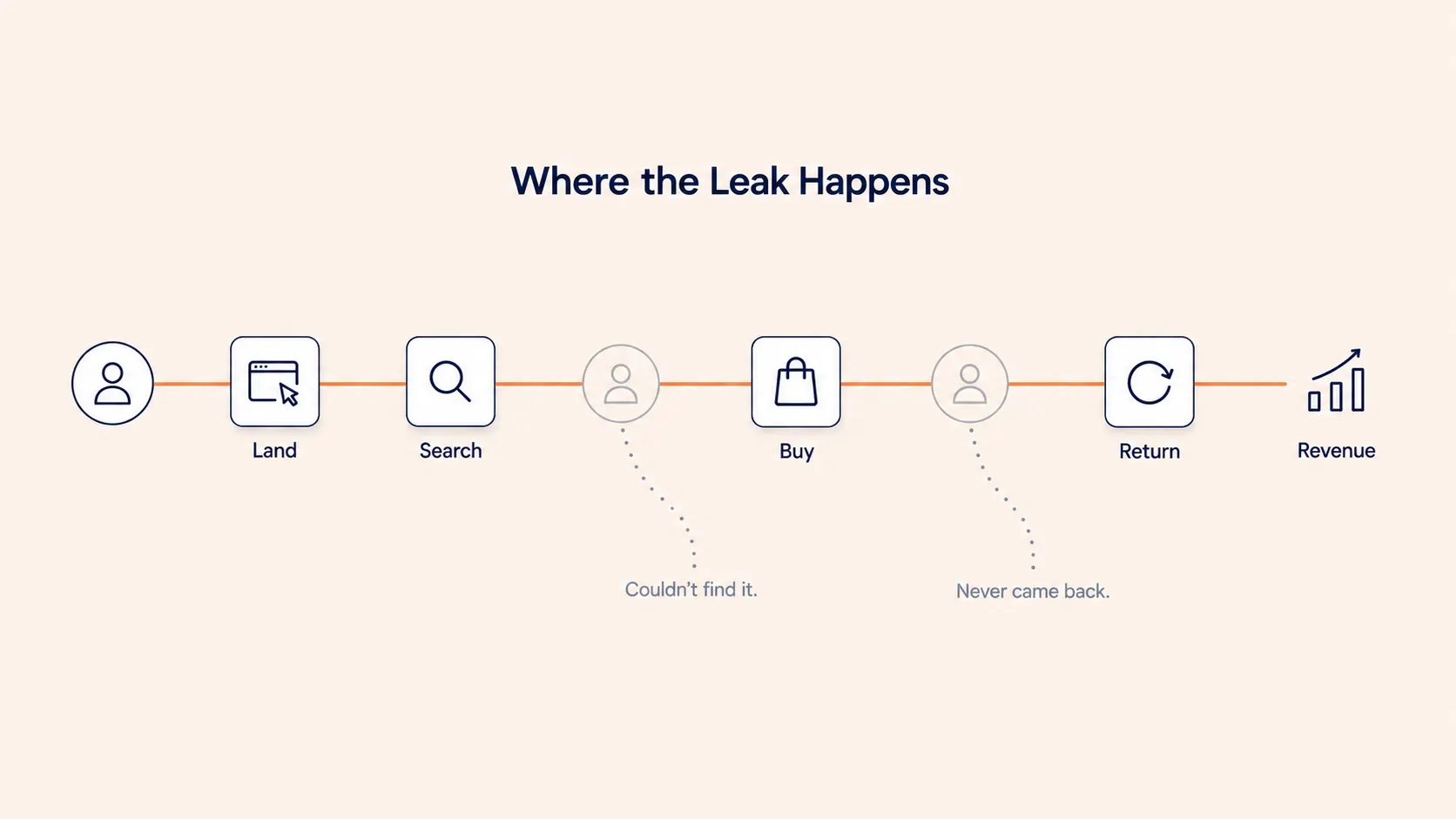
Worse, the reflex that follows makes the problem bigger. Flat sales trigger more spend, more campaigns, more sends to more people, on the theory that if the output is thin, the input must be too small. It’s the opposite. Pouring more visitors into a store that leaks after the click doesn’t patch the leak. It scales it. Every extra shopper the brand pays to bring in arrives at the same two cracks, and falls through them faster. And both cracks open the instant a shopper lands.
The first leak: they told you what they wanted, and nothing acted on it
This is the best visitor a store gets. They didn’t wander in from a broad awareness campaign to see what was on offer. They searched. They filtered. They built a wishlist. In plain language, they told the store exactly what they want. A shopper who types in a specific product has handed over their intent, their spec, their budget and their urgency in a single move, and online, that decision is made in three to five seconds.
In most stores, that’s precisely where it dies. The search returns nothing, because the catalogue filed the item under a different word than the shopper used. The results come back too broad to surface the few things that actually match. The wishlist quietly fills up and no message is ever built from it. A price drops, an item comes back in stock, and the one shopper who explicitly asked for exactly that never hears a word, because the signal the store captured never reaches the channel that could act on it.
There’s no error thrown, no complaint logged, no refund raised. Nothing lands in a report anyone would read on Monday morning. The shopper simply leaves, and the store never learns it happened. That’s what makes it the most expensive loss of all. This was the most qualified visitor in the building, the one closest to buying, and very often the one the brand paid the most to bring in. The store lost the shopper it was most ready to sell to, in the one place no one thinks to look.
And the ones who did find it, who bought, at least those the brand kept. Didn’t it?
The second leak: they bought once, then went quiet
This one every team will recognise, because they’ve been fighting it for years. A shopper buys, and then hears nothing that fits them. Generic journeys built for everyone and no one. A welcome offer sent to someone who has already ordered. A win-back for something they would never buy. So they don’t come back on their own, and the brand goes out and finds them again through paid, at full price, when keeping them would have cost a fraction of that. Silent unsubscribes. Quiet churn. Repeat revenue left on the table, month after month.
The customer the brand already paid to acquire becomes a customer it pays to acquire twice. The same shoppers it worked so hard to bring in, thinning out again one step further down the journey. And because this leak shows up as a slow erosion rather than a single dramatic drop, it’s even easier to ignore than the first.
It’s the same mistake, in two places
Follow one group of shoppers through both leaks and the pattern gives itself away. At the first leak, they told the store what they wanted, and it couldn’t act on the signal. At the second, they told the store who they were, and it didn’t use what it already knew. Different moment, same failure: the store is sitting on what it already knows about the shopper and putting none of it to work.
It was never two problems. The search that can’t find the product and the retention that can’t hold the customer are one leak, surfacing twice, for one reason. The tool that learns the shopper and the tool that speaks to them next don’t share what they know. The intent captured in the first three seconds never survives to shape the second visit. So the store keeps meeting the same person as a stranger, over and over, and paying for the privilege each time.
The fix isn’t more tools. It’s one journey.
Seen this way, flat sales on rising spend isn’t a traffic problem at all. It’s an after-the-click problem, and the fix is the same in both places: use what the shopper already gave you.
That doesn’t come from bolting another tool onto the stack. Point tools each fix one leak and quietly open another, because every new tool is one more place the shopper’s signal has to cross a gap, and gets dropped. It comes from treating the shopper as one journey with three moments rather than three disconnected systems. Help them find it. Help them buy. Then bring them back. Run all three off a single profile, so nothing falls through the gaps between them, and the intent a shopper shows in the first three seconds still counts when they return.
That’s the difference between turning shopper intent into revenue and paying, again and again, to buy the same intent back.
Final take
The case here isn’t that acquisition should stop. A store still needs new shoppers to grow the base it will eventually keep. The case is that the growth most teams are chasing is already inside the building: in the shoppers who searched and weren’t helped, and the buyers who were never given a reason to return. That revenue isn’t missing. It’s sitting one search and one purchase deep, waiting for a store that can act on what those shoppers already said.
The brands pulling ahead aren’t the ones acquiring hardest. They’re the ones who stopped letting the journey break after the click, and started running discovery and retention as a single motion off a single profile. The first step is simply to see where the leak is.
See which of these moments is quietly costing you the most.