Diwali Engagement Playbook is now


TL;DR
- Ecommerce customer analytics helps brands collect and analyze customer behavior, purchase history, and engagement data to make smarter, data-driven marketing and merchandising decisions.
- By understanding customer preferences and buying patterns, businesses can improve personalization, optimize customer journeys, increase conversion rates, and boost customer lifetime value.
- Key metrics such as customer acquisition cost (CAC), lifetime value (CLV), repeat purchase rate, average order value (AOV), cart abandonment rate, and churn provide actionable insights for revenue growth.
- Combining customer analytics with AI enables predictive segmentation, personalized recommendations, real-time campaign optimization, and proactive retention strategies.
- Brands that transform customer data into actionable insights can create better shopping experiences, improve marketing ROI, and drive sustainable ecommerce revenue growth.
Most ecommerce brands are drowning in dashboards but starving for actual revenue. Compiling pageviews and bounce rates will not impress a CFO who only cares about customer acquisition costs, lifetime value, and measurable return on investment. It is time to stop reporting on historical activity and start using predictive data to drive measurable, profitable growth. In this article, we will dive deeper into how to do ecommerce customer analytics and explore which AI tools are available today to make this less complex.
What is Ecommerce Customer Analytics?
Ecommerce customer analytics is the systematic process of capturing, analyzing, and acting on shopper behavior and transactional data to drive specific business outcomes. Unlike general web analytics, it focuses exclusively on the metrics that directly impact revenue, such as customer lifetime value, purchase frequency, and retention.
For too long, the industry has treated analytics as a passive mirror a way to look backward at what happened last month. Marketing directors spend hours compiling reports on click-through rates, session durations, and email open rates. But data without accountability is just noise. When you present a 20% increase in traffic to your executive team, their only question is, “How much revenue did that traffic generate?”
Ecommerce customer analytics, when executed correctly, bridges this gap. We know that modern growth leaders are under immense pressure to validate their technology investments. In the “Consider” stage of the Buyer’s Journey, you are likely evaluating whether your current tools can actually support a modern, AI-driven data strategy. To move forward, you must demand more from your data. You must demand that every insight points toward an actionable, revenue-generating decision. For a deeper dive into the exact financial metrics that matter, refer to our satellite guides on measuring true ecommerce ROI.
When we consult with enterprise marketing teams, we immediately audit their data dependencies. If a team is optimizing their campaigns based on the middle column above, they are bleeding revenue. Your analytics infrastructure must be capable of identity resolution. It must recognize a user across desktop, mobile app, and email, stitching those interactions into a single, unified view. Only then can you stop treating your customers like anonymous traffic and start treating them like revenue-generating relationships.
The 4 Types of Ecommerce Analytics
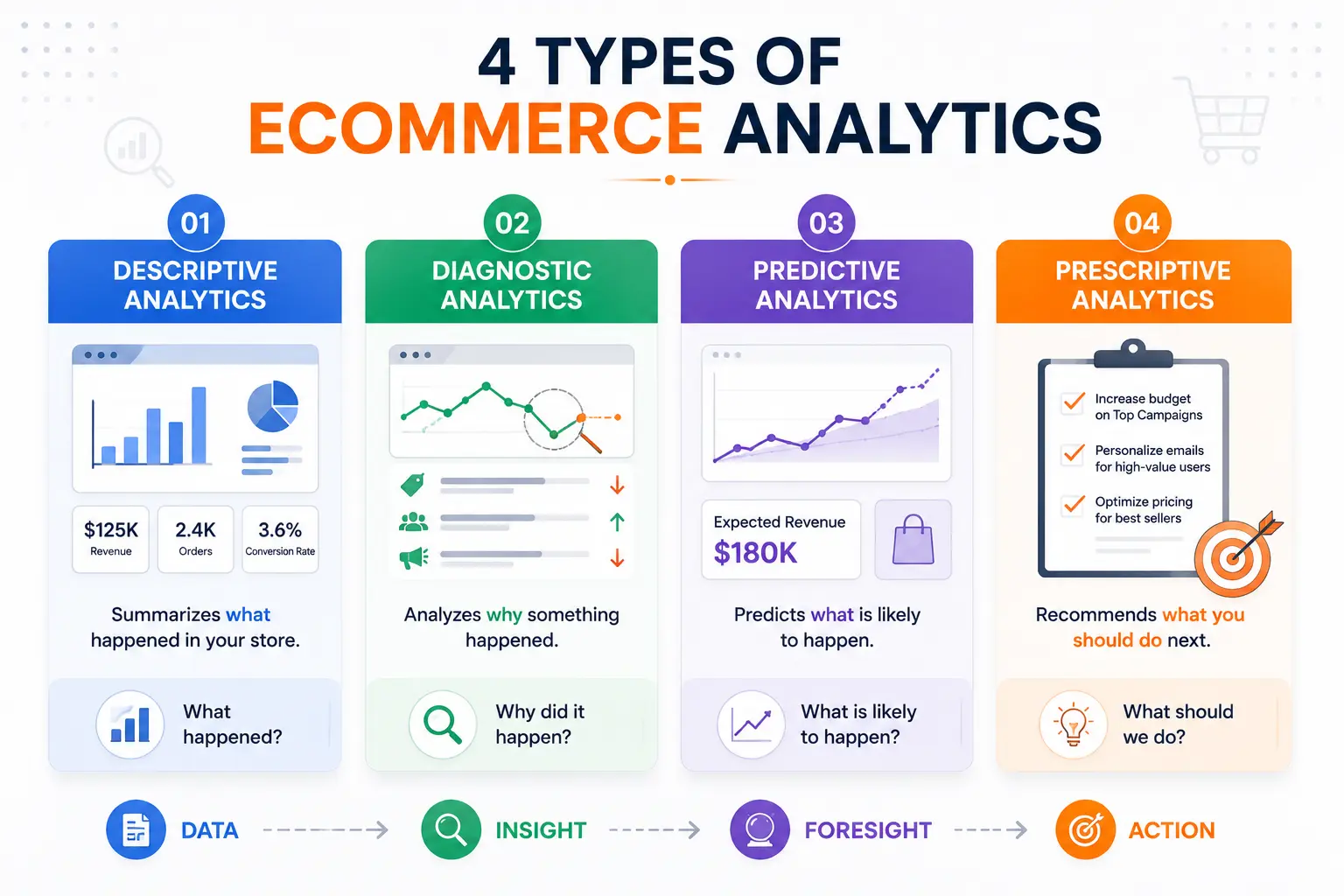
To build a robust data strategy, you must understand the analytics maturity curve. Most brands are stuck at the bottom, reporting on what happened yesterday. The brands that dominate their categories operate at the top, allowing AI to dictate what should happen tomorrow.
We categorize this journey into four distinct phases of intelligence:
- Descriptive Analytics (What Happened?)
This is the baseline. Descriptive analytics summarizes historical data, telling you how many sales you made last quarter or what your average open rate was. It is necessary for basic bookkeeping but offers zero competitive advantage.
- Diagnostic Analytics (Why Did It Happen?)
This phase involves digging deeper to find correlations. If sales dropped in November, diagnostic analytics helps you isolate the cause, perhaps a specific email campaign failed to deliver or a promo code was broken. It is reactive problem-solving. - Predictive Analytics (What Will Happen Next?)
This is where revenue generation begins. Using historical behavior, AI models forecast future actions. Predictive analytics identifies which customers are most likely to churn in the next 30 days and which are primed for a high-value upsell. - Prescriptive Analytics (What Should We Do About It?)
The ultimate goal. Prescriptive analytics doesn’t just forecast an outcome; it autonomously takes action. The platform decides the optimal channel, message, and send time to prevent churn without requiring a human to pull a list or set a rule.
The gap between descriptive and prescriptive is where marketing budgets are wasted. If you are paying data scientists to manually export lists from phase one and two, you are burning capital. Your platform must handle the heavy lifting, autonomously pushing insights into action. Netcore’s Insight agent is able to deliver actionable insights for every campaign real-time to optimize performance and also make tweats to increase revenue from campaigns.When your analytics platform can automatically suppress a discount code for a customer who was already going to buy full-price, you instantly protect your margins. That is the power of prescriptive intelligence.
Key Metrics to Track Across the Customer Journey
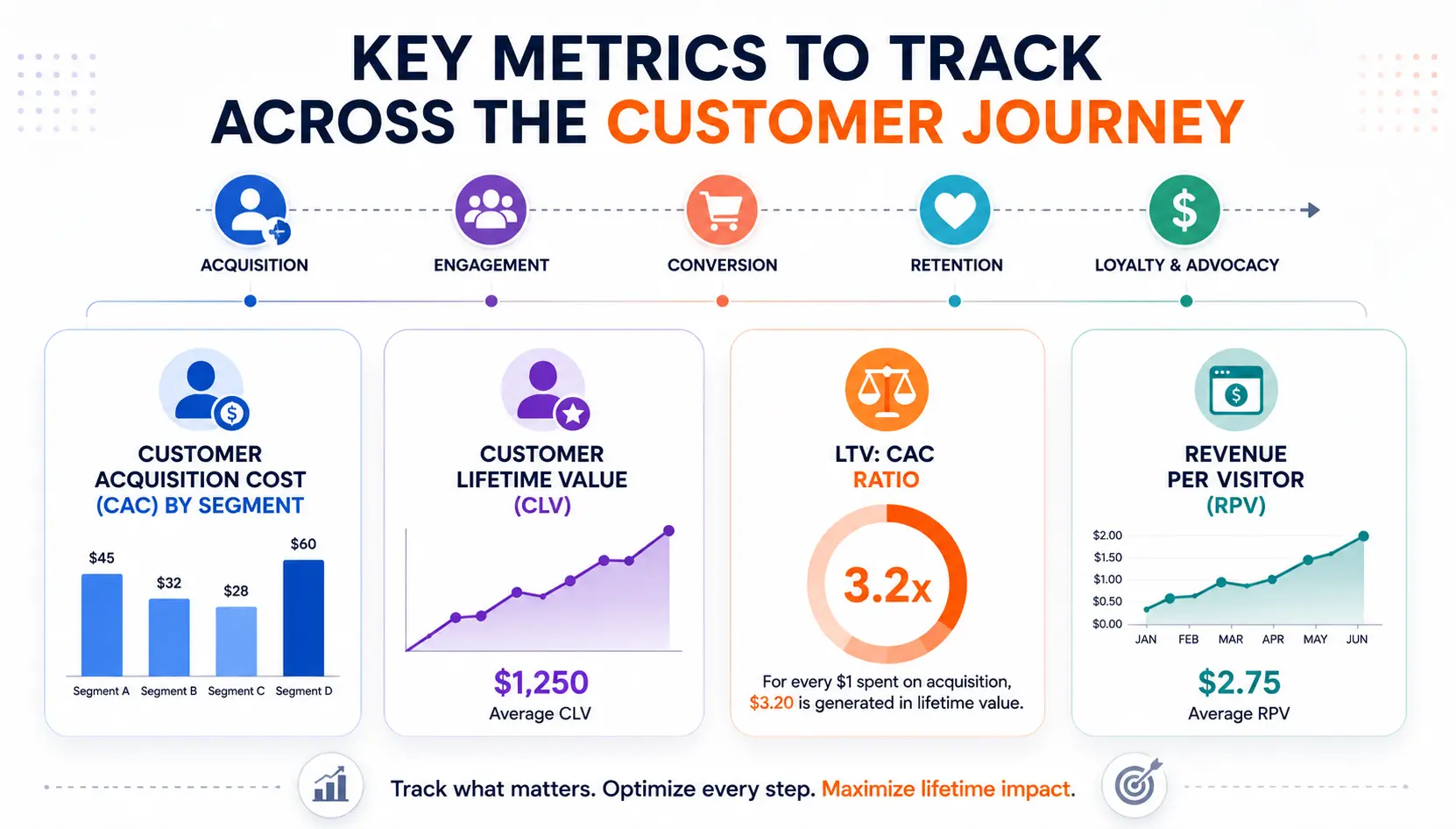
Tracking the wrong customer engagement metrics is more dangerous than tracking nothing at all. It provides a false sense of security. You can have a high click-through rate on an ad, but if those visitors bounce without buying, you have just paid to acquire bad traffic.
To align your department with the CFO’s expectations, you must anchor your strategy to four uncompromising financial indicators:
1. Customer Acquisition Cost (CAC) by Segment. Blended CAC is a lie. If you spend $10,000 to acquire 100 customers, your average CAC is $100. But if 80 of those customers only bought a $10 item and never returned, while 20 bought a $500 item and became loyalists, treating them equally in your data is strategic malpractice. You must use analytics to isolate the CAC of your most profitable segments.
2. Customer Lifetime Value (CLV): CLV is the north star of ecommerce. It measures the total revenue a customer will generate over their entire relationship with your brand. By utilizing predictive analytics, you can forecast CLV after a shopper’s very first purchase, allowing you to confidently spend more to acquire high-LTV profiles while throttling spend on one-and-done buyers.
3. LTV: CAC Ratio: The ultimate test of business sustainability. If you are paying $50 to acquire a customer who only ever spends $75, your margins will not survive fulfillment and operational costs. A healthy LTV: CAC ratio is generally 3:1 or higher. Your analytics platform must provide this ratio in real time, not at the end of the quarter when the budget is already spent.
4. Revenue per Visitor (RPV): Conversion rate optimization (CRO) is important, but RPV is better. If you run a discount that increases conversion rate but tanks your average order value (AOV), you might be losing money. RPV balances conversion rate and AOV, telling you exactly how much cash each site visitor is worth.
When we evaluate a brand’s data maturity, the shift from “traffic metrics” to “revenue metrics” is the most critical hurdle. If your current platform makes it difficult to extract CLV or segment your CAC, it is actively hindering your growth. Refer to our satellite guide on Advanced CLV Modeling to understand how to structure this data.
Overcoming Data Silos for a Unified View
Martech sprawl is the silent killer of ecommerce ROI. The average enterprise marketing team uses over a dozen different point solutions to run their campaigns one platform for email, another for SMS, a separate customer data platform (CDP), and an isolated analytics dashboard. This fragmentation guarantees a disjointed customer experience and makes accurate attribution impossible.
This Market Reality of the desperate need for one platform and unified control is why so many personalization initiatives fail. When your SMS tool doesn’t know that a customer just completed a purchase via your mobile app, it will inevitably send an irrelevant promotional text. This not only wastes money but actively damages the brand relationship. Data silos prevent you from seeing the complete picture, forcing your team to manually stitch together Excel files in a desperate attempt to prove what is actually driving revenue.
Overcoming this requires architectural consolidation. You cannot build a modern data strategy on top of disconnected tools. You need a single source of truth where behavioral data, transactional history, and campaign engagement live in one unified profile.
By collapsing the stack into a unified platform, you eliminate the latency between insight and action. When a shopper abandons a cart on their laptop, that signal must be immediately available to the mobile push notification engine. If it takes 24 hours for your analytics tool to sync with your execution tool, the revenue opportunity is gone. We believe that intelligence and execution must live in the same house. A unified view is not a luxury; it is the foundational requirement for scaling a profitable ecommerce business.
Omnichannel Personalization at Scale
Customers do not care about your internal marketing channels. They do not think, “I am interacting with the email department now, and I will interact with the SMS department tomorrow.” They expect a single, continuous, highly relevant conversation with your brand. Yet, because of the silos mentioned above, most brands deliver fragmented, generic experiences.
Personalization at scale is the primary driver of modern ecommerce conversions. However, standard ecommerce personalization like inserting a first name into a subject line is no longer sufficient. True omnichannel personalization uses deep customer analytics to deliver the right product recommendation, on the right channel, at the exact right moment.
Imagine a scenario where your analytics platform detects a high-value customer browsing running shoes on your mobile app but leaving without buying. A predictive model recognizes this user historically converts highest via WhatsApp, not email. Furthermore, it knows they are highly price-sensitive but respond well to scarcity. The platform autonomously triggers a WhatsApp message containing a dynamic image of the exact shoes they viewed, warning them that only two pairs remain in their size.
This level of orchestration requires real-time data processing possible with agentic marketing personalization. It requires a platform that understands the nuance of cross-channel engagement and can prioritize the touchpoint with the highest probability of conversion. When you align your data infrastructure to support true omnichannel personalization, you stop shouting into the void and start delivering bespoke digital concierge experiences that dramatically lift conversion rates. If your current tool limits you to single-channel logic, it is time to upgrade. Go deeper into this topic via our satellite post on unified omnichannel orchestration.
How AI and Predictive Analytics are Reshaping Ecommerce
The era of rules-based marketing automation is dead. If your team is still sitting in meeting rooms trying to guess the optimal time to send an email, or manually building “if/then” journey branches, you are losing to competitors who have handed these tasks over to artificial intelligence.
The most profound shift in the ecommerce landscape is the move toward intelligence over execution. Modern AI does not just crunch numbers; it acts as an autonomous agent. Predictive analytics analyzes billions of historical data points to identify patterns invisible to the human eye. It can segment your audience dynamically based on their likelihood to purchase, their affinity for specific categories, and their optimal engagement frequency.
For example, AI-native systems like Netcore’s Decisioning Agent can calculate “Send Time Optimization” uniquely for every single user in a million-person database. It can use generative AI to dynamically adjust the tone and copy of a message based on the recipient’s past behavioral triggers. It can deploy “Next Best Action” models to decide whether a customer needs a 10% discount to convert or if they will buy at full price with just a free shipping offer.
This is why we aggressively champion accountability and outcomes. AI is not a buzzword to put on a slide deck; it is a mathematical lever to increase profitability. By deploying agentic systems that make autonomous CX decisions, you dramatically reduce manual labor costs while simultaneously increasing campaign yield. The brands that refuse to adopt predictive analytics will soon find themselves incapable of competing on customer acquisition costs. They will be priced out of the market by smarter, AI-driven competitors who know exactly what every click is worth.
Using Customer Data to Drive Retention and Loyalty
Acquisition gets the glory, but retention pays the bills. The mathematical reality of ecommerce is that your profit margins are hidden in the second, third, and fourth purchases. Yet, an alarming number of brands spend 90% of their data resources trying to acquire new traffic while entirely neglecting post-purchase analytics.
Driving loyalty requires a fundamental shift in how you view your analytics. Instead of viewing a purchase as the end of a funnel, it must be treated as the beginning of a lifecycle loop. By analyzing purchase frequency and product affinity, you can deploy highly effective replenishment models. If data shows that customers who buy a specific 30-day supply of skincare typically repurchase on day 26, your analytics engine should autonomously trigger a frictionless re-order message on day 24.
Furthermore, identifying VIP cohorts is critical. Your top 10% of customers likely generate 40% or more of your revenue. Analytics must be used to fence these users off, ensuring they receive white-glove treatment, early access to product drops, exclusive tiered loyalty rewards, and zero promotional fatigue. Conversely, predictive churn models can detect when a previously loyal customer’s engagement drops below a historical baseline, triggering a win-back sequence before they defect to a competitor.
We prove time and again that retention is not a soft marketing concept; it is a hard data science problem. When you apply rigorous analytics to your post-purchase journeys, you extend the lifetime value of every acquired user, directly padding your bottom line.
Choosing the Right Platform for Revenue Growth
As you transition from standard reporting to an outcome-accountable mindset, the technology you choose will dictate your ceiling. A bad platform will keep your team trapped in operational minutiae. The right platform will act as an autonomous extension of your growth strategy.
When evaluating solutions in your Buyer’s Journey, you must ask vendors hard questions. Do not accept feature lists. Demand proof of revenue impact. Ask them how their predictive models handle cold-start problems. Ask them to demonstrate exactly how their platform identifies anonymous users and stitches them into unified profiles. Most importantly, demand a clear explanation of how their system attributes conversions to specific actions across multiple channels.
You need a platform that natively combines the data centralization of a CDP, the predictive intelligence of advanced AI, and the omnichannel execution capabilities of a modern marketing automation suite. Anything less will force you back into the cycle of building manual workarounds and battling data silos.
Final Take
Ecommerce customer analytics is not about building prettier dashboards; it is about building a predictable revenue engine. Data without accountability is just noise; you must arc every insight toward outcomes, proving to your leadership exactly how your strategy drives measurable business growth.
Ready to evaluate your options? Talk to us.