For D2C FMCG brands, growth is getting more expensive.
Customer acquisition costs continue to put pressure on margins, while broad paid campaigns can end up spending heavily on customers who were never particularly close to buying. The problem isn’t always a lack of demand. It’s knowing where to put the next rupee of marketing spend.
The same challenge was playing out inside the WhatsApp program of a fast-growing D2C health and nutrition brand selling products such as ghee, honey, and cold-pressed oils.
WhatsApp was already one of its highest-converting channels. But it was also one of its most expensive because every message came with a direct cost. The brand had sent 1,117 WhatsApp campaigns over the previous 12 months, yet ROI had plateaued at around 7X.
The deeper issue was audience precision.
Traditional segmentation treated the customer list largely as one addressable pool. A customer who had recently shown strong purchase intent could receive the same message as someone who had simply remained subscribed but shown little recent interest.
There was no predictive layer answering a more important question:
Who is actually likely to engage or buy if we reach them now?
That meant the brand was paying to reach customers who had very different probabilities of responding.
The opportunity was to change that equation, not by sending more WhatsApp messages, but by making each send more deliberate. Let’s understand how the D2C FMCG brand achieved 13X combined WhatsApp ROI using only a fraction of its annual send volume with Netcore’s AI-powered customer engagement platform.
The business context: A strong channel with an expensive downside
The brand is a premium D2C player in health and nutrition, selling products such as ghee, honey and cold-pressed oils. Its positioning is built around quality and transparency, and its customers respond particularly well to direct communication.
WhatsApp had become central to that relationship.
Over the previous 12 months, the brand had run 1,117 WhatsApp campaigns. The channel was already a proven revenue driver.
But WhatsApp comes with a constraint that email doesn’t: every message has a direct cost.
That changes the economics of targeting.
With email, sending to a large audience can be relatively inexpensive. On WhatsApp, reaching a customer who has little likelihood of engaging or purchasing is immediately measurable as wasted spend.
The brand therefore faced a trade-off:
Reach more customers, or concentrate spend on the customers most likely to respond?
The challenge: Strong performance had hit a ceiling
The brand was already achieving approximately 7X ROI from WhatsApp.
That sounds healthy until performance stops improving.
Traditional segmentation wasn’t giving the marketing team enough precision. Large audiences were being selected based on broad customer characteristics and campaign eligibility, but there was limited visibility into which individual customers were actually likely to engage with the next message.
A loyal customer who regularly interacted with the brand could sit in the same campaign audience as someone who had shown little recent interest.
Both received the same message.
The result was a classic performance ceiling: the brand could reach its customers, but it couldn’t distinguish enough between them.
And because every additional WhatsApp send carried a cost, improving efficiency mattered as much as increasing revenue.
The strategy: Predict behavior before spending on the message
The brand introduced an AI-powered propensity model that scored customers based on their predicted likelihood to engage with a WhatsApp campaign. Read more about affinity propensity segments.
Two predictive signals were used.
1. Likely to Open
This signal identified customers with a stronger history of brand engagement and a higher predicted probability of opening a message.
It was particularly useful for re-engaging loyal customers who had demonstrated affinity but weren’t necessarily showing immediate purchase intent.
The strongest WhatsApp campaign using this signal achieved a 67.20% open rate, the highest across the rollout.
2. Likely to Click
The second signal focused further down the funnel: customers predicted to be more likely to click and take action.
This audience showed stronger purchase readiness.
The strongest WhatsApp campaign generated a 7.12% click-through rate and delivered the highest revenue contribution among the four campaigns. The distinction mattered.
The objective wasn’t simply to find customers who would interact with the message. It was to identify different levels of predicted response and use those signals accordingly.
The team deliberately avoided changing the entire WhatsApp program at once.
Phase 1: Prove the model
The first campaigns were launched against a limited audience because of a platform-side reach constraint.
That actually created a useful test.
Even with restricted reach, the precision of the audience produced strong ROI. The early result suggested that the model was not dependent on simply reaching a huge audience.
Phase 2: Expand to a fresh audience
Once the reach constraint was resolved, the team applied the same approach to a new, untapped audience.
Revenue increased significantly, confirming that the first result wasn’t simply a function of one campaign or one small audience. The scale of the test is important.
Four AI-targeted campaigns represented only a fraction of the brand’s annual WhatsApp send volume, which was benchmarked against more than 1,000 legacy campaigns.
The goal wasn’t to replace the existing program overnight.
It was to demonstrate that precision could materially change the economics of an established channel.
The result: 13X ROI without increasing message volume
Across the four campaigns, the AI-targeted approach generated a 13X combined ROI.
That was approximately 1.8X the brand’s previous best performance.
The improvement wasn’t isolated to one metric.
Performance strengthened across the funnel, including:
- Delivery rate
- Open rate
- Click-through rate
- Conversion rate
- Average order value
- Revenue per click
The most important gains appeared toward the bottom of the funnel.
Conversion rates nearly doubled against the legacy baseline, while average order value and revenue per click also increased.
That distinction matters.
The model wasn’t simply finding people who were more likely to open a WhatsApp message.
It was helping the brand reach customers who were more likely to create economic value after opening it.
The economics changed too
The biggest shift was in the amount of revenue generated per message sent.
Rather than treating WhatsApp as a volume channel, where performance improves by continually expanding the audience, the brand could concentrate spend on customers with a stronger predicted probability of responding.
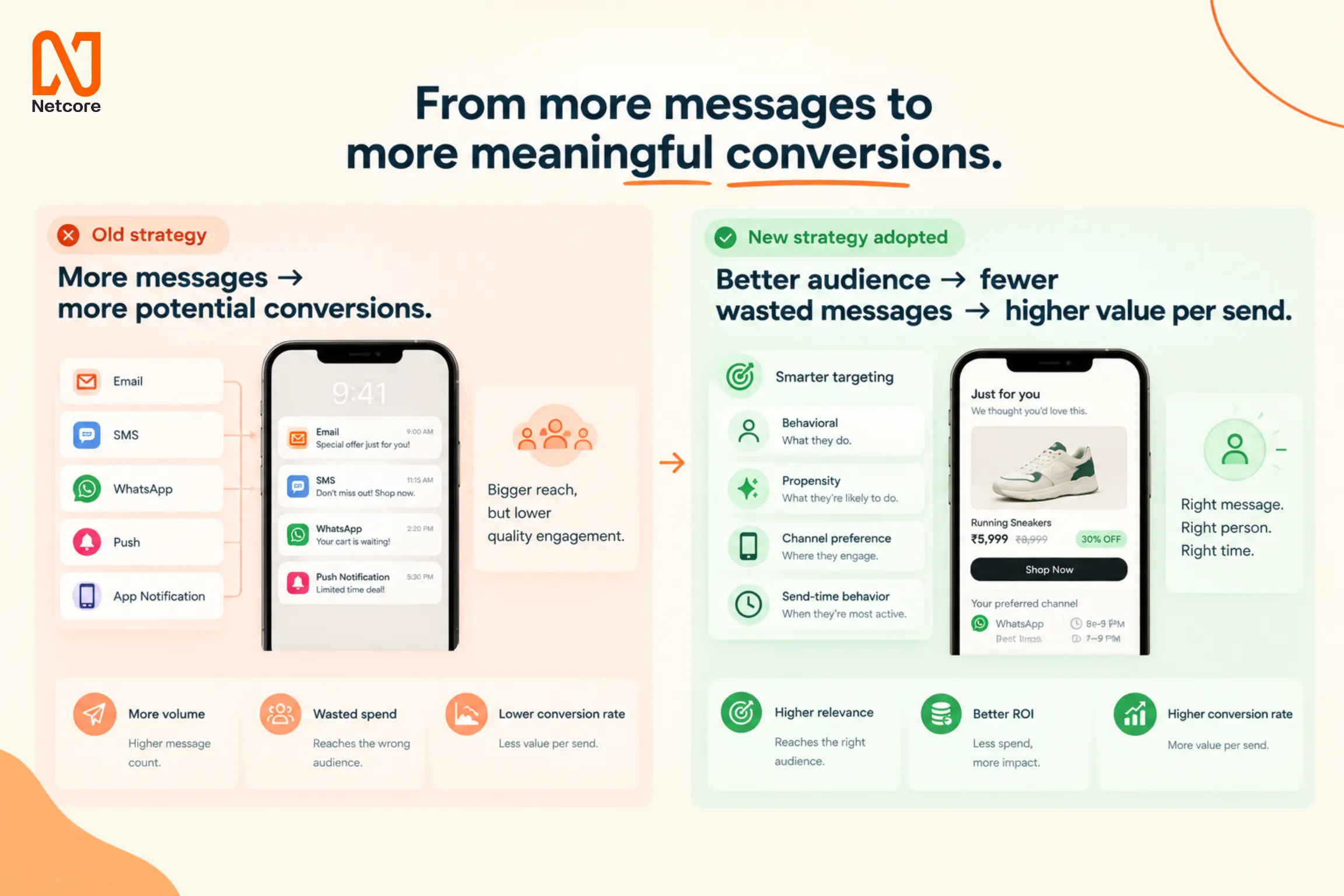
That changed the equation from:
More messages → more potential conversions
to:
Better audience → fewer wasted messages → higher value per send
WhatsApp remained a high-cost channel.
But it became a more efficient one.
Building the operating model for campaigns
The immediate opportunity is to take propensity targeting beyond four campaigns.
The brand can extend predictive targeting across its WhatsApp calendar, introduce additional signals around longer-window purchase probability, and improve exclusion logic so that campaigns don’t repeatedly target the same customers.
The next layer is personalization.
Propensity can answer:
Who should we reach?
Product affinity can help answer:
What should we show them?
Channel and send-time intelligence can answer:
Where and when should we reach them?
Together, those signals can turn audience selection into a more complete decisioning system, one that determines not just who receives a message, but what they see, where they see it, and when they are most likely to respond.
The same approach can also extend beyond WhatsApp to other channels where the cost of a wasted interaction is high.
What D2C and FMCG brands can take away
There are four lessons from this exercise.
1. On expensive channels, precision matters more than reach.
If every message has a cost, the audience should be treated as an investment decision—not simply a database to activate.
2. Predictive signals can improve targeting before a campaign is sent.
Knowing who is likely to open or click creates a more useful starting point than relying only on broad segmentation.
3. Start with a focused test or a pilot campaign.
A small, well-designed rollout can establish whether predictive targeting changes performance before a brand commits its entire campaign calendar.
4. The goal isn’t to send less. It’s to send smarter.
The value comes from concentrating spend where it has a better chance of generating revenue.
For this D2C brand, that shift took WhatsApp from a channel with a 7X ROI ceiling to a 13X ROI performance benchmark.
The broader opportunity is even more interesting.
As Agentic marketing moves deeper into customer segmentation and campaign decisioning, the question for D2C brands is no longer simply how many customers they can reach.
It’s how precisely they can decide who is worth reaching, what they should receive, and when the interaction is most likely to matter. Found this case study useful? Get consultation from our experts to get such powerful strategies built for your business using agentic marketing.