Diwali Engagement Playbook is now


TL;DR
- Customer journey automation uses real-time customer data, behavioral triggers, and automated workflows to deliver personalized experiences across the entire customer lifecycle.
- Instead of relying on manual campaigns, businesses can automatically engage customers through email, SMS, push notifications, in-app messages, and other channels based on individual actions and intent.
- The biggest benefits include higher conversions, improved customer retention, reduced churn, greater operational efficiency, and better visibility into customer behavior.
- Effective customer journey automation spans every lifecycle stage—from awareness and onboarding to conversion, retention, expansion, and advocacy.
- Modern platforms combine customer data, AI-driven decisioning, segmentation, omnichannel orchestration, and analytics to optimize journeys in real time.
- As customer expectations continue to rise, companies that automate and personalize customer journeys at scale will gain a significant advantage in revenue growth, customer loyalty, and long-term retention.
Today’s customers don’t follow a predictable path to purchase.
They discover your product through search, compare alternatives on review sites, sign up for a free trial, disappear for a week, return after seeing a retargeting ad, and then convert after an in-app experience finally demonstrates value.
The problem? Most SaaS companies still rely on manual follow-ups, disconnected tools, and generic nurture campaigns to manage these complex journeys.
That’s where customer journey automation comes in to create a dynamic customer journey map.
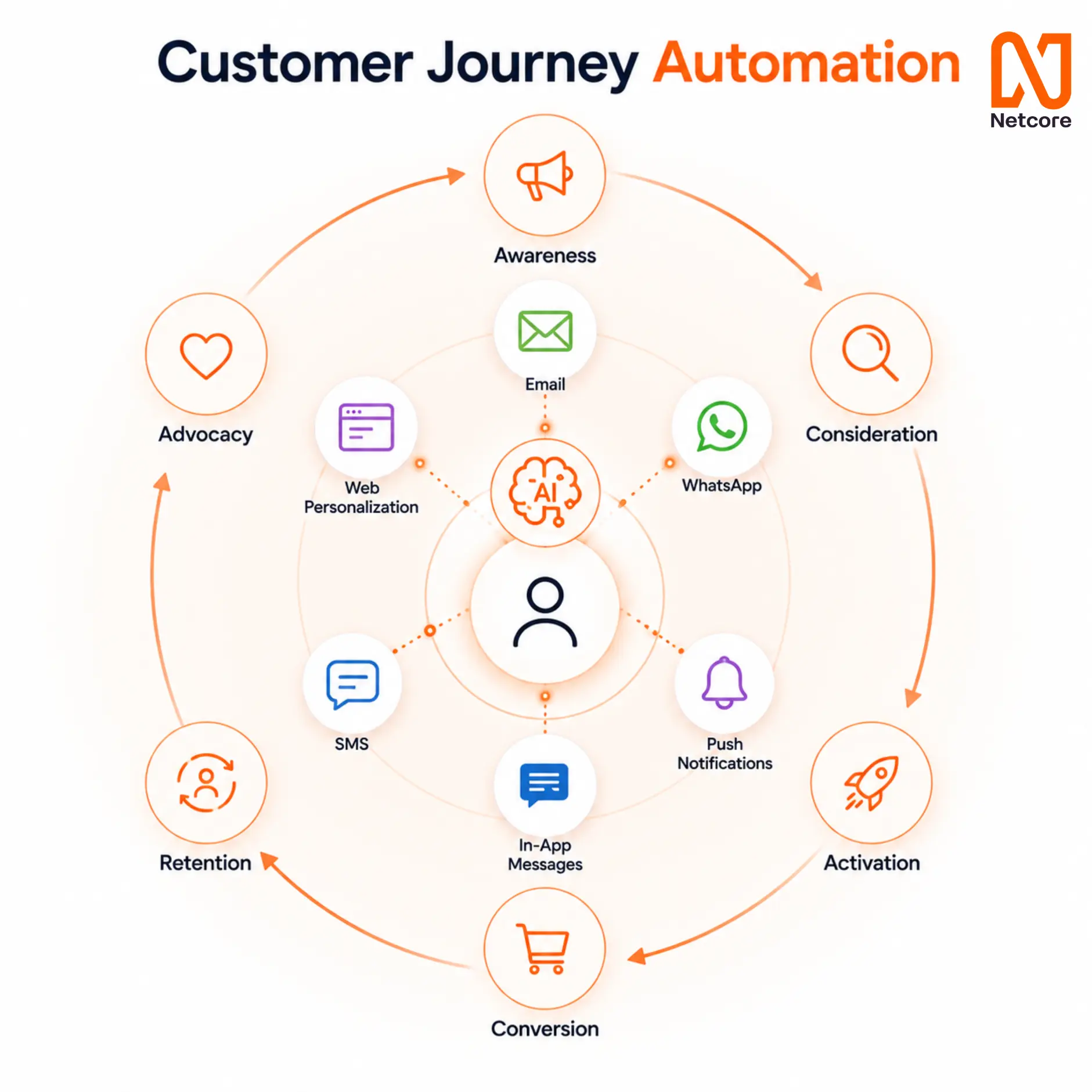
Customer journey automation enables businesses to automatically respond to customer behavior in real time, guiding prospects from awareness to advocacy with personalized experiences across email, in-app messaging, SMS, push notifications, and more.
Rather than forcing every customer down the same path, automation adapts to individual behavior, ensuring each user receives the right message at the right moment.
In this guide, we’ll explore how customer journey automation works, why it matters, the core lifecycle stages it supports, and how to choose the right platform for your business.
What Is Customer Journey Automation?
Customer journey automation is the practice of using software, customer data, and predefined workflows to automatically deliver personalized experiences throughout the customer lifecycle.
Instead of relying on manual outreach or generic campaigns, automation reacts to real-time customer actions, behaviors, and lifecycle signals.
For example:
- A user signs up for your free trial
- A prospect visits your pricing page three times
- A customer stops using your product for seven days
- An account reaches a usage threshold
Rather than waiting for a marketer or salesperson to intervene, automation immediately triggers relevant actions such as onboarding emails, product walkthroughs, re-engagement campaigns, or sales notifications.
The result is a customer experience that feels timely, relevant, and personalized at scale.
Why Customer Journey Automation Matters
Modern buying journeys are increasingly self-directed.
Prospects research products independently, compare alternatives, read reviews, and interact with your product long before speaking to a sales representative.
As customer expectations continue to rise, manual processes simply cannot keep up.
Customer journey automation helps businesses:
- Deliver personalized experiences at scale
- Engage customers in real time
- Reduce manual effort
- Improve customer retention
- Accelerate revenue growth
- Create a more consistent customer experience
Most importantly, automation transforms customer engagement from reactive to proactive.
Instead of responding after customers disengage, businesses can identify signals early and act before opportunities are lost.
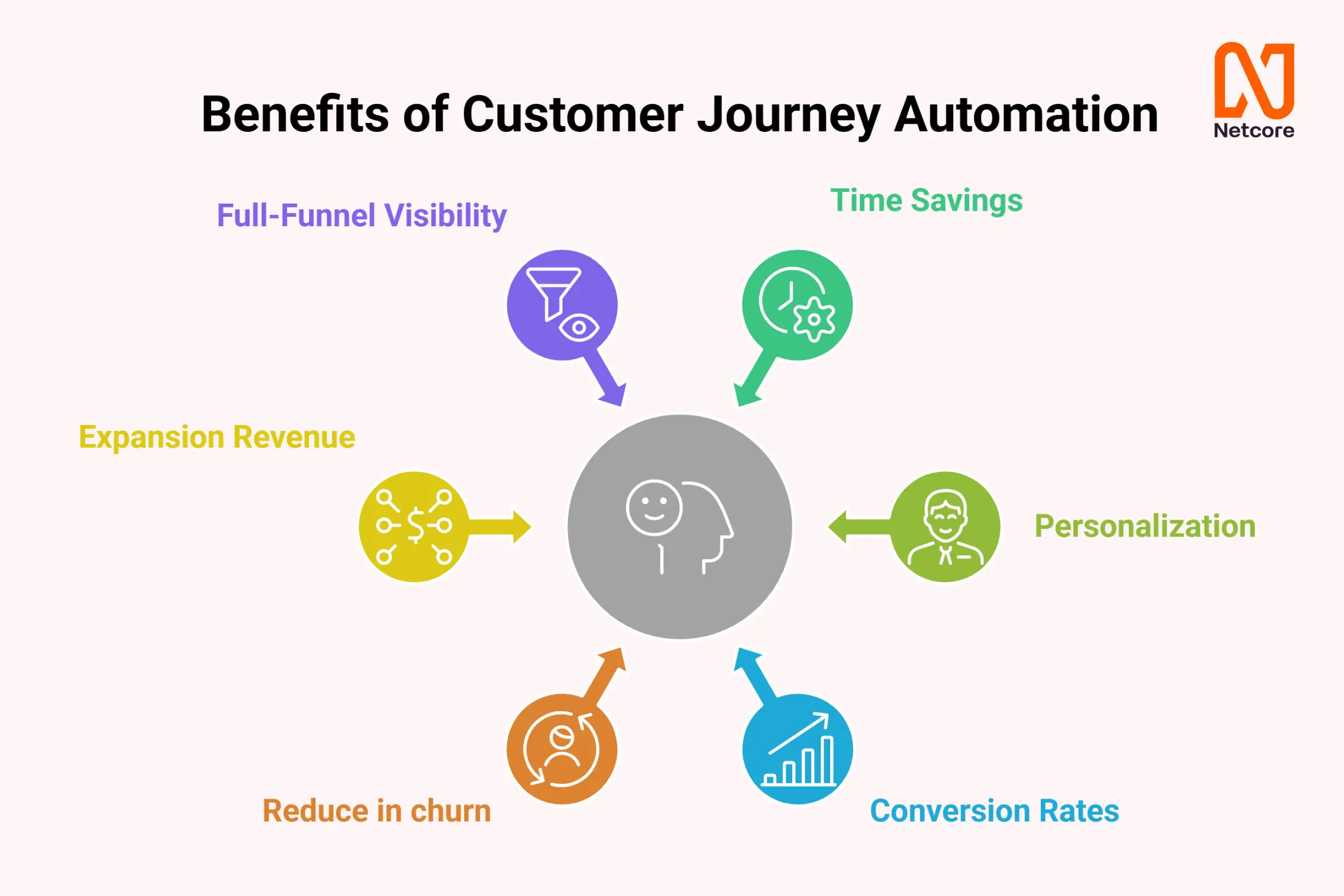
Core Benefits of Customer Journey Automation
1. Save Time Through Automation
Repetitive tasks such as onboarding emails, trial reminders, follow-ups, and re-engagement campaigns run automatically, allowing teams to focus on strategy and growth.
2. Personalize Every Customer Experience
Automation enables brands to tailor messaging based on customer behavior, lifecycle stage, company size, product usage, and other key attributes.
3. Increase Conversion Rates
Behavior-triggered messages consistently outperform batch campaigns because they reach customers when intent is highest.
4. Reduce Churn
Automated health monitoring and re-engagement workflows help identify at-risk users before they leave.
5. Drive Expansion Revenue
Upsell and cross-sell opportunities can be surfaced automatically when customers reach adoption milestones or usage thresholds.
6. Gain Full-Funnel Visibility
Journey analytics reveal which campaigns influence activation, retention, and revenue, creating alignment between marketing, sales, and customer success.
How Customer Journey Automation Works
At its core, every automation follows a simple framework:
Trigger → Condition → Action
Trigger
An event that initiates a workflow.
Examples include:
- Free trial signup
- Pricing page visit
- Feature adoption milestone
- Seven days of inactivity
Condition
Rules that determine which path a customer follows.
Examples include:
- Free vs. paid user
- Enterprise vs. SMB account
- Trial user who clicked a previous email
- Customer from a specific industry
Action
The response delivered by the system.
Examples include:
- Push notification
- In-app message
- SMS
- CRM update
- Sales alert
Together, these elements create highly personalized customer experiences without requiring manual intervention.
The Customer Lifecycle Stages You Should Automate
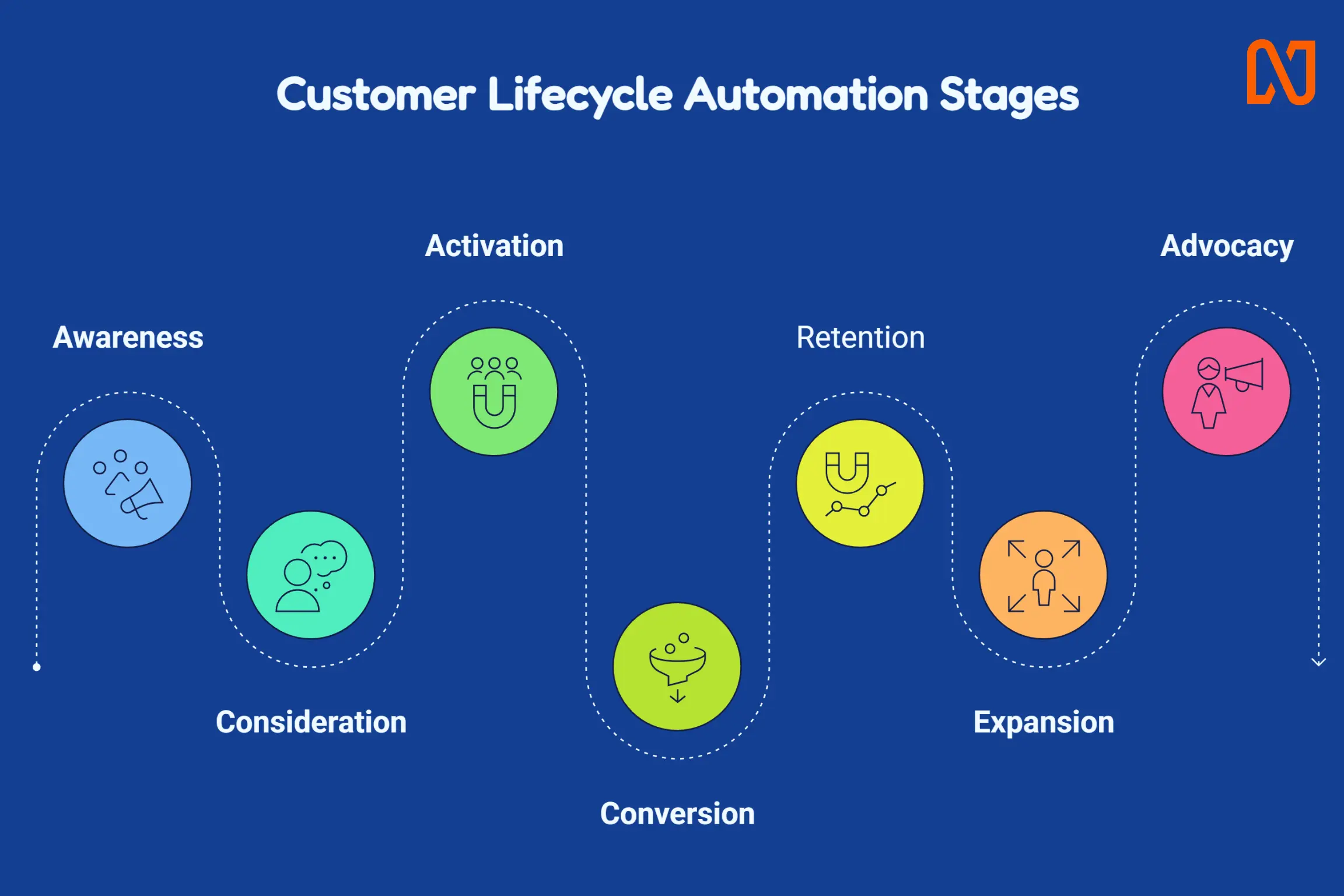
Customer journey automation spans every stage of the customer lifecycle.
Awareness
Introduce prospects to your brand through lead magnets, educational content, and retargeting campaigns.
Consideration
Deliver product comparisons, case studies, testimonials, and personalized nurturing sequences.
Activation
Guide new users toward their first meaningful success moment through onboarding emails and in-app experiences.
Conversion
Identify buying signals and deliver timely nudges that encourage free-to-paid upgrades.
Retention
Monitor customer health and proactively engage users before they churn.
Expansion
Automatically identify upsell and cross-sell opportunities based on customer behavior.
Advocacy
Turn satisfied customers into promoters through referrals, reviews, and community engagement.
How to Build a Customer Journey Automation Strategy
Step 1: Map Your Existing Customer Journey
Document every customer touchpoint from acquisition to renewal.
Look for:
- Drop-off points
- Engagement gaps
- Manual processes
- High-friction experiences
Step 2: Define Goals and Success Metrics
Every automation should have a measurable outcome.
Examples include:
- Increase activation rate by 15%
- Reduce churn by 10%
- Improve trial-to-paid conversion by 20%
Step 3: Create Behavioral Segments
Move beyond basic demographic segmentation.
Combine:
- Product usage
- Behavioral signals
- Firmographics
- Lifecycle stage
Step 4: Prioritize High-Impact Journeys
Start with:
- Onboarding
- Trial conversion
- Churn prevention
- Upsell campaigns
These typically deliver the fastest ROI.
Step 5: Test and Optimize
Continuously experiment with:
- Subject lines
- Send times
- Messaging
- Channels
- Calls to action
Step 6: Expand and Iterate
Customer behavior evolves constantly.
Review journeys regularly and refine based on performance data.
Core Components of a Customer Journey Automation Platform
Customer Data Platform (CDP)
Creates unified customer profiles from multiple data sources.
Journey Builder
Visual workflow editor used to create automation logic.
Multi-Channel Orchestration
Coordinates experiences across:
- SMS
- Push notifications
- In-app messages
- Paid media
Segmentation Engine
Updates audiences dynamically as customer behavior changes.
Analytics & Attribution
Measures business outcomes, not just engagement metrics.
CRM & Product Integrations
Ensures marketing, sales, and product teams operate from the same customer view.
Top Customer Journey Automation Platforms
Netcore
Built for modern customer engagement with AI-powered decisioning and omnichannel orchestration.
Key capabilities include:
- Decisioning Agent for real-time personalization
- Email, Push, WhatsApp, and RCS orchestration
- Customer lifecycle automation
- AI-driven journey optimization
Customer.io
Popular among product-led SaaS businesses thanks to its behavioral triggers and developer-friendly architecture.
ActiveCampaign
An affordable automation platform that combines CRM, email marketing, and customer journey automation for growing businesses.
How to Choose the Right Customer Journey Automation Platform
1. Prioritize Unified Customer Data
Choose platforms that combine customer data and activation within the same ecosystem.
2. Evaluate AI Capabilities
Look beyond basic automation and assess whether the platform can make intelligent decisions autonomously with the help of agentic marketing
3. Verify Revenue Attribution
The best platforms connect customer journeys directly to revenue outcomes.
4. Assess Scalability
Ensure the platform can support growing data volumes, channels, and customer segments.
5. Consider Vendor Partnership
Technology alone is not enough. Look for vendors that actively help improve performance and ROI.
Final Take
Customer journey automation is no longer a nice-to-have; it’s a competitive necessity.
The companies winning today aren’t simply sending more messages. They’re orchestrating personalized customer experiences that adapt in real time to customer behavior, intent, and lifecycle stage.
As customer expectations continue to rise, the gap between manual execution and intelligent automation will only widen.
The question is no longer whether you should automate customer journeys.
It’s whether your automation platform is intelligent enough to turn customer interactions into predictable, scalable revenue growth.