Diwali Engagement Playbook is now


TL;DR
- A customer journey map is a visual representation of every interaction a customer has with your brand, from awareness to loyalty and advocacy.
- Journey mapping helps businesses understand customer needs, identify friction points, and uncover opportunities to improve experiences across channels.
- The process typically involves defining customer personas, identifying touchpoints, mapping actions and emotions, and analyzing pain points throughout the journey.
- Effective customer journey maps align marketing, sales, product, and customer success teams around a shared understanding of the customer experience.
- Modern customer journey mapping combines behavioral data, customer feedback, and analytics to create more accurate and actionable insights.
- With AI-powered customer engagement platforms, businesses can move beyond static journey maps and deliver personalized experiences that adapt in real time to customer behavior.
Every marketer has been there. You’ve built what looks like a solid campaign email on Day 1, a push notification on Day 3, maybe an SMS follow-up on Day 5 and then you sit back and wait. The results trickle in, but you’re not sure why some users converted and others dropped off. Was it the channel? The timing? The sequence?
That uncertainty is precisely why customer journey mapping exists. And in 2026, doing it right means going far beyond sticky notes on a whiteboard.
What Is a Customer Journey Map?
A customer journey map is a visual or structured representation of every touchpoint a user experiences from first awareness to conversion and beyond. It documents what users do, what they feel, and where they disengage across channels like email, push notifications, SMS, and WhatsApp.
The goal isn’t just documentation. A good journey map exposes friction, identifies gaps, and when paired with the right tools becomes a live, optimizable asset rather than a static diagram.
Why Most Journey Maps Don’t Deliver Results
Here’s a stat worth sitting with: 73% of marketers say their biggest challenge is understanding cross-channel customer behaviour. Yet the standard approach to journey mapping still treats channels in isolation an email sequence here, a push campaign there, rarely connected into a coherent, measurable whole.
The three most common failure modes are:
Blind to cross-channel impact. Traditional A/B tests evaluate individual messages, not how channels work together across a full journey. An email that performs well in isolation may be redundant or even harmful when a push notification fired two hours earlier already did the job.
Guessing, not proving. Manually comparing multi-step journeys rarely produces actionable winners. Most teams give up before they reach statistical significance, or they wait so long that the results arrive too late to matter.
Set up once, never optimized. Many journeys are built during a campaign sprint and then left running on autopilot. Behaviour changes. Seasons change. The journey doesn’t.
How do you Map the Core Stages of the Buyer’s Journey?
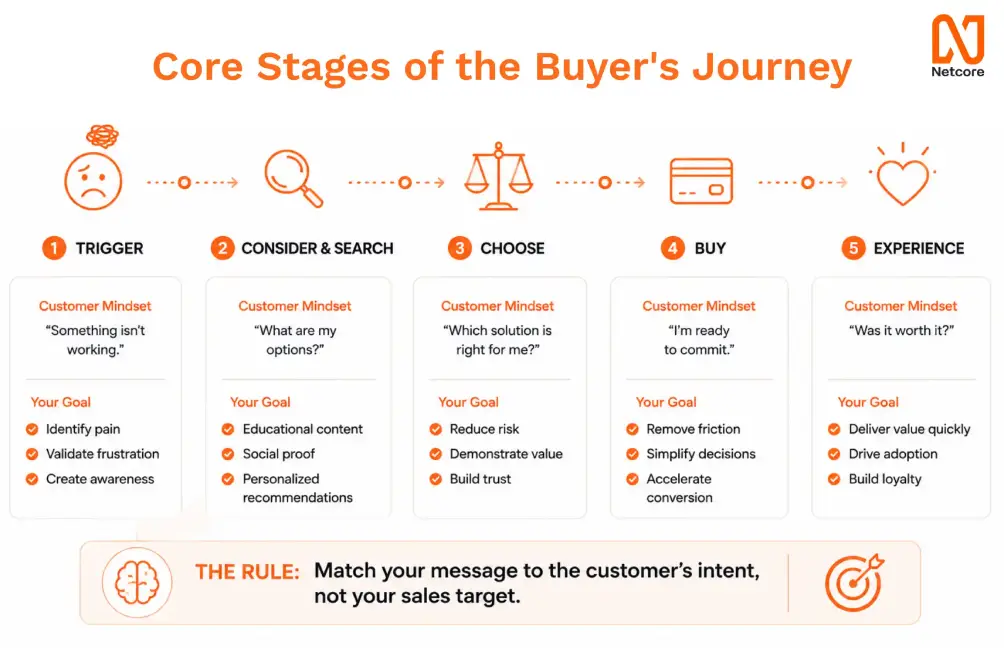
The buyer’s journey is the chronological narrative of your customer’s relationship with your brand. While the specific names of these stages might vary by industry, the underlying psychology remains the same. You need to map the journey not by what you want to sell, but by the state of mind the reader is in at each point.
Start with the Trigger phase. The customer is frustrated; they know something is broken but haven’t framed it as a purchase decision yet. Your map should deploy touchpoints that name their pain and validate their frustration.
Move them into the Consider and Search phases. Here, the customer is exploring solutions and building a mental shortlist. Your orchestration engine should automatically serve educational content, proof points, and personalized recommendations that build mental availability.
Finally, map the Choose, Buy, and Experience stages. This is where you reduce risk, clarify the total cost of ownership, and accelerate time-to-value post-purchase. By mapping these stages accurately, you ensure that your messaging always matches the customer’s exact level of intent.
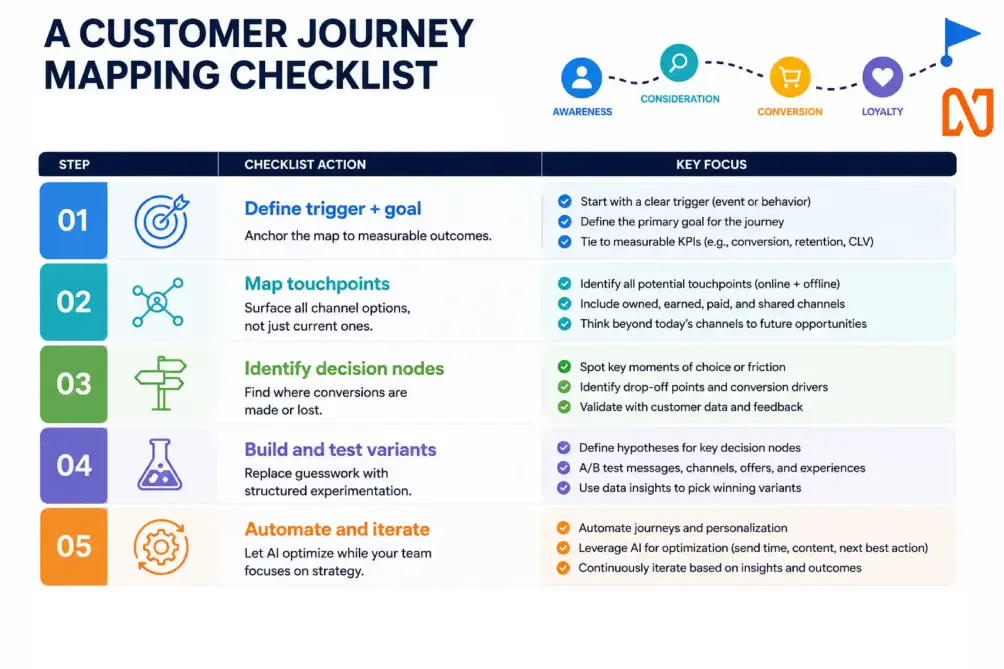
How to Create a Customer Journey Map: 5 Steps
1. Define the Journey Trigger and End Goal
Start by anchoring your map to a specific user behaviour (the trigger) and a specific business outcome (the goal). Ambiguity here cascades into everything downstream.Example: Trigger = cart abandonment. Goal = completed purchase within 72 hours.
2. Map Every Relevant Touchpoint
List every channel interaction a user might have between the trigger and the goal. Don’t just list what you’re currently sending map what’s possible. This is where most teams discover they’re over-relying on one channel and neglecting others.
Typical touchpoints for a cart recovery journey might include: Email → SMS → WhatsApp, or Push → Email → WhatsApp, or variations in timing (30 minutes vs. 2 hours post-abandonment).
3. Identify the Decision Nodes
Within any journey, there are moments where a user either progresses or drops off. These are your decision nodes the points where channel choice, timing, and message content combine to produce (or lose) a conversion.
This is also where static journey maps show their limits. You can guess whether Email→WhatsApp outperforms SMS→WhatsApp, but until you test it at scale, you don’t actually know.
4. Build Variants and Test Paths Systematically
This step separates teams that optimize from teams that hypothesize. Instead of picking one sequence and running with it, build 2–3 path variants that reflect your real strategic questions different channels, different timing windows, different message combinations.
A practical rule: give each path at least 500 impressions before drawing conclusions. And define a single, clear conversion goal per campaign so your variants are actually comparable.
Real example: Bacca Bucci, a D2C footwear brand, ran path optimization across email, web push, WhatsApp, RCS, and SMS for a product view abandonment journey. The result was 14.56% more conversions driven by dynamic path optimization that identified and scaled the winning sequence automatically.
5. Automate Optimization and Review Continuously
Here’s where modern journey mapping diverges sharply from the old model. Instead of waiting for a post-campaign analysis to tell you what worked, tools like Netcore’s Journey Path Optimizer (JPO) powered by its Decision Agent monitor path performance in real time and automatically shift traffic toward the converting sequence.
In a 3-day festive sale scenario, a marketer without this capability might spend Day 0 building variants, Day 1 watching and waiting, and only on Day 2 manually update the journey split with just 24 hours of the sale left to benefit. With JPO, the algorithm spots the winning path on Day 1 and redirects 65% of traffic automatically. By Day 2, 85% of traffic is on the best-performing path with zero manual intervention.
Key Takeaway
The most valuable customer journey maps aren’t documents they’re systems. They surface underperforming nodes, benchmark performance against industry standards, and flag issues directly on the journey canvas so your team can act without digging through reports.
Brands that personalize journeys generate 4.5x more revenue than those that don’t. That number isn’t achieved through better planning alone. It’s achieved through continuous, data-grounded optimization replacing the guess with the proof, and the one-time setup with a living, self-improving journey.
Start with your next high-frequency campaign cart recovery, onboarding, renewal reminders and treat the journey not as something you build once, but something you optimize always. Interested to understand how it would work for your brand? Talk to us.
Explore how Netcore’s Journey Path Optimizer or Decisioning Agent helps teams move from guesswork to proven, high-converting journeys automatically.