


TL;DR
Ecommerce brands don’t lack customer data; they struggle to turn buying signals into the right next action. Across customer journeys, three recurring problems stand out to us after analyzing some leading ecommerce clients: high-intent shoppers drop off before converting, marketing spend targets broad audiences instead of likely buyers, and messages reach customers on the wrong channel or at the wrong time. This blog explores how smarter audience segmentation, AI-powered recommendations, and send-time optimization help brands convert more intent into revenue.
Ecommerce brands have plenty of customer data. What they lack is decisions made from it.
We went through the journeys of thousands of ecommerce customers across brands, categories, and buying cycles, asking one question: where does intent get lost? We weren’t looking at where traffic drops or where a campaign underperforms. We were looking for the point where a customer has already shown enough buying intent that the brand should know better, and still gets the wrong next step.
Take a shopper who views the same product four times in a week, compares three similar ones, adds one to the cart, leaves, and returns two days later. Those signals say what they’re considering, what they’re struggling to decide, and how close they are to buying. In many journeys, the next thing they receive is still a generic email sent to thousands of other customers.
That’s where the interesting problems start to surface.
When you follow these journeys end to end, the same roadblocks keep appearing. High-intent shoppers disappear between consideration and conversion. Marketing spend gets distributed across broad audiences instead of following the strongest buying signals. And customers are often reached through a channel or at a time that doesn’t match how they actually engage.
They look like three separate problems, but they share one gap: brands have become very good at collecting intent signals and still act on them too slowly. So we looked at what the brands that convert more of that intent do differently: how they spot the signal, how do they segment, and how fast they turn it into the next customer action.
Top 3 Problems Faced by Ecommerce Brands & How to Solve
Problem 1. High-intent shoppers slip through the funnel without converting
The first leak is the one closest to conversion.
A shopper views the same product twice, checks another product page, adds an item to the cart, and disappears. The signals are obvious. Most journeys aren’t built to respond to them, so a viewed product, an abandoned cart or an unfinished checkout ends with a visitor who clearly wanted something and has no way back to the brand.
What the winning journeys do differently
1. Recognize the signal.
Take Fabindia, India’s largest private retail platform for handcrafted products. It sells ethnic apparel, home furnishings, wellness products, organic foods, and personal care across more than 350 stores in eight countries, and its online store draws nearly 1.1 million visitors a month. The foundation was strong, with trusted products and loyal customers.
The problem? Browsing and intent data from the web and app weren’t fully captured, and outreach leaned on generic blast campaigns across email, WhatsApp, app, and web. Their marketing team kept sending retargeting emails and push notifications for reminders on abandoned carts but got poor engagement.
What changed?
The team started by mapping shopper signals across web and app: product views, time spent on pages, cart activity and past purchases. To identify those moments, Fabindia created precise customer segments based on behavior, price sensitivity, and category affinity using Netcore’s Audience Agent. Then they built more than seven automated journeys that fire on what a shopper does, or doesn’t do, in real time. Registered customers get WhatsApp and email at optimized send times. Anonymous visitors get a push nudge to register, and once they do, they enter the same journeys.
In 120 days, the cart and product view abandonment journeys contributed about 50% of Fabindia’s digital revenue contribution. Across all its journeys and campaigns, digital revenue contribution roughly doubled, at a 9X ROI.
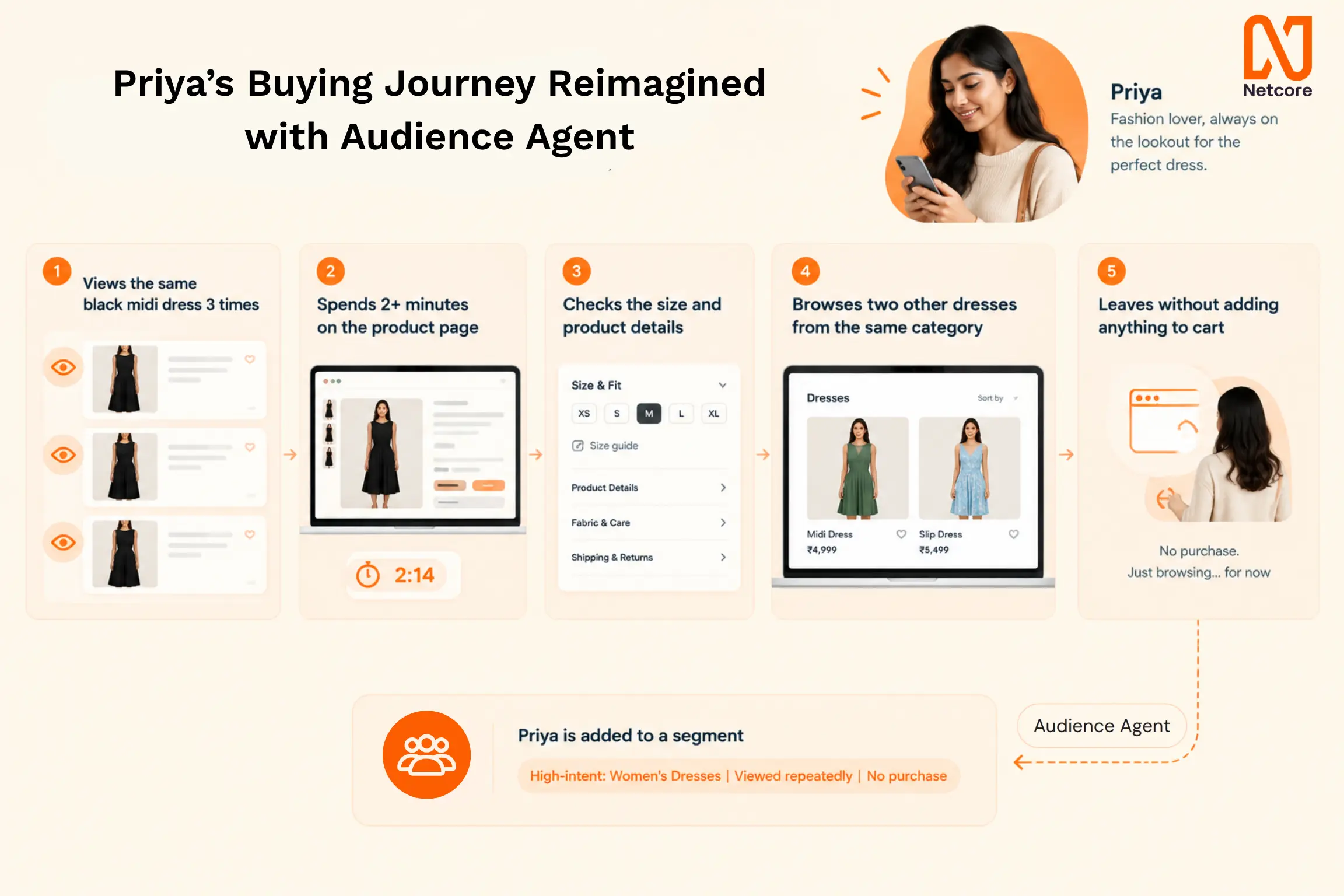
Say Priya is shopping on Fabindia for a new dress. In one session, she:
- Views the same black midi dress 3 times
- Spends 2+ minutes on the product page
- Checks the size and product details
- Browses two other dresses in the same category
- Leaves without adding anything to the cart
No single action proves much. Together they point to high purchase consideration. Instead of leaving Priya in a generic “website visitors” audience, Dynamic Segmentation can move her into a more relevant one:
High-intent: Women’s Dresses | Viewed repeatedly | No purchase
2. React while intent is fresh.
Build live segments around the moments that signal intent: viewed but didn’t buy, added to cart but didn’t check out, viewed three or more products. When a shopper lands in one, trigger the next action immediately instead of waiting for the next scheduled campaign. Journey Builder and Journey Path Optimizer (JPO) handle this.
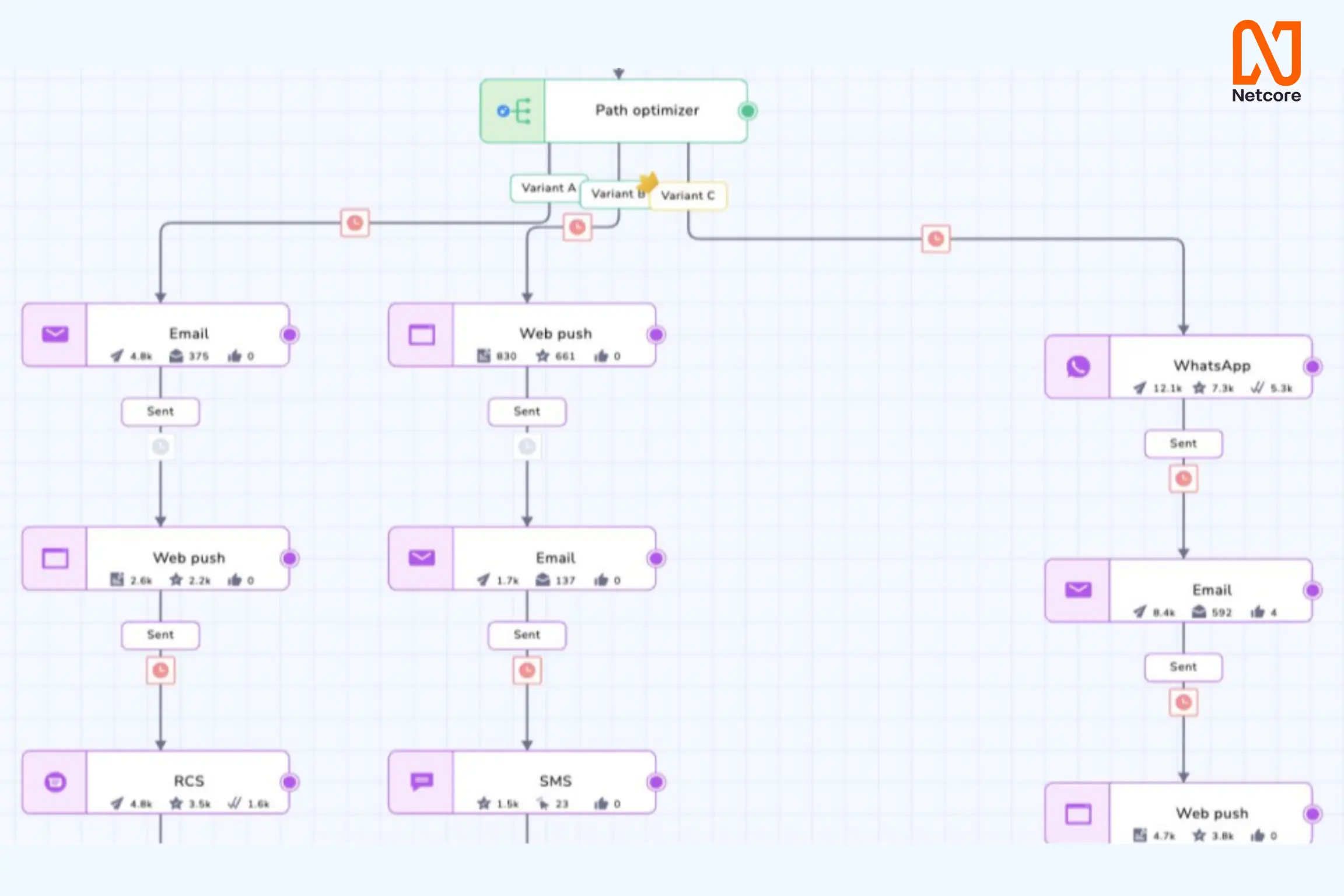
JPO is a new AI-powered capability built into Journey Builder. It tests multi-channel journey paths against each other, finds the highest-converting one, and scales it automatically. It optimizes the entire journey and keeps improving it without anyone running the analysis by hand.
Bacca Bucci, working with us, shows what this looks like in practice.
Before
Bacca Bucci followed up on product views by email only. The journey converted at about 4.2%. Improving it meant manual work: the team spent around three hours a week analyzing message variants to see what was working.
After
With Journey Path Optimizer, the team tested two multi-channel paths against each other: email then push, and email then WhatsApp. The AI read the results and, within 48 hours, moved 72% of traffic to email then WhatsApp. Conversions on the journey rose 14.56%.
3. Remove the friction.
Bring recently viewed products back into the experience with the help of conversion triggers. Use on-site nudges, recommendations, and product discovery to help shoppers continue where they left off. Use the conversion trigger alongside events like exit-intent, cart reminders, and web pop-ups to catch drop-offs and nudge return visits or checkout.
4. Recover across channels.
If the customer has opted in, continue the journey through push, email, WhatsApp, or RCS, using the channel most likely to get a response rather than sending everything everywhere.
5. Learn from the recovery.
Measure the complete journey from signal to purchase, not just message clicks. Use the drop-offs to refine triggers, timing, recommendations, and CTAs.
The principle is simple: don’t react to the customer after the moment has passed.
Problem 2. Marketing spend doesn’t follow customer intent
What does the above line mean? Marketers end up spending on channels that don’t matter, which ends up in wasted marketing cost, instead of putting it on channels that matter. This budget leak sits before conversion, and it quietly pushes acquisition costs up.
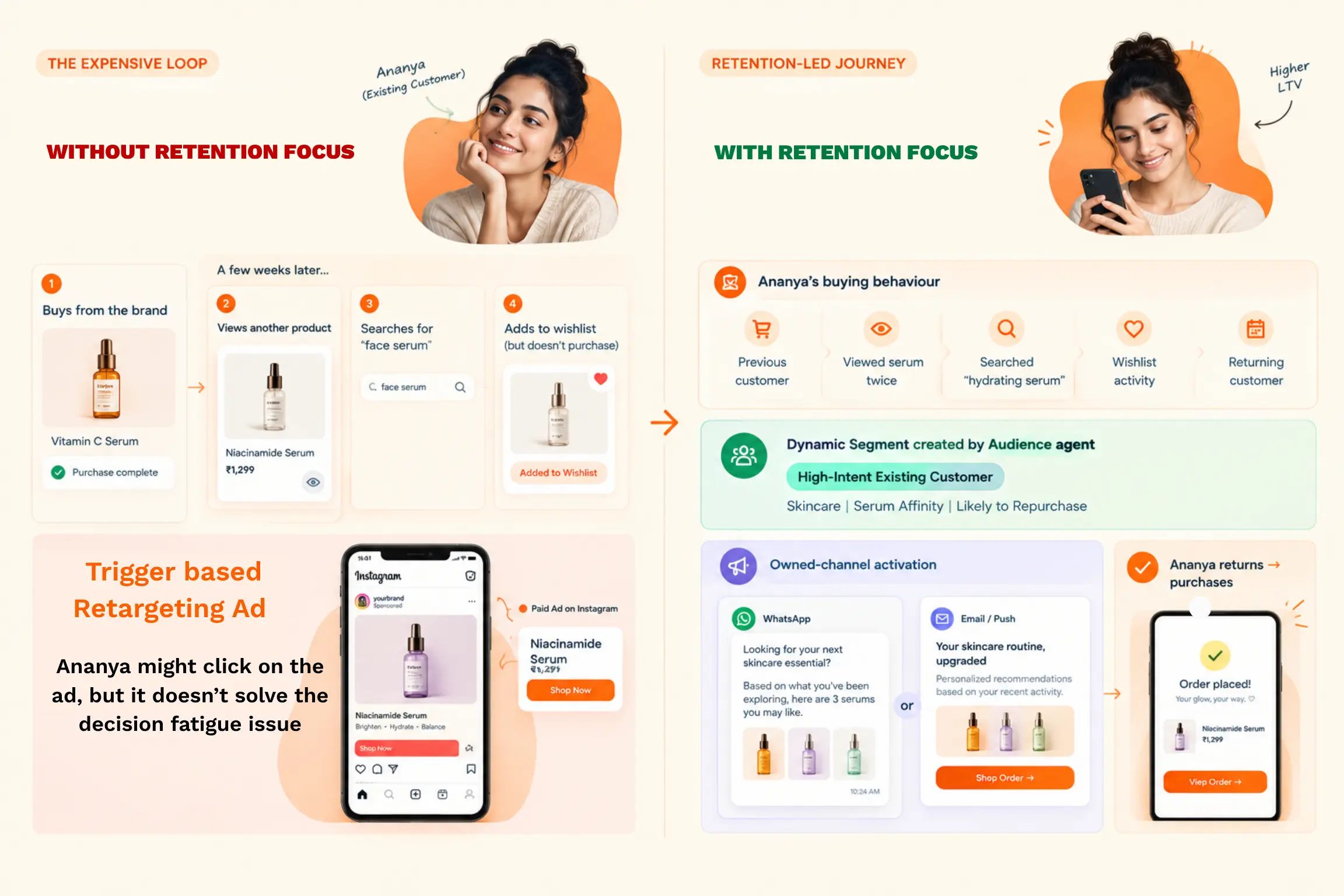
Brands keep spending against broad audiences while their highest-intent customers sit in their own first-party data. Segments get built around who customers are (age, location, demographics) and ignore what they’re showing they want. The loop that follows is broad audience, paid reach, repeat acquisition, rising spend, when the opportunity is often already in the customer’s behavior.
One brand that stood out to us here was Plum Goodness, a D2C skincare brand founded in 2014. It is vegan and cruelty-free, sold in 300+ cities and at 25,000+ retail outlets. Acquisition was strong, but engagement ran on broad logic, “all users” or “last opened”, which couldn’t separate loyal high-value customers from new ones. Retention-led growth had plateaued.
Plum changed what an audience meant.
Before
Plum’s acquisition was strong, but engagement ran on broad targeting logic: “all users” or “last opened.” That logic couldn’t tell a loyal, high-value customer from someone who had just signed up. With no behavioral segmentation, repeat purchases were hard to drive consistently, and retention-led growth plateaued.
After
With Netcore’s RFM analytics, Plum segmented customers by how recently they bought, how often, and how much they spent. It activated all nine core RFM segments and split them into 25+ micro-segments. Dormant users got win-back journeys, and high-value customers got loyalty rewards. Cohort analysis on top showed which repeat-purchase patterns were worth replicating across campaigns.
Messages went out on WhatsApp, RCS, SMS and app push. Offers like Plum Fridays cashback and festive gifting each went to a specific RFM cohort and not the full list.
Impact
- Repeat purchases rose 1.4x
- Revenue from repeat purchases rose 1.7x
- Website repeat purchases grew 130% between August and October
- App repeat purchases grew 140% over the same period
Each customer now got a message based on their own buying history, whereas earlier everyone got the same one.
What winning journeys do differently
1. Capture intent continuously. Pull product views, searches, wishlists, carts, purchase history, recency, affinity, and engagement into one view of each customer.
2. Build audiences around behavior. A single “fashion shoppers” audience hides too much. Split it into dynamic cohorts such as high-intent footwear shoppers, deal seekers, and high-value customers whose engagement is declining.
3. Add predictive signals. Propensity models flag who is likely to purchase, churn, respond to an offer, or spend more per order.
4. Cut unnecessary paid reacquisition. If an existing customer already shows strong intent and can be reached on an owned channel, don’t pay to reach them again by default.
5. Get more from the traffic you’ve already bought. Personalized recommendations, AI-powered search, dynamic web experiences, exit-intent messages and relevant product nudges help existing customers finish their next purchase. Each additional order from an acquired customer raises the revenue earned on the original acquisition spend.
6. Aim past the repeat purchase. A second order is what changes the game. Purchase frequency, basket size, category expansion, and lifetime value are what raise the revenue from each customer the brand already paid to acquire.
Targeting starts with one question: who is showing us, right now, that they’re worth acting on?
Problem 3. Brands are optimizing channel volume instead of channel value
This leak is easy to miss because the marketer’s dashboard shows activity everywhere.
An email goes out, then a push notification, then a WhatsApp reminder, and a few hours later another offer. The brand counts four touchpoints and a busy campaign calendar. The customer sees four requests to buy.
They may engage at first. Then repeated messages, irrelevant offers, bad timing, and too many reminders add up to message fatigue. They stop opening notifications, stop paying attention to the brand, or leave altogether.
Brands don’t have too few channels. They treat every customer as if more communication were the answer. One customer needs a reminder, another needs a better recommendation, and a third is already saturated. Sometimes the right action is to send nothing.
Let’s understand how to personalize messages that convert better, with the following e-commerce brand:
SuperIndo is an Indonesian grocery retailer that has operated since 1997, in partnership with Ahold Delhaize and Salim Group. More than 10,000 employees support it, and its tagline is “fresher, affordable, and closer.” Online, it wanted five things: more of its online transactions coming through the app, an active member base, less dependence on in-house IT, more engagement from new and existing app users, and limited-time promos that customers saw as worth acting on.
Before
Until Q2 2024, resource limits kept SuperIndo on basic app push notifications. Timely communication depended on manual effort from a small team and on IT involvement. Every customer got the same kind of message, and limited-time promos had low perceived value.
After
From Q3 2024, with Netcore’s guidance, SuperIndo started testing:
- App push variants. Push templates in four formats (text only, text with image, countdown timer, image carousel), used to bring offline users back to in-stock grocery items in the app.
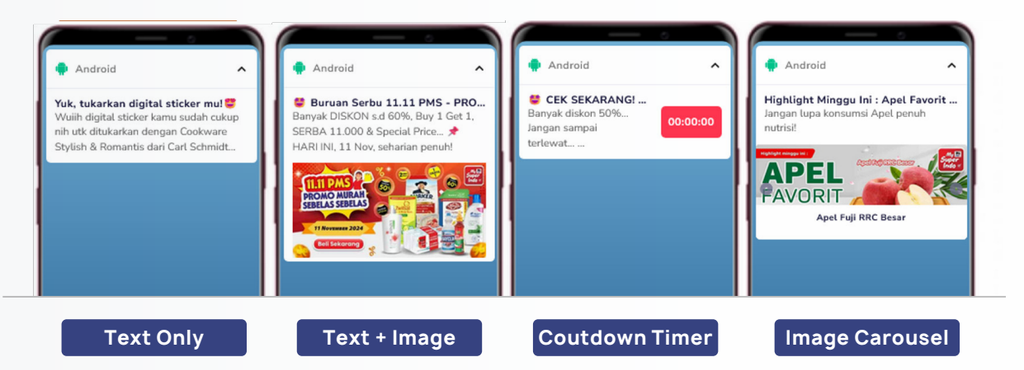
Different engagement formats introduced to the brand
- In-app messages. Promo and limited-time deal messages, with cutout designs on the pop-ups that drove additional absolute conversions.
- Automated journeys. Reactivation for users dormant in the last 30 days, instant conversion of window shoppers, cart abandonment handled within a day, and retargeting 20 days after each customer’s last purchase. Simple automation cut the manual work.
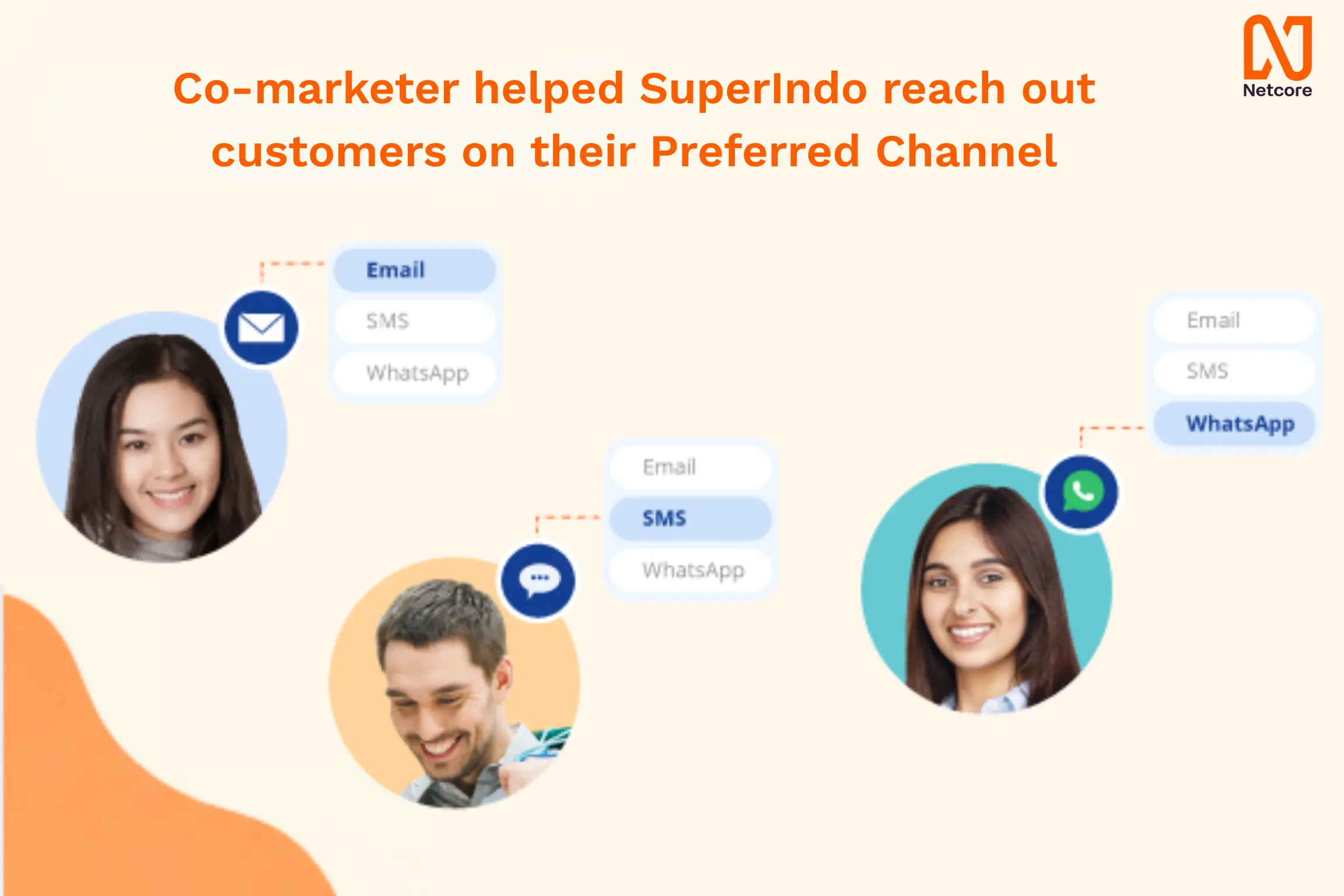
- Co-Marketer. Preferred Channel, Send Time Optimization, and Subject Line Optimization tuned how each customer was reached.
Impact
By December 2024, the results were visible. In the second half of FY24-25:
- Absolute conversions rose 10x
- Average repeat purchases reached about 43%
- SuperIndo reached about 90% of its online transaction target
The change was from one message for everyone to journeys that responded to what each customer did, or didn’t do.
What winning journeys do differently
1. Understand the customer’s trajectory. Look past the last click. Analyze what the customer has browsed, bought, engaged with, ignored, and responded to over time. That separates real purchase intent from fading interest or message fatigue.
2. Let context decide the next action. The same promotion shouldn’t trigger the same message for everyone. Before deciding what happens next, weigh recent behavior, past engagement, purchase history, channel preference, and how earlier campaigns performed.
3. Make every interaction earn its place. The Decisioning Agent picks the message, channel, creative, timing, and frequency for each customer. It can send, delay, switch channels, reduce frequency, or suppress the communication entirely.
4. Know when to stop asking. After several messages with no engagement, another reminder can make the experience worse. Pausing until a stronger intent signal shows up is the smarter move.
5. Learn from what happens. Every interaction is feedback: opened, ignored, purchased, unsubscribed, or answered on another channel. The Decisioning Agent learns from these outcomes and adjusts future decisions.
Reaching customers on every available channel was never the point. A message should arrive at the right time, be relevant, and be worth the customer’s attention. Sometimes the most customer-friendly message is no message at all.
Conclusion
After digging through thousands of ecommerce journeys, one thing becomes clear: the challenge isn’t a lack of marketing activity. Most brands already have the data, channels, campaigns, and customer touchpoints.
The bigger challenge is making better decisions across all of them, fast enough to matter.
This is where Agentic Marketing is changing how ecommerce teams can operate.
Instead of relying on marketers to manually build every segment, decide every audience, select every channel, personalize every recommendation, and optimize every campaign, AI agents can continuously work across these decisions.
Segment customers based on real-time behavior, affinity, and propensity.
Move beyond broad demographic audiences to identify customers based on what they are interested in, how likely they are to purchase, their value, and their changing behavior.
Make product discovery more relevant with AI-powered product recommendations.
Use browsing, purchase, and product-affinity signals to surface products that are more likely to help a customer discover, compare, or convert.
Optimize when and where customers are reached.
With AI-powered send-time optimization and the Decisioning agent, campaigns can adapt to individual engagement patterns rather than sending the same message to everyone at the same time.
Respond faster when the stakes are high. Festive seasons, flash sales, and other short revenue windows leave little time to react. During these periods, Insights shows what is shifting in customer behavior, campaigns, and performance, so marketers can catch opportunities and act before the window closes.
Put together, the pieces make an autonomous marketing system that observes, decides, executes, and learns in a continuous loop. Marketers keep the decisions that need strategy, context, and judgment.
For ecommerce brands, that’s what Agentic Marketing offers. Campaigns stay in place, and the way the whole customer journey is managed around them changes. Our Martech engineers can walk you through how it works in practice. Book a consultation.


