

Turn browsers into buyers, buyers into regulars
Connect store aisles and screens seamlessly
Earn trust with secure, compliant engagement
Move enquiries from showroom to ownership
Keep audiences watching, reading, subscribing
Fill bookings, bring travellers back again
Lift enrolments, keep learners on track
Scale engagement fast, without scaling cost
Embed engagement into your product, ship faster

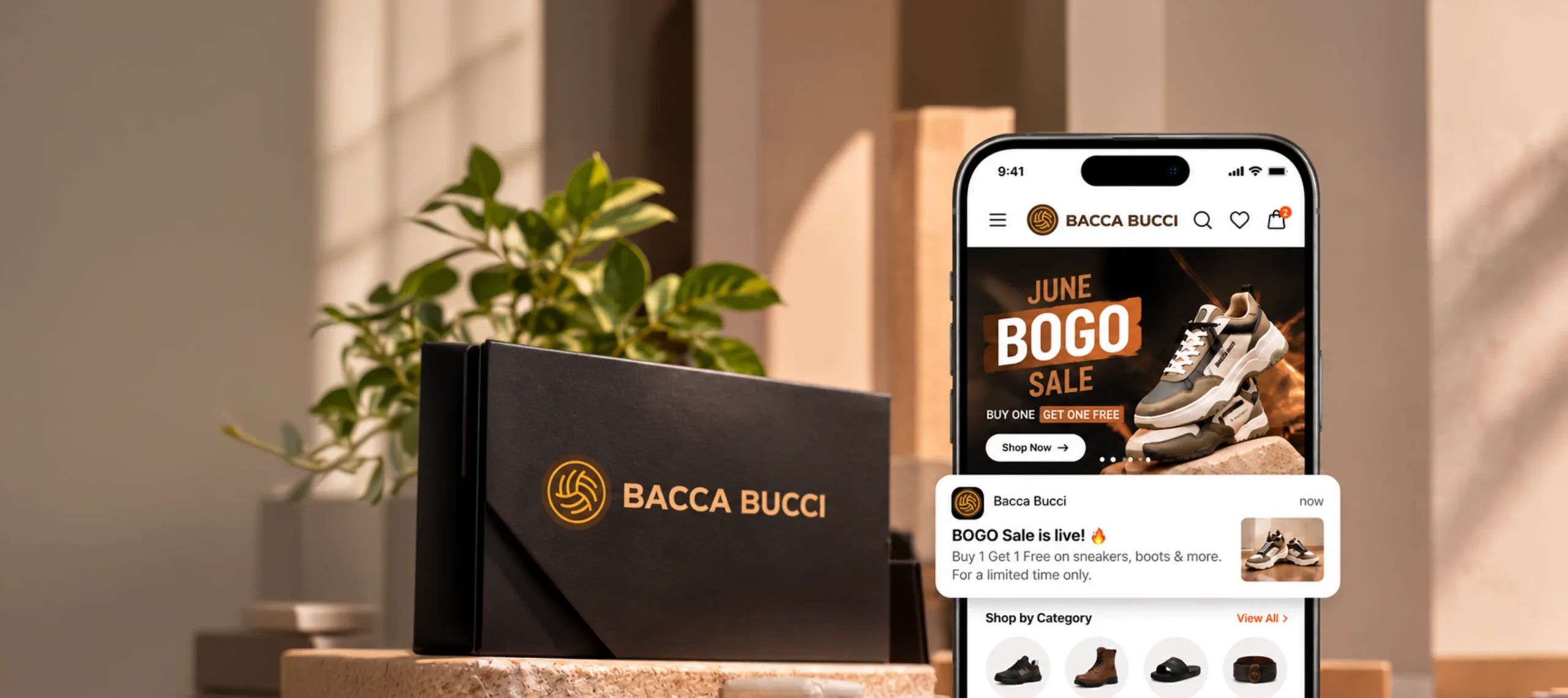
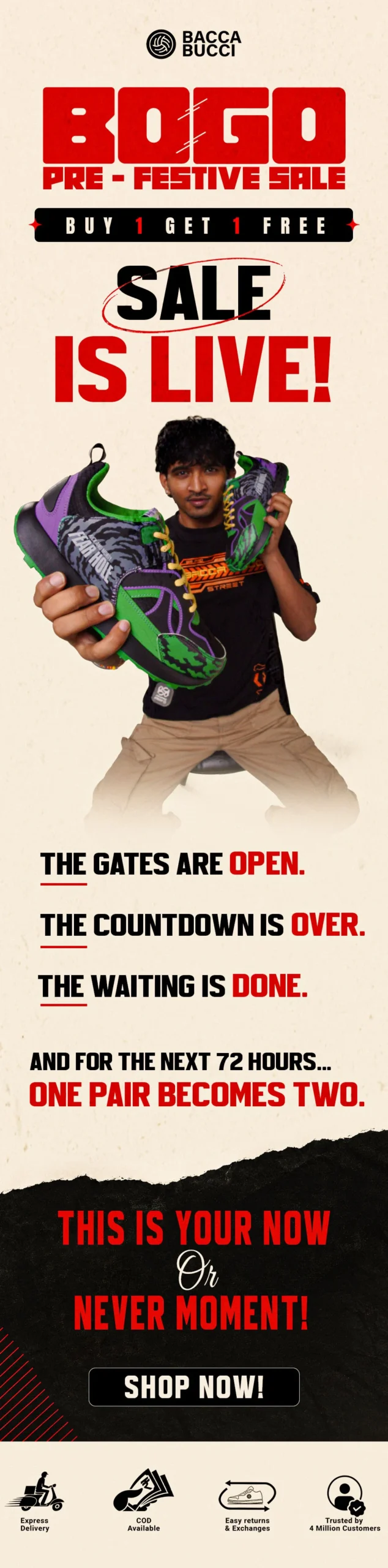
Bacca Bucci is one of India’s fastest-growing homegrown footwear and accessories brands, known for design-led sneakers, boots, and lifestyle footwear priced for India’s underserved mid-premium segment. Heading into its June 2026 BOGO (Buy One Get One) Sale, the brand faced a common sale-period risk: how do they broadcast the sale offer without risking low-intent shoppers fatigue, optimizing messaging costs, and keeping the campaign’s actual return intact.
Working with Netcore, Bacca Bucci used AI-powered affinity and propensity models to continuously score customers on discount affinity, purchase propensity, repurchase likelihood, and predictive lifetime value, then route WhatsApp and Email communication only to the resulting high-intent segments. The result was a sale campaign built on precision rather than volume.
Founded in Delhi in 2013, Bacca Bucci has grown into one of India’s leading D2C footwear and accessories brands, built around the idea of giving trend-conscious customers design-led style without a premium price tag. The brand has served over 45 lakh customers to date, ships more than 4,000 orders a day, across a catalog of roughly 3,700 SKUs spanning sneakers, boots, athleisure, belts, and wallets.
India’s footwear market is large and expanding fast, projected to grow from $17.9 Bn in 2024 to $45.5 Bn by 2032, but it remains split between mass-market players competing on price and established global brands competing on premium positioning. Homegrown, digitally-native brands like Bacca Bucci compete in the crowded middle, where sale events such as BOGO promotions are a key growth lever but also a high-risk one: a poorly targeted blast can just as easily erode margins and annoy customers as it can drive revenue.
For Bacca Bucci, the question heading into its June sale wasn’t whether to run a promotion, but how to make sure it reached the customers actually likely to convert.
For Bacca Bucci’s CRM team, the June BOGO Sale was a familiar opportunity with a familiar constraint: a fixed, short window to convert demand into revenue, and a customer base large enough that reaching everyone with the same message was easy, but reaching the right person with the right message at the right moment was the harder, more valuable problem to solve. The team knew that in a sale this size, precision would matter more than reach; a broad send could still produce opens and clicks, but wouldn’t distinguish a customer genuinely close to buying from one who simply happened to see the message. With the sale’s short runway leaving little room to course-correct once campaigns went live, the opportunity was to identify high-intent shoppers upfront and put the sale’s full weight behind reaching them well. Specifically, the brand wanted to:
Without a data-driven platform, segmentation for a base this size meant working in broad strokes, recent buyers, non-buyers, a rough geography or category split, since anything finer would have meant manually cross-referencing browsing history, past orders, and engagement across spreadsheets. That approach works well for always-on communication. A time-boxed sale like BOGO called for something sharper: a way to know, before a single message went out, which customers were genuinely close to buying, so the sale’s full marketing effort could be pointed at them from day one rather than spread evenly across the base.
Bacca Bucci worked with Netcore to replace manual audience selection with AI-powered affinity and predictive models that continuously scored, layered, and routed customers, covering the sale from pre-launch targeting through post-sale retention.
Sending the BOGO offer to the full database meant reaching plenty of passive browsers alongside genuine buyers, driving up communication cost without a matching lift in conversion. Netcore’s AI Affinity Models addressed this by reading each customer’s historical browsing behavior, purchase patterns, product interactions, discount responsiveness, and engagement signals to produce a Discount Affinity Score. This isolated customers with a medium-to-high tendency to buy when a value-driven offer showed up, rather than relying on recency alone
A single score is still a guess. Netcore layered in three more signals on top of the initial affinity score:
Netcore combined all four signals, discount affinity, purchase propensity, predictive CLTV, and repurchase likelihood, with historical engagement behavior into one high-intent pool, so every customer targeted met more than one signal of genuine intent rather than a single loosely-correlated one.
This qualified pool was then split by channel. WhatsApp received the full high-intent audience, paired with urgency-led, offer-focused creative built for a fast scroll. Email was narrowed further, to customers with a history of actually opening and clicking previous emails, and soft bounces, hard bounces, and unsubscribed contacts were automatically excluded before every send, protecting sender reputation and deliverability rather than leaving that hygiene to a manual list-cleaning step.
WhatsApp and Email ran as a coordinated sequence rather than isolated blasts, creating multiple touchpoints to re-engage shoppers who hadn’t yet converted and deliver personalized sale messaging at the right moment across the BOGO campaign’s lifecycle, rather than a single one-shot announcement at launch.
Using Netcore’s RFM (Recency, Frequency, Monetary) segmentation, customers were grouped into cohorts, Loyal, At Risk, and New Enthusiasts, based on recent WhatsApp and Email opens, clicks, and purchase behavior. That gave the team a lifecycle structure for re-engagement, timely promotions, and personalized journeys that outlasted the sale itself, rather than starting from zero again for the next campaign.

Results are best read as three connected outcomes: how efficiently the sale spent its marketing budget, how much of total revenue CRM channels drove, and how well the AI-targeted audiences actually engaged.
Targeting only high-intent, multi-signal audiences meant sale spend converted at a level broad targeting couldn’t match:
Precision targeting didn’t just improve efficiency, it grew the CRM channel’s actual weight in the business:
Because messaging was matched to intent rather than sent broadly, the audiences that did receive campaigns responded at a noticeably higher rate:
Bacca Bucci plans to extend the same AI-led approach, affinity and propensity scoring, layered intent signals, and RFM-based retention, beyond BOGO to other sale events and everyday lifecycle marketing, treating this campaign as the template rather than a one-off effort.

Vaman Sahni, Growth Marketing and CRM lead
“Our partnership with Netcore has been instrumental in driving our business's success. The CSM Team has not just been a vendor but strategic partners in our journey. We've witnessed remarkable results and anticipate further growth, with Netcore's contribution yielding an 15X ROI, accounting for a significant portion of our overall revenue.”
Please wait while you are redirected to the right page...