


Here’s how to prove it
Clicks are easy to measure. Open rates are easy to track. Attributed revenue can be neatly packaged into a dashboard.
But ask a more fundamental question “How much of this revenue actually happened because of our marketing?” and the answer isn’t always clear. That’s the real measurement challenge. Without a clear view of incremental impact, marketers are left reporting what happened, rather than proving what their marketing changed.
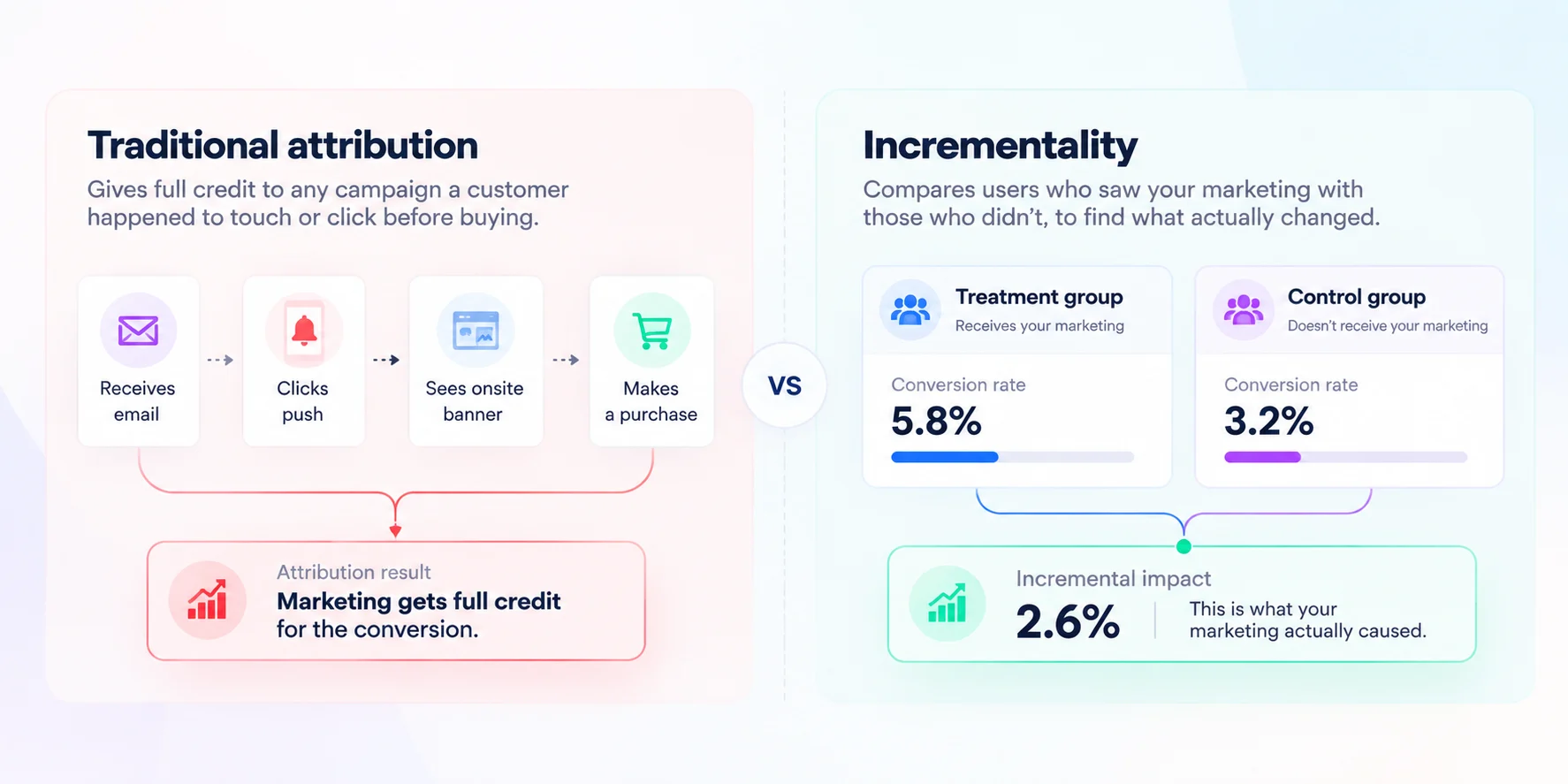
If you are running multi-channel marketing programs across email, push notifications, WhatsApp messages, and tailored web experiences in Netcore, you already have plenty of activity data. What you do not have, if you are still relying on traditional click-based attribution, is actual proof. Traditional click models give full credit to any campaign a customer happened to touch or click before buying. For instance, if a loyal customer receives a promotional push notification while already browsing your app to buy their regular restock, traditional tools credit that sale entirely to the push message. It makes no difference whether your message actually changed their behavior or if they were already standing at the checkout line with their credit card in hand. Global Control Groups (GCG) in Netcore replace that guesswork with a real counterfactual: what would have happened if we had done nothing at all?
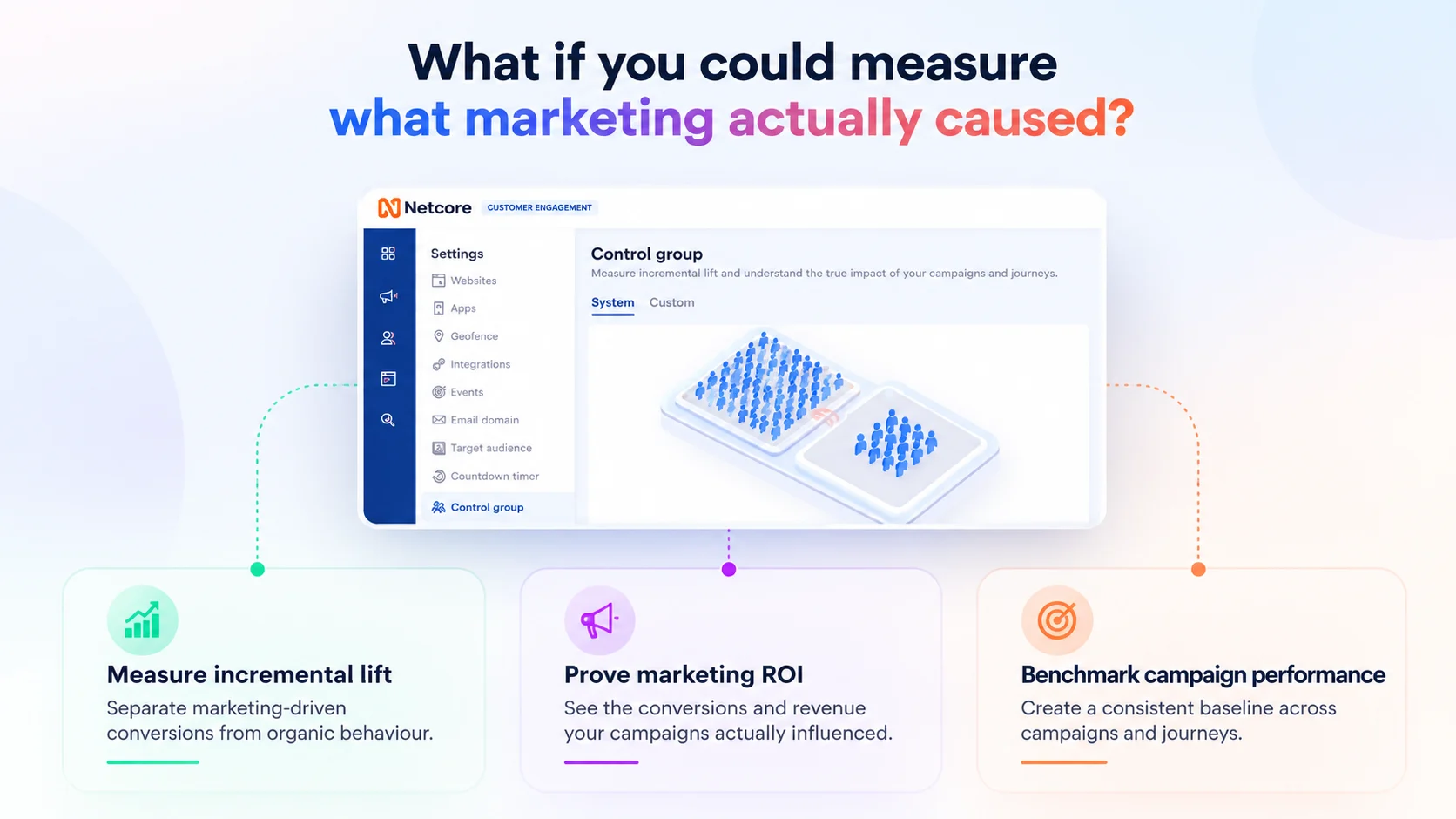
The Real Question: What Did Marketing Change?
Traditional click-based attribution is a generous storyteller. A customer lands on your homepage, sees a bold hero banner announcing a seasonal sale, ignores clicking it, and completes a purchase a short while later. Traditional attribution hands that homepage banner zero credit simply because there was no direct interaction. The only question standard analytics tools know how to ask is, “Did this customer click before converting?” That surface-level question completely fails to capture the true subtle influence of an onsite banner, a social proof nudge, or a personalized recommendation that worked exactly as intended.
A Global Control Group shifts your focus away from credit-claiming analytics and asks the exact question your leadership team is asking: How many additional conversions did this marketing program actually generate?
Instead of relying on a patchwork of temporary campaign-level control groups or click-based rules, a Global Control Group holds out the same population across your entire database. This audience is kept permanently, consistently, and intentionally unexposed to any marketing communications:
- Treatment Group (TG): The vast majority of your active audience, exposed to your multi-channel Netcore campaigns, automated journeys, and web personalization experiences.
- Global Control Group (GCG): A statistically sound, panel-level holdout population kept completely unexposed to marketing communications across every channel.
The resulting gap in conversion rates between these two groups is not a proxy or an estimate. It is your true incremental impact, measured directly from real user behavior.
Core Use Cases: What Global Control Groups Measure
Establishing a consistent, panel-level holdout unlocks three primary use cases that traditional click attribution models completely overlook:
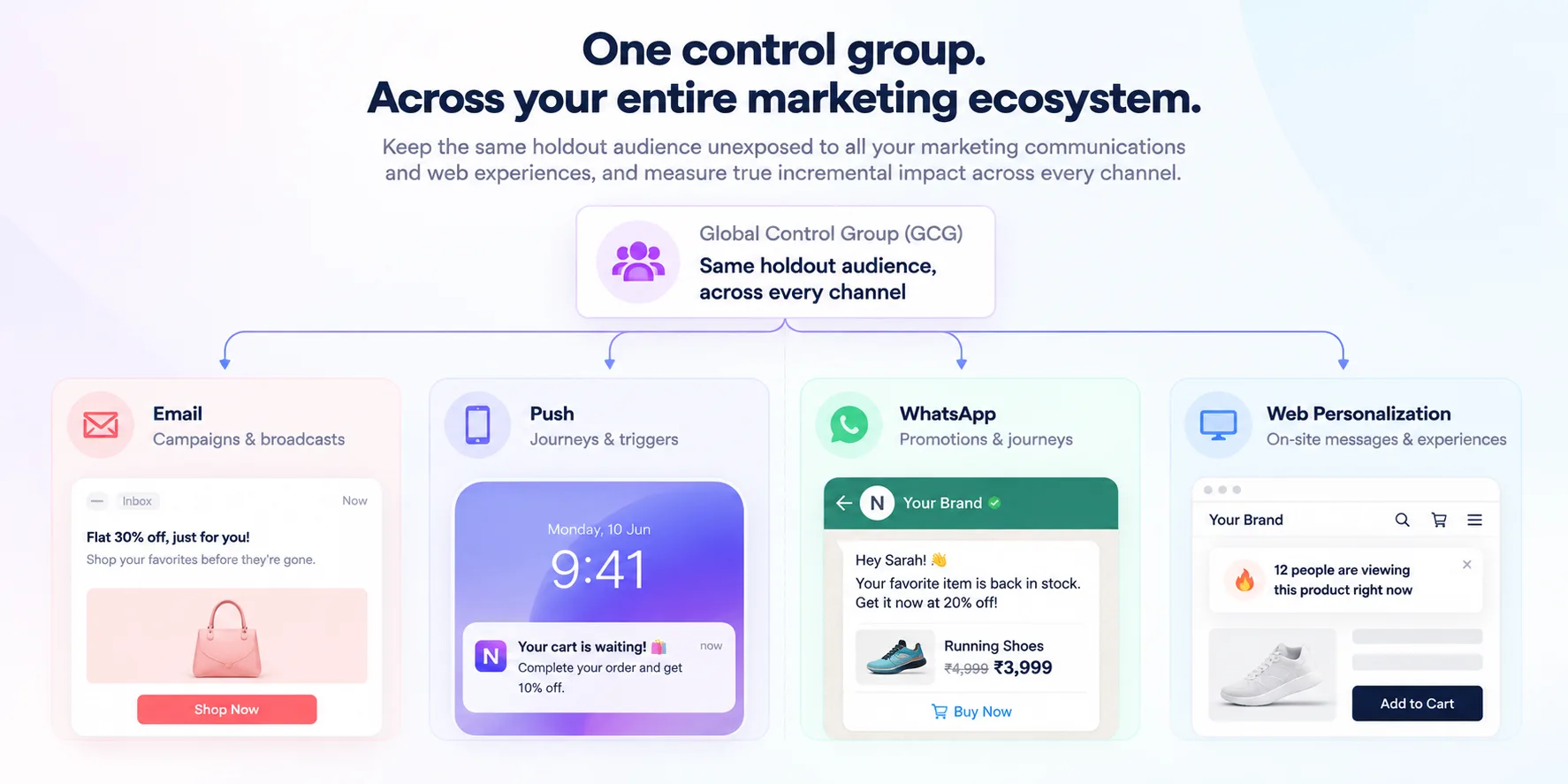
- Netcore-Level Revenue Incrementality Across Channels: Measure the true net-new incremental revenue generated across your entire Netcore marketing engine. Instead of tracking individual channels in isolated silos, you get a single baseline that rolls up Email, Push, WhatsApp, and App performance into one source of truth.
- Web Personalization & Unclicked Conversions: Track real conversion uplift for onsite personalization campaigns, including social-proof nudges, contextual banners, dynamic recommendations, and inline web widgets. GCG captures conversions from users who view these experiences and complete a purchase without ever making a direct click.
- Consistent Panel-Level Control: Maintain a single, unbiased baseline across your whole database. Holding out a continuous panel eliminates moving targets, ensuring every comparison between exposed and unexposed users is fair and accurate.
The Revenue Your Attribution Model Cannot See

Direct messaging channels like email and SMS are relatively simple to measure because there is always a direct link or button click to point to. Onsite personalization, however, has always suffered from a massive reporting handicap, and it has been quietly underfunded in marketing budgets because of it.
Imagine a shopper landing on your product page. Netcore dynamically displays a subtle social-proof nudge reading, “12 people are viewing this item right now.” The user reads the message, feels a subtle pulse of urgency, continues browsing the site, and checks out a few minutes later without ever clicking the banner itself.
Standard click-based attribution logs this high-converting interaction as nothing. Because there was no explicit click, standard tools give the homepage banner zero credit. As a result, high-converting onsite banners and dynamic recommendations end up on the chopping block during quarterly budget reviews simply because traditional analytics could not prove their value.
Global Control Groups eliminate this reporting blind spot entirely. GCG does not rely on a click; it compares the overall conversion rate of everyone who was exposed to the nudge against the holdout group who never saw it. You simply present the clear difference in conversion behavior between the two groups, proving that your onsite experience directly generated a net-new uplift in revenue.
Stop Reconciling Metrics. Start Reporting Outcomes.
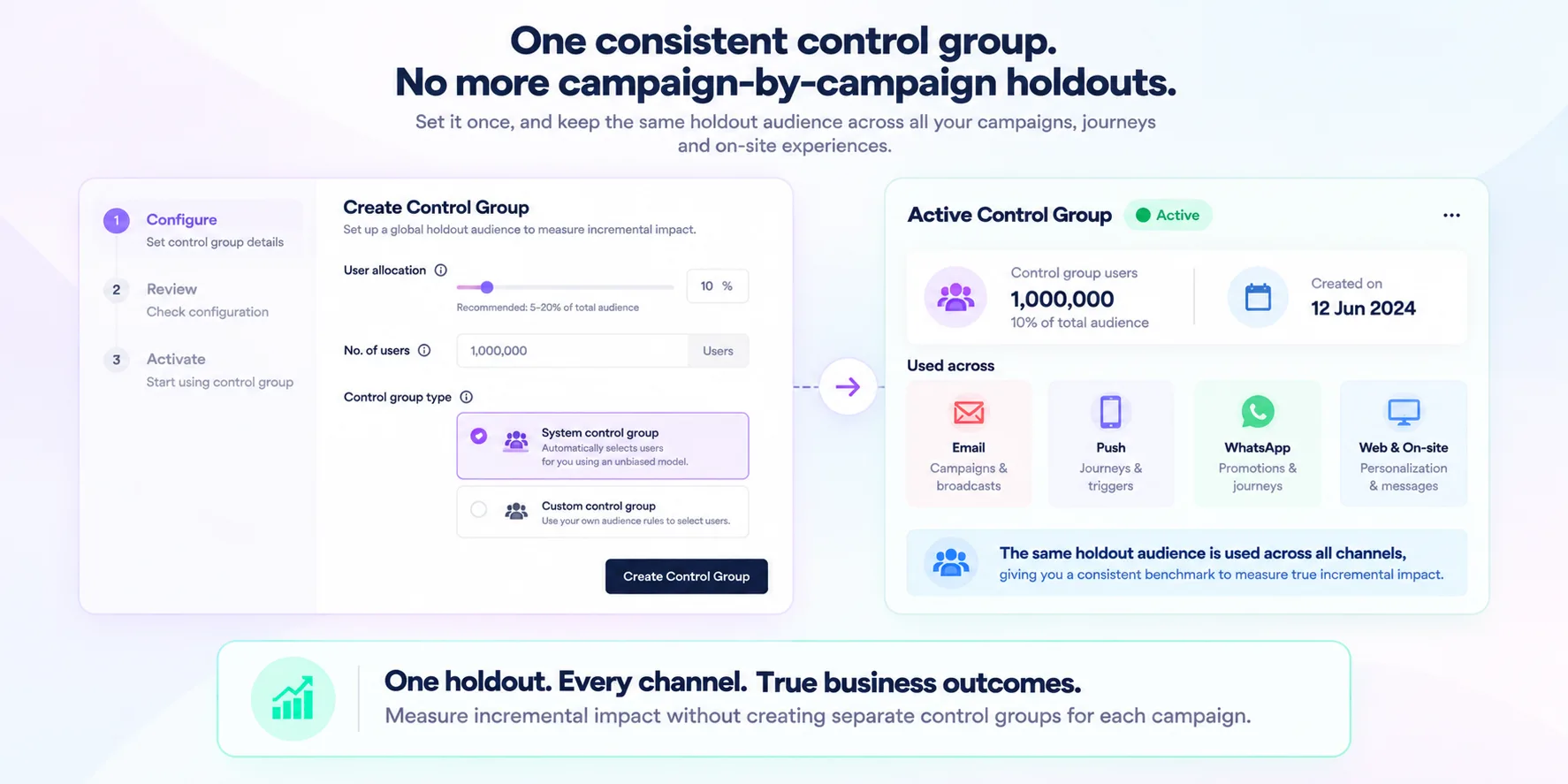
Running fragmented, isolated A/B tests creates a chaotic web of moving baselines. If your email team tests a promotion against a temporary holdout this week while your website team runs a separate test with a different holdout next week, your metrics are constantly moving. Every time a campaign ends, its control group vanishes, leaving your team drowning in a pile of disconnected micro-metrics that never add up to a cohesive story leadership can act on.
A Global Control Group creates one consistent holdout benchmark across your entire marketing stack:
- More Relevant Attribution Logic: Evaluates onsite and personalized channels by tracking overall conversion behavior rather than relying strictly on direct clicks.
- Defensible Net-New Revenue: Reports true added revenue rather than stacking attribution credit that double-counts sales across multiple channels.
- Easy to Understand User Flows: Evaluates performance clearly from a holistic user flow perspective because both exposed and control groups start from the exact same reference point.
- Saves Manual Configuration Effort: Marketers no longer need to spend hours manually configuring control group percentages for every individual campaign, trigger, or journey separately. Netcore manages the holdout panel automatically.
One crucial factor worth keeping in mind: a Global Control Group is only as credible as its size and duration. Running a holdout panel through a full purchase cycle ensures you capture real decision-making. This guarantees the gap you observe represents genuine behavioral shift rather than temporary statistical noise, giving you a number you can confidently defend in front of the board.
The Shift: From “We Think This Worked” to “Here Is What We Caused”
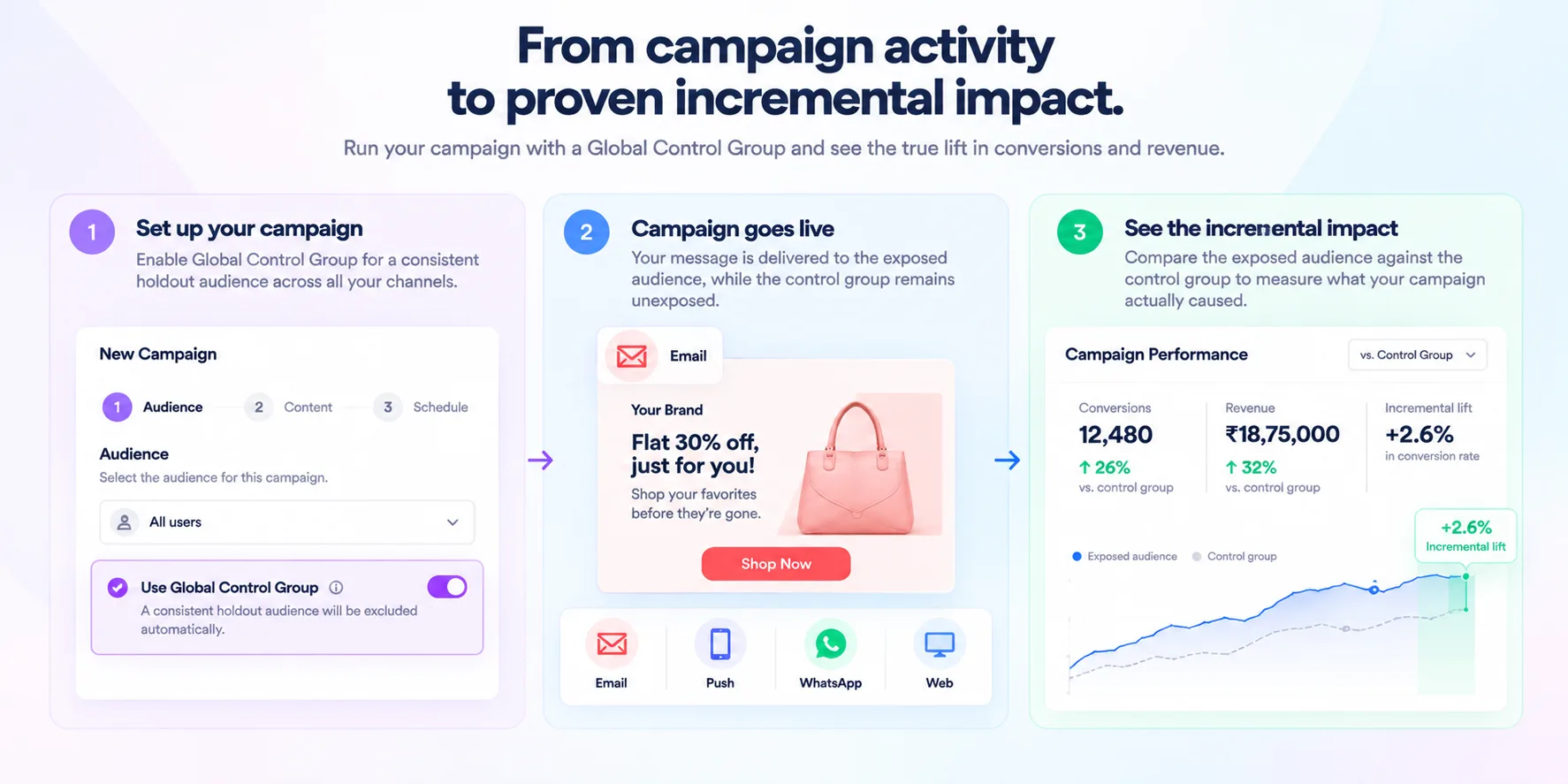
When you move beyond credit-claiming attribution models, your entire growth narrative changes. Instead of defending your strategy with surface-level click metrics, Global Control Groups empower you to justify fair, net-new business outcomes to leadership by running experimentation on consistent audiences. You can track and validate the real conversion contribution of web personalization campaigns, calculate exact Netcore-level incremental revenue across all channels, and eliminate setup overhead across your growth team.
You do not need to add more marketing channels. You simply need a baseline you can trust. Global Control Groups provide that exact holdout standard, turning assumed marketing value into proven revenue that survives every budget conversation.


