
Domino's Indonesia Recovers ~51% of Drop-Offs with Netcore Agentic Marketing
⚡Dive into the future of AI Agents in Marketing at Agentic Marketing 2026!
Platform
Solutions
  • E-commerce

    Turn browsers into buyers, buyers into regulars

  • Retail

    Connect store aisles and screens seamlessly

  • BFSI

    Earn trust with secure, compliant engagement

  • Automotive

    Move enquiries from showroom to ownership

  • Media & Entertainment

    Keep audiences watching, reading, subscribing

  • Travel & Hospitality

    Fill bookings, bring travellers back again

  • EdTech

    Lift enrolments, keep learners on track

  • Startup

    Scale engagement fast, without scaling cost

  • ISV

    Embed engagement into your product, ship faster

Resources
Request a Demo
Single Case Study
Dominos
SUCCESS STORY| Retail

Half of Drop-Offs Come Back: Domino's Indonesia's AI-Led Engagement Play

~51%
Of mid-order drop-offs recovered
~44%
From in-app pop-ups
~38%
First-time buyer activation

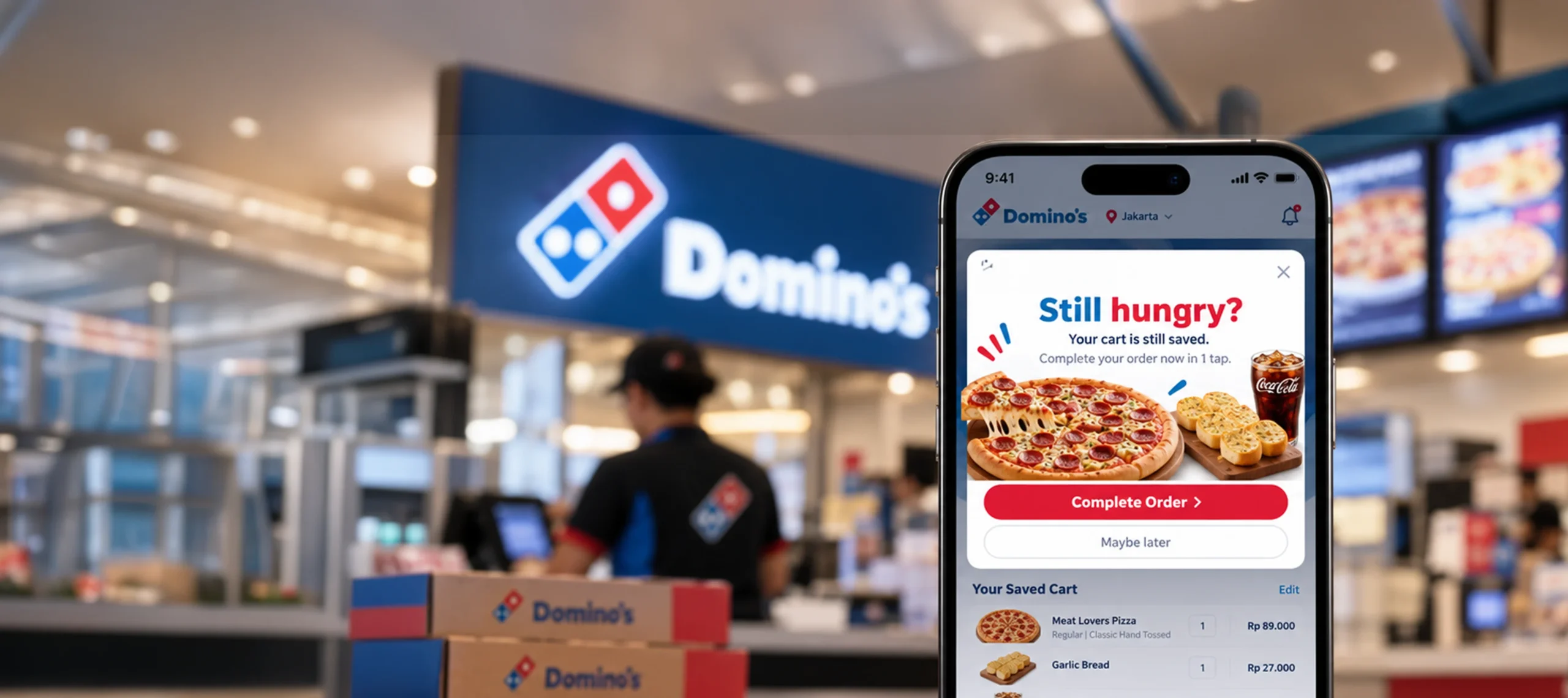
Roughly half the customers who drop out of a Domino’s Indonesia order mid-journey now come back. The mode that does that work, Recovery Journeys, has become the single largest revenue bucket among the four AI-led engagement modes the brand now runs.

Working with Netcore, Domino’s Indonesia’s team replaced its broadcast model – one offer, one send time, everyone on the list – with six operational plays feeding four engagement modes that run at the same time on one stack. The shift wasn’t a bigger discount or a longer list. It was a change in what a click was allowed to set off, and how quickly.

The Four Modes, By Revenue Contribution

~51%

Recovery Journeys

~44%

In-App Pop-Ups

~38%

First-Time Buyer Activation

~11%

Order-Value Based triggers

Figures as reported by Domino’s Indonesia. Each belongs to its own mode rather than to a shared total – the four don’t sum that way – and the source states a denominator only for Recovery Journeys.

About Domino's Indonesia

Domino’s Pizza Indonesia opened its first store in Pondok Indah, Jakarta, in August 2008 and holds the exclusive master franchise for the brand across the country. The business sits under PT Mitra Adiperkasa (MAP) and Everstone Capital, and runs more than 100 stores across six cities: Jakarta, Bekasi, Depok, Bogor, Bandung and Bali. Its house line, “Sell More Pizza, Have More Fun,” has held steady. What has shifted is where the selling happens – counter and phone orders have given way to app, web and in-store digital touchpoints, which puts the marketing stack between the brand and most of its demand.

Industry Context

Indonesia’s quick-service restaurant market is growing at roughly 8.5% a year through 2032, pushed by urbanisation, rising smartphone penetration and a fast pivot to delivery-first ordering. The complication sits underneath that growth: a large share of online food discovery in Indonesia runs through third-party aggregators – GoFood, GrabFood, ShopeeFood – rather than a brand’s own app. So the moment a customer decides they’re hungry doesn’t belong to Domino’s by default. It belongs to whichever surface reaches them first. For a brand running its own direct-order channels alongside those aggregators, owning that moment isn’t a nice-to-have; it’s the whole fight.

Millions of Interactions, Three Gaps

Domino’s Indonesia wasn’t short on data. The brand was already processing millions of digital interactions – clicks, app opens, cart activity – across its ordering channels. Three gaps sat in how that data got used.

Broadcast-led sends. One offer, one send time, everyone on the list. Customers who wanted pizza right then saw the offer late; everyone else stopped opening messages that had nothing to do with them.

Segment overlap. Segmentation was rule-based rather than behavioural, so the same customer often sat in three segments at once and got three sends for it. More volume against the same orders, and falling open rates to show for it.

Timing rules that ignored hunger. Send rules blocked the morning hours outright, while the evening peak – when hunger and order volume both climb – stayed structurally under-served.

None of this was an effort problem. It was a ceiling built into a broadcast-era operating model, and the team had already reached it.

Working closely with Netcore, Domino’s Indonesia’s team rebuilt the model around six operational plays on Netcore’s Agentic Marketing Platform, each one replacing a specific broadcast-era default:

  • Predictive Segments – modelling what a customer is likely to do next, rather than sorting them into static buckets based on who they are.
  • Propensity Modelling – matching outreach effort to a customer’s actual likelihood of converting, scored across 14- and 28-day windows instead of treating every contact the same.
  • Click Drop-Off Recovery – retargeting a customer’s strongest intent signal of the day – a click that didn’t convert – before it fades, rather than waiting for the next scheduled campaign.
  • Send Time Optimisation – delivering when hunger actually hits, not when the calendar says to send.
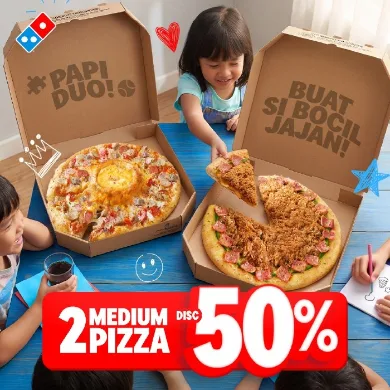
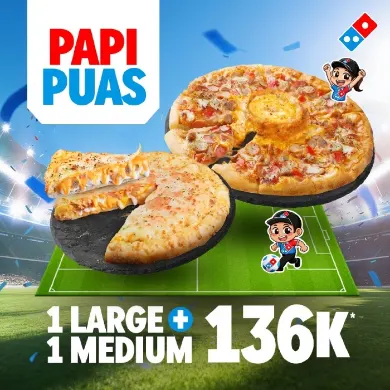
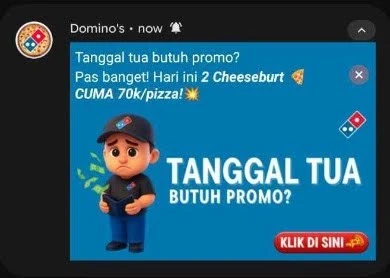
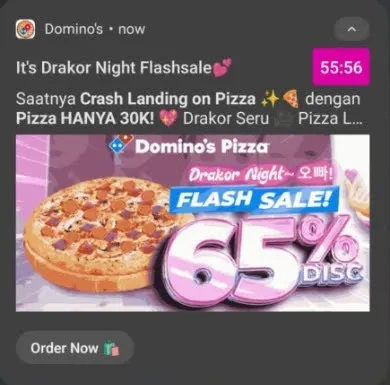
  • AI Creative at Scale – producing a variant of every campaign for every segment – a value bundle for one audience, a family-occasion creative for another, a live-countdown flash sale for a third, a payday-triggered push for a fourth – without adding design headcount.
  • AI Insights – moving analysis from a post-campaign report into something that can tune a live campaign mid-flight.
Value Bundle Creative

Family Occasion Creative

Payday-triggered push

Flash sale with live countdown

The Four Modes. Those six plays feed four engagement modes that now run simultaneously rather than as separate campaigns competing for the same inbox: First-Time Buyer Activation catches new signups at peak intent, Recovery Journeys wins back mid-journey drop-offs, Order-Value Based triggers use a customer’s past spend to predict the next purchase, and In-App Pop-Ups add a layer of right-screen, right-moment conversion on top of whatever the campaigns themselves deliver.

Who decides what ships. Three rules govern how the team runs the model, and the third is the one a franchise business can’t skip. Speed is treated as a feature: an offer that arrives after the craving passes is a missed order, not a saved one. Data is treated as borrowed, not owned – in Sanyal’s framing, every data point is a withdrawal from a trust account, refilled by faster ordering and better offers, drained by tracking that gives nothing back. And automation is not authority. AI proposes; brand and franchisee context still decide what actually goes out.

READY TO SEE SIMILAR IMPACT?

See how brands hit 10X results when Netcore co-owns the outcome.

GET A DEMO

Recovery Journeys was the standout. About half of the customers who drop off mid-order now return, which makes it the largest revenue bucket of the four. In-App Pop-Ups and First-Time Buyer Activation report ~44% and ~38% within their own modes, doing different jobs at different points in the journey. Order-Value Based triggers, at around 11%, are the smallest of the four by design: precision aimed at repeat purchase, not reach.

What mattered more than any individual figure was what a click came to mean operationally. Under the broadcast model it was a count that turned up in a weekly report. Under the four modes it’s a signal with a shelf life, and the stack is now built to act inside it.

See how we can deliver similar results for your brand

Request a Demo →
Unlock unmatched customer experiences,
get started now
Let us show you what's possible with Netcore.