In crowded FMCG categories, brand recognition is no longer enough to guarantee loyalty.
When shoppers face multiple products that appear to solve the same need, the decision can become surprisingly difficult. They compare, hesitate, browse, leave, and sometimes choose the competitor that makes the decision easier.
For a global FMCG leader in health-focused food and beverages, that created a different kind of growth challenge. The brand already had the trust, distribution, and product portfolio. What it needed was a better way to stay relevant across the moments that influence consideration, purchase, and repeat behaviour.
The answer was a shift toward omnichannel automation and personalization, using customer behaviour, life stage, interests, loyalty status, and context to make engagement more relevant.
Across key brands, the approach contributed to a 37% uplift in customer lifetime value (CLTV), alongside improvements in conversion, returning website users, and digital engagement.
From Brand Legacy to Digital Relevance
The company had built significant equity around its mission of bringing health through food to as many people as possible. But some of its specialized nutrition categories were becoming harder to differentiate.
Consumers had more choices. They also had more questions.
Which product is right for my child? What should I choose at a particular stage? What should I do next? And once the immediate need was solved, what reason did I have to come back?
The company was already pursuing a broader growth strategy focused on restoring competitiveness and creating long-term value. Customer engagement became an important part of that agenda.
The challenge was to make digital engagement feel less like a sequence of campaigns and more like a useful relationship.
Four Signals That the Old Playbook Wasn’t Enough
Several indicators pointed to the same underlying issue.
First, there was limited differentiation between products and brands, making it harder for consumers to make confident choices.
Second, session times and returning-visitor rates were declining, suggesting that customers were spending less time engaging with the brand digitally.
Third, there was room to improve conversion through better targeting and messaging. Reaching a customer was not the same as giving them a compelling reason to act.
And fourth, repeat purchases and retention were declining, a more fundamental concern because customer lifetime value depends on what happens after the first transaction.
The response was to stop treating customers as a single audience.
Instead, engagement could be shaped around who the customer was, where they were in their journey, what they had done recently, and what mattered to them at that particular stage of life.
The Strategy to Improve CLTV & Customer Retention
The operating principle was simple: Right message. Right customer. Right moment.
The brand brought together automation, personalization, and omnichannel communication across email, WhatsApp, web, and mobile.
The objective wasn’t to increase message volume. It was to make each interaction more useful.
That meant reactivating dormant users, helping browsers before they left, giving loyalty members more reasons to participate, and using educational content to build relationships beyond the immediate purchase.
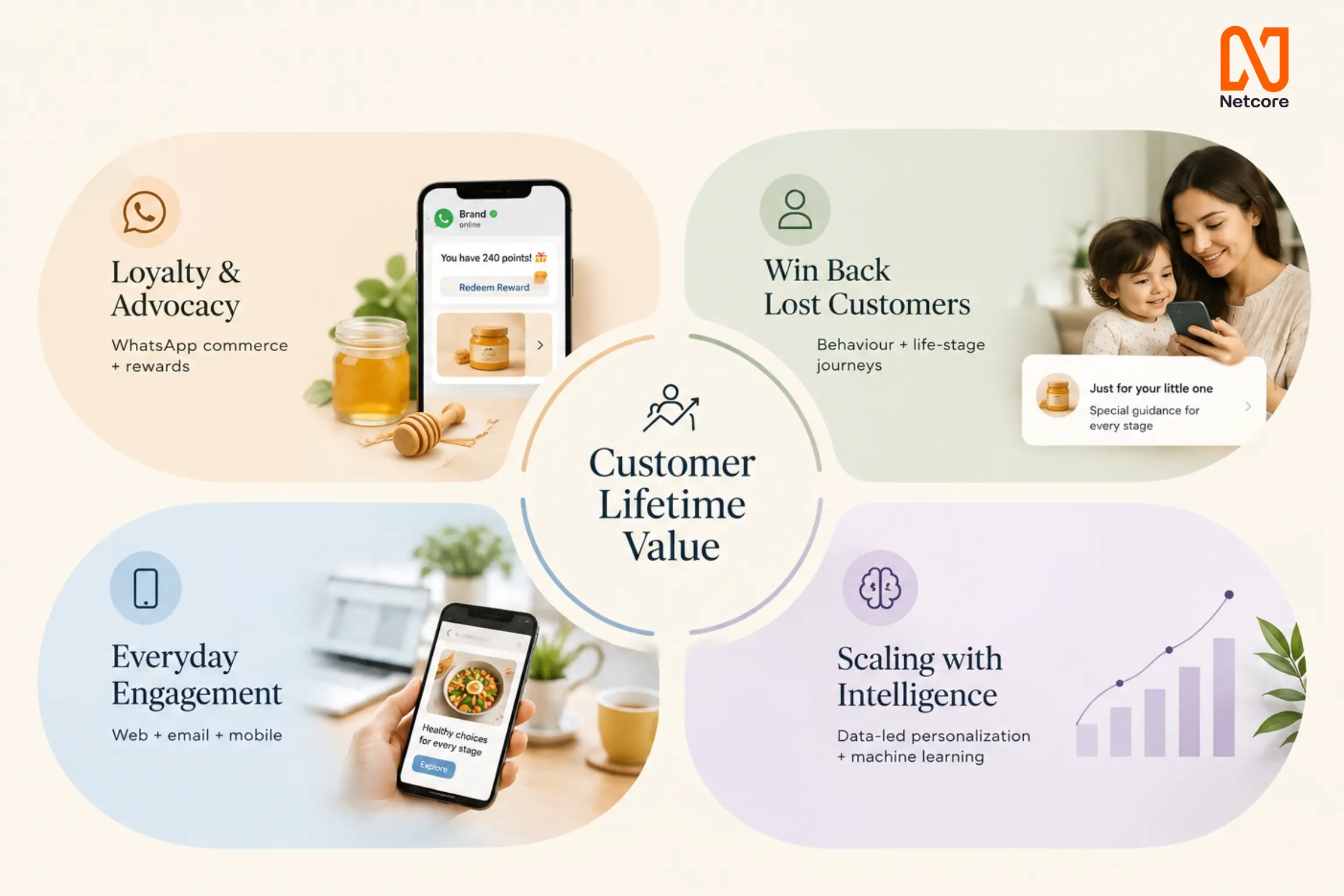
Four areas became particularly important.
1. Turning Loyalty Into a Conversation
WhatsApp became more than a communication channel. It became a loyalty and commerce touchpoint.
High-potential customers received carousel-based campaigns, while chatbots made practical tasks, such as uploading receipts, checking points, and redeeming rewards, easier to complete within the conversation.
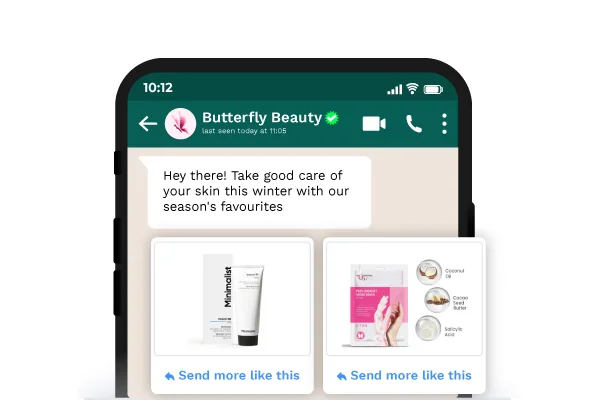
Example of carousal based WhatsApp campaigns
Rewards could also be tailored to loyalty tiers rather than treating every member the same.
The brand extended this approach into life-stage journeys. Email and WhatsApp were combined to deliver nutrition education and timely guidance, helping position the brand as a partner through different stages of child development rather than simply another product on the shelf.
The distinction matters: loyalty becomes stronger when the program provides utility, not just discounts.
2. Winning Back Customers Before They Were Lost
Retention required a more contextual approach.
The brand combined behavioural signals, such as browsing activity, with life-stage information, including a child’s age, to determine when a customer might need a relevant reminder.
For example, journeys could align with important early-childhood transitions, such as moving from formula to solids.
Instead of sending a generic “come back” message, the brand could use the stage itself as the reason for communication: relevant education, useful reminders, and contextual offers.
This approach contributed to approximately 16% monthly average subscribers and 7% monthly average returning website users.
The same principle was applied on the website.
Exit-intent and scroll-based triggers helped engage visitors before they left, while interactive walkthroughs guided new visitors toward registration and other useful resources.
The result was a 41% increase in website engagement, alongside stronger adoption of tools and club sign-ups.
3. Making Everyday Engagement More Relevant
Not every customer interaction needs to be about conversion.
For a health-focused brand, educational content can be just as important in building long-term engagement.
The brand used web pop-ups and contextual widgets to recommend content based on a parent’s pregnancy or parenting stage. Rich-media web push notifications could be triggered when users became inactive, while interactive widgets surfaced relevant tools and resources.
The widgets themselves generated measurable engagement, delivering 2.57% CTR on homepage placements and 2.89% CTR within articles.
Average session time increased by 2.2%, while customers consumed more content across channels.
Email followed the same philosophy. Rather than relying primarily on promotional campaigns, the brand introduced more educational and nurturing journeys, with contextual offers informed by browsing and previous behaviour.
Send-time optimization added another layer, allowing communications to reach customers during periods when they were more likely to engage.
4. Scaling Personalization Without Scaling Complexity
Personalization becomes difficult when every journey requires manual intervention.
The brand therefore used machine learning to strengthen segmentation and make personalization more scalable.
Customer profiles were enriched with real-time behaviour and demographic information. Lookalike modelling helped identify audiences with similar characteristics to higher-potential customers, while website widgets could adapt to factors such as device, time, and location.
The objective was not personalization for its own sake.
It was to make better decisions faster, and allow successful journeys to scale without turning every campaign into a manual exercise. Want to replicate this for your own FMCG business? Switch to Netcore.
Know How Danone Transformed Loyalty & Retention with Netcore
Access the growth storyThe Results: Business Outcomes That Compound
The impact appeared across the customer lifecycle:
- 37% increase in CLTV across key brands
- 17% higher conversion rates through omnichannel engagement
- 7% increase in monthly returning website users
- 2.2% increase in average session time
At the individual brand level, the gains were equally visible.
Nutrition Brand A reached 45% engaged members, with a 14% conversion rate, up 33% year over year, and achieved 12% CLTV growth.
Nutrition Brand B reached 36% engaged members and a 19% conversion rate, representing a 177% year-over-year increase, while CLTV grew by 61%.
Here, conversion refers to whether loyalty members took an action, such as earning or redeeming points, after receiving CRM communication through email, SMS, or WhatsApp.
The important point is that the gains appeared across multiple stages of the customer journey, from website engagement and loyalty participation to conversion and lifetime value.
The engagement was built around a collaborative approach that started with identifying the business problems: declining retention, weaker repeat purchase behaviour, and the need for better-quality conversion.
From there, the teams prioritized interventions where the potential impact was clearest, such as dormant-user reactivation, then tested, learned, and scaled what worked.
Both sides were accountable to business outcomes including CLTV, conversion rate, and returning-user percentage, rather than simply campaign delivery metrics.
That changed the conversation from “How many campaigns did we run?” to “Did customers engage, return, and become more valuable?”
What FMCG Brands Can Learn
Relevance is becoming a competitive advantage. In categories with similar products, helping customers make confident decisions can matter as much as promotion.
Life stage and behaviour work better together. Behaviour tells you what a customer is doing; life stage helps determine what may be relevant to them.
Loyalty works harder when it works for the customer. Putting rewards, tracking, and redemption into a familiar channel such as WhatsApp reduces friction between engagement and action.
The website is part of the engagement strategy. Exit-intent experiences, widgets, and walkthroughs can improve the experience while also creating signals for other channels.
CLTV is built across the journey. Activation, engagement, conversion, repeat behaviour, and retention each contribute to the final number.
Conclusion
For a global FMCG brand, the opportunity was not to communicate more. It was to make existing customer interactions more useful and more timely.
By connecting life-stage signals, behaviour, loyalty data, and omnichannel automation, the brand created more opportunities to engage customers when those interactions mattered.
The result was measurable: 37% higher CLTV across key brands, supported by stronger conversion, engagement, and repeat visits.
For FMCG marketers, the more useful benchmark is how effectively every interaction contributes to the next purchase and a longer customer relationship.