Here’s a test. Open your current email platform and try to build one interactive email – something where a customer can shop, fill a form, or claim an offer without leaving their inbox. Time how long it takes.
If you’re on Dotdigital, the answer is: longer than it should. You’ll write code. You’ll validate it externally through Google’s AMP Playground. You’ll wait for Google’s approval. Then, finally, you send, assuming the campaign is still relevant by the time it clears the queue.
If that sounds familiar, you’re not doing anything wrong. That’s just what the platform requires.
Netcore.ai was built to remove that entire chain of steps, not just for interactive email, but across analytics, personalization, AI, and every channel your customers actually use.
This isn’t a feature comparison. It’s a plain look at what changes the day you switch to Netcore.ai.
Why marketers are leaving Dotdigital for Netcore.ai
1. Build interactive email in minutes. Dotdigital makes you code it.
Dotdigital’s EasyEditor is a solid drag-and-drop tool for static email. But the moment you want something interactive- a live product carousel, an in-email form, a checkout that doesn’t bounce someone to a webpage- it hands you off to a code editor, then an external validator on Google’s AMP Playground, then a wait for Google’s approval before you’re allowed to send. Three tools, two waiting periods, one email.
Netcore’s interactive email builder skips all of it. You build with drag-and-drop blocks, and the platform checks whether it’s ready to send right there, with a built-in pass/fail validator. No code editor. No external tool. No approval queue. If it’s ready, it’s ready; you send it.
This isn’t a small convenience. It’s the difference between an interactive email being something your team can do occasionally, with developer help, versus something your team does every week, on their own.
2. Netcore.ai tells you where your emails actually land. Dotdigital tells you they sent.
Almost no platform tells you whether an email landed in Primary, where people look, or Promotions, where it quietly dies unread.
Netcore’s inbox intelligence, built around a system called NIVO, closes that gap. It shows you exactly where your emails are landing, diagnoses what’s hurting your placement, and gives you a path to fix it before your next send, not after you’ve already lost the quarter’s opens. Underneath that sits a full deliverability stack, authentication checks, spam scoring, error tracking, and brand verification, all built in, all automatic.
Dotdigital’s deliverability tooling covers the basics too. What it doesn’t offer is the same level of proactive placement monitoring, the “here’s what’s about to go wrong” layer, rather than just “here’s what already went wrong.”
The result for Netcore.ai customers: 95%+ inbox placement across more than 50 billion emails sent every month, at a customer base of 6,500+ brands.
3. See the whole customer journey. Dotdigital shows you a dashboard.
Ask most marketing teams what their email analytics actually tell them, and you’ll hear some version of “opens, clicks, and a bit of guessing.” That’s Dotdigital’s ceiling. Its reporting is spread across separate dashboards, opens here, clicks there, with no funnel view, no cohort view, no trend view, and no way to act on what you’re looking at without exporting it somewhere else.
Netcore’s analytics work differently. You get unified funnel, cohort, and trend reporting in one place, with the ability to drill into a specific customer segment by behaviour, predicted affinity, or device, and launch a campaign to that exact group without leaving the screen. An AI summarizer sits on top of it, surfacing what actually changed and why, instead of leaving you to spot it yourself in a wall of numbers.
If you’re running loyalty programs or repeat-purchase campaigns, this goes deeper still. Netcore.ai offers three separate RFM models, ways of scoring customers by how recently, how often, and how much they buy, with configurable rules and visual flow charts showing how customers move between segments over time. Dotdigital has a version of this (eRFM), but it’s a single model with no flexibility on how you define value, and no way to track customers moving between tiers.
Translated simply: Netcore.ai shows you why a campaign underperformed and who to target next. Dotdigital shows you that it happened.
4. Netcore’s AI agents are working today. Dotdigital’s are on a waitlist.
Every platform is talking about AI right now. The honest question is: is it actually available to you, or is it a roadmap slide?
Dotdigital WinstonAI currently offers two agents, one for content, one for segments, and both are still in private preview, meaning most customers can’t use them yet. Where it is available, it’s capped at 200 AI requests every 24 hours, and limited to email and SMS.
Netcore.ai runs eight AI agents live, for every customer, right now, coordinated by a system called Co-Marketer:
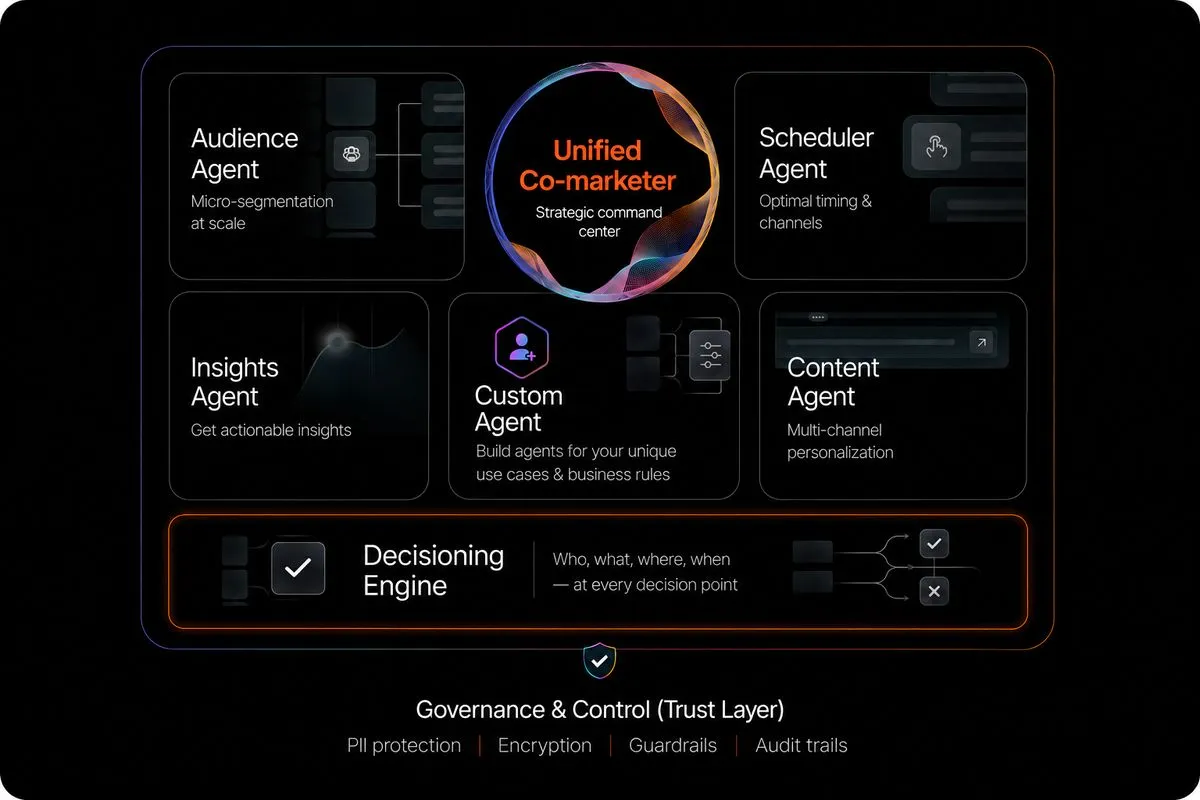
That last point matters more than it sounds. Dotdigital’s agents work in isolation, ask the content agent for a subject line, ask the segment agent for an audience, and nothing connects them. Netcore’s agents share context. If the insight agent spots a revenue dip, it can brief the audience agent to build the right segment and trigger the decisioning agent to act, without a human manually stitching three tools together.
5. Personalization that doesn’t stop at email. Dotdigital’s does.
Dotdigital’s SmartBlocks personalize content across web, email, and mobile app, solid, as far as it goes. But it doesn’t natively personalize WhatsApp, in-app messages, or web push before you send. Get those working, and you’re looking at a developer-built API workaround.
Netcore.ai personalizes natively across every channel- email, SMS, app and web push, WhatsApp, on-site content- using the same customer data and the same rules, with no separate build required per channel. That includes rule- and algorithm-based web personalization, Liquid Tags for dynamic content inside emails and messages, and Unbxd-powered search personalization on-site, so the product results a customer sees are shaped by their own behaviour, not a generic catalogue view.
6. Journeys that adapt while they’re live. Dotdigital’s don’t.
Dotdigital’s Program Builder gives you four trigger types and basic splits, but once a journey is live, you can’t edit it. If something’s underperforming, you pause, fix, and relaunch.
Netcore’s journey builder supports seven trigger types, live editing, and a path optimizer that automatically routes customers to the better-performing branch, with a journey insight agent flagging exactly where drop-off happens and how to fix it.
7. Netcore.ai predicts what customers will do next. Dotdigital tells you what they already did.
Dotdigital’s Customer Predictions gives a single, static churn score with no configurable window and no way to track whether retention campaigns worked.
Netcore’s approach is built to close that loop. Netcore’s churn intelligence runs across configurable 7/14/28-day windows, sorts customers into three risk tiers, and measures whether retention efforts actually reduced churn. It also predicts what a customer is likely to buy next, using category affinity, brand affinity, and price sensitivity, before they act.
8. Built for Europe, recognized globally
Netcore.ai is fully GDPR compliant with EU data handling built in from the ground up.It was named as a Strong Performer in The Forrester Wave™: Email Marketing Service Providers, Q1 2026, scoring the highest possible mark, 5.00/5.00, for in-email innovation, and holds 4.5 stars on both G2 (1,285 reviews) and Gartner (302 reviews).
And the results aren’t hypothetical:
- Holzkern saw a 182x return on email spend, alongside a 20% revenue uplift.
- Farmison grew conversions by 300% using email marketing on Netcore.ai.
- Bidoo grew email revenue by 46%.
- Sabina grew email revenue and conversions by 1.4x, with a 2x return on email spend.
9. Email is the entry point. It’s not where Netcore.ai stops, and it’s not where Dotdigital can go.
Dotdigital is a genuinely capable email and SMS platform, fast to start with because the scope is narrow. That narrowness is also the ceiling. The moment you need push, in-app messaging, search, or product experience tools, you’re onboarding a second vendor, then a third.
Netcore.ai covers email, SMS, WhatsApp, push, app, web, on-site search, and product experience tools, all on one customer profile, coordinated by the same six AI agents. You don’t re-implement anything as you grow. You just switch a channel on.
Switching platforms doesn’t have to be the six-month project you’re dreading
Every point above is worth nothing if the move to get there feels riskier than staying put. So let’s address that directly, because it’s usually the real reason teams stay on a platform they’ve outgrown.
With Netcore.ai, here’s what actually happens:
- Migration is free. Segments, journeys, templates, and data move across at no extra cost.
- A dedicated migration team runs it, not your marketing team. Netcore.ai has done this more than 6,500 times.
- It’s fast, because the team has already solved the problems your migration will hit.
- Pricing is tied to outcomes, not just usage. A meaningful part of Netcore’s pricing model, roughly a quarter of it, is variable, linked to the results you actually get, with a success kicker tied to agreed KPIs, so Netcore.ai has a direct reason to make the switch pay off.
Compare that to staying on a platform with capped API calls, pricing that shifts as you scale, and no owned layer for the channels you’ll eventually need anyway.
Ready to see it for yourself?
You don’t need to take our word for any of this. The fastest way to know whether switching is worth it is to see Netcore.ai working against your own campaigns, your own data, your own customers.
No slides. No pressure. Just a look at what changes.