For decades, heritage retail brands built their businesses on a simple premise: earn trust in person, one store visit at a time. That model worked, until digital commerce rewrote the rules of customer relationships. The brands that thrive today are not necessarily the ones with the strongest offline legacy, but the ones that successfully translate that legacy into a digital-first loyalty engine.
This is the case study of one such transition: a heritage-led ethnic fashion brand that built its reputation through offline retail craftsmanship, then had to answer a harder question: how do you convert in-store trust into online repeat behavior at scale? The answer came not from a bigger marketing budget, but from a fundamentally different operating model: lifecycle-driven, AI-powered customer engagement.
The Strategic Inflection Point
The brand’s foundation was never in question. Years of curated offline retail across major cities had built genuine credibility, rooted in product quality and customer trust. But as consumer behavior shifted decisively online, offline equity alone was not enough. The brand needed to become D2C-led without diluting its craft-driven identity, a transition many heritage retailers attempt, and few execute well.
The core issue was structural, not creative. Customer communication was fragmented across channels, campaigns were largely one-off and reactive, and there was no unified view of the customer across her journey. In effect, the brand was acquiring customers efficiently but leaving loyalty to chance. Leadership recognized that sustainable growth would depend on three capabilities: personalization at scale, lifecycle-stage-aware marketing, and a single source of truth for customer engagement.
From Campaigns to Customer Lifecycles
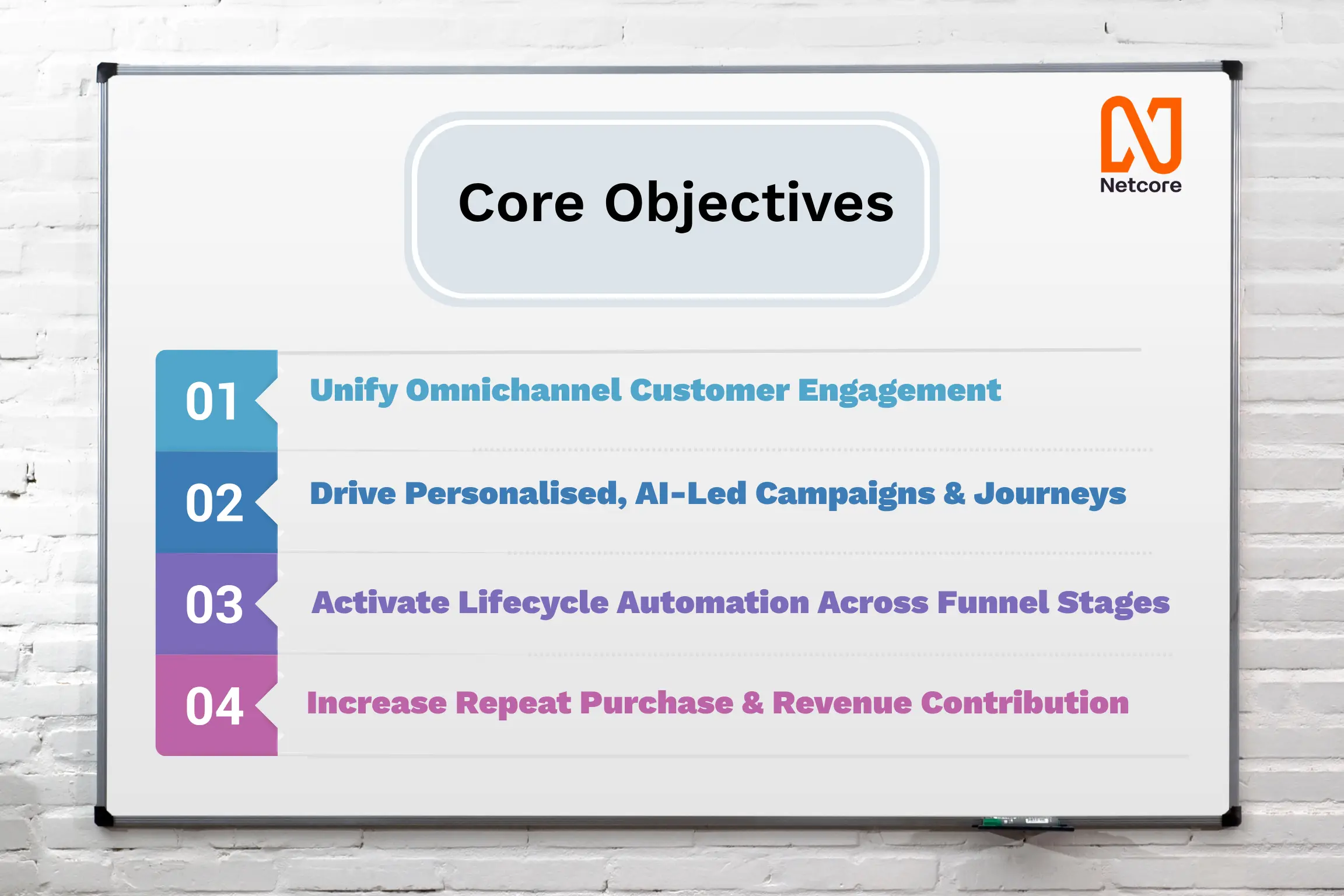
The strategic shift was best captured in a single mindset change: from campaign-led outreach to lifecycle-driven growth. Four objectives anchored the new approach.
Unify omnichannel engagement. Rather than running Email, WhatsApp, SMS, and RCS as disconnected channels, the brand consolidated them onto a single engagement platform, ensuring consistent messaging and a coherent brand voice regardless of where the customer encountered it.
Drive AI-led personalization. Generic broadcast campaigns gave way to messaging informed by real behavioral signals, product affinity, browsing patterns, and cart activity, so that relevance replaced volume as the primary lever of engagement.
Activate always-on lifecycle automation. Instead of relying on scheduled campaigns, the brand implemented persistent, trigger-based journeys covering Welcome, Browse Abandonment, Cart Abandonment, Checkout Abandonment, Cross-sell, and Upsell, designed to capture customer intent the moment it appeared.
Rebalance toward retention economics. The definitive shift was in what success looked like: from optimizing for first-time conversion to optimizing for repeat purchase rate, customer lifetime value, and incremental revenue from existing customers.
Building the Engine: Segmentation, Mapping, and Orchestration
Three structural components underpinned execution.
The first was intent-based segmentation. Using AI-driven analysis of browsing behavior, purchase history, and engagement signals, the brand identified which customers were high-intent or “repeat-ready”, enabling targeted engagement rather than blanket outreach.
The second was funnel-stage mapping. Customer movement was tracked explicitly across browse, product view, add-to-cart, checkout, and post-purchase stages, allowing the brand to trigger the right message at the right moment rather than relying on generalized timing.
The third was orchestration across channels. Email, WhatsApp, SMS, and RCS were activated in a coordinated sequence rather than in isolation, meeting customers on their channel of preference and reinforcing messages across touchpoints for higher recall.
Layered on top of this infrastructure were several execution-level innovations: send-time optimization and subject-line intelligence to maximize open rates; cohort analysis to understand repurchase cycles and fine-tune journey timing; and richer creative formats, GIFs, carousels, and AMP-enabled emails, to increase interactivity and reduce friction at the point of conversion.
The Business Impact
The results validate the thesis that lifecycle-driven engagement, not campaign volume, is the more durable growth lever for a brand transitioning from offline to D2C.
Repeat purchase rate climbed from 24% to 28%, a 17% relative repeat purchase increase, is one of the hardest metrics to move, signaling genuine gains in retention rather than one-time promotional lift. Revenue contribution attributable to the engagement platform doubled, rising from roughly 2% to 4% of overall revenue following the lifecycle automation rollout. Engagement quality also improved materially, with AMP-powered emails delivering a 143% uplift in click-through performance through richer, more interactive formats.
The channel-level data is particularly instructive. Excluding sale-period activity, a deliberate control to isolate baseline performance rather than promotion-driven spikes, month-on-month revenue growth was substantial across every channel: WhatsApp grew 676% (₹3.4L to ₹26L), Email grew 218% (₹8L to ₹25L), RCS grew 180% (₹0.5L to ₹1.4L), and SMS grew 57% (₹6L to ₹10L). The disproportionate growth in WhatsApp and RCS is notable: these emerging conversational channels, when integrated into a unified lifecycle strategy, can outperform even well-established channels like email.
What Other Brands Should Take Away
Three lessons stand out for brick-and-mortar brands navigating a similar transition.
First, offline trust is a starting point, not a strategy. It earns the first purchase, but digital loyalty has to be engineered deliberately through personalization and lifecycle design; it does not transfer automatically.
Second, channel unification is a prerequisite for personalization, not a parallel initiative. AI-driven targeting is only as effective as the customer data feeding it, and siloed channels fragment that data by definition.
Third, retention metrics deserve board-level attention alongside acquisition metrics. A 4-point improvement in repeat purchase rate and a doubling of platform-attributed revenue contribution are the kind of compounding gains that acquisition spend alone cannot replicate.
For heritage retail brands eyeing D2C growth, the lesson is clear: converting trust built over years into durable digital loyalty requires an entirely new operating model, built on data, automation, and relevance at every stage of the customer lifecycle. If you want to understand how this would work out for you, then talk to us.