Diwali Engagement Playbook is now


If you’re a marketer using AI regularly, you’ve probably had the same question I have:
Should I use ChatGPT or Claude?
And once you move beyond the free versions, the question gets even more specific:
When is ChatGPT-5.6 actually better than Claude Opus 5, and when is Claude the better choice?
I’ve found that comparing the two based on benchmarks isn’t particularly useful for marketers.
What matters more is the actual job I’m trying to get done.
If I need a meta description, a few headline variations, or a basic persona, I don’t need either flagship model. A free model can handle that perfectly well.
The difference starts showing up when I give the model real business context, customer conversations, campaign data, competitor research, hundreds of pages of documents, or complex strategic constraints.
That’s when model choice starts affecting the quality of the work.
Based on how I use these models, here’s how I’d choose between ChatGPT-5.6 and Claude Opus 5 across seven marketing use cases.
1. Audience Research and Persona Development
If I just need a basic buyer persona or a Jobs-to-Be-Done framework, I honestly don’t reach for either ChatGPT-5.6 or Claude Opus 5.
A free model can generate a perfectly good starting point.
The difference shows up when I feed the model actual customer data, sales call transcripts, support conversations, survey responses, win/loss notes, or customer interviews.
Instead of creating another generic “enterprise CMO persona,” I want the model to identify patterns that actually exist in my customer data.
That’s where both ChatGPT and Claude become useful, but they approach the task somewhat differently.
ChatGPT-5.6
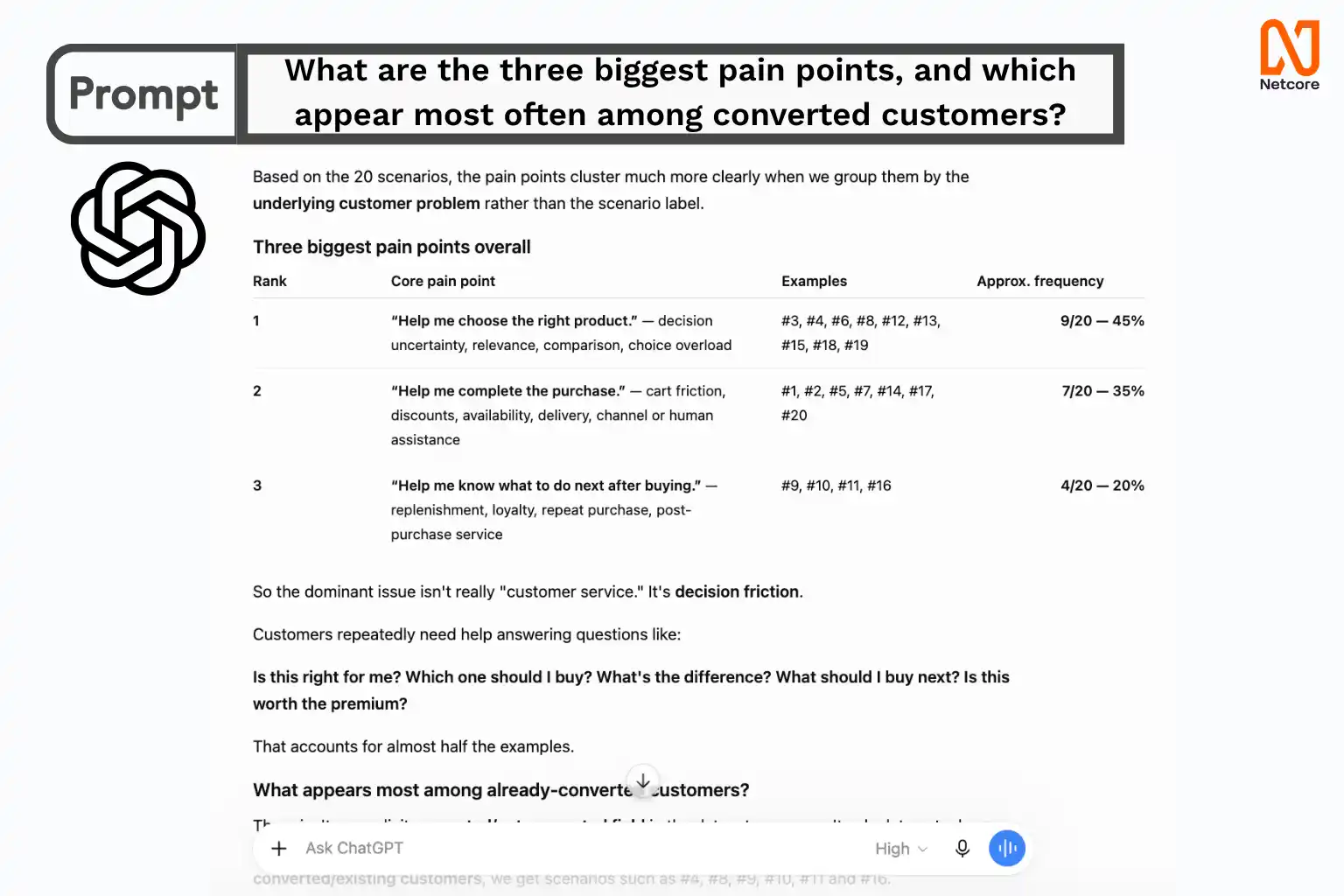
I find ChatGPT particularly useful when I want to explore the data conversationally.
I can start with: “What are the three biggest pain points?”
Then follow up: “Which of these appears most frequently among customers who converted?”
That iterative workflow is where ChatGPT-5.6’s interactive style becomes valuable.
Claude Opus 5
Claude is particularly strong when I want a structured synthesis of a large amount of research.
Give it a large collection of customer conversations and ask it to identify themes, supporting evidence, and contradictions, and it tends to produce a more restrained, organized analysis.
The source comparison also found Claude particularly strong on complex research tasks, while GPT-5.6 tends to provide faster, more detail-rich responses.
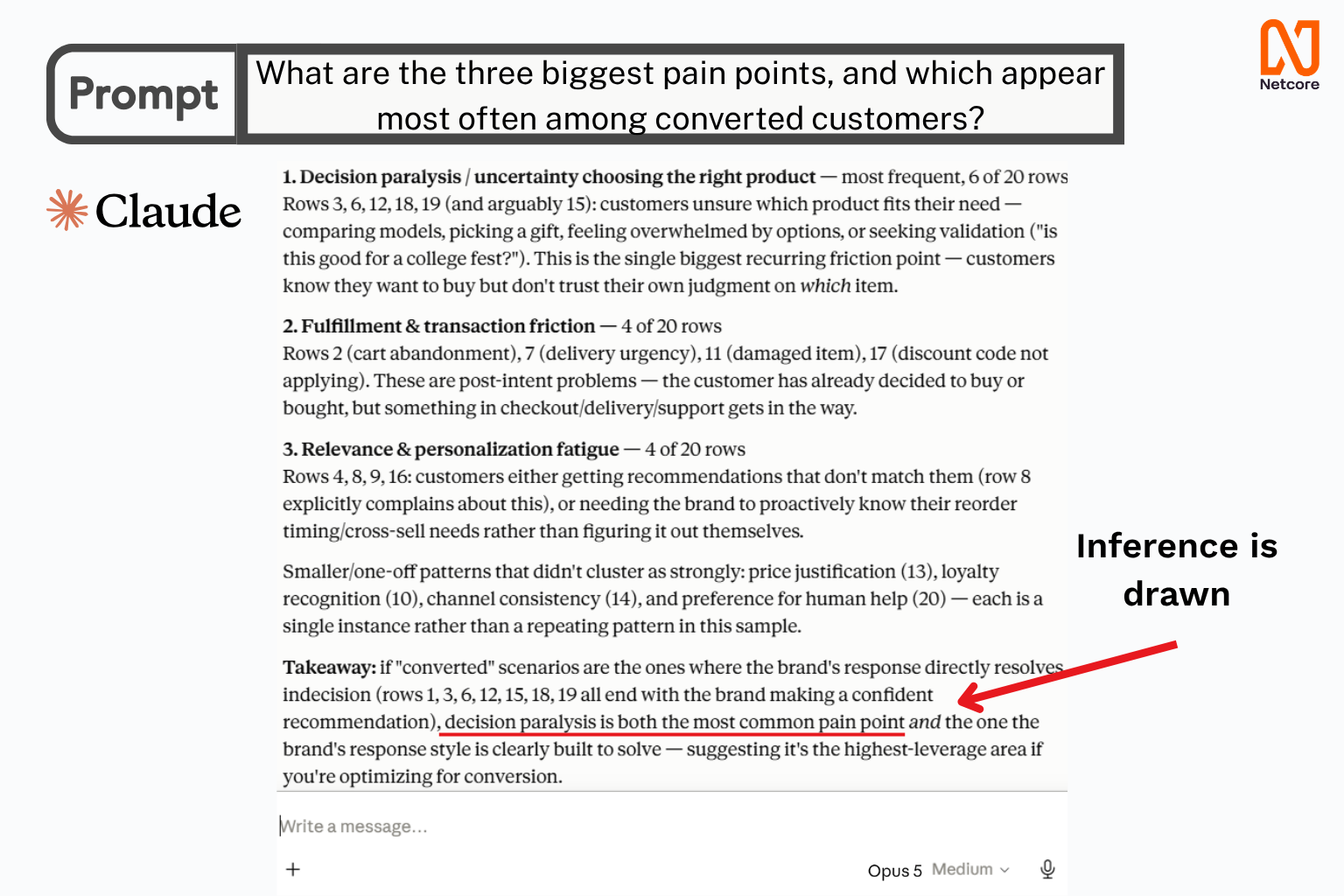
Comparing the two responses
From an analytical perspective, both ChatGPT and Claude highlighted the same core points of conflict, such as decision paralysis, uncertainty, and cart friction. However, the primary difference is that Claude acts as a decision-maker by drawing clear inferences from the data, providing an immediate recommendation for you to validate and execute. In contrast, ChatGPT presents the analysis more neutrally, requiring you to examine the data and draw your own conclusions.
My pick
ChatGPT-5.6 if I’m exploring customer data and asking lots of follow-up questions.
Claude Opus 5 if I’m conducting a deep, structured customer research exercise.
Free model if I only need a persona template.
2. SEO and AEO
SEO is one of my biggest AI use cases.
For content ideation, keyword suggestions, title tags, FAQs, or meta descriptions, I don’t think either flagship model is necessary.
Free models are already good enough.
Where things get interesting is when SEO becomes a research problem rather than a content-generation problem.
For example: “Analyze these competitor pages. Identify the content gaps, compare search intent, tell me what they’re missing, and identify where we have a realistic opportunity to compete.”
That’s a much harder task.
ChatGPT-5.6
I prefer ChatGPT when I want to move from research into execution.
I can analyze a topic, identify opportunities, develop an outline, generate FAQs, create title variations, and then turn the same research into social posts or a content brief.
It works particularly well when SEO and AEO become part of a broader content workflow.
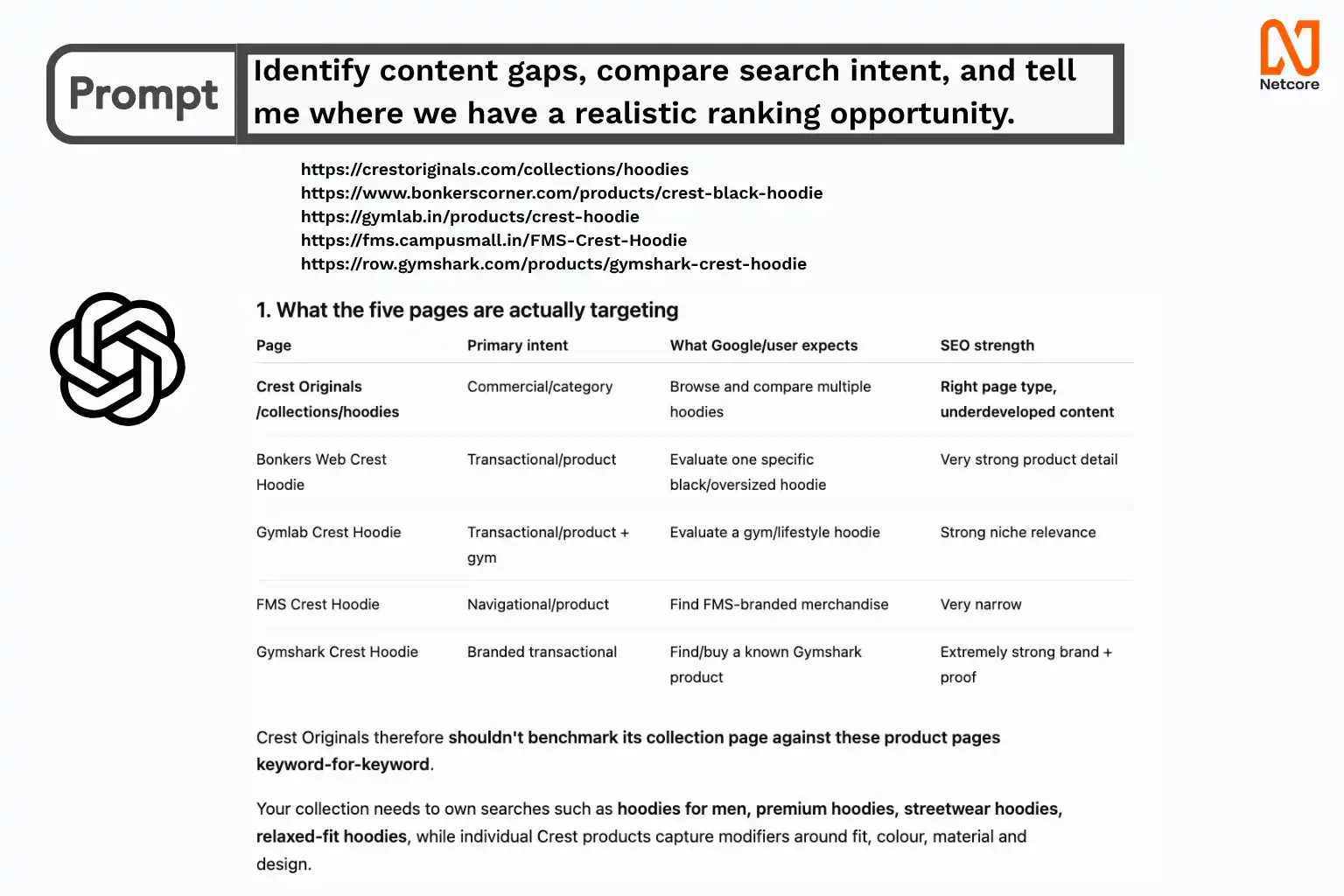
Claude Opus 5
Claude is attractive when the primary task is deep content and research analysis.
If I’m giving it a large collection of competitor pages and asking it to identify patterns, gaps, and search-intent differences, its structured approach can be useful.
For serious content research, I’d lean toward Claude when I care more about thoroughness than speed. The source comparison similarly found Claude stronger for complex research, while GPT was faster.
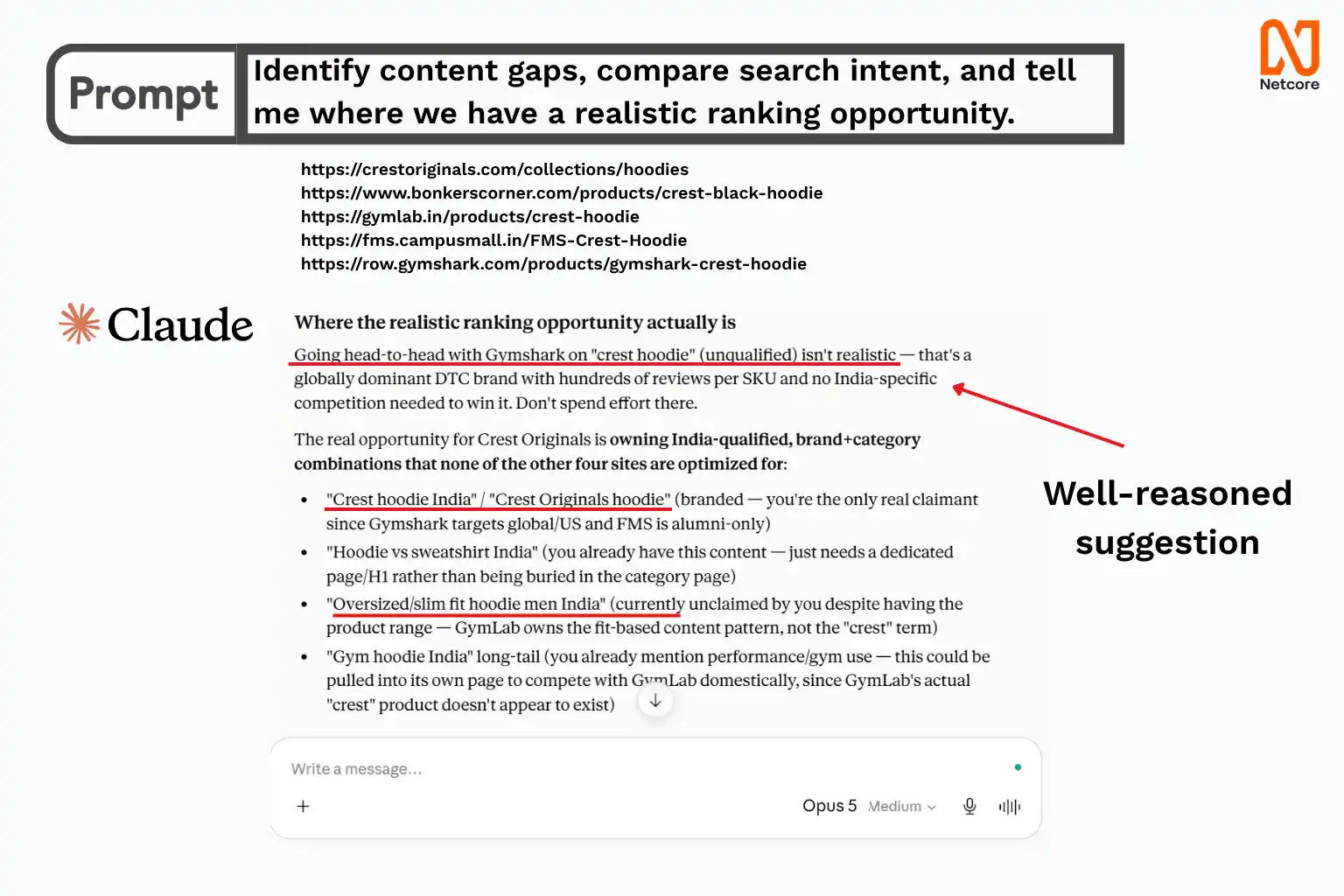
Comparing both responses
From an SEO expert’s perspective, Claude’s response is more actionable and well-reasoned. It recognizes that Gymshark already dominates the top rankings and that competing head-to-head with a global D2C giant is unrealistic. Consequently, it suggests targeting “Crest hoodie India” to establish a unique branded term, focusing effort where it matters most to drive tangible results. In contrast, ChatGPT simply analyzes each page and leaves you to piece the data together. It provides generic suggestions like “hoodies for men” or “premium hoodies,” missing out on high-intent, long-tail variations like Claude’s “oversized/slim fit hoodie men India.”
My pick
ChatGPT-5.6 for SEO/AEO workflows that move from research → strategy → content production.
Claude Opus 5 for deep competitor and content research.
Free model for SEO production tasks.
3. Image Generation
This one is much easier. ChatGPT wins.
If my work involves creating LinkedIn carousels, blog illustrations, ad concepts, social graphics, or presentation visuals, having image generation directly within the workflow is a major advantage.
I can generate something, critique it, change a specific element, and create another version without switching tools.
Claude’s deliberate limitation around photographic image generation means marketers who depend on visual creation will generally need another tool alongside Claude.
4. Data Analysis and Campaign Insights
This is where I think AI can create some of the biggest business value for marketers.
Campaign data is rarely clean.
I’m usually working with multiple CSV exports, dashboards, CRM reports, spreadsheets, and marketing platforms.
The first problem is getting all that data into one place.
Connectors become particularly interesting here.
Instead of downloading CSVs every time I want to analyze campaign performance, I can connect supported platforms directly to ChatGPT.
If your marketing platform or CRM supports connectors- for example, a platform like Netcore.ai you can potentially bring campaign data directly into the conversation and start investigating performance without manually moving files around.
Then the questions become much more interesting:
- Why did conversions suddenly drop?
- Where is the funnel leaking?
- Which campaigns deserve more budget?
- Which audiences are driving pipeline?
- What changed between this month and last month?
- What’s the most likely explanation for this performance trend?
ChatGPT-5.6
This is where I would generally choose ChatGPT.
Its ability to combine analysis with conversational exploration makes it useful when I’m not sure what the data is going to tell me.
I can ask one question, discover something unexpected, and immediately investigate it.
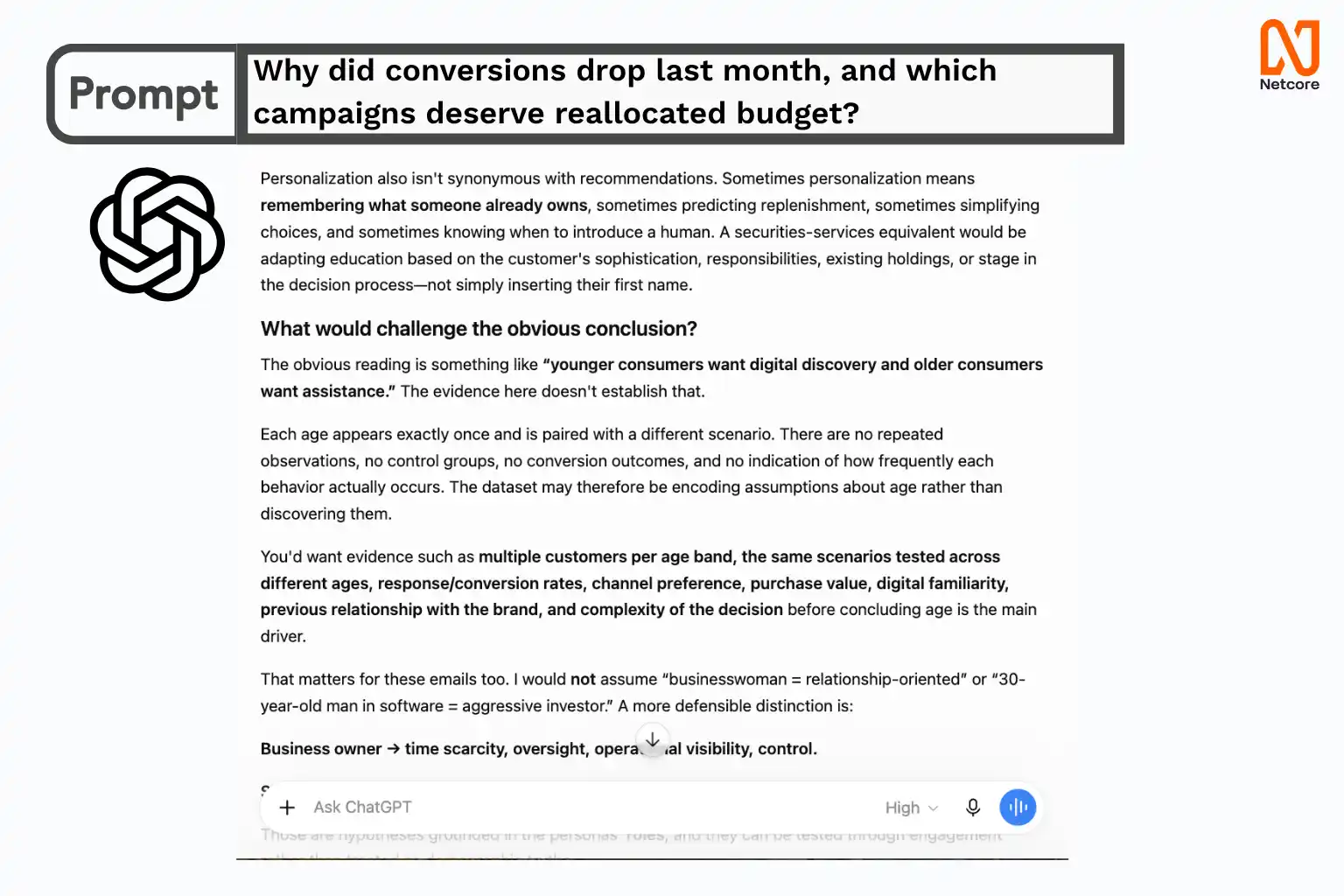
Claude Opus 5
Claude is also very capable for analytical work, particularly when the task involves a large amount of structured information, and I want a careful synthesis.
But for an interactive marketing-analysis workflow, I’d give ChatGPT the edge.
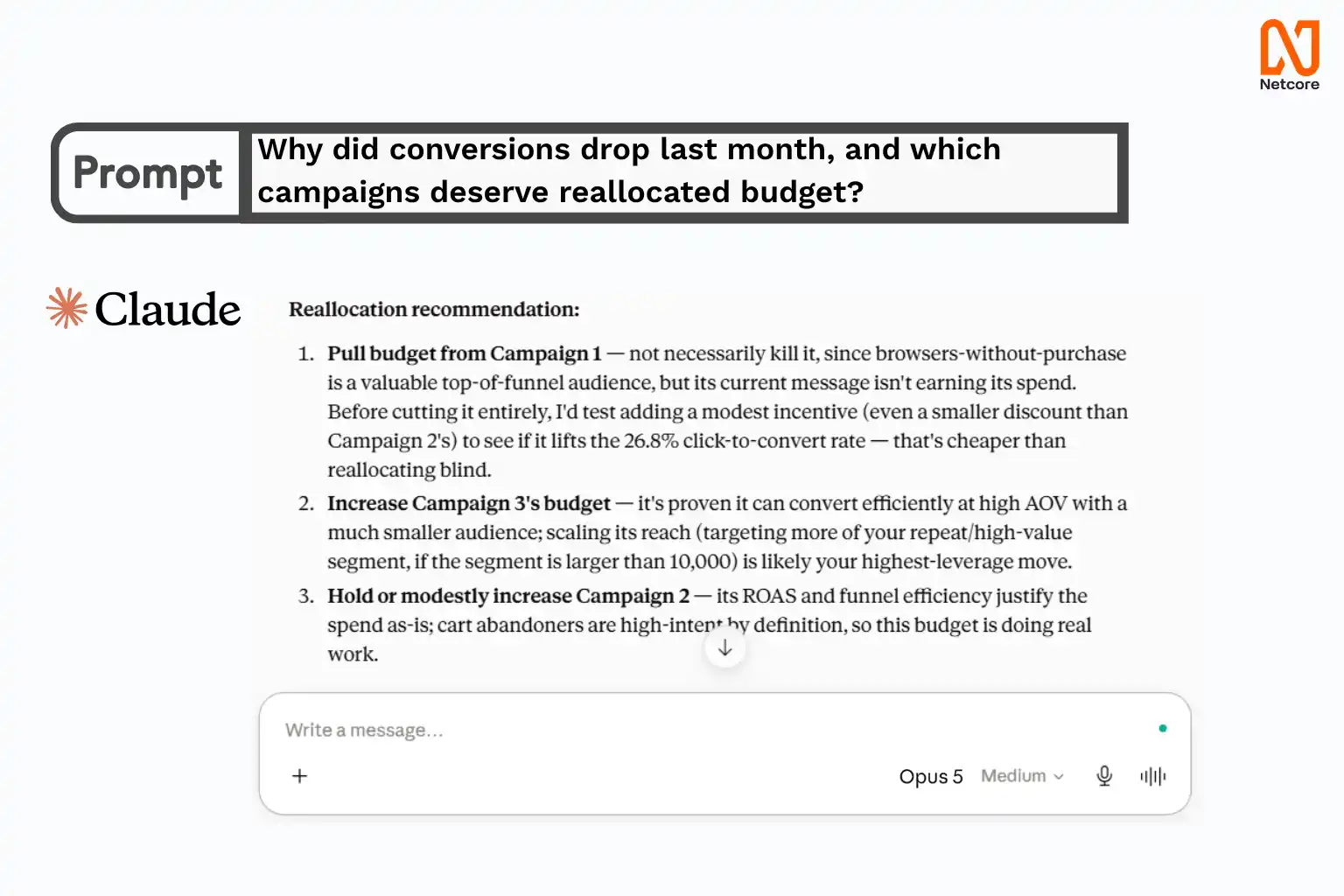
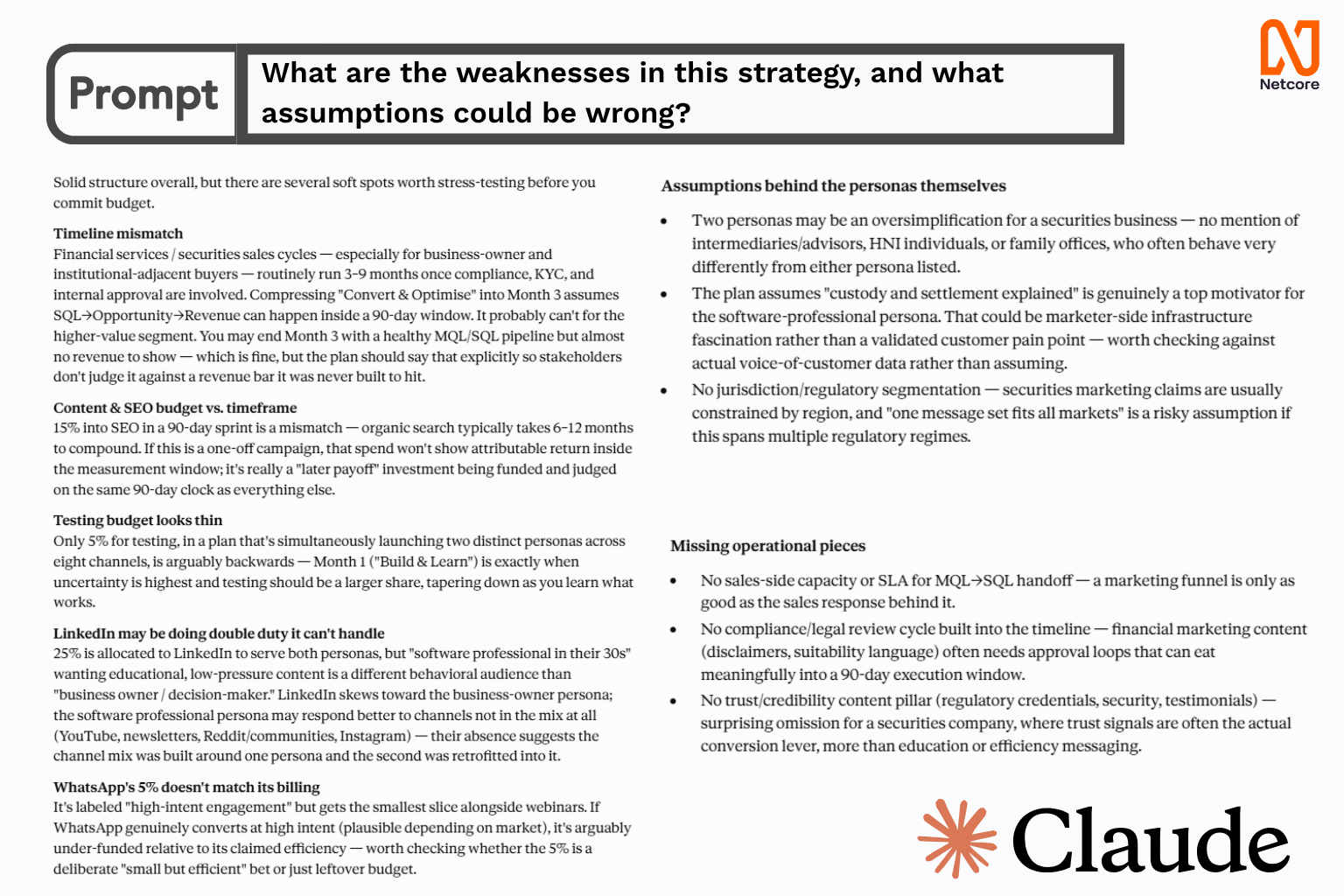
Comparing both responses
Claude directly offers budget reallocation suggestions, whereas ChatGPT provides a deep dive into messaging issues before giving its budget recommendations. From a campaign optimization perspective, ChatGPT-5.6 wins, but Claude wins if you simply want a direct answer for budget reallocation or quick, actionable steps. Especially when under tight deadlines.
5. Personalization at Scale
Writing one personalized email isn’t difficult anymore.
Almost every decent AI model can do that.
The challenge is personalization across:
- Industries
- Personas
- Accounts
- Funnel stages
- Use cases
- Buying triggers
For example, I might want different landing-page messaging for a CMO at a fintech company, a VP of Growth at an ecommerce company, and a CRM leader at a retail brand.
That’s where I find ChatGPT-5.6 particularly useful.
ChatGPT-5.6
The advantage here is iteration.
I can create an initial messaging framework and then quickly generate dozens of variations:
Industry + Persona + Pain Point + Buying Stage → Message
Then I can ask the model to make each version more specific, more executive-focused, or more aligned with the customer’s actual pain points.
Claude Opus 5
Claude can also be excellent at long-form personalized messaging, particularly when I give it detailed brand guidelines, account research, or positioning documents.
Its more restrained writing style can actually be an advantage when I don’t want the model to over-edit or become too creative.
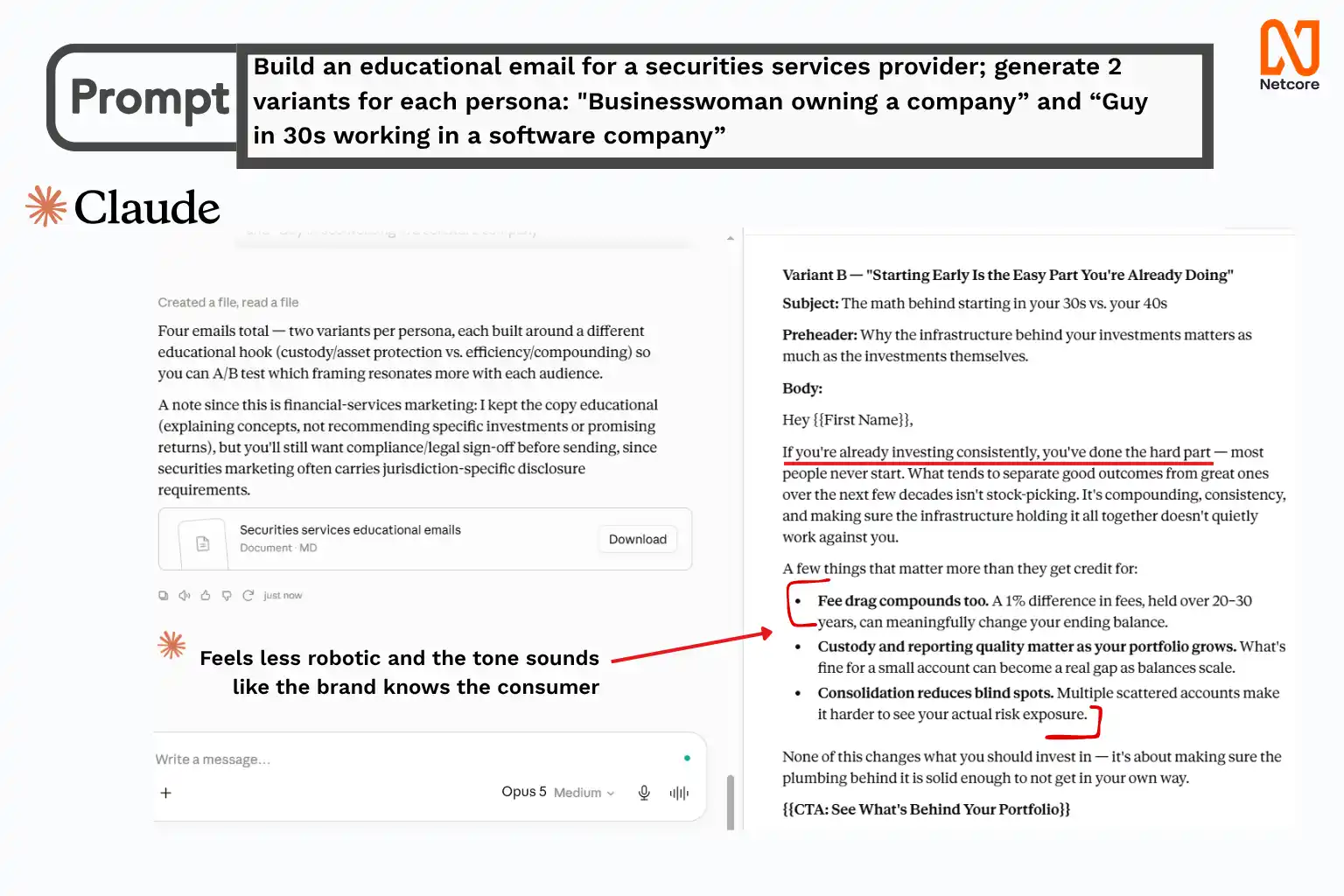
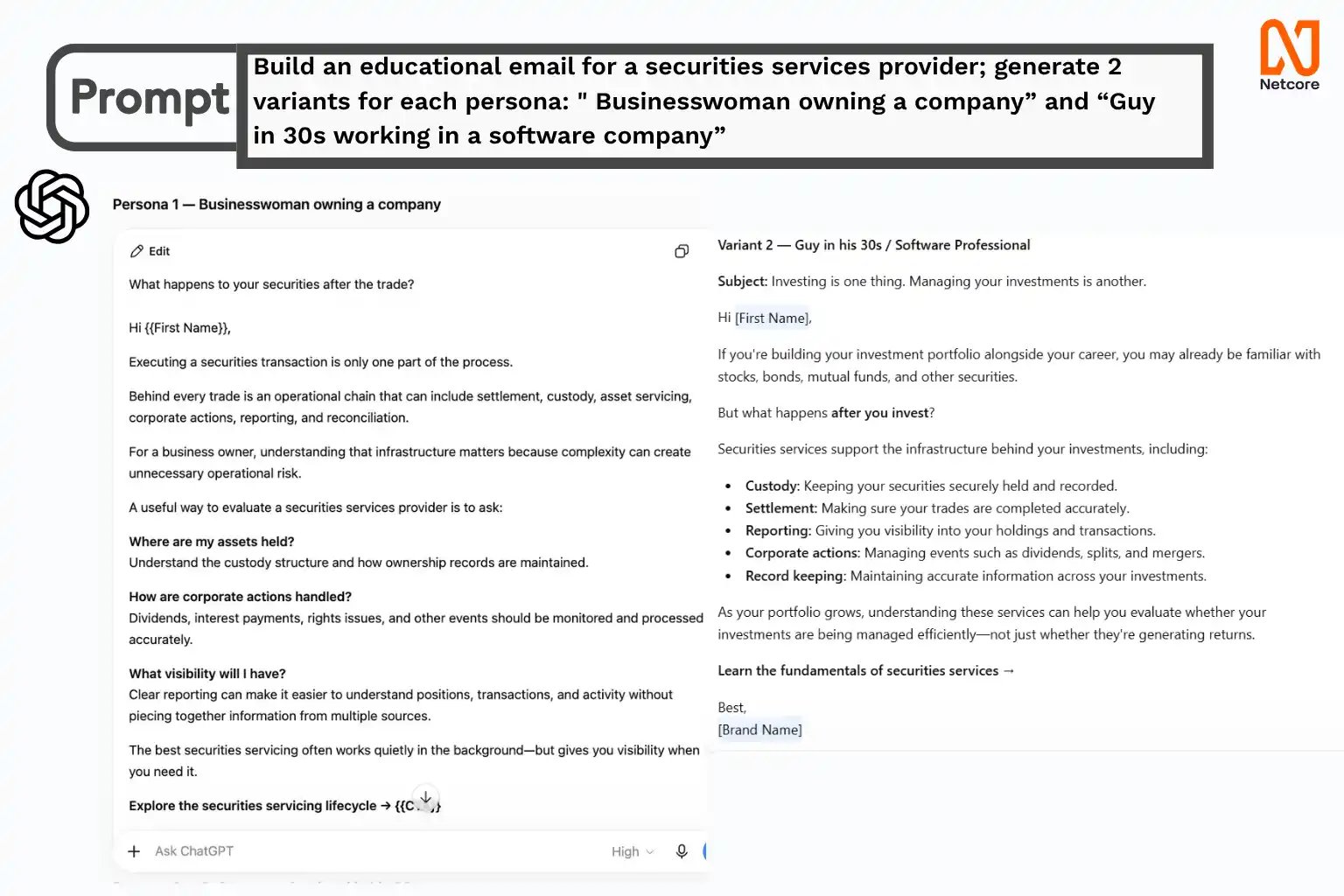
Comparing both responses
When asked to write an educational email for a securities services provider, generating two variants for each persona (“Businesswoman owning a company” and “Guy in his 30s working in a software company”), both ChatGPT and Claude created email drafts. However, ChatGPT’s messaging sounded robotic and clearly required human editing. In contrast, Claude felt far less robotic, delivering a warm tone that made the brand sound genuinely connected to the consumer.
My pick
ChatGPT-5.6 for high-volume personalization and rapid experimentation.
Claude Opus 5 when personalization depends on a large amount of account research and carefully controlled messaging.
6. Customer Research and Feedback Analysis
This is one of my favorite AI use cases.
Imagine having thousands of:
- Reviews
- NPS comments
- Survey responses
- Support tickets
- Sales conversations
- Product feedback
- Feature requests
I don’t want AI to simply summarize them.
I want it to tell me what they mean.
ChatGPT-5.6
ChatGPT is particularly useful when I want to interrogate the data.
I’ll ask:
“What are the recurring themes?”
Then:
“Which of these actually affects buying decisions?”
Then:
“What patterns are we missing?”
And finally:
“What evidence challenges this conclusion?”
That conversational loop is extremely useful.
Claude Opus 5
Claude has an advantage when I want a more structured research output.
For example:
Theme → Evidence → Frequency → Customer segment → Business implication
That makes it useful when I’m preparing a formal customer-research brief or trying to synthesize a very large volume of qualitative data.
My pick
ChatGPT-5.6 for exploratory customer analysis.
Claude Opus 5 for structured customer research.
And honestly, this is one area where I’d consider using both.
Have one model identify the patterns and ask the other to challenge them.
7. Marketing Strategy and Planning
This might be the most misunderstood use case.
If I’m creating a generic content calendar, campaign framework, or GTM template, I don’t think GPT-5.6 gives me a huge advantage.
Neither does Claude Opus 5.
Free models can already do that.
The difference appears when strategy depends on real business context.
For example, I could give the model:
- Historical campaign performance
- Budget constraints
- ICP information
- Competitor research
- Pipeline targets
- Sales feedback
- Existing channel performance
Then ask:
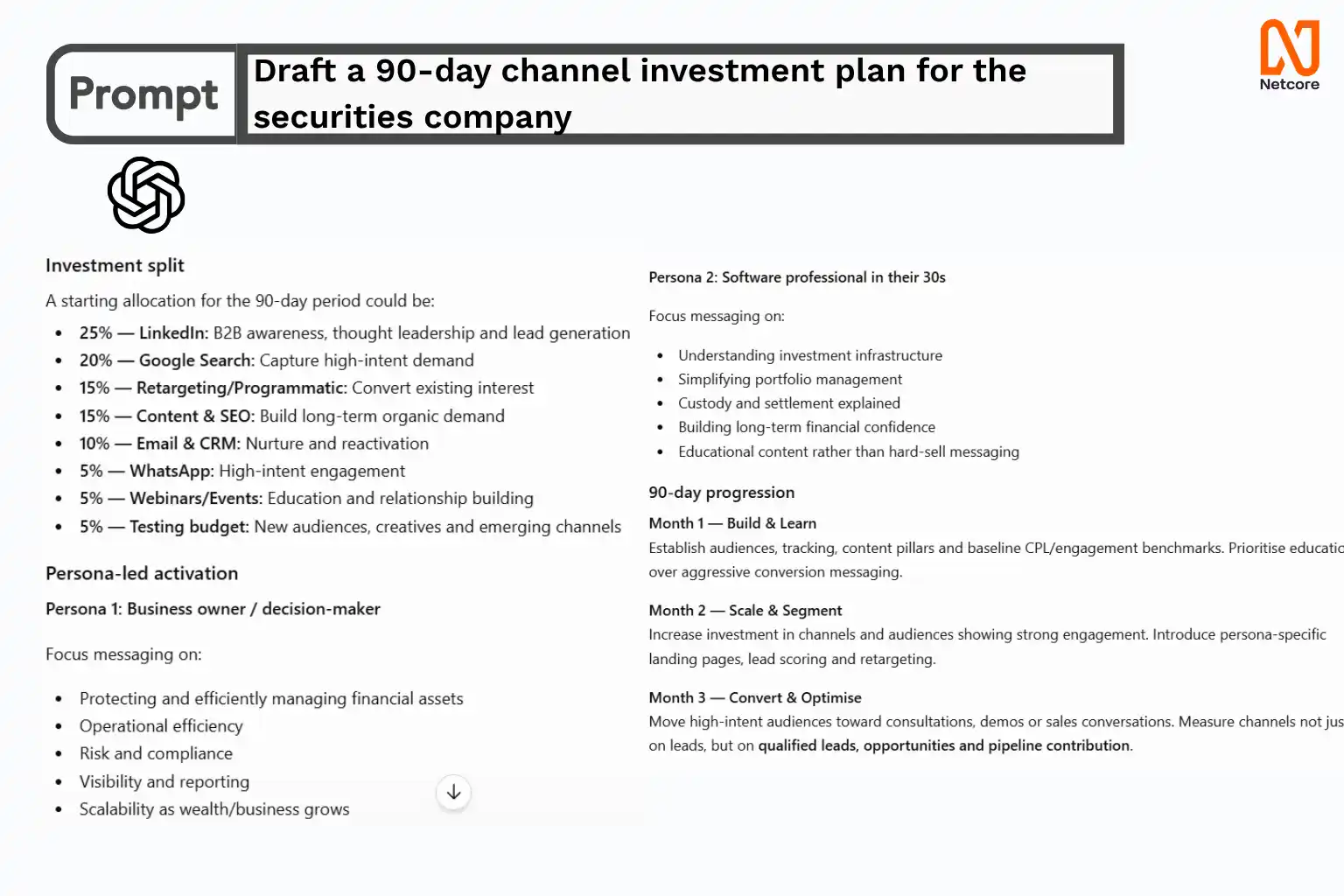
“Given these constraints, where should I invest the next 90 days? Which channels should I scale, which should I reduce, and what assumptions are behind your recommendation?”
Now I’m not asking AI to create a marketing plan.
I’m asking it to make trade-offs.
ChatGPT-5.6
I’d choose ChatGPT when I want a strategy partner I can iterate with.
I can challenge its recommendation, add new constraints, change the budget, and ask it to rebuild the plan.
Claude Opus 5
Comparing both responses
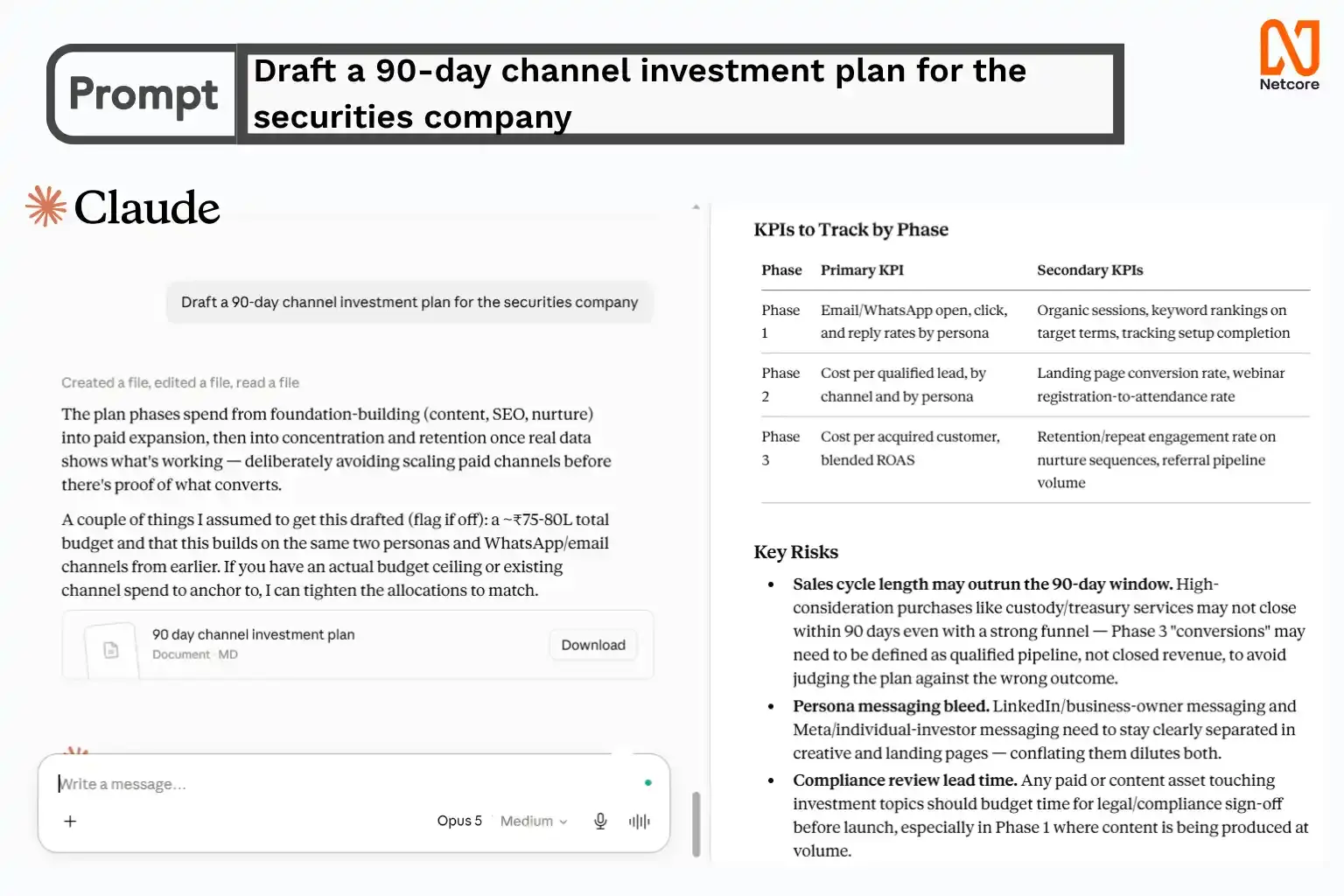
I’d bring Claude in when I want the plan audited. As the response covered KPIs to track and also shared key risks that might be associated with the plan. Whereas ChatGPT just straightaway shared the detailed investment plan.
The source comparison found that combining the two models can be particularly effective: one creates the plan while the other audits it.
My pick
ChatGPT-5.6 for strategy creation.
Claude Opus 5 for strategy auditing.
So, Which One Should Marketers Actually Choose?
After using both, I don’t think the answer is simply “ChatGPT is better” or “Claude is better.” The better choice depends on what you actually do with AI every day.
For writing, I often find Claude feels less robotic and more natural. If I’m working on long-form content, refining messaging, or trying to make something sound more human, Claude can have the edge.
For presentations and documents, I’d also lean toward Claude. The way it structures and works with longer documents makes it particularly useful when the output needs to be more than just a block of text.
But when it comes to voice interactions and image generation, ChatGPT is my clear preference. The voice experience feels more natural for conversational workflows, while the integrated image-generation capabilities make it much easier to move from an idea to a finished visual without switching tools.
Then there’s another area where Claude gets particularly interesting: custom repetitive workflows.
If I have a task I need to perform repeatedly, Claude’s Skills functionality can turn that workflow into something reusable instead of forcing me to explain the same process every time. That’s particularly useful for marketers who have repeatable processes around content, analysis, reporting, or document creation.
And Claude’s Cowork takes this a step further by bringing more agentic capabilities into the workflow. Instead of simply asking AI to complete a task, you can set up work for it to carry out, including scheduling tasks so that the AI can continue working for you.
That distinction is important.