



Holzkern Drives 182X ROI and 20% Revenue Lift | Netcore
⚡ Netcore Cloud is now Netcore.ai
Platform
Solutions
  • E-commerce

    Turn browsers into buyers, buyers into regulars

  • Retail

    Connect store aisles and screens seamlessly

  • BFSI

    Earn trust with secure, compliant engagement

  • Automotive

    Move enquiries from showroom to ownership

  • Media & Entertainment

    Keep audiences watching, reading, subscribing

  • Travel & Hospitality

    Fill bookings, bring travellers back again

  • EdTech

    Lift enrolments, keep learners on track

  • Startup

    Scale engagement fast, without scaling cost

  • ISV

    Embed engagement into your product, ship faster
Resources
Request a Demo
Single Case Study
ALL CASE STUDIES
Holzkern
SUCCESS STORY Retail

Holzkern drove a 20% increase in revenue and a massive 182x return on their email platform investment

How a brand built on one-of-a-kind products made its messaging match

Holzkern
182X
Return on email spend
20%
Revenue uplift
74%
Increase in click rates

Holzkern makes watches and accessories from natural materials, where no two pieces are ever identical. But its email programme couldn’t reflect that. On its previous platform, customer data was hard to store and harder to filter, so the team had no reliable way to segment – and a brand built on uniqueness ended up sending everyone the same message.

Holzkern moved to Netcore. Together, the teams rebuilt the programme in two layers: unified customer data with activity-based and attribute-based segmentation, then AMP-powered emails carrying tap-to-reveal gift boxes and virtual scratch cards, so customers could uncover and redeem an offer without ever leaving the inbox. Netcore’s team ran the phased rollout and brought internal stakeholders along with it.

OutcomeResultWhat drove it
Revenue20% upliftRelevant messaging reaching the right segments
Return on subscription cost182xRoughly 4x the retail and ecommerce email benchmark of $45 per $1
Email open rates45% increaseMore of what arrived was worth opening
Click rates74% increaseBigger jump than opens — interactive offers gave readers something to act on inside the email
Customer retention10% improvement YoYRelevance maintained between purchases, not just at the point of sale

About Holzkern

Holzkern makes watches, jewellery and accessories from wood, stone, nacre and more than fifty other natural materials. That last detail is the point of the company, not a footnote. Because the materials are natural, no two pieces come out the same – every grain, every marbling, every pattern is specific to the object you end up wearing.

The brand states its vision in four words: be proud to be unique.

It started in 2015 in Upper Austria, where Elias Ferihumer founded the company on his own, out of a love for nature and a conviction that people should be more conscious of how they spend their time. The team is now around 150 people, working across a Vienna headquarters, ten stores in Austria and Germany, and an online business that ships worldwide. Holzkern is a brand of Time for Nature GmbH, and it runs direct to consumer end to end – design, distribution, customer service.

Which makes what follows a slightly awkward thing to admit, and a good reason to admire the team for admitting it.

Industry context

Watches and accessories are a scale category mid-shift. Mordor Intelligence puts the global watch market at $132.2 billion in 2026, reaching $183.1 billion by 2031. Specialty stores still hold 55.6% of revenue – but online is the fastest-growing channel at an 8.66% CAGR, leaving real room for D2C brands to take share.

Email is their sharpest tool for taking it – no auction, no algorithm deciding who sees what. Litmus, the DMA and Omnisend put email’s return at 36–42 per $1 spent in 2026, and $45 for retail and ecommerce. Paid search returns $2. Paid social, $2.80.

Which makes an inability to segment expensive in a way nothing flags. Nothing breaks – the programme just underperforms. And the usual fix is interruption: pop-ups, overlays, chat widgets, engagement bought at the cost of experience. Holzkern declined that trade.

Holzkern’s email programme ran on Brevo. And on Brevo, two things were consistently difficult – data storage and filtering. Customer information was hard to hold on to and even harder to put to use. Those data gaps showed up directly in segmentation: the team could not segment their audience on the attributes that actually mattered to them.

Put those together and you get a marketing team that knows exactly what it wants to say to a particular kind of customer, but no reliable way to work out who that customer is. Which means, in practice, that everybody gets roughly the same email.

For a brand whose entire proposition is that no two customers are alike and no two products are alike, this was a contradiction sitting in the middle of the marketing plan.

The team had three clear objectives: generate more leads, lift engagement, and build a customer journey that felt seamless rather than stitched together. All three ran straight into the same two constraints.

Worth being precise about what kind of problem this was. Holzkern wasn’t buckling under email volume, and platform performance wasn’t the issue. This was a growth-stage constraint – a business that had become more ambitious than its tooling. The limit was on what they could do, not how much of it they could send.

“We knew what we wanted to say to different kinds of customers. What we couldn’t do was reliably work out who those customers were. Storing the data was difficult and filtering it into segments that meant something was harder still – so in practice, most people received the same email.”

– Georg Holzer, CEO, Holzkern

Holzkern’s decision to move was strategic rather than reactive. The team wasn’t looking for a cheaper platform or a faster one. They were looking for a partner who could take the two constraints holding the programme back – data and segmentation – and build something on the other side of them.

What followed was collaborative rather than transactional. The Netcore and Holzkern teams worked through the programme together in joint sessions, mapping what Holzkern wanted to achieve against what was now possible once the data problem was solved. That working relationship is the reason the next set of decisions were good ones.

It also mattered internally. Not every stakeholder at Holzkern was immediately convinced that email could carry this much of the engagement strategy – a reasonable position, given what email had been able to do for them until then. Netcore’s team took on that education directly, walking stakeholders through the technology and what it would change. Rather than argue the case in the abstract, the rollout was deliberately phased so that early results could make the argument instead. Initial resistance turned into buy-in on the strength of what the first campaigns did.

“Partnering with Netcore was a strategic decision, not just a platform change. Their team worked alongside ours to rethink how we approach lead generation and customer engagement, and their support has been instrumental in what we’ve achieved since.”

– Georg Holzer, CEO, Holzkern

The strategy behind it

Email: not the obvious choice, but a clear winner

With Netcore on board, the question became how to actually create the engagement Holzkern was after. Chatbots and pop-ups were both on the table, and both got a real evaluation.

The teams went a different way. Personalised email, they concluded, was the less intrusive and more effective way to talk to customers – a judgement about brand experience rather than a feature comparison. A company that asks people to slow down and be more conscious of their time is not an obvious fit for a pop-up.

That decision is worth pausing on, because it reframes the question. Holzkern wasn’t choosing between interactive engagement and quiet engagement. They were asking whether interaction had to arrive as an interruption. Working with Netcore, they found it didn’t – the interaction could happen inside the email itself.

What Netcore built: two layers, in order

Layer one: segmentation built on what customers actually do.

Netcore brought Holzkern’s customer data into one place, and the team could finally filter on it. Two kinds of segmentation went to work:

  • Activity-based – segmenting on what customers actually did. How they engaged, what they interacted with, how they behaved across the programme.
  • Attribute-based – segmenting on the characteristics held about a customer, so a message could be aimed at a defined group rather than the whole list.

Worth naming what this isn’t. There’s no propensity modelling here, no affinity scoring, no predictive layer. Holzkern’s gains came from doing the fundamentals properly – holding customer data reliably, then filtering it on activity and attributes that meant something to the business.

That’s a more useful lesson than a sophisticated one would be. The constraint was never a shortage of clever models. It was that basic segmentation had been out of reach, and once it wasn’t, the programme had somewhere to go.

Layer two: AMP, and interaction by invitation.

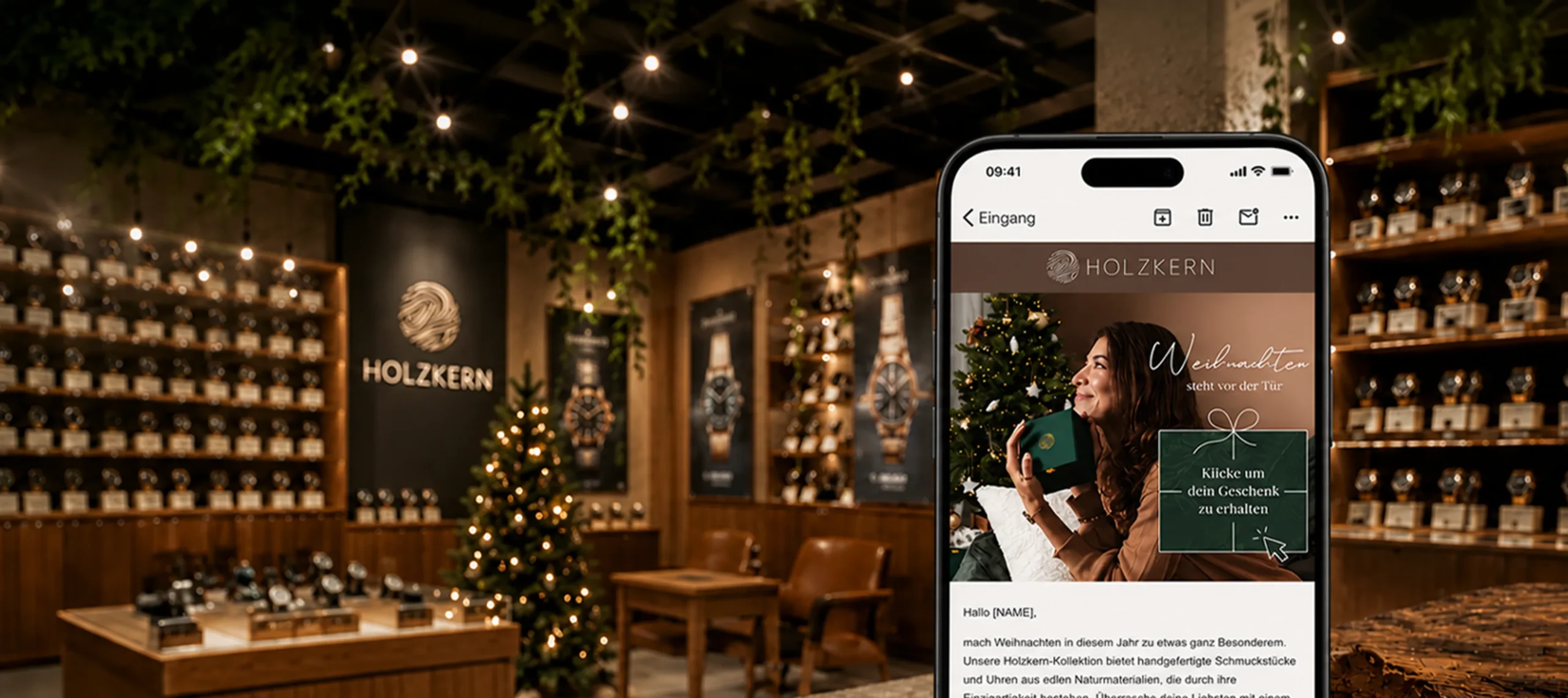
With the audience question answered, Netcore’s AMP capability changed what the emails themselves could do. Holzkern built interactive experiences directly into promotional campaigns, so customers never had to leave the inbox to act. Two use cases went live:

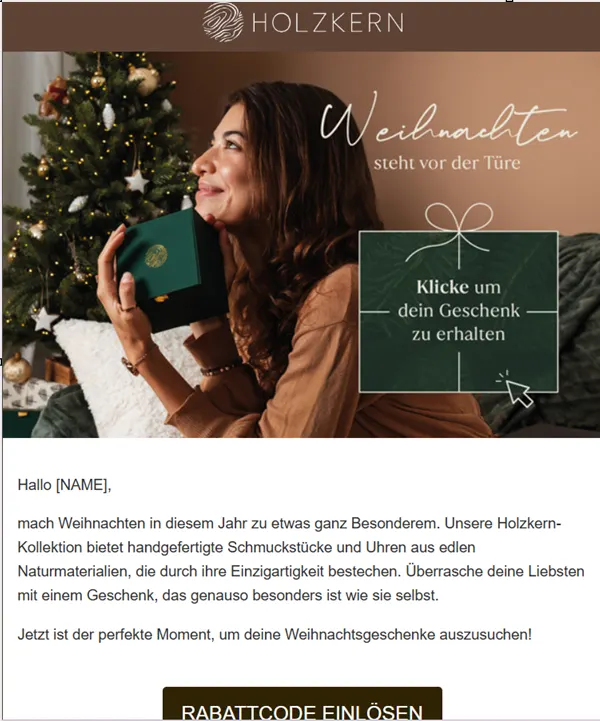
Tap-to-reveal discount code. The email arrives carrying a gift box. Tap it, and the discount code appears inside the email itself – no landing page, no redirect, no waiting on a page load. The reveal happens where the customer already is.

Tap To Reveal Discount

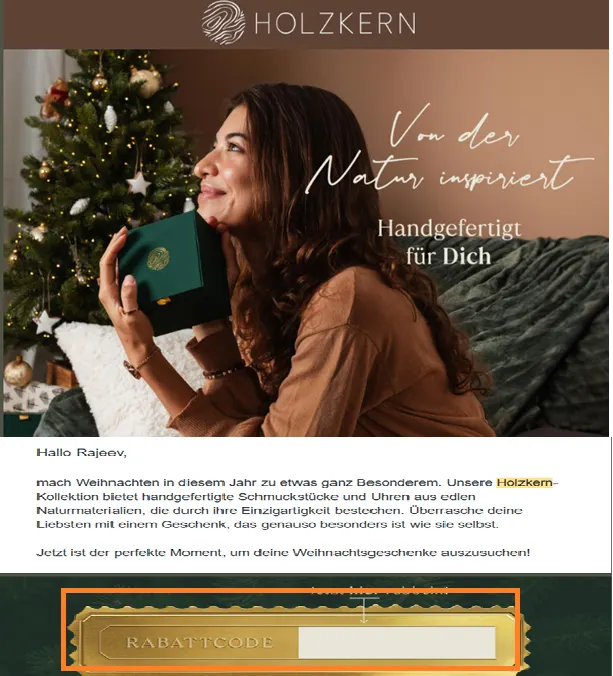
Scratch card. A virtual scratch card sits inside the email. The customer scratches it, and the promotional code is revealed on the spot.

Scratch

Both mechanics do the same two things. They make redeeming an offer effortless, because the path from seeing to having collapses to a single tap. And they turn a promotional email into something the customer participates in rather than reads.

For this brand in particular, the fit is unusually neat. Holzkern’s entire product experience is built on discovering something specific to you – you don’t know exactly what grain or marbling you’re getting until it arrives. A gift box you tap to reveal and a card you scratch to uncover reproduce that same small moment of discovery in the inbox.

They also settle the question Holzkern had asked at the outset. A pop-up interrupts you without being asked. A gift box waits to be tapped. Both create interaction; only one of them takes something from the customer to get it. That is the whole argument for AMP over the interruptive playbook, and Holzkern’s campaigns are the proof.

The order of the two layers matters more than it looks. AMP on an unsegmented list is a novelty – a clever email that everyone gets. AMP on top of real segmentation is the thing Holzkern had been trying to build all along: a communication as specific to the person receiving it as the product they bought.

READY TO SEE SIMILAR IMPACT?

See how brands hit 10X results when Netcore co-owns the outcome.

GET A DEMO

Revenue rose 20%. Against the cost of the subscription, the programme returned 182x – roughly four times the $45-per-dollar benchmark for retail and ecommerce email.

Engagement moved in the same direction, and the pattern is consistent with what these two layers are supposed to do. Open rates increased 45% – more people willing to look, because more of what arrived was relevant to them. Click rates increased 74%, a bigger jump than opens, which is the shape you want: the people opening were also finding something worth acting on. With a gift box or a scratch card sitting inside the email, there was something to act on immediately rather than a link to somewhere else.

Retention improved 10% year on year over the same period.

But the outcome the team keeps returning to is less about any single figure.

Georg Holzer

Georg Holzer

CEO, Holzkern

"Having all the data we need in one place has made us more efficient. We spend less time pulling information together and more time improving the quality of our content and optimising our other channels. That efficiency has been a game-changer for us."


This is the part that explains the 182x rather than just reporting it. The return didn’t come from a bigger team or a bigger budget. It came from a team that stopped spending its hours assembling audiences and started spending them on the work that actually moves numbers – better content, better campaigns, other channels that had been getting whatever attention was left over.

Holzkern’s marketing team now has the same thing its customers do: something built to fit rather than something built to fit everyone.

For a company that has spent a decade insisting that mass-produced sameness is the problem, that’s less a marketing upgrade than a matter of consistency.

See how we can deliver similar results for your brand

Request a Demo
Unlock unmatched customer experiences,
get started now
Let us show you what's possible with Netcore.