


A newsletter is more than a message sitting in your subscriber’s inbox. It’s a recurring moment of attention, and an opportunity to monetize it.
For years, publishers have treated newsletters primarily as a content and engagement channel. Readers open, consume, and move on. But what if that same newsletter could work more like your website, with live ad inventory that can be served, measured, and monetized?
That’s exactly what a leading media house set out to change.
By reimagining its static newsletter and bringing Google Ad Manager-powered advertising into the inbox, the publisher turned every open into a potential ad impression, and its newsletter into a new, scalable source of ad inventory.
The result? A channel that had always delivered audience attention was suddenly delivering something more: revenue.
The Blind Spot: An Audience With No Rate Card
This wasn’t a case of an underperforming channel. It was a channel that had never been asked to earn anything in the first place.
The newsletter sat outside the publisher’s entire ad business
This publisher, like most media houses, runs display advertising across its website and app through Google Ad Manager, inventory sold, tracked, and reported against like any other media asset. The newsletter never touched that system. Not one impression from it ever counted toward the numbers that ad sales were working against.
A static email can’t carry a live ad, so the conversation never started
Here’s the structural reason it took this long: a conventional newsletter is a fixed snapshot, rendered once at send time and frozen from then on. There’s no way to slot a live, auction-driven ad unit into something that can’t update. It’s less “missed opportunity” and more “the format never allowed the question to be asked.”
8% opens, zero ad dollars, and nothing about that looked like a problem
This is the part worth sitting with. The metrics weren’t bad. They were simply beside the point. An email newsletter isn’t graded on ad yield, so nobody was watching for the fact that this one produced none, until the format itself changed and made that absence visible.
The Fix: Give the Inbox the Same Ad Rail as the Website
To be clear about what actually moved the needle: AMP didn’t create the opportunity by itself. AMP built the road that let Google Ad Manager drive into the inbox.
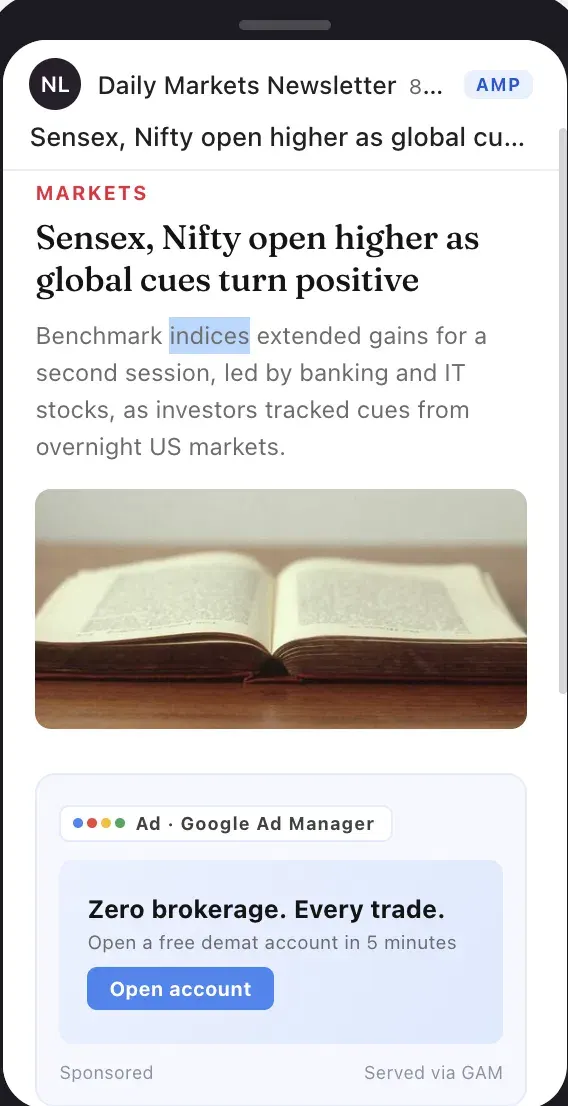
AMP for Email swaps that frozen snapshot for content that renders live, the same way a webpage does, which means, for the first time, a real ad slot can sit inside the email and pull a live, sold impression on every open, not a static graphic baked in months earlier.
1. Interactivity was the entry ticket, not the destination
AMP made the newsletter behave like a live page instead of a printed flyer: components that load, refresh, and respond after the send goes out. That’s what qualified the format to carry a genuine ad placement in the first place. Everything downstream depended on clearing that bar first.
2. A better open rate meant a bigger room to sell into
Once the format could support real interaction, open rates followed, 8% climbed to 16%, doubling in the same list, same cadence. That number matters here for a very specific reason: every one of those additional opens is now a placement Google Ad Manager can serve into. The newsletter didn’t just get more engaging. It got a bigger room.
3. The publisher didn’t build a new ad business, it extended the one it already had
This is the actual shift. No new sales team, no new advertiser relationships, no new ad product to pitch. The same Google Ad Manager inventory that already runs across web and app now has one more surface to serve on. The newsletter stopped being a line the business paid for out of goodwill and started contributing the same way every other channel already does.
Business Impact & Results
- 2,961% growth in total send volume, from 16.56M non-AMP emails to 506.77M AMP emails, each one now a sellable placement instead of a free impression.
- 1,812% growth in monthly average volume, from 3.3M to 63.5M emails a month, expanding the inventory available to Google Ad Manager.
- 2x open rate, from 8% on non-AMP to 16% on AMP, doubling the number of served ads on the same subscriber base.
- A newsletter that finally earns its keep: every incremental open now counts as ad-serving activity, on the same terms as the publisher’s website and app inventory.
Take the percentages away, and the plain version is this: a channel that spent years generating attention with nothing to show for it commercially is now serving hundreds of millions of live ad impressions a year, using an ad system the publisher had already built, just never extended this far.
The Takeaway: The Ad Inventory You’re Missing Might Already Have an Audience
Most publishers go looking for more ad inventory in the obvious places: more pageviews, more app sessions, more traffic. It’s easy to overlook a channel that’s already delivering a captive, repeat audience simply because nobody built a way to monetise it.
A conventional newsletter is content with a subscriber list attached. An AMP-powered one is a media property with its own ad rail: same readers, same publisher, same cadence, but only one of those can actually be sold against.
The question worth asking isn’t how to find a new audience to advertise to. It’s whether you already have one, sitting in a channel nobody thought to check.
Ready to find out what your newsletter is worth as ad inventory? Let’s talk about how Netcore can help.

