TL;DR
- Customer journey mapping helps brands visualize customer experiences, while journey analytics reveals how customers actually behave across touchpoints.
- The best platforms combine journey visualization, behavioral and funnel analytics, real-time data, predictive insights, and journey activation to identify drop-offs, optimize experiences, and drive conversions and retention.
- Netcore.ai: Best for AI-powered journey analytics with real-time omnichannel activation and personalization.
- Adobe Customer Journey Analytics: Best for advanced cross-channel analytics within the Adobe ecosystem.
- Salesforce Marketing Cloud: Best for CRM-connected journey orchestration and enterprise marketing automation.
- CoreMedia: Best for enterprise content management, real-time personalization, marketing automation.
- Mixpanel: Best for product analytics, behavioral tracking, funnels, and retention analysis.
- Amplitude: Best for digital product analytics, journey discovery, and behavioral insights.
- UXPressia: Best for visual customer journey mapping, personas, and collaborative experience design.
- Smaply: Best for customer journey mapping, service blueprints, and CX-focused visualization.
Customer journeys in 2026 are more complex than ever, spanning websites, apps, email, social media, and messaging channels. Understanding how customers move across these touchpoints is critical for improving conversions, reducing drop-offs, and driving retention.
While journey mapping visualizes the customer experience, journey analytics reveals how customers actually behave, where they drop off, what creates friction, and which paths drive conversion. The right journey orchestration platform brings these insights together with real-time data, predictive analytics, and journey activation to help brands turn customer behavior into measurable growth.
How Do Customer Journey Analytics and Mapping Work Together?
Journey mapping shows what the journey looks like. Journey analytics shows what is actually happening within that journey. It all starts with how to create a customer journey map.
For example, a customer journey map may show that a customer moves from an ad to a product page, then to checkout. Journey analytics can reveal that customers from a specific segment frequently visit the product page multiple times before abandoning checkout, indicating a potential friction point.
Together, these capabilities help brands visualize, understand, optimize, and activate customer journeys based on real customer behavior.
Key Capabilities to Look For
Journey mapping and orchestration are table stakes now. Almost every platform in the category has them, so I won’t spend any more time mentioning the journey creation-related features and will straight away share three capabilities that matter in a customer journey analytics & mapping platform today.
AI-driven analytics. The AI should do the analysis, not just draw the charts. It should find patterns in customer behavior on its own and predict whether a customer is likely to buy or leave. If an analyst still has to dig through dashboards to find the story, the AI is a label on the box.
No-code infrastructure. Your marketers should be able to build a segment and launch a journey without filing an engineering ticket. In the demo, ask your own team to build one from scratch while the vendor’s solutions engineer watches. You’ll learn more from that than from any feature list.
Recommendations, not just reporting. A good platform tells you what to do next: which customers to target and what message to send them. Insight alone leaves the decision, and the delay, with you. The test is to point the platform at a churning segment and see whether it answers with a named audience and a message, or with another chart.
Top 8 Customer Journey Analytics and Mapping Platforms
1. Netcore

Visual demo of analyzing customer engagement on Customer analytics platform
Netcore combines a unified customer data platform, visual journey orchestration, behavioral analytics, AI-powered insights, and omnichannel activation to help brands understand and optimize customer journeys end-to-end. Instead of simply mapping customer paths, Netcore.ai enables marketers to analyze real-time behavior, identify journey bottlenecks, predict customer intent, and immediately activate personalized experiences across channels.
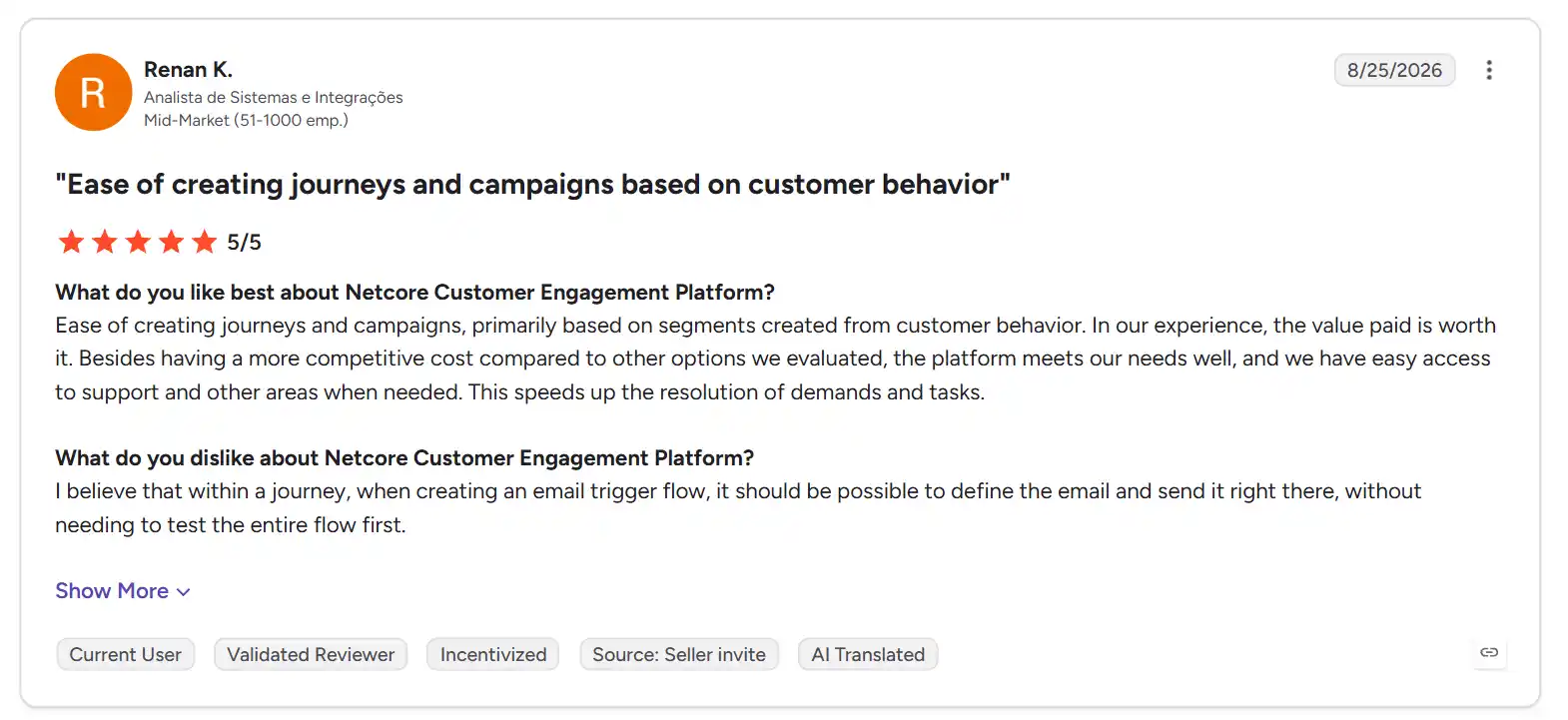
Customer review of Netcore.ai customer journey analytics platform on G2
Why choose Netcore: Choose Netcore if you want the platform to flag underperforming journey nodes and suggest fixes benchmarked to your industry. It also turns predictive segments into live audiences you can push into a journey with one click. Marketers can run the changes themselves through a no-code canvas and A/B testing, though the best fit is a mid-market or enterprise team, and you should ask in the demo whether it recommends the message itself or only optimizes subject line and send time.
Standout Features & Integrations
- Unified Customer View: Bring customer data and interactions into a single profile.
- Visual Journey Builder: Build and manage journeys with a simple no-code, drag-and-drop interface.
- Customer & Funnel Analytics: Track funnels, cohorts, user paths, RFM, and journey performance.
- AI-Powered Analytics: AI identifies anomalies, drop-offs, bottlenecks, and performance gaps, and surfaces why they may be happening.
- Actionable Recommendations: Go beyond insights with recommendations on whom to target, what message to send, and what action to take next.
- Real-Time Audiences: Create dynamic behavioral and predictive segments and activate them directly in journeys.
- No-Code Experimentation: Test and optimize journeys, messages, send times, and nudges without developer support.
- Omnichannel Orchestration: Execute journeys across Email, Push, WhatsApp, RCS, SMS, In-App, and Web.
- Enterprise Integrations: Connect data sources, APIs, warehouses, and enterprise systems through no-code integrations.
Pros
- AI-powered insights that lead to action
- No-code infrastructure for faster execution
- Real-time behavioral and predictive targeting
- Insight-to-activation in one platform
- Broad omnichannel capabilities
- Strong enterprise and ecommerce fit
Cons
- Broad platform capabilities may require onboarding and enablement
- May be more comprehensive than required for smaller organizations focused only on journey visualization
Pricing: They offer value-based pricing that ties their fee to your results, such as revenue growth, conversion, and retention.
2. Adobe Customer Journey Analytics
Adobe Customer Journey Analytics is an enterprise analytics solution designed to connect customer interactions across multiple touchpoints and provide a unified view of customer journeys.
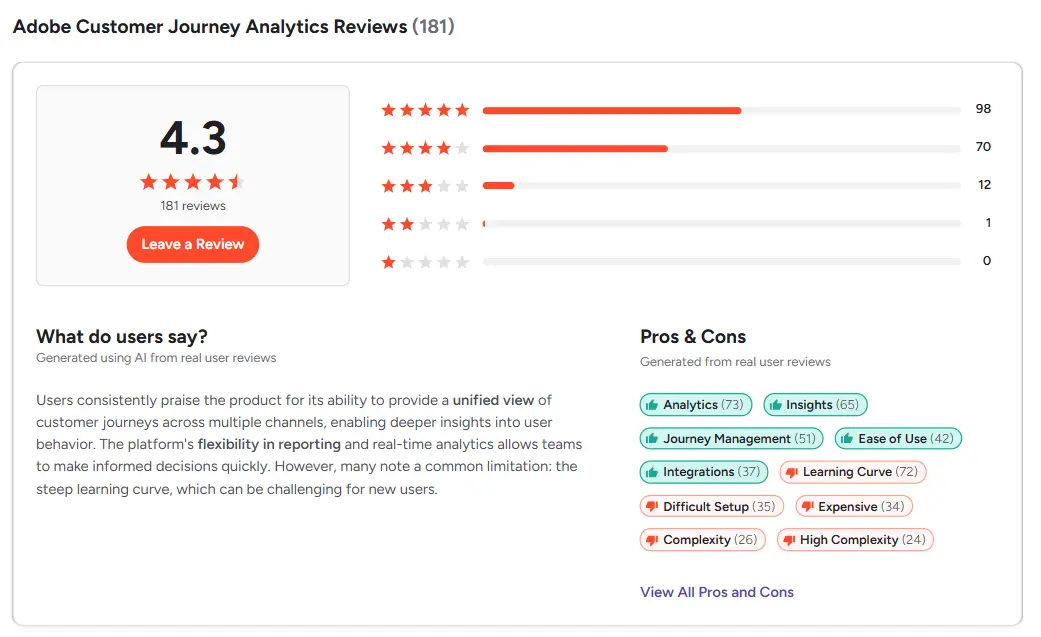
Why choose it: Choose Adobe if your data and campaigns already run on Adobe Experience Cloud and you need analytics at enterprise scale. It unifies large volumes of online and offline data into a single person-centric view, and its AI feeds segmentation, attribution, and predictive modeling. The action layer sits in Journey Optimizer, where the top package adds offer decisioning and AI models for next best offer. You get depth, but you buy two products to get it, and G2 reviewers find Journey Optimizer expensive and want simpler onboarding.
Standout Features & Integrations
- Cross-channel journey analysis
- Customer journey visualization
- Real-time and historical data analysis
- Attribution and pathing analysis
- Integration with Adobe Experience Platform
- Integration with Adobe Experience Cloud applications
- Customer segmentation and analytics
Pros
- Strong enterprise analytics capabilities
- Deep integration with Adobe ecosystem
- Powerful cross-channel analysis
- Highly customizable for complex enterprise requirements
Cons
- Complex implementation
- Steep learning curve
- Can require significant technical resources
- Potentially high total cost of ownership
Pricing: Adobe asks you to contact them for Customer Journey Analytics pricing, and Journey Optimizer comes in three packages (Select, Prime and Ultimate) with customized quotes. The next-best-offer AI is in the top tier, so go for that one if recommendations are your goal.
3. Salesforce Agentforce
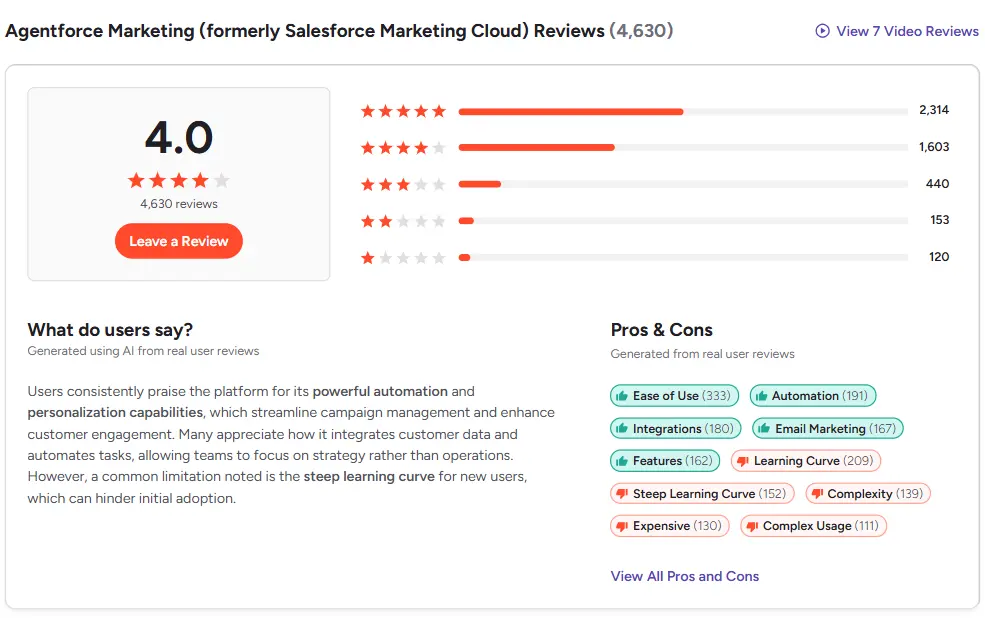
Salesforce Marketing Cloud supports customer journey analysis and orchestration through its broader Salesforce ecosystem, connecting marketing engagement with CRM and customer data.
Why choose it: Choose it if your customer data and sales and service teams already run on Salesforce. Agentforce Marketing (formerly Marketing Cloud) is sold as an agentic marketing solution built to personalize each moment of engagement across the customer lifecycle, with journey orchestration included. It works alongside existing Marketing Cloud products, so there’s no rip and replace.
Standout Features & Integrations
- Journey Builder
- Customer journey orchestration
- Cross-channel campaign tracking
- CRM integration
- Salesforce Data Cloud integration
- Email, SMS, Push, and other channel engagement
- Customer segmentation and personalization
Pros
- Strong CRM integration
- Extensive enterprise ecosystem
- Powerful journey orchestration
- Suitable for complex customer lifecycle programs
Cons
- Can be complex to implement and manage
- Advanced capabilities may require multiple Salesforce products
- High potential total cost of ownership
- Analytics and activation can span multiple Salesforce solutions
Pricing: Pricing depends on where you start. New customers begin on the Growth or Advanced edition, while existing Marketing Cloud customers renew into a “+” edition to unlock Agentforce. You can unlock Agentforce builder with Enterprise edition and above.
4. CoreMedia
CoreMedia is a Digital Experience Platform with built-in AI that brings enterprise content management, real-time personalization, marketing automation, and customer engagement, including a cloud contact center, together in one system.
Why choose it: Choose CoreMedia if your customer journeys involve high-value decisions where people often want to talk to someone before they buy.
Standout Features & Integrations
- AI contact classification with transcription, summary, and mood per conversation.
- Lead tracking that groups every interaction, digital and contact center, into one journey per lead.
- Email, WhatsApp, and SMS campaigns.
- Live chat, click-to-call, and video calls through a cloud contact center.
- 100+ integrations, including Salesforce, SAP, and commercetools.
Pros
- Acts on customer intent in real time, across digital channels and the contact center
- Agents get the customer’s full digital journey as context
- Shows where leads were lost without a conversion action
Cons
- Designed for mid-sized and large organizations
- No self-serve setup or free tier: implementation is led by CoreMedia or a partner
- Less depth in product analytics (funnels, cohorts, retention) than dedicated analytics tools
- No dedicated visual journey mapping for CX workshops
Pricing: CoreMedia doesn’t publish pricing. Quotes are customized based on the capabilities you choose and the scale of your deployment.
5. Mixpanel
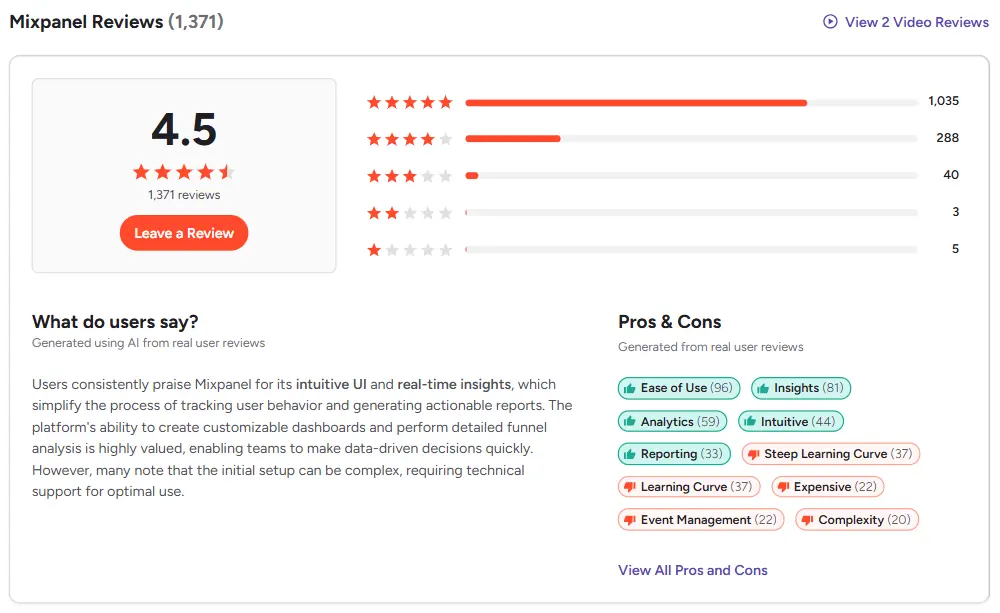
Mixpanel is a product analytics platform focused on understanding how users interact with digital products and identifying behaviors that influence activation, conversion, and retention.
Why choose it: Choose Mixpanel if you’re a product or growth team that wants AI analytics without writing queries. Its Spark AI lets you ask questions in plain language and get editable reports with charts.
Standout Features & Integrations
- Event-based analytics
- User journey and path analysis
- Funnels
- Retention analysis
- Cohort analysis
- Product usage insights
- A/B testing integrations
- Data warehouse and CDP integrations
Pros
- Strong product analytics
- Excellent event-based behavioral analysis
- Intuitive funnels and retention reports
- Good fit for SaaS and product-led businesses
Cons
- Primarily focused on product analytics rather than full marketing journey orchestration
- Cross-channel marketing activation may require integrations
- Can require careful event instrumentation
Pricing: Mixpanel has a free tier, then a Growth plan that charges per event beyond the free quota, at $0.28 per 1,000 events.
6. Amplitude
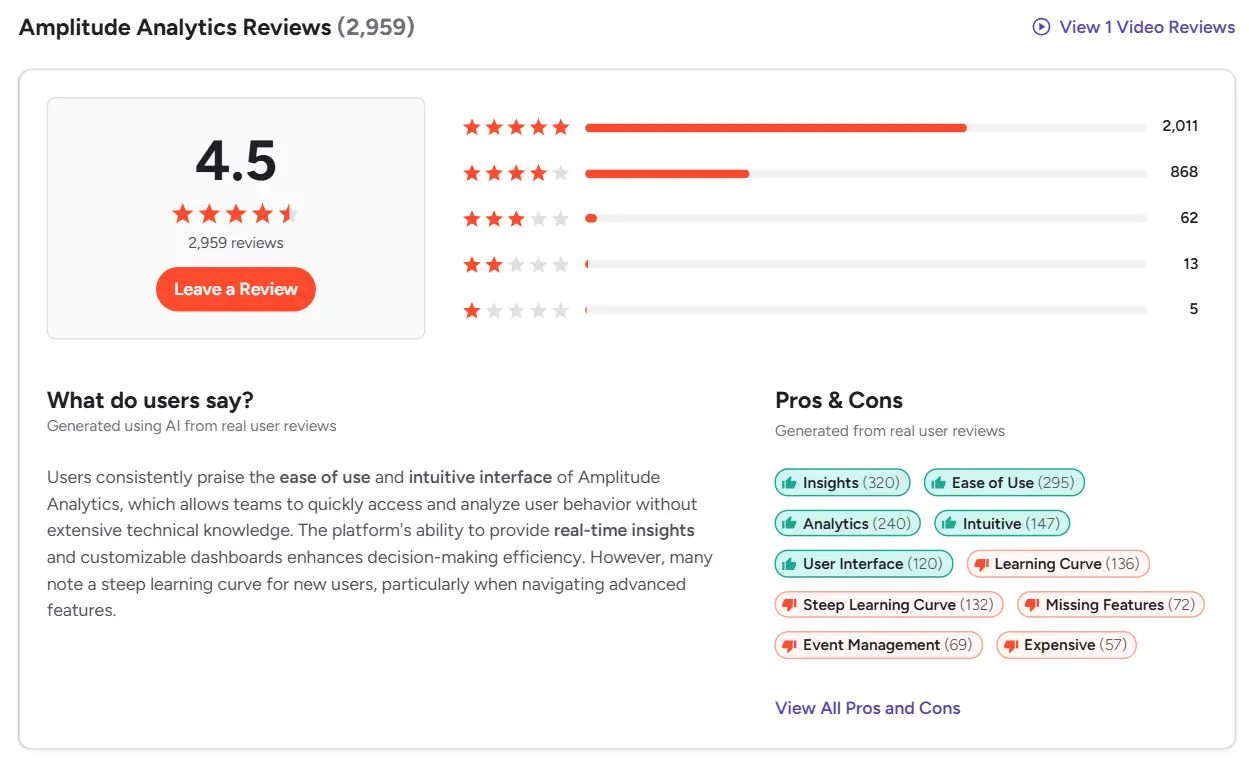
A digital analytics and product intelligence platform that helps businesses understand user behavior, discover customer journeys, and identify opportunities to improve conversion and retention.
Why choose it: Choose Amplitude if you’re a product-led team that wants AI analytics first. Its AI agents combine behavioral data with unstructured feedback to explain why your numbers are moving.
Standout Features & Integrations
- Journey and path analysis
- Funnel analysis
- Cohort analysis
- Retention analytics
- Behavioral segmentation
- Experimentation
- Product analytics
- Integration with CDPs, data warehouses, and marketing tools
Pros
- Strong behavioral and product analytics
- Powerful journey discovery
- Excellent funnel and retention analysis
- Strong visualization capabilities
- Well suited for digital products and SaaS
Cons
- More focused on product analytics than end-to-end customer engagement
- Activation often depends on integrations with other marketing platforms
- Can require technical expertise for advanced implementations
Pricing: Amplitude has a free tier and a Plus plan from $49 a month on annual billing. Growth and Enterprise are custom quotes.
7. UXPressia
UXPressia is a dedicated customer journey mapping and experience design platform focused on helping teams visually map customer interactions and identify experience gaps.
Standout Features & Integrations
- Customer journey maps
- Experience maps
- Personas
- Stakeholder collaboration
- Journey visualization
- Emotional journey mapping
- Templates and collaborative workflows
- Integrations with business and collaboration tools
Pros
- Easy-to-use visual journey mapping
- Strong collaboration capabilities
- Excellent for workshops and experience design
- Useful for documenting customer experiences
Cons
- More focused on journey mapping than behavioral analytics
- Limited real-time customer data analysis
- Limited native campaign activation capabilities
Pricing: The free plan covers 3 journey maps, 3 personas and 3 impact maps, while paid plans are priced per user with unlimited maps. UXPressia lists enterprise pricing as custom and sells AI features as an AI Boost add-on, with pricing on request.
8. Smaply
Smaply is a customer experience management and journey mapping platform designed to help organizations visualize customer journeys, personas, and service experiences.
Why choose it: Choose Smaply if you need a journey management system with prioritization, research synthesis and links to planning tools, not just a map. It was named a Strong Performer in Forrester’s Q4 2025 journey management wave, and its AI helps turn customer feedback into insights.
Standout Features & Integrations
- Customer journey mapping
- Persona creation
- Stakeholder maps
- Service blueprints
- Experience visualization
- Collaborative journey planning
- Templates and team workflows
Pros
- Strong customer experience visualization
- Easy collaboration
- Useful for service design and CX teams
- Strong journey mapping capabilities
Cons
- Primarily focused on journey mapping rather than quantitative journey analytics
- Limited behavioral data analysis
- Limited real-time journey monitoring and campaign activation
Pricing: Smaply has a free plan and paid per-editor plans with unlimited journey maps.
Customer Journey Analytics vs. Customer Journey Mapping
You need journey analytics if your goal is to drive measurable revenue; you only need journey mapping if you are brainstorming UX concepts. Journey mapping is a static, theoretical exercise that visualizes an idealized path a customer might take. It relies on generalized personas and assumptions. Journey analytics, conversely, is dynamic and empirical. It ingests massive volumes of real-time behavioral data to show you exactly what customers are actually doing across all channels. In 2026, purchasing a standalone mapping tool without the analytics engine to execute and measure the results guarantees a negative ROI on your software investment.
Quick Comparison of Customer Journey Analytics & Mapping Platforms
| Platform | Best For | Journey Analytics | Journey Mapping | Behavioral Analytics | Real-Time Data | Activation |
| Netcore.ai | AI-powered journey analytics + engagement | ✓ | ✓ | Advanced | ✓ | Native |
| Adobe CJA | Enterprise analytics | ✓ | ✓ | Advanced | ✓ | Via ecosystem |
| Salesforce Marketing Cloud | Enterprise journey orchestration | ✓ | ✓ | Advanced | ✓ | Native |
| Mixpanel | Product analytics | ✓ | Limited | Advanced | ✓ | Via integrations |
| Amplitude | Product & behavioral analytics | ✓ | Limited | Advanced | ✓ | Via integrations |
| UXPressia | Visual journey mapping | Limited | ✓ | Limited | No | No |
| Smaply | CX and service design | Limited | ✓ | Limited | No | No |
Choose Netcore if:
- You want analytics and journey activation in one platform
- You need real-time behavioral journey insights
- You want predictive and AI-powered customer intelligence
- You need omnichannel journey orchestration
- You want to turn journey insights into immediate customer engagement
Final Take
Customer journey analytics is evolving from simply visualizing where customers go to understanding why they behave the way they do, and what to do next.
The best platform depends on whether your priority is journey mapping, product analytics, enterprise data analysis, or real-time customer engagement.
For brands that want to connect behavioral intelligence with immediate journey activation, platforms that combine analytics, segmentation, personalization, and omnichannel engagement can offer a significant advantage, turning customer journey data into measurable business outcomes rather than leaving insights trapped in dashboards.