TL;DR
A heritage outdoor brand transformed its customer feedback process by ditching redirect-heavy landing pages for interactive, in-inbox surveys powered by Netcore. By leveraging AI-driven marketing agents, specifically Content, Scheduler, and Insights Agents, the brand achieved a 325% boost in response rates and a 92% increase in engagement.
Few names carry the rugged credibility of this heritage outdoor footwear and apparel brand. Since the early 1990s, it has grown into an internationally recognized label with more than 600 exclusive outlets across multiple continents, and its customers are loyal, outdoorsy, and happy to share an opinion. The problem was that almost none of that opinion was getting back to the brand, until it changed one thing about how it asked. Then came Netcore, and with Netcore came a specialized team of marketing agents
The Challenge
Like most retailers, the brand collected post-purchase feedback by emailing customers a link to a separate survey page. Every redirect was a leak. Shoppers dropped off at the landing page, abandoned a slow-loading form, or simply lost the thread between inbox and browser. Response rates stayed stubbornly low, and the little data that did arrive came too late and too thin to act on, too sparse to be representative, and collected at the very moment a customer is most willing to talk.
The Fix: Bring the Survey Into the Inbox
The brand didn’t rebuild the survey funnel; it removed the funnel. Working with Netcore, the feedback survey was embedded directly inside the email as an interactive, app-like form the customer could complete in a couple of taps, without ever leaving the inbox.
That interactivity comes from Shoppable Commerce, the framework that lets ratings, fillable forms, product cards, carousels, and gamification work inside the message itself. The interactive template was assembled in Netcore’s no-code editor.

Where the agents fit
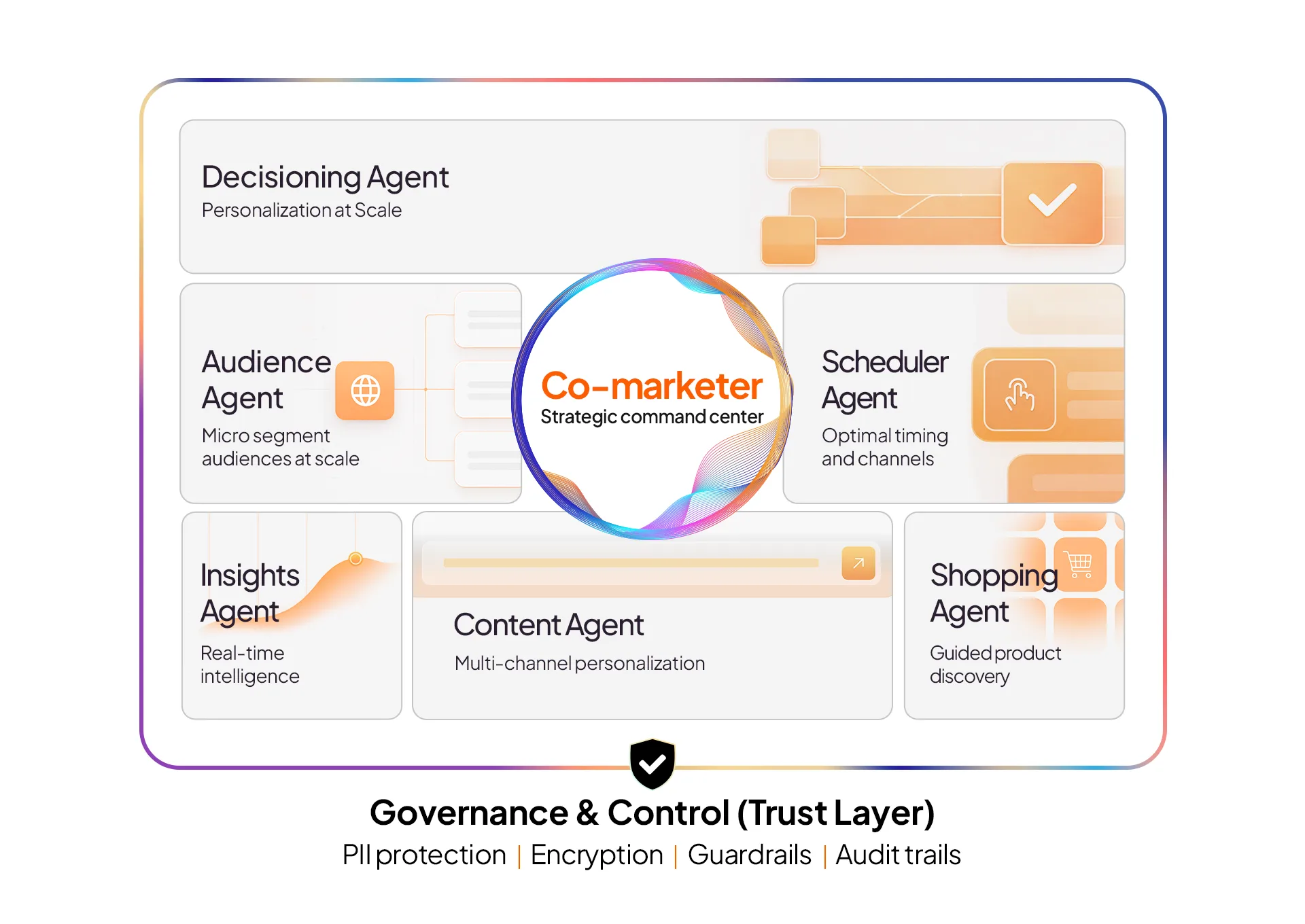
With the interactive email in place, a small set of Netcore’s marketing agents, coordinated by the Co-Marketer, which keeps every send inside the brand’s voice and approval rules, handled the parts that genuinely benefit from automation:
- The Content Agent generated the on-brand copy that fills the template, subject lines, question wording, and tone tuned to the brand, so each send was ready in seconds rather than being handwritten. (It writes the creative; the interactive form itself is the Inbox Commerce template.)
- The Scheduler Agent decided when and on which channel to send, learning each customer’s preferred window so the request landed when they were most likely to respond, and holding back when a recent message risked fatigue.
- The Insights Agent read responses as they arrived, scoring sentiment at scale and surfacing patterns a team would miss in a spreadsheet, turning what used to be days of manual reporting into a near-real-time read that feeds the next send.
Leverage the power of the above agents by talking to us today!
How it worked, end to end
The loop was simple. A purchase completes. The Scheduler Agent sends the interactive feedback email at the customer’s best time and channel. The customer rates the purchase and shares sentiment in two taps, zero-party data, volunteered willingly. The Insights Agent reads the signal and hands it back so the next send is sharper. No redirects, no manual survey ops, no waiting on a reporting cycle. Direction stays human, the team sets the goal, the voice, and the guardrails, while execution runs automatically inside them.
The results
Removing the redirect changed the economics of feedback collection:
- 325% uplift in customer response
- 92% increase in engagement
Because the data was zero-party, volunteered directly by the customer rather than inferred from behavior, it was more accurate and more durable than the third-party signals brands can no longer rely on.
That gave the brand a faster, clearer read on customer sentiment to feed sharper segmentation, more relevant content, and better lifecycle decisions. As the brand’s head of digital marketing put it, reaching the right customer at the right time and price is the key to engagement and to lifting both customer lifetime value and overall experience.
Why it matters
The brand’s old funnel wasn’t broken for lack of ideas; it was broken because every good idea each better-timed send, each interactive format- cost more manual effort than a lean team could sustain. Removing the redirect and letting agents own the copy, the timing, and the analysis lets the brand collect richer feedback at far higher volume without adding headcount. For a heritage outdoor brand, the inbox stopped being a place to send surveys and became a place where customers actually talk back.
Talk to us today to learn more about the subject.