TL;DR
By 2030, the most successful email service providers will be defined by their ability to remove friction from marketing workflows. The shift from manual campaign building to agentic AI, covering cohort discovery, adaptive journeys, content production, actionable insights, and primary-inbox engineering, is essential for e-commerce brands to scale efficiently without operational burnout.For years, choosing an Email Service Provider was relatively straightforward. Marketers compared deliverability rates, automation builders, segmentation features, and pricing. That buying framework is rapidly becoming obsolete.
As Forrester noted in its Q1 2026 evaluation, there had been “many years of limited change in email marketing vendor capabilities.” That stability is now giving way to one of the most significant shifts the category has seen in over a decade. This is the shift that agentic AI is beginning to address.
The challenge facing modern e-commerce brands is no longer a lack of tools. The actual strategy, the work that drives growth, often gets squeezed between operational tasks. The most important change isn’t that AI can write an email or create a segment. Those capabilities already exist. The real opportunity is reducing the amount of manual coordination required to turn customer data into customer experiences. By 2030, the best ESPs won’t be defined by how many features they offer. They’ll be judged by how effectively they remove friction from the marketing workflow. Here are the capabilities ecommerce brands should be looking for.
1. Cohort Discovery Instead of Cohort Building
Most marketers don’t wake up wanting to build segments. They want to identify customers who are likely to buy, churn, upgrade, or re-engage. Yet much of CRM marketing still revolves around manually defining audiences through dozens of conditions and filters.
Consider a beauty retailer preparing for a seasonal promotion. A marketer might need to identify customers who purchased skincare products within the last six months, haven’t purchased recently, have engaged with email in the past 30 days, and have shown interest in a specific product category. The technology exists to build that audience. The challenge is the time required to define it.
Agentic systems like the Audience Agent change the interaction model. Instead of constructing audiences rule by rule, marketers describe business objectives. The platform then recommends the most relevant audience based on historical behavior, purchase signals, engagement patterns, and predictive indicators.
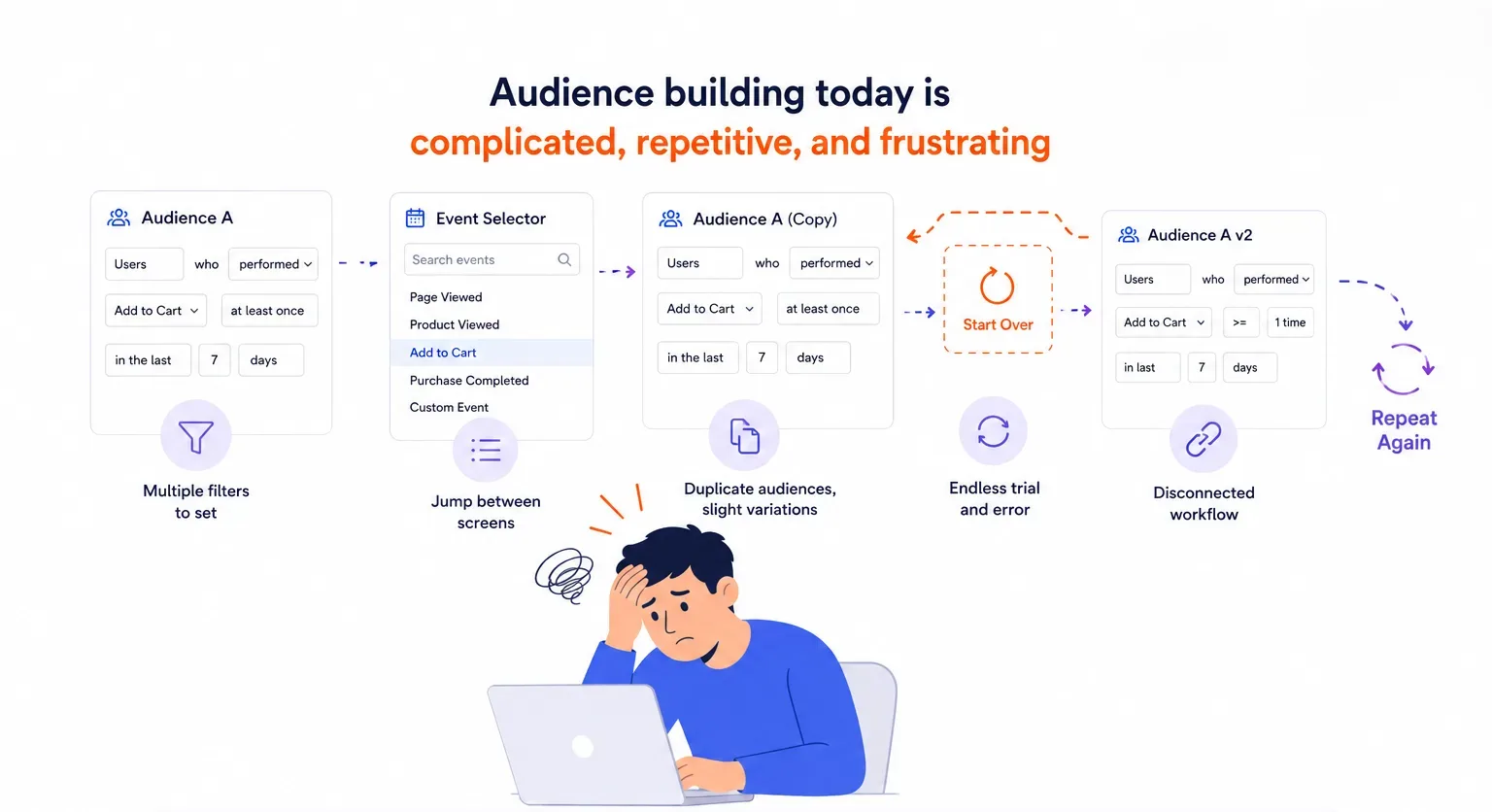
The marketer still makes the decision. The platform simply reduces the effort required to get there.
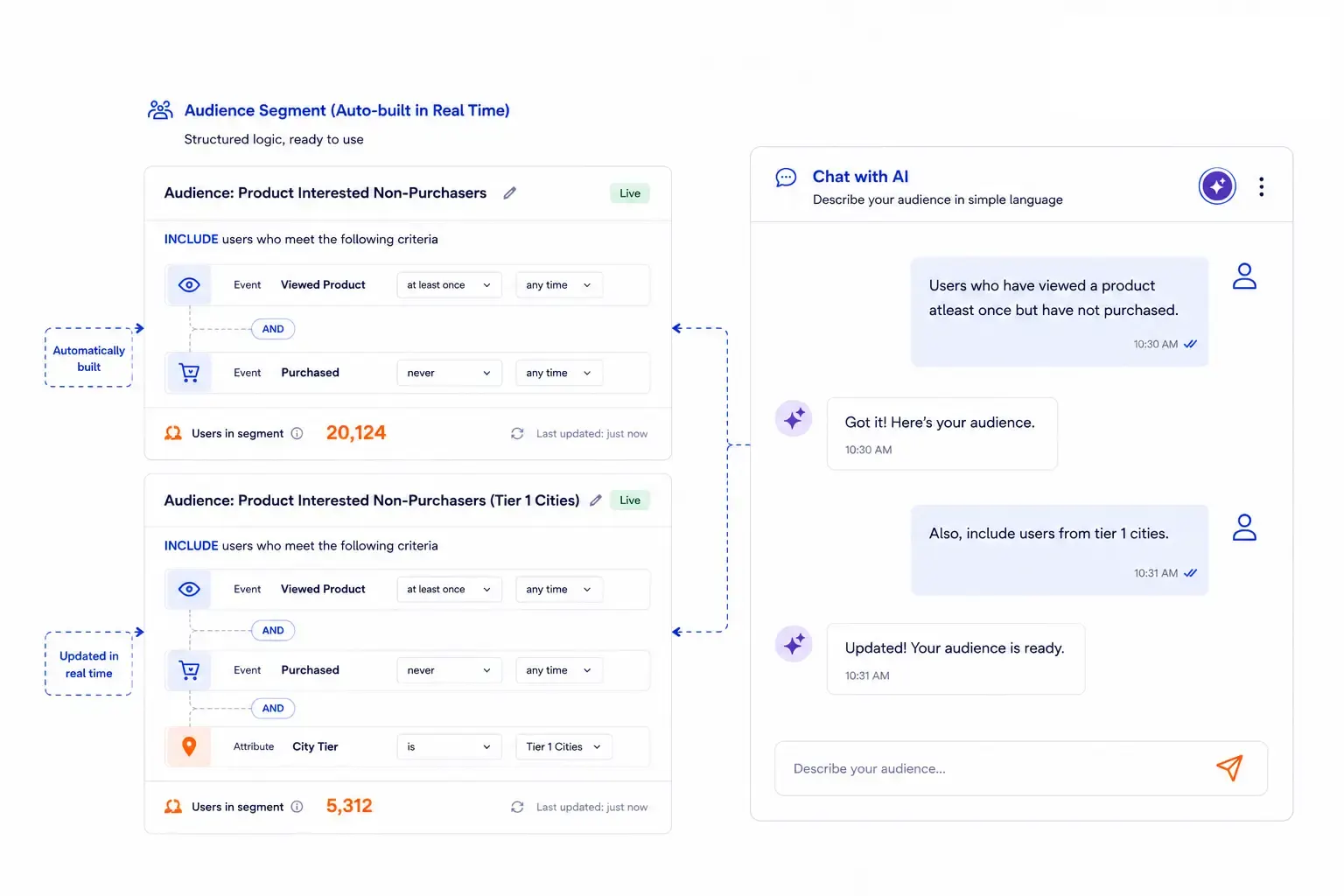
Here’s how the Audience Agent works
2. Journeys That Adapt Instead of Following Fixed Rules
Mapping out complex customer journeys has historically meant building massive, fragile flowcharts of “if/then” rules. However, even the most intricate manual journeys eventually hit a mathematical wall; human marketers simply cannot predict the next best action for every customer at scale.
This is where AI takes over the heavy lifting of execution. A Decisioning Agent replaces rigid journey mapping and static A/B testing with continuous, contextual intelligence.
Rather than relying solely on send-time optimization, modern AI decisioning focuses on predicted engagement. By analyzing behavioral signals, purchase intent, historical interactions, and campaign performance, it can identify which customers are most likely to engage with a message and prioritize delivery to those users first. This helps create stronger engagement signals early in a campaign, improving overall performance while allowing marketers to respond more quickly to any emerging delivery issues.
The advantage becomes even more powerful when the ESP controls the delivery engine itself. Because decisioning and delivery operate together, the platform can continuously optimize not just who receives a message, but how campaigns are delivered and monitored in real time. The result is more relevant customer experiences, stronger engagement, and a healthier path to inbox placement than traditional platforms that rely on disconnected delivery infrastructure.
Check out our documentation on the Decisioning Agent to see the various business cases it supports.
3. Content Production Without Bottlenecks
Personalization has always been limited by production capacity. Most brands know different customers should receive different messages. Few have the resources to create hundreds of variations for every campaign. A footwear retailer, for example, might want different creatives for runners, casual shoppers, loyalty members, first-time buyers, and high-value customers.
The challenge isn’t strategy. It’s execution at scale. Creating more content is easy. Creating more content that still sounds like your brand is not.
This is where content agents provide practical value. Not by replacing creative teams, but by extending them. Instead of manually producing every variation, marketers can generate channel-specific drafts, audience-specific messaging, and creative variants that are automatically aligned to approved brand guidelines, tone of voice, product messaging, and campaign objectives.
The result is scale without fragmentation. Hundreds of personalized experiences can be created while maintaining the consistency customers expect across email, mobile, web, and other channels. Creative teams spend less time adapting assets and reviewing minor variations, and more time shaping strategy, storytelling, and brand direction.
4. Insights That Lead to Action
Most marketing teams don’t suffer from a lack of reporting. They suffer from a lack of clarity.
Open rates, clicks, conversions, revenue, unsubscribes, engagement scores, modern teams have access to more data than ever before. Yet many still struggle to answer a simple question: “What should we do next?” This is where AI has the potential to be genuinely transformative.
Rather than generating more dashboards, agentic systems like the Insights Agent can help marketers understand the drivers behind performance.
- Why did one campaign outperform another?
- Why is engagement declining among a specific audience?
- Which customer segment presents the biggest opportunity?
The goal isn’t replacing analysts. It’s helping teams spend less time searching for answers and more time acting on them.
Did you know?
Forrester highlights: “Transparent AI builds trust and reduces risk.” The most valuable agentic systems won’t be the most autonomous. They’ll be the ones that clearly explain recommendations, respect brand guardrails, and operate on trusted first-party customer data.
5. Beyond Basic Deliverability: Predictive Primary-Inbox Engineering
If a promotional email technically bypasses a spam filter but quietly lands in the Gmail Promotions tab, it hasn’t actually been seen. For a high-volume retailer, that invisible drop in engagement translates directly to evaporating revenue.
Mailbox providers (MBPs) like Google, Yahoo, and Microsoft no longer rely solely on IP reputation and spam traps; their algorithms ruthlessly filter based on positive and negative user engagement signals. According to research, average inbox placement hovers near a precarious 75%. In this environment, dodging spam is not enough; you have to continuously earn visibility.
Modern platforms like Netcore are shifting from reactive deliverability to primary-inbox engineering. Instead of generating post-mortem bounce reports, an advanced ESP utilizes machine learning to model sender reputation predictively. It runs continuous, real-time diagnostics on domain health and dynamically routes shaky or disengaged audience segments into specialized win-back tracks before a domain’s visibility takes a hit. This proactive reputation engineering ensures that your highest-value offers consistently command attention in the primary inbox.
The Future Belongs to Marketers, Not Machines
The question isn’t whether your ESP has AI. The question is whether AI reduces the work marketers have to do every day. Analysts capture this distinction well, encouraging buyers to look for “AI as a functionality enabler, not as a feature.” In other words, the value isn’t an AI button. The value is removing friction from segmentation, orchestration, content production, and analysis.
Much of the conversation around AI focuses on replacement. The reality inside ecommerce organizations looks very different. The most successful brands aren’t searching for systems that eliminate marketers. They’re searching for systems that eliminate unnecessary work. The future ESP is not an autonomous marketing department. It’s a platform that helps talented marketers spend more time thinking about customers and less time managing workflows. That’s the real promise of agentic marketing. Not replacing human judgment. Amplifying it.
The future of email marketing won’t be defined by more features. It will be defined by how effectively platforms help marketers discover audiences, orchestrate journeys, create content, improve inbox visibility, and turn insights into action.
Netcore’s Agentic Marketing Platform is built around that vision, combining AI-powered decisioning, predictive engagement, content generation, and primary-inbox engineering in a single platform.
Book a demo to see how leading ecommerce brands are preparing their marketing stack for the next decade.