




TL;DR
“Jewellery brands do not lose most of their revenue to weak demand. They lose it to four quiet moments in the customer journey: the high-intent customer who leaves and gets a generic nudge, the channels that talk over each other, the catalogue that hides its best pieces, and the silence after a purchase that slowly turns a customer into a stranger. This piece breaks down each one, and what it is actually costing the business.”
Ask any jewellery retail leader where growth will come from and the answer is usually more: more traffic, more campaigns, more spend. Yet in most jewellery retail businesses, the bigger opportunity is not acquiring more demand. It is the demand already arriving and quietly leaking revenue on its way through: customers who came close and drifted, customers who bought once and were never spoken to again, pieces that never met the person searching for them.
None of these leaks announces itself. Each one hides inside numbers that look normal: a conversion rate that has always been around one percent, an unsubscribe rate creeping up slowly, a dormant list everyone has stopped questioning. Here are the four places jewellery brands leak the revenue they already earned, and what each one costs.
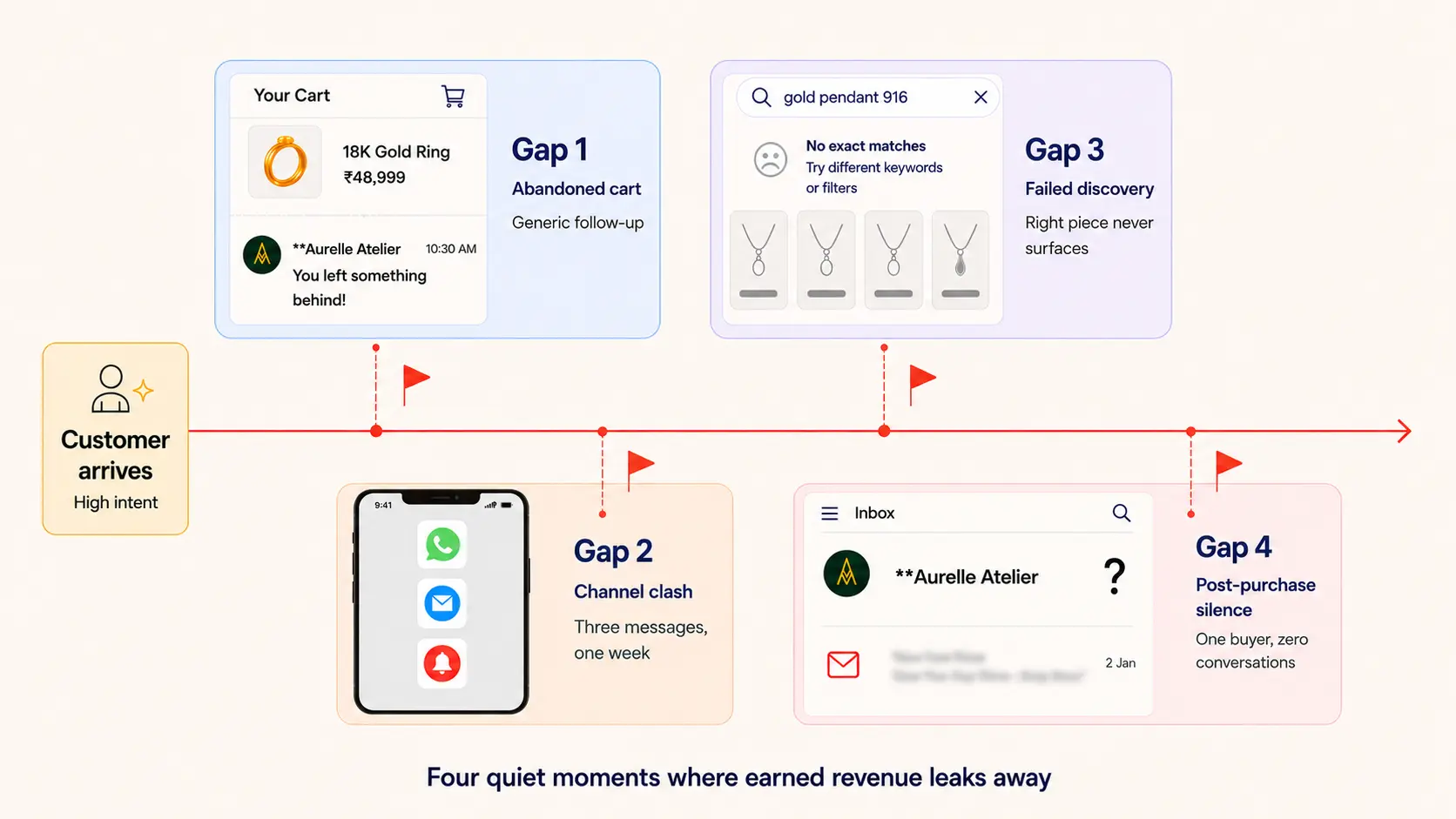
1. The Customer Came From Your Ad, Added to Cart and Vanished. The Follow-Up Treated Everyone the Same.
A customer clicks a campaign, lands on the site and adds a piece to the cart. Then the tab closes. In jewellery this is rarely disinterest; a purchase this considered means checking with a partner, waiting for the right moment, weighing trust against the size of the spend. The customer is not gone. The customer is deciding.
What follows is the same reminder everyone gets: one automated nudge, same copy, same timing, whether the visit lasted thirty seconds or the deliberation ran across four sessions. Sometimes it arrives on email, sometimes on WhatsApp, sometimes not at all, because the reminders fire inconsistently and nobody quite trusts them. A brand with full visibility into the customer’s intent responds with a message written for nobody in particular.
THE IMPACT: The most expensive traffic a brand buys converts at its lowest possible rate. Ad spend keeps refilling a cart-shaped bucket with a hole in it, and conversion sits near one percent while everyone debates creative and budgets. The gap between one and two percent sounds small; on jewellery ticket sizes it is the difference between a channel that drains money and one that compounds. And every generic nudge sent to a deliberating customer does worse than nothing: it tells a person making a significant decision that the brand was not paying attention.
2. Three Tools, Three Calendars, One Confused Customer.
Email runs on one platform. WhatsApp runs through a chatbot on another. A separate system tracks loyalty and dormancy, and in some businesses the whole stack sits with an external vendor the brand cannot see into. The segments may even be shared. The conversations are not.
So the customer hears from the brand the way the org chart is drawn, not the way a relationship works. A WhatsApp about a new collection, an email about the same collection with a different offer, a push about a sale ending, all in the same week, none aware of the others, some arriving after the purchase has already happened. Each message is reasonable on its own. Together they read as a brand that does not know its own customer.
THE IMPACT: Fatigue arrives before revenue does. The customer starts skimming, then muting, then unsubscribing, and every channel’s performance decays at once while each team optimises its own dashboard. In a category where a customer weighing a one lakh purchase is really deciding whether the brand can be trusted, contradiction is not a messaging problem, it is a trust problem. The brand pays for every channel and gets the credibility of none, and the cost lands hardest on the highest-value customers, the ones receiving the most messages.
3. Forty Thousand Pieces in the Catalogue. The Customer Saw Twenty of the Wrong Ones.
A jewellery catalogue is one of the deepest in retail: tens of thousands of SKUs across metals, purities, weights, occasions and price points, refreshed constantly as new designs arrive. A customer comes looking for something specific, a gift, an occasion, a budget, and types it into search.
The results return everything and nothing: hundreds of products, most irrelevant, the right piece buried on page six or missing entirely because the search does not understand what 916 means or that a pendant needs a chain. The customer filters, scrolls, gives up. The right piece existed. The catalogue just never showed it. And at the moment a purchase does happen, the pieces that naturally complete the set, the earrings for the necklace, the band for the ring, never surface at all.
THE IMPACT: The brand’s largest merchandising investment performs like its smallest. Every design that never surfaces is inventory paid for, photographed, uploaded and invisible, and every failed search is a high-intent session ending at a search bar instead of a checkout. The cross-sell that is native to jewellery, sets, pairings, matching pieces, goes uncaptured, so average order value stays flat while the catalogue keeps growing. The business keeps adding SKUs to solve a problem that was never about selection.
4. The Customer Bought. You Went Quiet. Ten Years Later, a Row in a Dormant List.
The weeks after a significant jewellery purchase are the warmest a customer relationship will ever be: satisfaction is fresh, trust is proven, attention is earned. Most brands spend that window in silence. An invoice, maybe a delivery update, then nothing until the next mass festive blast, which speaks to that customer exactly the way it speaks to someone who has never bought at all.
Repeat that pattern purchase after purchase, year after year, and it compounds into the number every established jewellery brand recognises and few interrogate: a customer base built over a decade in which most people bought once. The emails still go out, tens of thousands a month. Thousands sit permanently unopened. The list keeps growing. The audience does not.
THE IMPACT: The cheapest revenue in the business, the second purchase from a customer who already trusts the brand, becomes the rarest. Reactivating a dormant customer costs several times what staying present would have, and most reactivation campaigns arrive years too late, competing against every brand the customer has met since. Meanwhile lifetime value quietly caps at one transaction, which forces growth back onto paid acquisition, the most expensive lever available, to replace customers the brand already had. The dormant list is not a segment. It is a ledger of warm moments that were left to cool.
The Revenue Is Already in the Building
These four leaks share one root: engagement that is generic where jewellery demands specificity, fragmented where it needs coordination, and absent at the moments of highest intent. None of them shows up as a crisis, which is exactly why they persist. The customer who abandoned, the customer hearing three versions of one campaign, the piece nobody finds, the buyer who was never spoken to again: each is revenue the brand already earned, leaking out in silence.
Each of these gaps has a specific, proven fix, and that is where this series goes next.
Final take
The four leaks covered in this piece share one underlying cause: engagement that is generic where jewellery demands specificity, fragmented where it needs coordination, and absent at the moments that matter most.
A customer who fills a cart from an ad and leaves is not lost but deliberating, and a one-size reminder is the wrong answer to a high-consideration decision. Channels running on separate tools and calendars contradict each other and quietly erode the trust a high-value purchase demands. A catalogue of forty thousand pieces means nothing if the right one never surfaces for the right customer. And the silence after a purchase, repeated year after year, is how a decade of customers becomes a dormant list.
None of these leaks announces itself on a dashboard. Together they compound, and they all drain the same thing: revenue the brand already earned. The demand is arriving. The customers exist. The revenue is already in the building. The opportunity is to stop watching it leave.
Now that we have seen the four problems and what each one costs, the next piece takes the obvious step forward: the solutions and practices that close each of these gaps, from behaviour-led recovery to the thirty days after purchase.