





And why the brands asking the wrong questions end up paying the most.
Let’s start with an honest admission: when most marketing leaders hear “platform migration,” they immediately think about two things time and money.
How long will it take? What will it cost? Can we survive the disruption?
These are fair questions. But they’re also the least important ones. Because the brands that fixate on migration cost almost always underestimate migration value and in doing so, they end up making one of the most consequential strategic decisions in their marketing calendar based on incomplete math.
So before you open a spreadsheet and start calculating vendor licensing fees, let’s ask some harder questions.
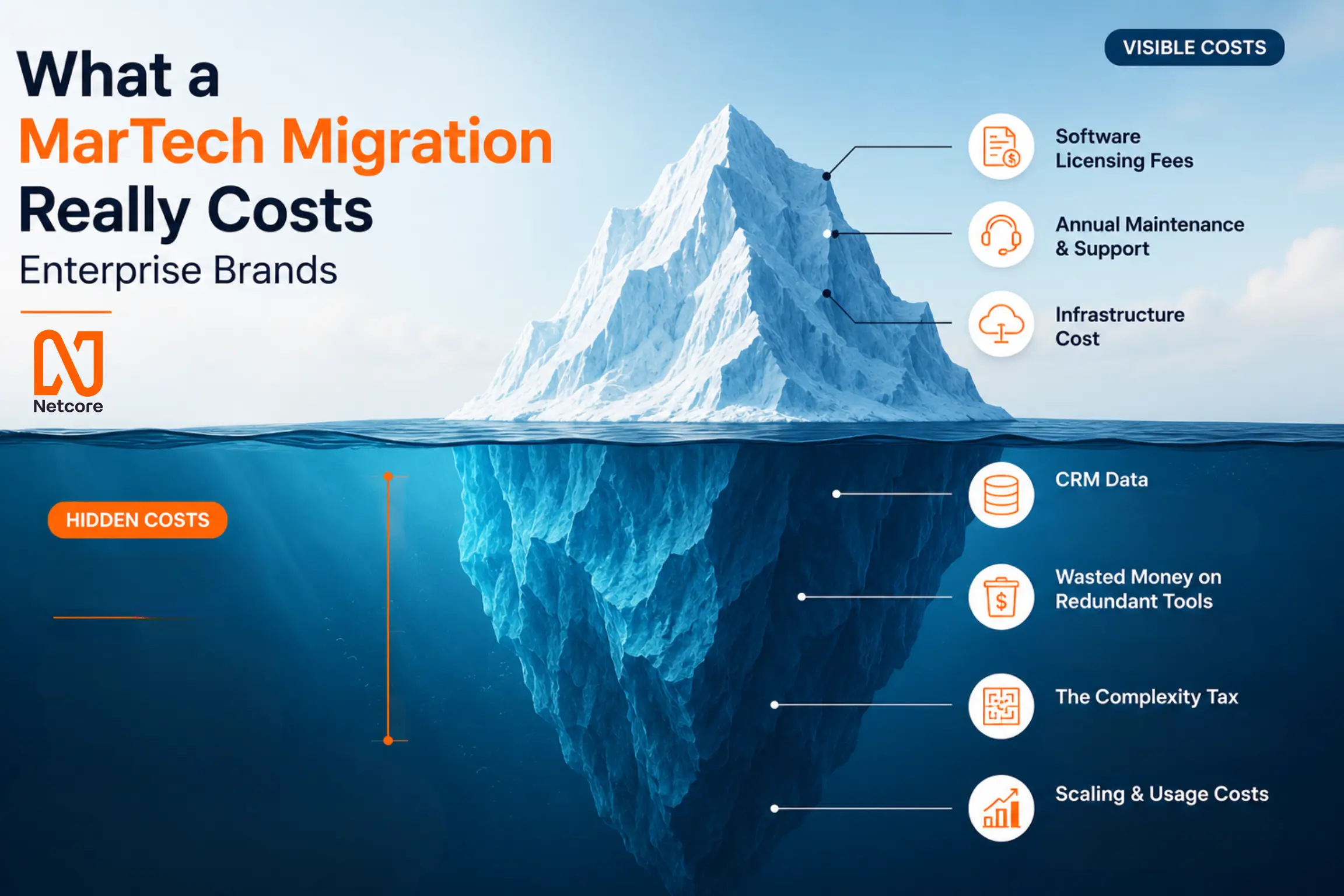
First: What Is Your Current Platform Actually Costing You?
Not in licensing fees. In outcomes.
How many customer segments are you unable to build right now because your data sits in disconnected silos one tool for email, another for push, a third for SMS, and a CRM that none of them talk to properly?
When was the last time you could genuinely say your marketing acted on real-time customer behaviour rather than scheduled batch logic designed around your platform’s limitations?
And here’s the one that stings: how much of your customer data are you actively wasting?
Every enterprise brand accumulates a goldmine of behavioural data over time, purchase histories, browse patterns, content preferences, channel responsiveness, and churn signals. But if your platform can’t ingest, unify, and act on that data in real time, it’s not a goldmine. It’s a warehouse with no map.
That’s the first real cost of staying on a legacy stack. Not what you’re paying. What you’re leaving on the table.
Now Let’s Talk About the AI Capability Gap
Here’s a question worth sitting with: Is your current platform capable of personalization at scale or is it capable of segmentation at scale?
There’s a critical difference. Segmentation puts customers into buckets. Personalization responds to each customer as an individual, in real time, across every channel they use.
Legacy platforms were built for the former. The shift to AI-native marketing platforms isn’t cosmetic; it’s architectural. When you migrate to a platform with genuine AI capabilities, you’re not just switching tools. You’re unlocking the ability to predict who’s likely to buy next, identify churn risk before a customer goes quiet, serve the right product recommendation at the right moment, and optimise send times and channels per individual, not per segment.
The cost question to ask here isn’t “what does migration cost?” It’s: what does another 12 months without these capabilities cost you in missed conversions, customer churn, and campaign inefficiency?
Run that number. It’s usually more uncomfortable than the migration invoice.
What Are You Actually Seeing and Not Seeing Right Now?
Let’s talk about dashboards, because this is where a lot of enterprise teams are flying blind without realising it.
How many platforms do you currently log into to get a complete picture of marketing performance? Is your SEO data in one place, your paid search (PPC) in another, your email metrics in a third, and your CRM conversion data somewhere else entirely?
If your answer involves more than two tabs, you don’t have a measurement problem. You have a visibility problem. And visibility problems become investment problems because you can’t validate marketing spend, optimise ROI, or make fast decisions when the data you need is spread across tools that don’t talk to each other. Here’s a CRM platform migration guide, to help you make better decisions.
A truly unified platform doesn’t just migrate your campaigns. It becomes the single source of truth, pulling performance signals from PPC, SEO, CRM, and lifecycle channels into one actionable view. The result isn’t just cleaner reporting. It’s the ability to make decisions in hours, not weeks.
So ask yourself: when was the last time you genuinely knew, in real time, which campaigns were driving revenue and which ones were quietly draining budget?
Are You Compliant Or Do You Just Think You Are?
GDPR, CCPA, DPDP in India. The regulatory landscape around customer data has fundamentally changed, and it’s not getting simpler.
Here’s the uncomfortable question: do you know, right now, where every piece of customer data in your stack lives, who has access to it, and how it’s being used?
Legacy platforms often make compliance harder than it should be, with fragmented data storage, inconsistent consent management, and audit trails that are incomplete or difficult to reconstruct. As privacy regulations tighten, this isn’t just a legal risk. It’s a brand risk.
A modern migration, done correctly, isn’t just a technical upgrade. It’s a compliance reset with regional data hosting, full encryption, role-based access controls, and audit logs that give you complete visibility into every data interaction. The cost of not doing this isn’t hypothetical. For enterprise brands operating across geographies, it’s a matter of when, not if.
The Deepest Question: Are You Still Living in Silos?
This is the one that separates brands that transform from brands that just migrate.
Most enterprise marketing teams are operationally fragmented. Email team. Push team. Paid team. CRM team. Each with their own tools, their own data, their own view of the customer and very little coordination between them.
What would it mean for your business if all of that changed?
Imagine a platform that acts as a genuine marketing brain, unifying data from every channel, reading customer behaviour in real time, automatically triggering the right intervention at the right moment. Not because a human set up a rule three months ago, but because the system is continuously learning and acting.
That means:
- A high-value customer who browses but doesn’t buy gets a personalised nudge within minutes, not days.
- A customer showing early churn signals gets routed into a retention workflow before they cancel.
- Revenue workflows, cart recovery, cross-sell, and re-engagement run continuously in the background, accelerating returns without proportional increases in team effort.
The question isn’t whether this kind of unified, AI-native platform creates value. It clearly does. The question is how long you’re willing to let siloed operations cap your ceiling.
Key Takeaway
When you add it all up, the data that goes unactivated, the AI capabilities you don’t have, the visibility you’re missing, the compliance exposure you’re carrying, and the revenue that siloed operations are leaving behind, the cost of migration looks very different.
It’s not a line item. It’s a trade-off calculation.
And the real question, the one worth spending serious time on, isn’t “what will this migration cost us?”
It’s: “What is delaying it costing us, every single quarter?”
That number, for most enterprise brands, is the one that finally makes the decision easy.
Netcore has helped brands including Senco Gold & Diamonds, The Souled Store, PayU, ClearTax, Metropolis, Skullcandy, Bighaat, Plum, VisionPlus, and 7-Eleven navigate MarTech migrations that delivered measurable performance lifts, not just platform changes. Talk to our experts if you are interested in migrating to Netcore.