Diwali Engagement Playbook is now


TL;DR
- The retail customer journey is no longer linear. Modern shoppers move across websites, apps, marketplaces, social media, email, WhatsApp, and physical stores before making a purchase.
- Understanding each stage of the journey from Awareness and Consideration to Purchase, Retention, and Advocacy is critical for improving customer experience and maximizing revenue.
- Leading retailers use customer journey mapping to identify friction points, optimize touchpoints, and create seamless omnichannel experiences.
- AI-powered personalization, product recommendations, customer data platforms, and marketing automation are helping brands deliver 1:1 experiences at scale.
- Brands like Amazon, Sephora, Nike, and Starbucks succeed by connecting discovery, engagement, conversion, and loyalty into a unified customer journey.
You have probably spent weeks building a beautiful customer journey map, only to watch shoppers behave nothing like the journey you carefully documented. They discover products on Instagram, compare prices on marketplaces, read reviews on Google, abandon carts on mobile apps, and finally purchase through a completely different channel. The reality is that today’s retail customer journey is no longer linear; it’s dynamic, fragmented, and constantly changing. This shift is forcing retailers to rethink how they approach customer journeys. According to research from McKinsey & Company, companies that excel at personalization generate 40% more revenue from those activities than average performers. Meanwhile, consumers increasingly expect brands to recognize them across every touchpoint.
The challenge? Most brands still treat customer journey mapping as a static exercise rather than a living growth strategy. A diagram on a whiteboard doesn’t recover abandoned carts, personalize product recommendations, or react to customer intent in real time.
At Netcore, we believe customer journey mapping is only the starting point. The real opportunity lies in orchestrating every touchpoint across email, web, app, WhatsApp, SMS, and in-store interactions to create seamless, revenue-generating experiences.
In this guide, you’ll learn what the modern retail customer journey looks like, how to map it effectively, key touchpoints to optimize, and real-world examples from leading retailers that turn customer journeys into measurable business growth.
What is a Retail Customer Journey?
The retail customer journey is the sum total of every interaction a person has with your brand, from the moment they realize they have a need, through the transaction, and deep into their lifecycle as a loyal advocate.
Historically, the industry has framed this strictly as a Customer Experience (CX) metric. Agencies will sell you expensive audits to improve the “sentiment” of these customer touchpoints. But sentiment does not pay the bills. If your journey mapping does not directly arc toward outcomes, specifically revenue, conversion rates, and lifetime value (LTV), you are wasting time.
At Netcore, our stance is clear: we deliver your results, not just your messages.
To us, defining the retail customer journey requires looking at it through the lens of accountability. Every email sent, every push notification triggered, and every in-store promotion activated must answer one question: What does this mean for the customer’s results? If an interaction does not reduce friction or accelerate a purchase decision, it does not belong in your strategy.
Stages of Retail Customer Journey
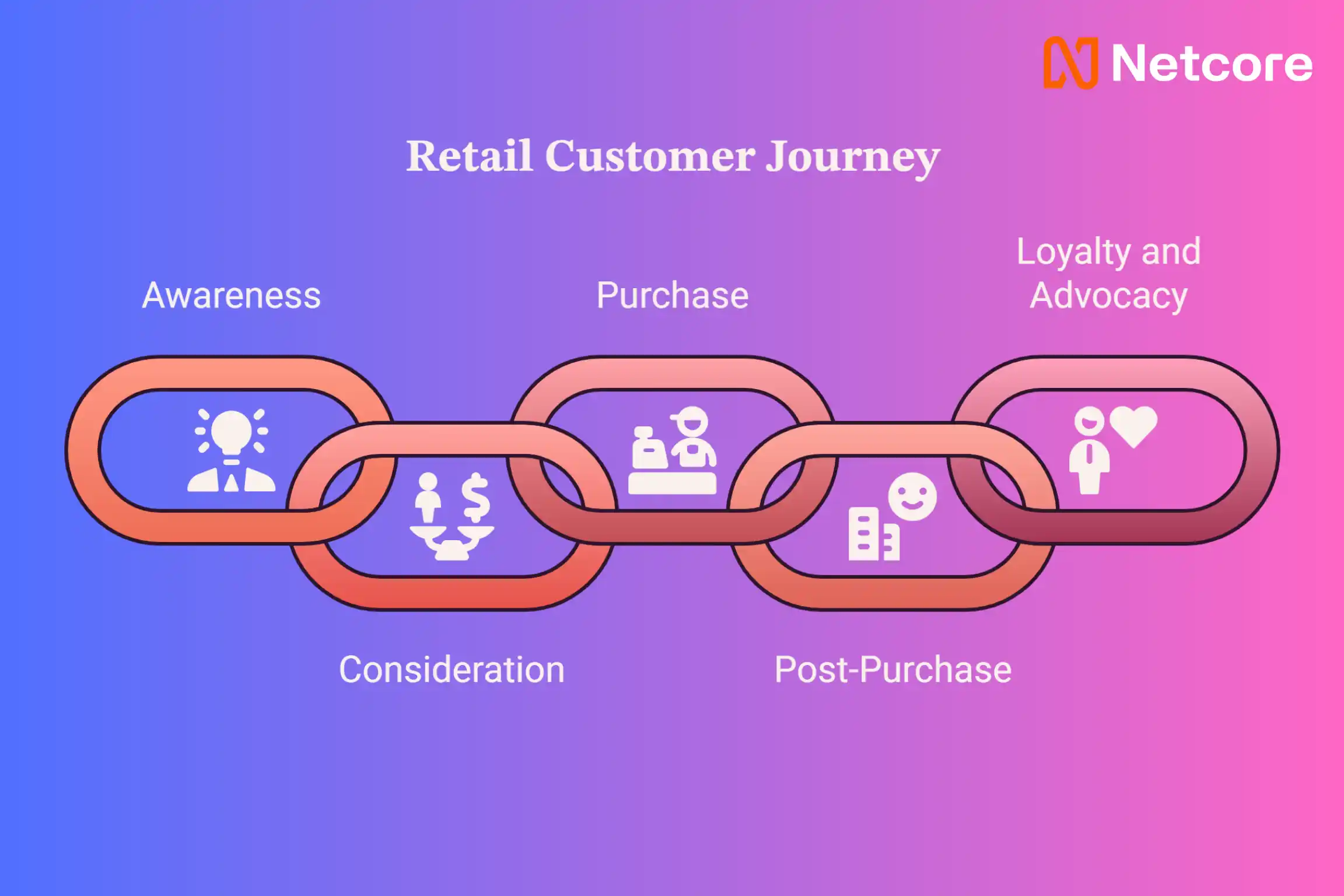
To orchestrate the journey, you first have to understand the framework. While buyers move unpredictably, their psychological progression generally falls into five distinct phases. Most legacy guides treat these as separate silos. We treat them as a continuous, unified loop where data from one stage immediately informs the next.
1. Awareness
The trigger moment. The consumer realizes they have a problem or a desire. They are frustrated by a broken product, or they are inspired by something they saw online. Your job here is not just to be seen; it is to capture first-party data early so you can personalize everything that follows.
2. Consideration
The exploration phase. They are comparing your brand against competitors. They are reading reviews, checking prices on your mobile app, and looking for physical store locations. This stage requires heavy educational content and seamless cross-channel retargeting.
3. Purchase
The transaction point. This is where most revenue is lost due to friction. Whether they are checking out online or walking up to the cash register, this stage must be flawless, fast, and fully integrated with inventory systems.
4. Post-Purchase
The fulfillment and onboarding phase. The anxiety of waiting for shipping or figuring out how to use the product. Your communication here dictates whether they will ever buy from you again. It is a critical revenue preservation stage.
5. Loyalty and Advocacy
The expansion phase. Turning a one-time buyer into a repeat customer who refers friends. This is where predictive intelligence and personalization at scale drive massive ROI.
How do you win the Discovery Phase?
In the early stages of the journey, your buyer is distracted. They are bombarded with thousands of ads daily. A generic, untargeted campaign will be ignored entirely. To win the discovery phase, you must leverage personalization at scale.
This means understanding that your customer does not see “channels.” They do not think, “I am now interacting with the brand’s email marketing department.” They simply see the brand. Therefore, the awareness and consideration stages require seamless digital-to-physical transitions.
If a customer clicks a Facebook ad for a specific winter coat, your website should instantly reflect that product category on the homepage. If they abandon the site and open your mobile app later, the app should highlight that same coat, perhaps offering a localized push notification letting them know it is in stock at their nearest store.
You cannot execute this with disconnected tools. You need a Customer Data Platform (CDP) acting as the single source of truth, gathering behavioral signals in real-time and feeding them directly into your execution engine. When you unify control, you stop interrupting the customer and start guiding them.
How do you eliminate friction at the point of sale (Purchase)?
The purchase stage is the ultimate test of your omnichannel retail strategy. You have spent money acquiring the lead and nurturing their interest. Now, any minor annoyance, a slow-loading checkout page, an out-of-stock notification, or a lack of flexible payment options will kill the conversion.
One of the most critical battlegrounds here is BOPIS (Buy Online, Pick Up In-Store). BOPIS is the perfect intersection of digital convenience and physical fulfillment. But if your inventory management system does not talk to your marketing automation platform, BOPIS becomes a nightmare.
Imagine a customer purchasing an item on their phone, driving to your store, and finding out the item was actually out of stock. You have not just lost a sale; you have lost a customer for life.
To drive ROI at the purchase stage, Netcore helps you orchestrate real-time triggers. If a user abandons their cart, an autonomous system should instantly evaluate their preferred channel, whether that is WhatsApp, email, or an in-app message, and send a highly personalized recovery prompt, perhaps incentivizing them with a BOPIS discount if they are within three miles of a store.
How do you turn buyers into advocates (Post-Purchase and Loyalty)?
Many retail brands effectively vanish after the credit card is charged. They send a generic receipt and immediately start bombarding the customer with unrelated promotional emails. This destroys lifetime value.
Your most profitable demographic is your existing customer base. Mapping the post-purchase experience is critical for long-term customer retention.
The post-purchase journey should be highly contextual. If a customer buys a high-end espresso machine, your next communication should not be a discount on another espresso machine. It should be a triggered sequence offering maintenance tips, a video on how to brew the perfect shot, and eventually, a timely offer for coffee beans just as they are likely running out.
This requires moving from rules-based automation to intelligent, predictive lifecycle marketing. When you understand the buyer’s unique consumption patterns, you can predict their next purchase date and automate cross-channel outreach perfectly timed to intercept their need.
Steps to Build a Retail Customer Journey Map
Drawing the map is only the beginning. To build an architecture that actively drives revenue, you must approach the mapping process with accountability in mind.
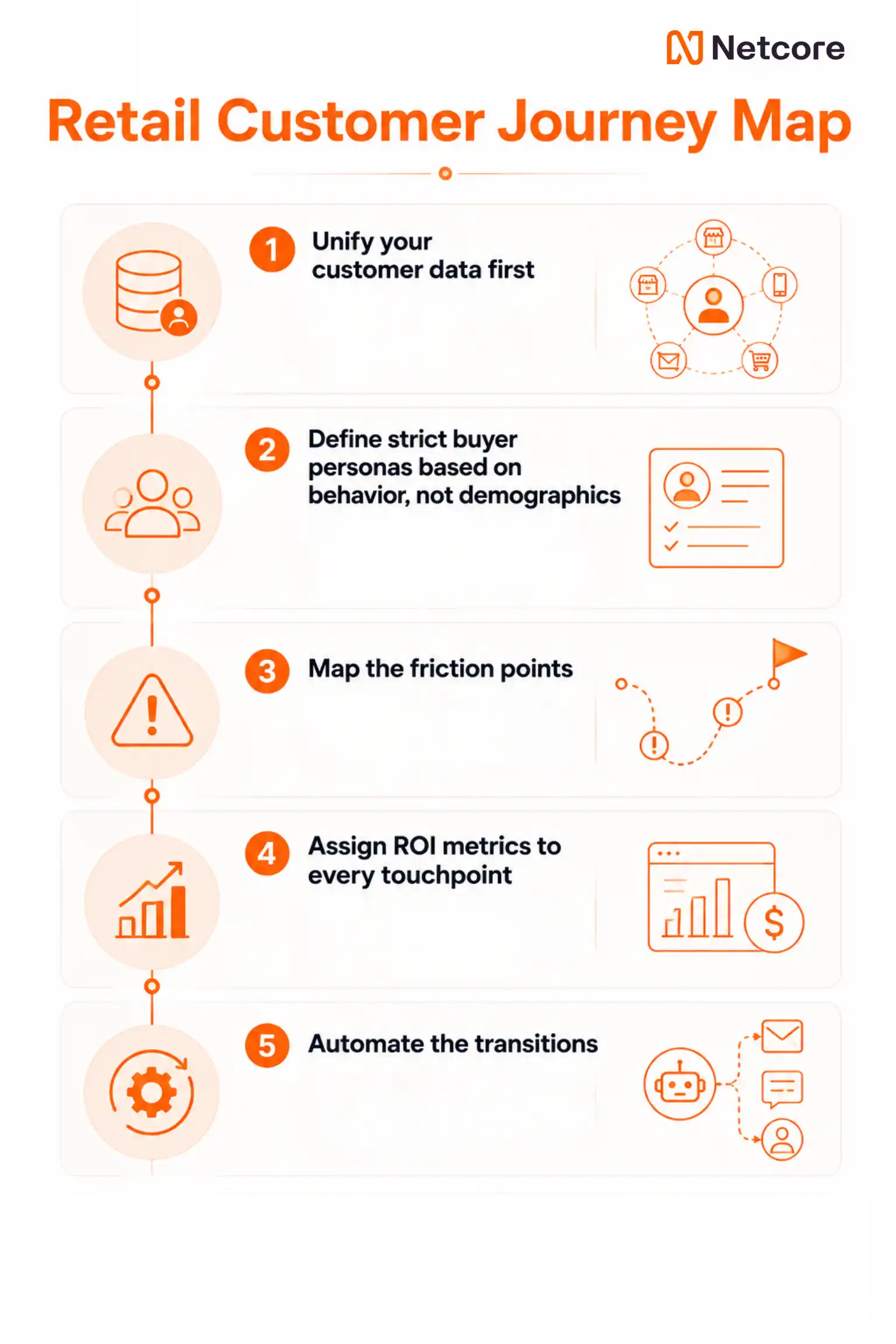
Here is how you build a functional, ROI-generating journey map:
- Unify your customer data first
Before you draw a single touchpoint, you must connect your disparate data sources. Integrate your POS system, your mobile app analytics, and your website tracking into a single unified platform. You cannot map what you cannot see. - Define strict buyer personas based on behavior, not demographics
Stop categorizing customers purely by age or location. Group them by behavioral signals: frequent cart abandoners, discount hunters, high-AOV loyalists. This dictates how the journey should be personalized. - Map the friction points
Do not just map the ideal path; map where things break. Identify exactly where customers drop off between channels. Is it the transition from email to mobile app? Is it a clunky in-store return process? - Assign ROI metrics to every touchpoint
Attach hard numbers to every stage. If you implement an SMS alert for shipping updates, track how that reduces support tickets and increases repeat purchase rates over the next 90 days. - Automate the transitions
Use an execution engine to bridge the gaps. If a customer triggers a specific friction point, your platform should autonomously deploy a fallback sequence on their preferred channel.
You can also check our article on how to create a customer journey map.
Retail Customer Journey Examples to Learn From
The best customer journey maps are inspired by brands that consistently deliver seamless and personalized experiences. Here are three real-world retail journey examples:
- Sephora: Omnichannel Discovery to Purchase
Sephora connects online and offline experiences through its website, mobile app, loyalty program, and physical stores. Customers can browse products online, receive personalized recommendations, save favorites, and redeem loyalty rewards in-store—creating a frictionless path from discovery to purchase. - Amazon: Cart Recovery & Product Recommendations
Amazon has mastered the post-browse journey. Customers receive personalized product recommendations, abandoned-cart reminders, and tailored promotions based on browsing and purchase behavior. This helps drive repeat visits, higher conversions, and increased average order value. - Nike: Loyalty & Retention Journey
Nike uses its membership ecosystem to keep customers engaged long after their first purchase. Through personalized content, exclusive product drops, fitness apps, and loyalty rewards, Nike creates ongoing value that encourages repeat purchases and strengthens brand loyalty. - Starbucks: Loyalty-Driven Customer Journey
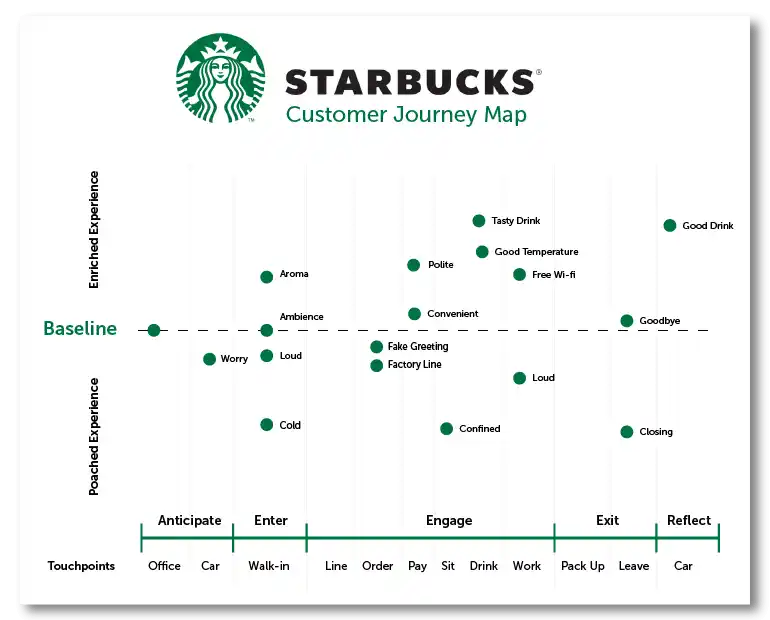
Source: The CDO Times
Starbucks has built one of the world’s most successful loyalty ecosystems. Customers can discover products through the mobile app, place orders ahead of time, earn rewards, receive personalized offers, and seamlessly redeem points in-store. Every interaction is designed to increase convenience, frequency, and customer lifetime value.
These examples show that great retail journeys are not just about making a sale. They connect discovery, engagement, conversion, and retention into a continuous experience that increases customer lifetime value and long-term growth.
Final Take
Mapping the retail customer journey means nothing if you lack the unified platform required to actually orchestrate it in real time. If you continue treating digital, mobile, and physical touchpoints as separate silos, the gap between your whiteboard diagrams and your actual revenue will only grow wider. At Netcore, we know that true omnichannel success comes from anticipating the customer’s next move and delivering a frictionless, AI-driven experience that closes the loop across every channel. You must move past passive mapping and adopt active, accountable execution that proves value to the CFO every single day. Interested to know how? Talk to us.