Diwali Engagement Playbook is now


When it comes to consumer finance, getting attention is hard. Turning that attention into action is harder.
That was the challenge facing a leading mobile-first fintech brand. The brand had strong product interest across lending, investing, onboarding, and referrals. But the issue was not demand generation. It was what happened after users showed intent.
Emails were informative, but static. Users had to leave the inbox to calculate eligibility, understand potential value, or request a callback. New users began onboarding, but many stalled during Customer Identification Program (CIP) steps such as document upload, verification, bank-detail submission, or e-sign. App users completed signup, but needed stronger reasons to return and take their first meaningful action. Dormant users needed timely nudges before they disengaged completely.
The brand did not need more campaigns. It needed every campaign to become easier to act on.
Here is how the fintech brand partnered with Netcore to turn passive communication into interactive, guided, high-converting customer journeys.
The Challenge: The Friction-Heavy FinTech Funnel
Like many fast-growing fintech brands, the company relied on lifecycle marketing across email, app, and messaging channels. But mobile-first users expected more than reminders. They wanted faster answers, clearer next steps, and the ability to act instantly without switching channels or restarting the journey elsewhere.
The marketing team identified four major bottlenecks:
- Static email experiences: Emails were informative but not actionable. Users had to click out to calculate eligibility, understand potential value, or request a callback. Every redirect created a drop-off point.
- Customer Identification Program (CIP) abandonment: CIP refers to the regulated identity-verification journey users must complete before accessing many financial products. It can include mobile verification, document upload, bank detail submission, and e-sign. Completion rates were only 18%, indicating that a large share of high-intent users began onboarding but dropped off before becoming fully verified customers.
- Weak post-onboarding activation: Even after completing onboarding, many users failed to take a meaningful first action, such as using a calculator, exploring a product, completing a transaction, consuming educational content, setting up a recurring action, or referring another user.
- Weak repeat engagement and dormancy recovery: Active users needed timely reasons to return, while dormant users and uninstallers needed targeted win-back nudges to re-engage.
The core issue was not a lack of demand. It was a lack of timely guidance at the moments where users were most likely to hesitate.
The Strategy: Turning Campaigns Into Action-Led Experiences
Netcore helped the brand move from disconnected campaign sends to behavior-led journeys, where each email, app push, SMS, RCS, or in-app message was based on what the user had done, where they had paused, and what step they needed to complete next.
The strategy focused on three high-impact areas.
1. Shoppable Emails That Removed Redirects
The first priority was to make email more than a traffic driver.
Netcore helped the brand turn emails into interactive experiences where users could explore, calculate, engage, and raise interest without leaving the inbox.
Solution actions:
- Embedded live calculators inside emails. For an asset-backed loan journey, users could enter inputs such as asset weight, purity, value, tenure, or interest assumptions directly inside the email instead of opening a separate calculator page.
- Enabled real-time outputs inside the same email. Once the user changed the input, the email could instantly show the estimated eligible loan amount, tenure options, monthly interest, and total interest.
- Added direct “Request Callback” actions. After seeing the estimated value, users could raise interest or request a callback from the email itself, shortening the path from curiosity to inquiry.
- Used gamified email experiences to increase attention. Example: word puzzles and reward-led interactions gave users a reason to spend more time with the brand instead of passively reading a static message.
- Reduced dependency on landing pages, app switches, and multi-step redirects. A loan prospect could move from product curiosity to calculation to callback intent within the inbox, rather than clicking out and restarting the journey elsewhere.
The result: email became a conversion environment, not just a click-through channel.


2. Guided Customer Identification Journeys That Reduced Drop-Off
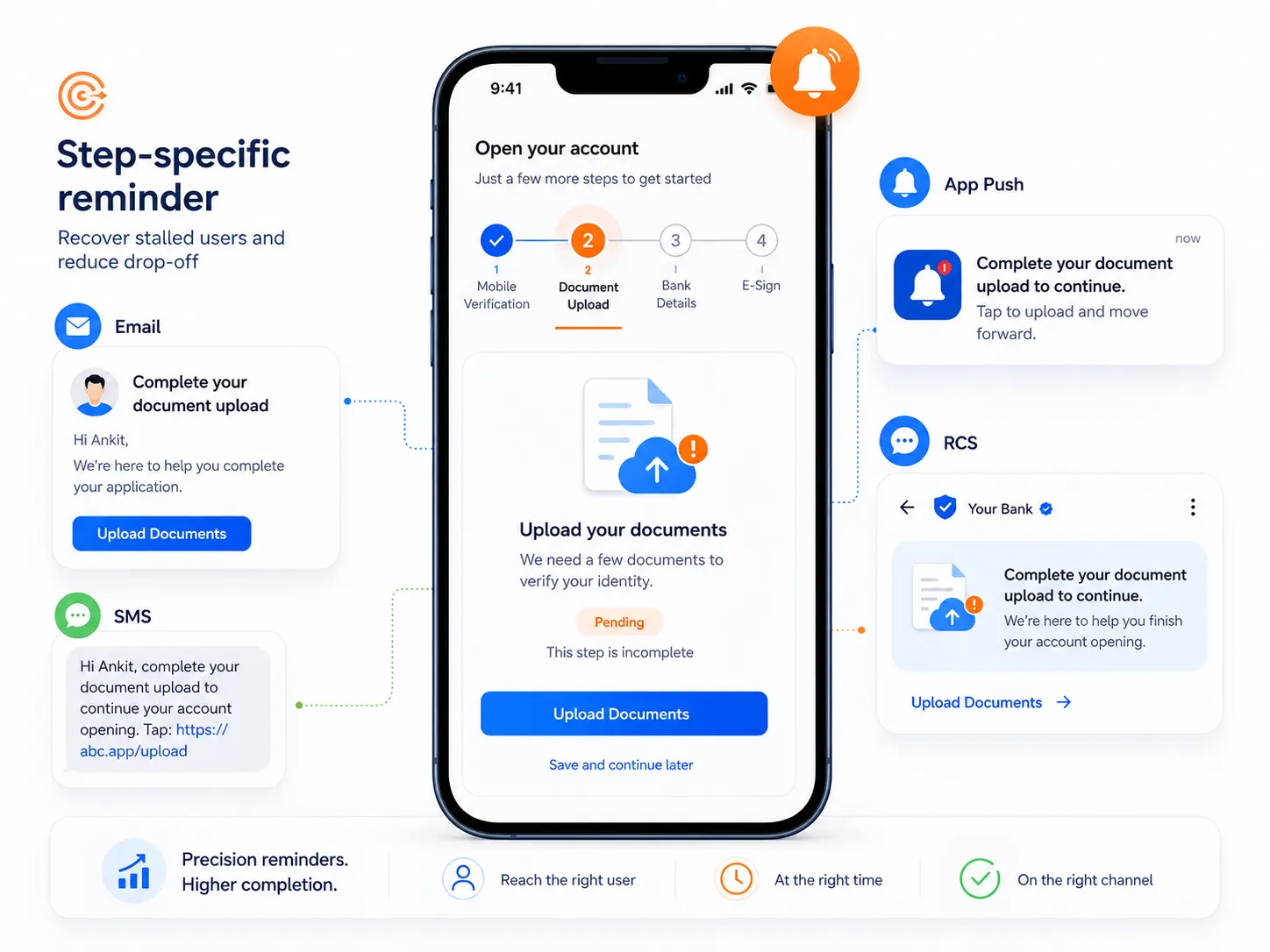
The second priority was onboarding completion. Instead of sending one generic reminder to everyone who had not finished onboarding, the brand used Netcore to identify the exact step where each user had paused and trigger a relevant nudge.
Solution actions:
- Mapped the onboarding journey into clear stages such as mobile verification, document upload, bank detail submission, and e-sign.
- Identified users by the stalled step, time elapsed since the last action, funnel stage, and likely response channel.
- Triggered step-specific reminders. Example: a user stuck at document upload received a document-upload reminder, while a user pending e-sign received an e-sign completion nudge.
- Used coordinated nudges across email, SMS, app push, in-app messages, RCS, and messaging channels so high-intent users were not dependent on one channel alone.
- Changed the message from a generic “complete your onboarding” to a more helpful “complete this exact next step.”
- Used testing to improve the effectiveness of messages and interactive formats, so the team could identify which nudges moved users forward fastest.
The result: onboarding felt supported instead of abandoned, helping users resume before hesitation turned into permanent drop-off.
3. Contextual Engagement That Built App Stickiness
The third priority was post-onboarding engagement.
Once users completed onboarding, the brand needed to solve three different problems: helping new users take their first meaningful action, giving active users timely reasons to return, and bringing dormant users back before disengagement became permanent.
Solution actions:
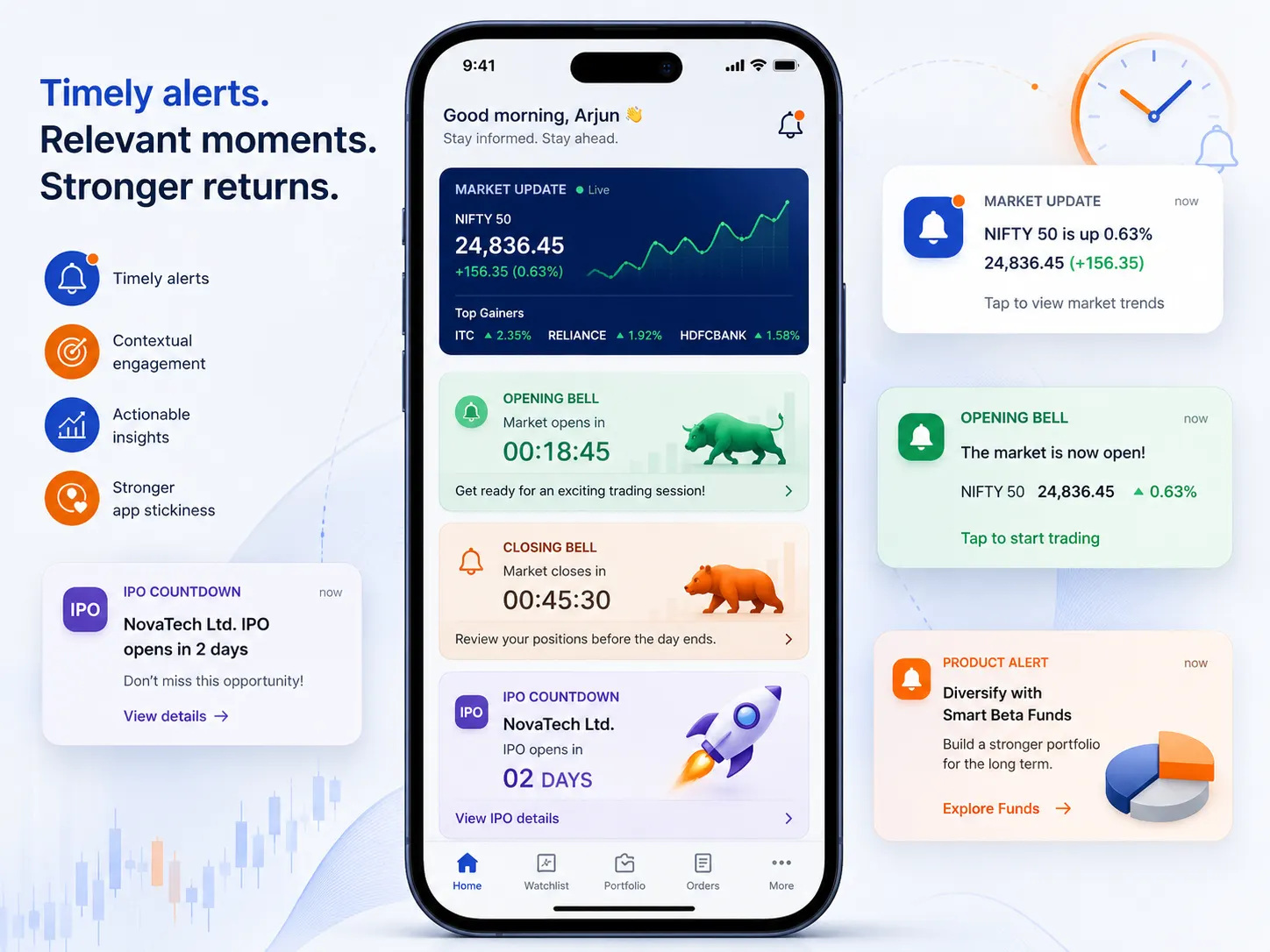
- Activated newly onboarded users with first-action nudges. Example: depending on the user’s intent, the next step could be product exploration, calculator use, a demo, an educational video, a first transaction, or a recurring setup.
- Kept active users engaged with timely alerts. Examples included market updates, opening and closing bell alerts, IPO countdowns, product opportunities, and reminders tied to moments of higher relevance.
- Used educational content to build confidence before action. Examples included newsletters, market explainers, weekly insight series, trading-tip videos, blogs, and product demos.
- Created in-app engagement hubs for non-transactional moments. Example: when users were not actively transacting, in-app banners could guide them to blogs, videos, product demos, or referral actions.
- Built relationship-led touchpoints such as birthday and anniversary journeys, so engagement did not feel purely transactional.
- Launched win-back journeys for dormant users and uninstallers using recency, previous interest, new benefits, reminders, and incentives.
- Built referral journeys that made it easier for engaged users to recommend the platform directly from the app.
The result: the app became more than a transaction utility. It became a recurring source of guidance, education, reminders, and timely action.
Business Impact & Results
By reducing friction across email, onboarding, and app engagement, the fintech brand improved performance at the moments where user intent was highest.
- 13X uplift in click-to-open rate through Shoppable Emails, supported by a 63% CTA interaction rate and 4,000+ calculator engagements from users exploring options inside the inbox.
- CIP completion increased from 18% to 33%, an 85% efficiency gain driven by stage-specific onboarding nudges.
- Monthly active users grew by 40%, adding 11,000 active users in one quarter, with daily active users up 15%, referral-led acquisition up 2.8X, and educational content views up 6.3X.
The result was not just higher engagement. Email became interactive, onboarding became guided, and retention became easier to influence.
The Takeaway
Fintech users do not always need another offer. Often, they need one less step.
Sometimes that means a calculator inside an email. Sometimes it means a reminder tied to the exact onboarding stage. Sometimes it means education before a transaction. Sometimes it means a timely reason to return before a user becomes dormant.
For companies, the lesson is clear: growth does not come only from acquiring more users. It also comes from helping existing users move faster from intent to action.
Ready to turn static campaigns into high-converting customer journeys? Let’s chat about how Netcore can elevate your fintech engagement strategy.