 Diwali Engagement Playbook is now


You are not imagining it
Sends are up. Frequency is up. Open rates are up. Email revenue is flat.
That is the quarter most Europe lifecycle teams have just lived through, and it is the quarter no one wants to present. The dashboard says the program is healthier than it has been in years. The revenue number disagrees. Something between those two numbers is broken, and it is almost certainly not the part of the program the team has been working on.
It is the part no one has been looking at.
One in five emails never gets there
The Netcore Email Benchmark Report 2026 analysed more than 500 billion emails across 6,500 brands in 40 countries. The single most uncomfortable finding for Europe senders is this:
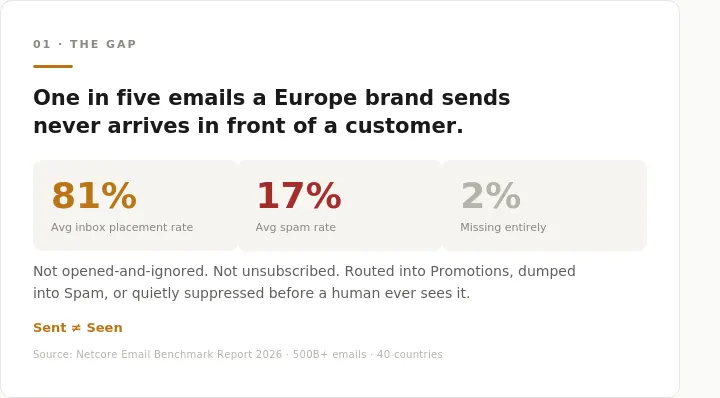
The average inbox placement rate is 81%.
Seventeen percent of emails go to spam. Two percent are simply missing – untracked, unrecoverable. One in every five emails a Europe brand sends in 2026 never lands in front of the customer it was sent to. Not opened-and-ignored. Not unsubscribed. Just routed into Promotions, dumped into Spam, or quietly suppressed by the inbox provider before a human is in the room.
The subscriber was paid for at acquisition. The email was paid for at send. And because that customer will eventually go dormant from never seeing the messages, they will be paid for a second time through retargeting. That is the real cost of the gap between sent and seen, and it is not on anyone’s dashboard.
The open rate stopped meaning what you think it means
The reflex objection is fair. Our opens are fine.
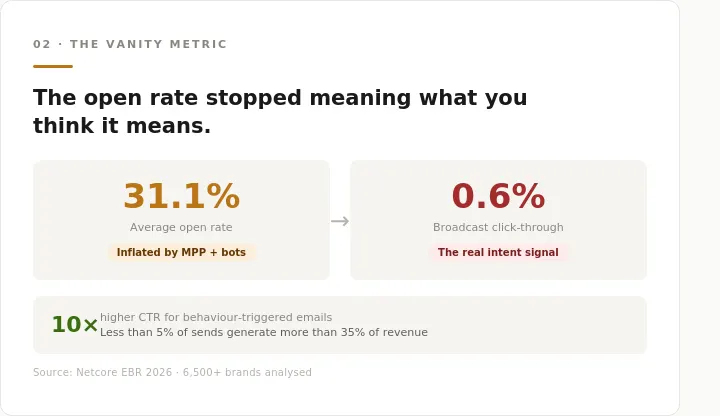
They probably are. The benchmark average sits at 31%, which sounds healthy. The trouble is that the number is doing different work than it used to.
Apple Mail Privacy Protection fetches images on send, before the email is opened by a human. Bots and security scanners trigger the open pixel automatically. Gmail’s annotations and AI summaries can drive engagement with an email without ever firing what counts as an “open” in the dashboard.
Clicks are the cleaner signal. And the broadcast click-through rate, across the global benchmark, is 0.6%. For behaviour-triggered emails – the cart, the back-in-stock, the post-purchase – it is roughly ten times higher. Less than five percent of sends generate more than thirty-five percent of revenue.Most teams are reporting on a number that has lost its meaning, while the engagement signal lives in the five percent of sends they have not invested in.
The leak is hiding inside the average
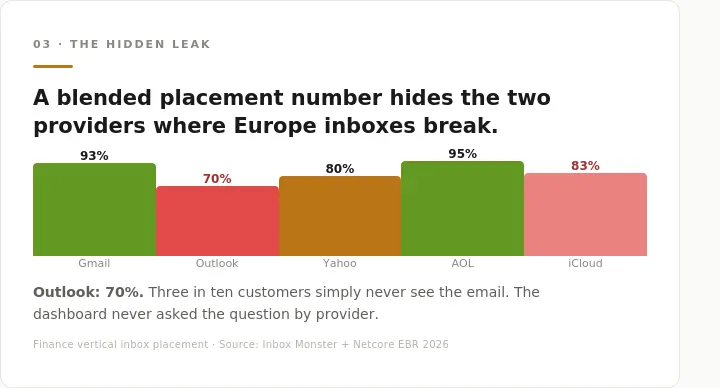
Provider-level data tells a sharper story than the overall placement rate. The same Europe Finance brand reporting a “healthy” 76% blended inbox rate is, on the underlying numbers, hitting just 70% on Outlook. Three in every ten Outlook-reachable customers are not being reached at all.
Outlook is the dominant inbox in European BFSI. iCloud is the default across iOS-first consumer segments. And both consistently sit below the headline number. A brand reporting a single blended placement number is averaging away the two inbox environments most likely to be hiding the leak.
The team running that program does not know it. The dashboard never asked the question by provider.
Fewer sends, more revenue
The instinct, on reading all of this, is to assume the fix means sending more. Or sending differently. Or a six-month deliverability overhaul that no one has time to scope.
It is none of those things. The case study that most cleanly disproves the assumption comes from Bidoo, Italy’s leading lifestyle and electronics auction platform. Email is the lifeline of their bidding experience – every “you won the bid” notification, every restock alert, every auction-closing reminder. When those messages stopped landing in the primary inbox, the auction stopped working.
What Bidoo changed was not volume. They re-engineered visibility. The result, in twelve months:
- 9.23% fewer emails sent
- 5.59% lift in open rate
- 15.3% lift in click rate
- 46.48% lift in email-attributed revenue
- 48.49% lift in total transactions
Fewer sends. More revenue. The gap between sent and seen closed not by working the list harder, but by making sure the messages were arriving where they were supposed to.
The question worth taking into the next review
The most useful question a Europe CRM leader can ask in 2026 is not how do we send more? It is not even how do we send better? It is much simpler than that.
How many of the emails we sent last quarter were actually seen?
If the answer is one blended number, the answer is that no one knows. If the answer is broken down by Gmail, Outlook, Yahoo and iCloud, the leak – and the revenue trapped behind it – becomes visible for the first time.
Sends are not the metric that pays in 2026. Seen is.
The full EBR 2026 Inbox Visibility benchmark breaks placement down by vertical and by provider – including the Outlook and iCloud gaps most European brands have never measured.

