


TL;DR
A Unified Marketing Platform brings customer data, product discovery, omnichannel engagement, analytics and AI together in one connected ecosystem. It helps businesses eliminate data silos, accelerate campaign execution, deliver consistent customer experiences and move from fragmented automation to autonomous marketing. With real-time customer intelligence, specialist AI agents, native channel infrastructure and outcome-based accountability, businesses can spend less time managing disconnected tools and more time driving conversions, retention and revenue growth.
Marketing teams today have access to more technology than ever. They use CDPs to understand customers, engagement platforms to run campaigns, analytics tools to measure performance, product discovery engines to influence purchases, and AI tools to automate repetitive tasks.
Yet, there’s a fundamental problem: most of these systems don’t work together seamlessly.
Customer data sits in different places. Campaign execution happens across disconnected tools. Insights don’t always translate into action, and marketing teams spend more time managing technology than improving customer experiences.
This is where a Unified Marketing Platform comes in.
Instead of adding another tool to the marketing stack, it brings customer data, engagement, product discovery, analytics, and AI capabilities together in one connected ecosystem. The goal is simple: help businesses move from fragmented marketing operations to connected, intelligent, and outcome-driven customer experiences.
Let’s understand what a unified marketing platform is, why businesses need one, and how it can transform marketing operations.
What Is a Unified Marketing Platform?
A Unified Marketing Platform is an integrated technology ecosystem that connects customer data, marketing execution, product discovery, analytics, and AI capabilities within a single platform.
Unlike traditional marketing stacks, where businesses depend on multiple tools to manage different parts of the customer lifecycle, a unified platform allows these capabilities to work together using shared customer data and context.
For example, a customer browsing a product, abandoning a cart, responding to an email, or making a purchase generates valuable signals. In a disconnected setup, these signals may take time to reach the right systems. In a unified platform, the same information can immediately influence audience segmentation, product recommendations, campaign decisions, and customer engagement.
A modern unified marketing platform typically brings together six key capabilities:
- Unified technology stack: Product discovery, CDP/context layer, customer engagement, and analytics operating within one ecosystem.
- Real-time CDP and context layer: A continuously updated customer graph that connects identities, behaviors, preferences, transactions, and consent information.
- Omnichannel engagement: Native execution across email, WhatsApp, RCS, SMS, push notifications, and in-app channels. Often offered by an Omnichannel marketing platform.
- Product discovery: AI-powered search, recommendations, and merchandising that improve product discovery and purchase experiences.
- Agentic AI: AI agents that can plan, execute, analyze, and optimize marketing activities rather than simply recommend the next action.
- Governance and enterprise controls: Privacy management, role-based access, approval workflows, audit trails, and guardrails for safe AI-driven execution.
The biggest differentiator isn’t simply having all these features under one roof. It’s ensuring that data, decisions, and execution flow seamlessly between them. We have explained more in depth in the omnichannel marketing guide.
What are the Core Benefits of a Unified Marketing Platform?
The problem with fragmented marketing technology goes beyond managing multiple vendor relationships. It directly affects marketing efficiency, customer experience, and revenue performance.
Here are five reasons why businesses are moving towards unified marketing platforms.
1. Eliminate Data Silos and Get a Complete Customer View
When customer information is spread across CRM systems, analytics platforms, CDPs, and engagement tools, marketers rarely get a complete picture of customer behavior.
A unified platform creates a shared, real-time customer view by connecting browsing activity, purchase history, engagement patterns, preferences, and lifecycle signals.
Example: An ecommerce brand can identify customers who repeatedly browse premium products but purchase lower-priced alternatives. By combining behavioral data, purchase history, and product affinity, marketers can build more relevant audience segments and target customers with personalized recommendations.
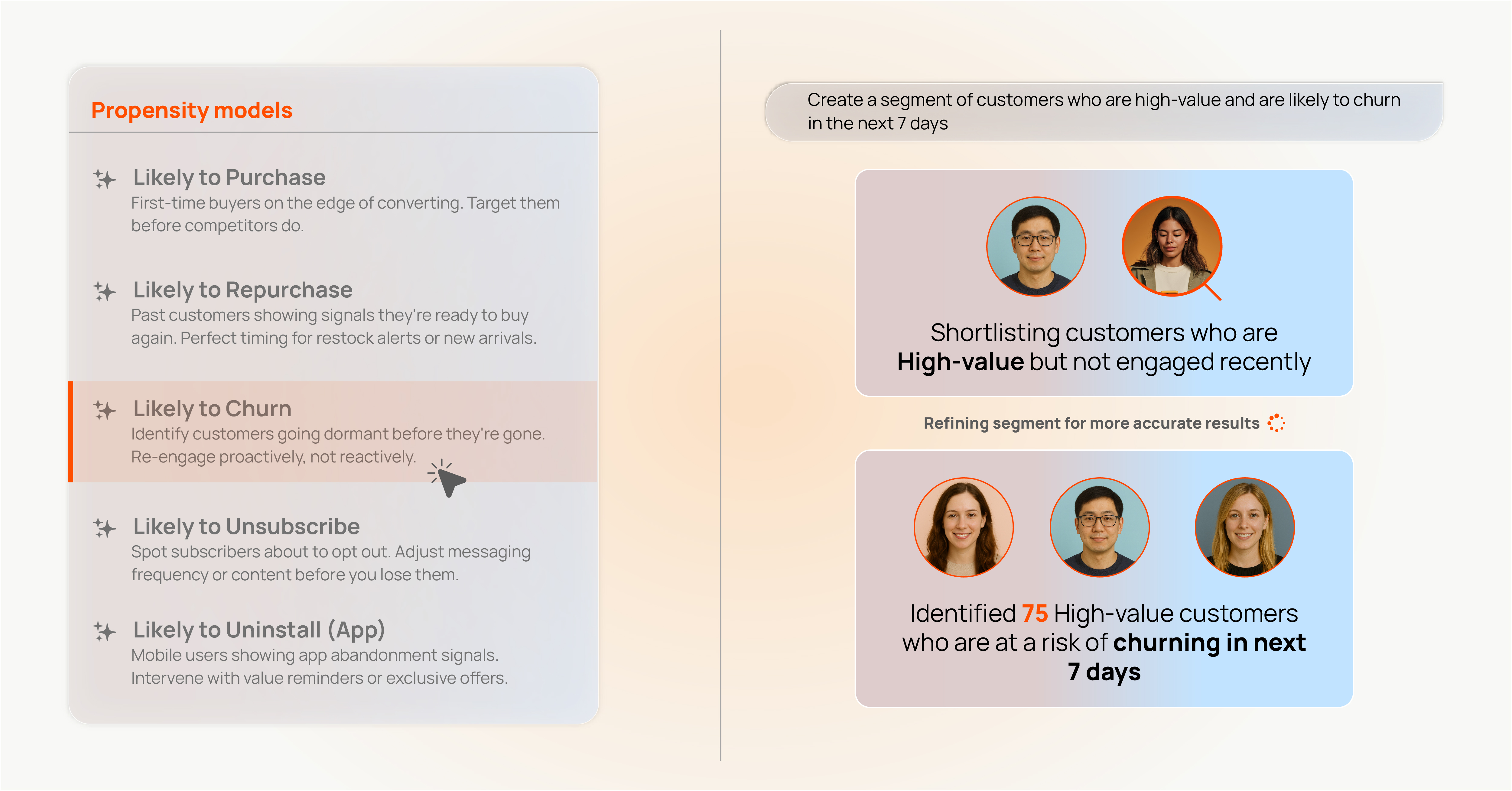
Instead of relying on broad demographic segments, teams can activate audiences based on deeper behavioral and propensity signals.
2. Improve Campaign Execution and Time-to-Value
Managing multiple marketing platforms often means separate onboarding processes, integrations, vendor contracts, and migration projects.
A unified platform simplifies this through consolidated onboarding, migration playbooks, and a single platform relationship.
Omnichannel customer journeys, templates, customer data, and campaign configurations can be migrated through a coordinated process rather than rebuilding everything independently.
This reduces operational complexity and helps businesses move from implementation to live campaigns faster.
Example: A retail brand migrating from multiple engagement platforms can consolidate its email, push, WhatsApp, and customer segmentation workflows into one environment. Instead of maintaining separate integrations and campaign logic, teams can manage the customer lifecycle from a shared platform.
3. Improve Customer Engagement Across Channels
Customers don’t interact with brands through a single channel. They might discover a product on a website, receive a WhatsApp notification, revisit through an app push, and eventually purchase through a different touchpoint.
A unified platform connects these interactions and enables coordinated omnichannel engagement through a Context Layer.
Native channel infrastructure, including email delivery systems (MTA), WhatsApp, RCS, SMS, push notifications, and in-app messaging, can further improve delivery control, campaign activation, and operational efficiency.
Example: When a customer abandons a shopping cart, a unified platform can trigger an appropriate follow-up based on their engagement history and channel preferences. If they respond to WhatsApp, the platform can suppress redundant email reminders and adapt subsequent communication.
The result is a more consistent customer experience without unnecessary messaging.
4. Move from Basic Recommendations to Autonomous Marketing Execution
Most traditional marketing automation tools help marketers identify opportunities, generate recommendations, or automate predefined workflows.
Agentic AI takes this further.
A modern unified marketing platform can bring together specialist AI agents that collaborate across the marketing lifecycle:
- Insights Agent: Identifies performance trends, customer behavior changes and revenue opportunities.
- Audience Agent: Builds and refreshes micro-segments using behavioral and predictive signals.
- Content Agent: Creates personalized marketing content across channels.
- Decisioning Agent: Determines the next-best action, offer, channel and send time.
- Scheduler Agent: Optimizes campaign timing based on customer engagement patterns.
- Shopping Agent: Improves product discovery through intelligent search and recommendations.
- Additional specialist agents: Support coordinated marketing workflows through the central Co-Marketer.
Together, these agents can plan, execute, analyze, and optimize lifecycle campaigns, with human approvals and enterprise guardrails wherever required.
Example: A subscription business experiencing a decline in renewals can use an Insights Agent to identify the affected customer segments. The Audience Agent can build relevant segments, the Content Agent can create tailored renewal communication, and the Decisioning Agent can determine the right incentive and channel.
Instead of manually coordinating multiple tools and teams, marketers can orchestrate the process through an interconnected AI ecosystem.
5. Align Marketing Technology with Business Outcomes
One of the biggest challenges with traditional marketing technology investments is that businesses often measure platform adoption and business performance separately.
Businesses pay for software, manage implementation, and monitor usage, but the marketing team largely remains responsible for delivering revenue growth.
A newer approach is outcome co-ownership.
Here, technology providers like Netcore and their customers share accountability for measurable business outcomes such as engagement, conversions, retention, and incremental revenue.
Some commercial models even link a portion of platform fees to agreed client KPIs. This creates stronger alignment between technology performance and business results.
The platform provider is no longer just responsible for making the software work; it has a greater incentive to help customers achieve measurable outcomes.
Unified Marketing Platform Examples: How Different Industries Can Benefit
The value of a unified marketing platform becomes clearer when applied to real business scenarios.
| Industry | Marketing challenge | How a unified platform helps |
| Ecommerce & Retail | Cart abandonment, fragmented customer data, and low repeat purchases | Connects browsing and purchase signals, builds affinity-based segments, activates personalized recommendations and orchestrates omnichannel retention journeys. |
| Banking & Financial Services | Disconnected customer interactions and complex lifecycle communication | Unifies customer profiles, applies consent and governance controls, and activates personalized onboarding, product recommendations and renewal journeys. |
| Travel & Hospitality | Inconsistent engagement across booking, travel and loyalty experiences | Connects booking behavior, customer preferences and loyalty data to trigger contextual offers, travel updates and repeat-booking campaigns. |
| Subscription Businesses | Customer churn and declining renewal rates | Identifies at-risk segments, predicts renewal propensity and coordinates personalized retention campaigns across channels. |
Consider an ecommerce business using separate tools for product recommendations, customer segmentation, email marketing and WhatsApp engagement.
A unified platform connects these capabilities. A customer’s product browsing activity can influence their audience segment, product recommendations, campaign content, and next-best engagement action.
This creates a continuous feedback loop where every customer interaction can inform the next marketing decision.
Popular Unified Marketing Platforms
Several technology providers offer platforms that bring together different aspects of marketing, customer data, personalization and engagement. While their capabilities and areas of specialization vary, here are some platforms worth evaluating.
1. Netcore: Unified Agentic Marketing Platform
Netcore brings together customer data, product discovery, omnichannel customer engagement and analytics within an integrated platform.
Its architecture connects a real-time Customer Data Platform (CDP) and Context Layer with customer engagement capabilities and AI-powered product discovery through Netcore Unbxd.
Key capabilities include:
- Unified CDP and Context Layer: Creates a connected customer view using behavioral, transactional and engagement data, with identity resolution, privacy controls and governance. Native channels like Email, WhatsApp, RCS and push notifications.
- Omnichannel Engagement: Supports email, WhatsApp, RCS, SMS, push notifications, in-app and web engagement.
- Agentic Marketing: Uses 6 AI agents for audience segmentation, content creation, decisioning, scheduling, shopping and insights.
- AI-Powered Product Discovery: Enables intelligent search, product recommendations and merchandising for ecommerce businesses with Native Search & Product Discovery.
- Outcome Co-Ownership: Combines platform capabilities with dedicated growth engineering support and performance-aligned commercial models.
Best for: Enterprises looking to consolidate customer data, product discovery, marketing automation and omnichannel engagement while moving towards AI-led marketing execution.
2. Salesforce Marketing Cloud
Salesforce Marketing Cloud brings customer data, CRM capabilities, marketing automation and AI-powered engagement together within the Salesforce ecosystem.
Its integration with Data Cloud and Agentforce helps businesses connect customer information, orchestrate personalized journeys and use AI to support marketing workflows.
Best for: Large enterprises looking for CRM-led marketing, customer journey orchestration and integration across Salesforce products.
3. Adobe Experience Cloud
Adobe Experience Cloud combines customer data, content management, analytics, personalization and marketing orchestration.
With Adobe Experience Platform at its core, businesses can connect customer profiles, activate audiences and deliver personalized digital experiences across multiple touchpoints.
Best for: Enterprises with complex digital experiences, content operations and personalization requirements.
4. Braze
Braze is a customer engagement platform focused on real-time, cross-channel customer experiences. It combines customer data capabilities, journey orchestration, experimentation and AI-powered decisioning.
It enables marketers to coordinate personalized interactions across email, mobile, web and other digital channels.
Best for: Consumer-facing businesses prioritizing real-time lifecycle engagement, mobile experiences and customer retention.
5. HubSpot Marketing Hub
HubSpot Marketing Hub combines marketing automation, CRM, email marketing, campaign management, lead nurturing and analytics.
Its strength lies in connecting marketing activities with customer and sales data, helping teams manage the customer journey from lead acquisition to conversion.
Best for: Growing businesses and B2B organizations looking for an integrated CRM-led marketing and automation solution.
6. Iterable
Iterable is an AI-powered customer engagement platform that brings together audience segmentation, campaign management, customer journey orchestration and cross-channel messaging.
It supports channels such as email, SMS, push, in-app messaging, WhatsApp and RCS, along with AI-powered decisioning and personalization capabilities.
Best for: Digital-first businesses looking to scale personalized customer engagement across multiple channels.
What Should You Look for in a Unified Marketing Platform?
Not every platform that offers multiple marketing features qualifies as truly unified.
Before evaluating a solution, businesses should look beyond the number of integrations or channels supported.
Here are five important considerations:
- A genuinely connected architecture: Customer data, product discovery, engagement and analytics should share a common data and context layer.
- Real-time data activation: Customer signals should translate into actionable segments and campaigns without lengthy synchronization delays.
- Native channel infrastructure: Evaluate whether the platform offers direct control over channel delivery and activation rather than relying entirely on third-party dependencies.
- Enterprise-ready AI and governance: AI agents should operate with appropriate permissions, privacy controls, approval workflows and auditability.
- Faster implementation and outcome accountability: Look for structured migration support, dedicated onboarding and commercial models that align platform performance with business KPIs.
Key Takeaway
Marketing technology is moving beyond disconnected tools and predefined automation workflows.
As customer expectations evolve and AI becomes increasingly capable of executing complex marketing tasks, businesses need an infrastructure that connects customer intelligence, decision-making, and execution.
A unified marketing platform provides that foundation.
It reduces technology fragmentation, accelerates campaign execution, creates more relevant customer experiences, and enables AI to move from generating recommendations to taking meaningful marketing actions.
But the real shift is bigger than technology consolidation.
The future of marketing won’t be defined by how many tools a team uses or how many campaigns it launches. It will be defined by how effectively it connects customer intelligence with decisions and turns those decisions into measurable business outcomes. It’s time you migrate to a unified agentic marketing system, switch to Netcore, or talk to us.


