Diwali Engagement Playbook is now


TL;DR
MarTech migration doesn’t have to be disruptive. This guide provides a proven roadmap to help enterprise teams migrate with confidence, from aligning stakeholders and preparing your teams to auditing data, testing in phases, and optimizing for long-term success.
- Plan for stakeholder alignment and team readiness
- Audit, clean, and optimize your customer data
- Take a phased approach to testing and migration
- Optimize continuously for long-term business impact
- See how Netcore simplifies enterprise MarTech migration
- Learn from real brands that achieved successful migrations
There is a particular kind of organizational dread that descends the moment someone suggests migrating your marketing technology stack. Not because the idea is wrong in most cases, staying on a legacy platform is the far riskier choice, but because the stakes feel impossibly high. Years of customer data. Hundreds of campaign templates. Automations and journeys that took months to build. Revenue-critical workflows running around the clock.
Done right, a MarTech migration doesn’t just solve a technical problem. It unlocks a new ceiling for what your marketing can achieve. Done poorly, it erodes customer trust, breaks revenue-critical workflows, and costs orders of magnitude more than the license fees you were trying to escape.
This guide covers every dimension of a successful migration like people, data, testing, technology, and post-migration optimization, drawing on Netcore’s experience migrating brands, including Senco Gold & Diamonds, The Souled Store, PayU, ClearTax, Metropolis, Skullcandy, Bighaat, Plum, VisionPlus, and 7-Eleven.
Step 1: Plan for Alignment and People Before Anything Else
Here is a truth that most migration playbooks bury in the fine print: the majority of MarTech migrations that fail or stall don’t fail for technical reasons. They fail because the right people weren’t in the room early enough.
Legal surfaces a GDPR compliance gap at go-live. IT discovers an infrastructure dependency nobody scoped. Finance hasn’t signed off on the new vendor contract. Sales finds out their CRM integration wasn’t included in the migration plan. Any one of these situations can add weeks to your timeline and tens of thousands of dollars in remediation costs.
The fix is structural, not reactive. Build a cross-functional migration team from the first week, not the final one. This means IT for infrastructure and security requirements, Legal for data processing agreements and regulatory compliance (GDPR, CCPA, HIPAA, where applicable), Finance for vendor approval and budget sign-off, and Sales for CRM integration requirements and data access needs. Designate a single migration owner, someone with the organizational authority to escalate when departments conflict and the accountability to keep the timeline moving.
But team structure is only half the equation. The other half is human adoption, and it is harder than most organizations expect.
A platform is only as powerful as the people operating it. A migration that delivers technically but fails to bring the marketing team along with it is, in practical terms, a failed migration. Invest in hands-on workshops and guided certifications before go-live, not after. Build a continuous enablement program that doesn’t end on launch day. Train until confidence is genuinely high, not until time runs out. This is the difference between a team that uses 20% of a platform’s capability and one that uses 80% of it within the first quarter. We have created an article to guide you how to make Martech migration easier.
Step 2: Audit and Optimize Your Data Before You Move It
Your new marketing platform will be no smarter than the data you migrate into it. This is one of the most underappreciated realities of platform migration, and it’s where many otherwise well-planned projects quietly go wrong.
Legacy stacks accumulate years of data entropy. Duplicate customer profiles from multiple sign-up flows. Stale contacts who haven’t engaged in two or three years. Unmapped event fields from product changes that nobody cleaned up. Inconsistent attribute naming conventions across systems that were integrated over time. None of this is visible in daily operations until you try to move it somewhere else.
The first principle of data migration is simple: purge before you migrate. Identify and leave behind duplicate profiles, contacts with zero engagement in the past 12 months, test data that found its way into your live environment, and any records that don’t meet your new platform’s data quality standards. Moving less data, cleanly, is significantly better than moving more data with integrity issues.
The second principle is mapping and transformation. Every data field in your legacy system needs to be explicitly mapped to its equivalent in the new platform’s schema. Don’t assume field names, data types, or event taxonomies align; they rarely do. Mismatched mappings don’t always cause immediate failures; they cause silent errors that corrupt segmentation and personalization logic weeks after go-live.
The third principle is validation before launch. Run automated data quality checks after transfer. Reconcile record counts between source and destination systems. Spot-check at least 10 to 15 percent of migrated profiles manually. Don’t go live until your data passes validation no matter how much pressure there is to hit the launch date.
Netcore’s migration methodology includes a dedicated data accuracy and reachability correction layer built into the process itself. Historical purchase data auto-syncs for up to 12 months from Shopify and Magento, with S2S APIs for older datasets and bulk import APIs for attributes and engagement history. Every dataset is validated for accuracy and compliance before a single campaign goes live.
Step 3: Take a Phased Approach to Testing
The migration that goes from zero to full production in a single cut-over is the migration that produces the most spectacular failures. The risk is not only technical it’s revenue disruption at precisely the moment your team is most stretched and least equipped to diagnose problems.
A phased testing approach eliminates this risk by validating progressively rather than committing everything at once that might lead to Martech migration challenges.
Start by transferring and testing your most critical assets first. This means transactional templates welcome sequences, order confirmations, password resets, and shipping notifications that are both revenue-critical and zero-tolerance for failure. These are the communications your customers depend on and notice immediately when they break. Test them exhaustively, on real data, before touching anything else in your migration queue.
Once critical transactional assets are validated, move to parallel campaign execution. Run ongoing campaigns on both platforms simultaneously using small, carefully selected data batches. Choose a low-stakes segment for your first parallel test: a quiet geographic market, a single product category, a lower-value customer cohort, something small enough that failure is survivable but large enough to generate statistically meaningful performance data. Compare open rates, click rates, journey completion rates, deliverability scores, and suppression compliance side by side. Only commit to full cut-over when parity or improvement is confirmed across all key metrics.
Define your go/no-go criteria before testing begins, not during it. If any metric is more than 15 percent worse than your established baseline, stop, diagnose, and resolve before proceeding. This discipline is what separates migrations that deliver confidence from those that deliver anxiety.
Step 4: Rebuild Journeys With Outcomes in Mind, Not Just Continuity
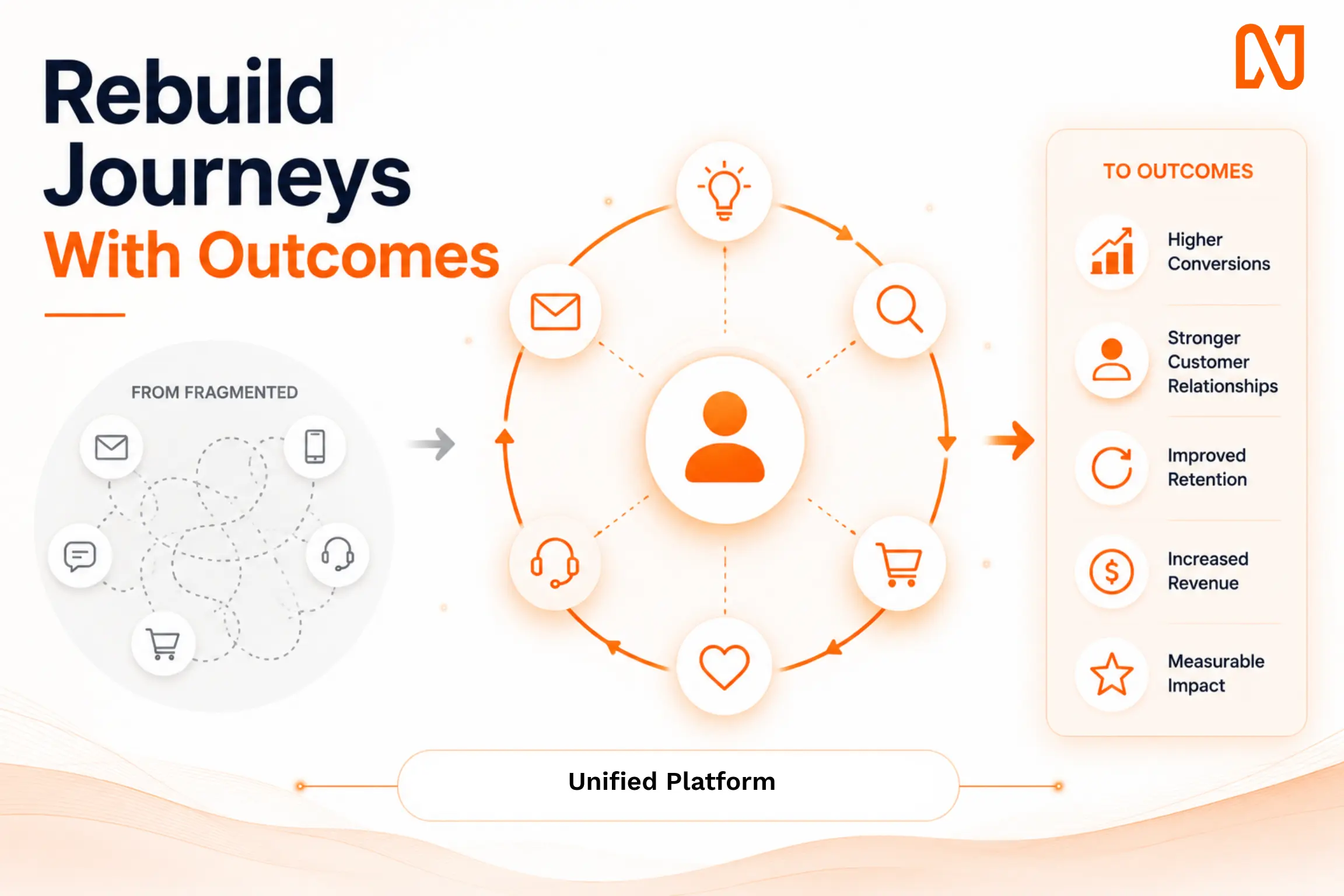
One of the most common mistakes in campaign migration is treating it as a copy-paste exercise. The instinct to replicate what existed before is understandable; it feels like the safest option. But replicating underperforming journeys in a more capable platform doesn’t make them better. It just makes them faster.
The migration of campaigns and journeys is an opportunity to rebuild with outcomes in mind rather than continuity. Netcore’s approach to journey rebuilding goes further than simple replication. Push and email journeys are reconstructed with behavioral triggers, real-time data, and AI-driven personalization that legacy platforms were architecturally unable to support.
Pomelo Fashion completed their migration from a legacy platform to Netcore and saw a 5x boost in click-to-order rates and a 31% uplift in conversions, not because they switched platforms, but because they rebuilt their journeys to respond to customer behavior in real time rather than executing on static schedules. Learn What a MarTech Migration Really Costs Enterprise Brands.
For brands like The Souled Store and 7-Eleven, where the customer lifecycle spans discovery, repeat purchase, and long-term loyalty, the quality of journey logic isn’t an optimization consideration. It’s a primary business metric.
Step 5: Optimize for Continuous Impact After Go-Live
Go-live is the starting line, not the finish line. The brands that extract the most value from a MarTech migration treat the first 90 days post-launch as an intensive optimization sprint.
Establish automated data quality checks and performance benchmarking from day one. Set baselines before migration so you can measure actual lift, not just activity. Monitor deliverability closely for the first four to six weeks, because IP and domain warm-up actively affects inbox placement rates and requires hands-on management during the transition period.
Activate AI personalization capabilities as soon as sufficient behavioral data is flowing into the platform. Predictive segmentation, churn prediction, next-best-offer modeling, and send-time optimization all compound over time; the sooner they are running on real engagement data, the sooner they start delivering returns.
Schedule a formal 30-day post-launch review with your migration partner’s customer success team. Identify gaps. Capture quick wins. Adjust campaign logic based on early performance data. The brands that do this systematically consistently outperform those that treat go-live as the end of the engagement.
Netcore’s post-migration framework includes AI agents that activate once the platform goes live: a Segment Agent building real-time adaptive audiences, an Insights Agent predicting next-likely-to-buy customers, a Content Agent optimizing messaging per individual, and a Scheduler Agent executing at each customer’s preferred channel and time. The result isn’t just better campaigns, it’s a marketing operation that continuously learns and improves.
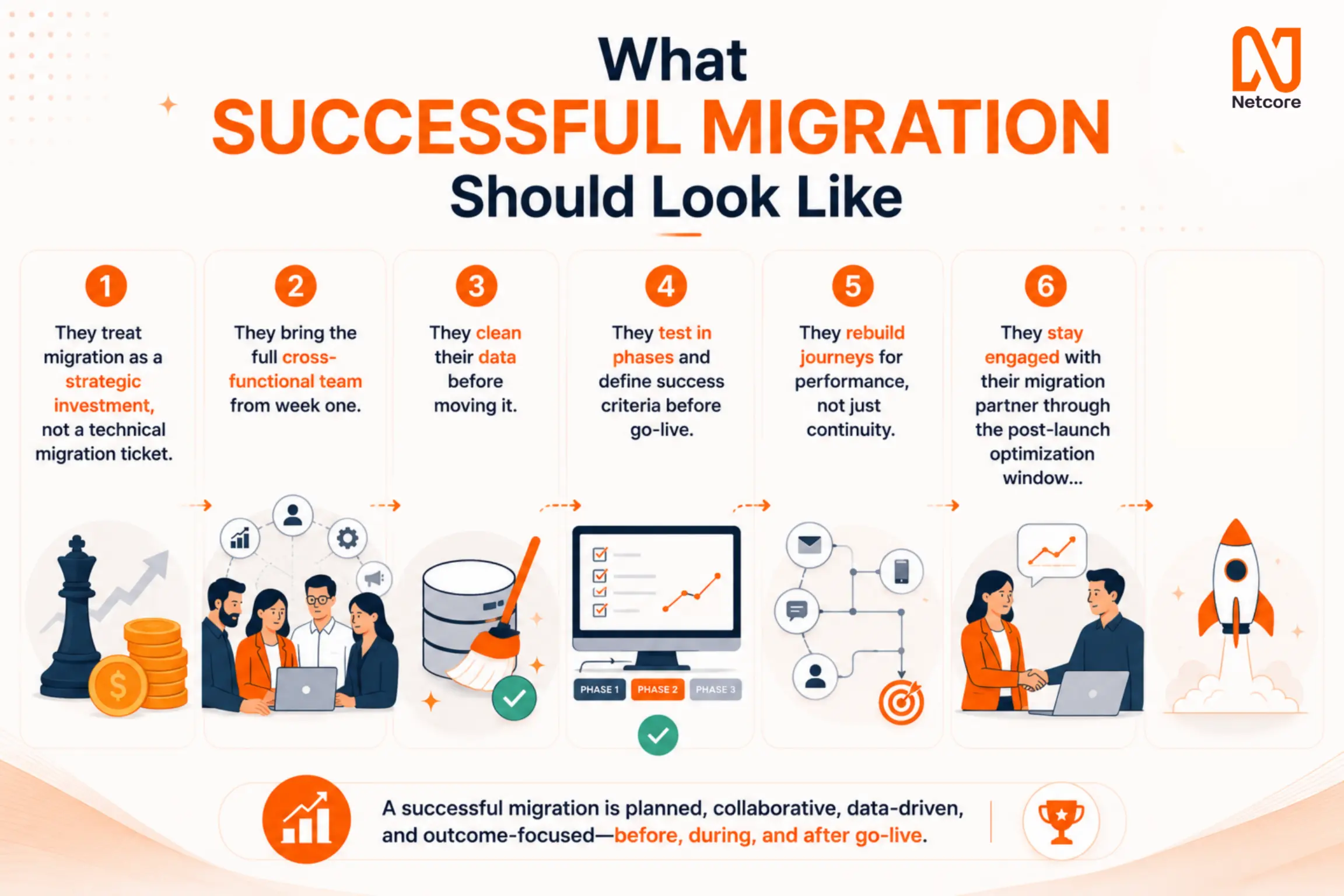
What Successful Migration Really Looks Like
Across more than 100 brand migrations in the past 12 months, spanning D2C, BFSI, healthcare, agritech, and consumer electronics, Netcore has observed a consistent pattern among the organizations that achieve the fastest and most durable performance lifts.
They treat migration as a strategic investment, not a technical migration ticket. They bring the full cross-functional team from week one. They clean their data before moving it. They test in phases and define success criteria before go-live. They rebuild journeys for performance, not just continuity. And they stay engaged with their migration partner through the post-launch optimization window rather than disengaging at go-live.
The brands that do all of this emerge from migration with cleaner data, more capable technology, better-trained teams, and AI capabilities that compound quarter over quarter.
The brands that treat migration as a copy-paste exercise emerge with the same limitations they started with, running on a newer invoice.
Netcore has successfully migrated brands including Senco Gold & Diamonds, The Souled Store, PayU, ClearTax, Metropolis, Skullcandy, Bighaat, Plum, VisionPlus, and 7-Eleven with zero downtime, full historic data transfer, and measurable results within 45 days.
Final Take
If you’ve made it this far, we hope this guide has given you a clear view of how to approach MarTech migration the right way, what best practices to follow, what essentials to prioritize, and where teams typically go wrong. More importantly, we hope the migration benchmarks shared here help you set a higher, more structured standard every time you evaluate or execute a move in your own MarTech stack.
Migration is never just a technical shift, it’s a strategic reset. Use these principles as your reference point, challenge your current approach against them, and build with intent rather than urgency.
If you’re planning a migration or want to get it right the first time, talk to us.