Diwali Engagement Playbook is now


Switching your MarTech platform is rarely a decision you make lightly.
You’ve likely spent weeks or months evaluating platforms, aligning stakeholders, building the business case, and setting expectations around what the new technology should deliver: better ROI, stronger personalization, higher retention, smarter automation, or more efficient marketing operations.
So when migration day arrives, the pressure is real.
And here’s the part that often gets overlooked: migration risk isn’t limited to broken journeys or missed integrations. The bigger risk is completing the platform migration successfully but failing to achieve the business outcomes that justified the switch in the first place.
A journey can technically migrate without a single error, and still perform worse than it did before.
That’s why choosing the right migration partner matters.
Top 10 Hidden Risks of Journey Migration
1. Trigger and timing logic doesn’t translate 1:1
Every platform interprets events, sessions, inactivity windows, and triggers differently. A cart-abandonment journey that worked perfectly on your old platform may fire too early, too late, or twice after migration if the underlying event logic isn’t validated.
2. Suppression and frequency-capping gaps
Do-not-contact lists, frequency caps, quiet hours, and channel preferences often sit outside the visible journey logic. Miss one, and customers could receive too many messages, or messages they should never receive.
3. In-flight customers falling through the cracks
What happens to customers who are already halfway through a journey when you cut over?
Without a clear migration strategy, some may receive duplicate messages while others disappear from the journey altogether. And unfortunately, these issues often become visible only after customers experience them.
4. Data and personalization mismatches
A field that is dynamically calculated in one platform may arrive as a static value in another. The journey may run perfectly, but the personalization doesn’t.
That can mean stale recommendations, incorrect offers, or irrelevant messaging- the exact opposite of why you migrated.
5. Attribution and reporting continuity breaks
A new platform can mean new attribution models, reporting definitions, and measurement methodologies. If historical benchmarks aren’t mapped properly, your team may struggle to answer the most important question:
Is the new platform actually delivering better results?
6. Integrations and webhooks get forgotten
CRM updates, product feeds, Ad audience syncs, webhooks, sales alerts, and other dependencies don’t always live inside the journey builder. Missing one can quietly break downstream processes that your marketing and sales teams rely on.
7. Consent and compliance metadata gets lost
Consent isn’t simply an email address with an opt-in flag. Source, timestamp, channel preference, and other metadata may be critical for compliant communication. These details need to move with the customer.
8. Testing doesn’t reflect production reality
A journey that works for 20 test contacts may behave very differently when thousands or millions of customers enter it simultaneously. Race conditions, event delays, API limits, and send-rate issues often emerge only at scale.
9. Multi-channel journeys drift
Email, SMS, push, WhatsApp, and in-app messages may operate through different infrastructure or vendors. Timing assumptions from your previous platform don’t automatically carry over, potentially breaking the customer experience. So a platform with native channel availability is a plus in such scenarios.
10. Institutional knowledge disappears
Sometimes, the most important part of a journey isn’t documented anywhere.
Why is there a three-day delay? Why does this audience exclude those customers? Why does this segment receive a different offer?
Your team may know the answer because they’ve lived with the journey for years. A migration partner that simply recreates the visible logic can easily lose the invisible logic.
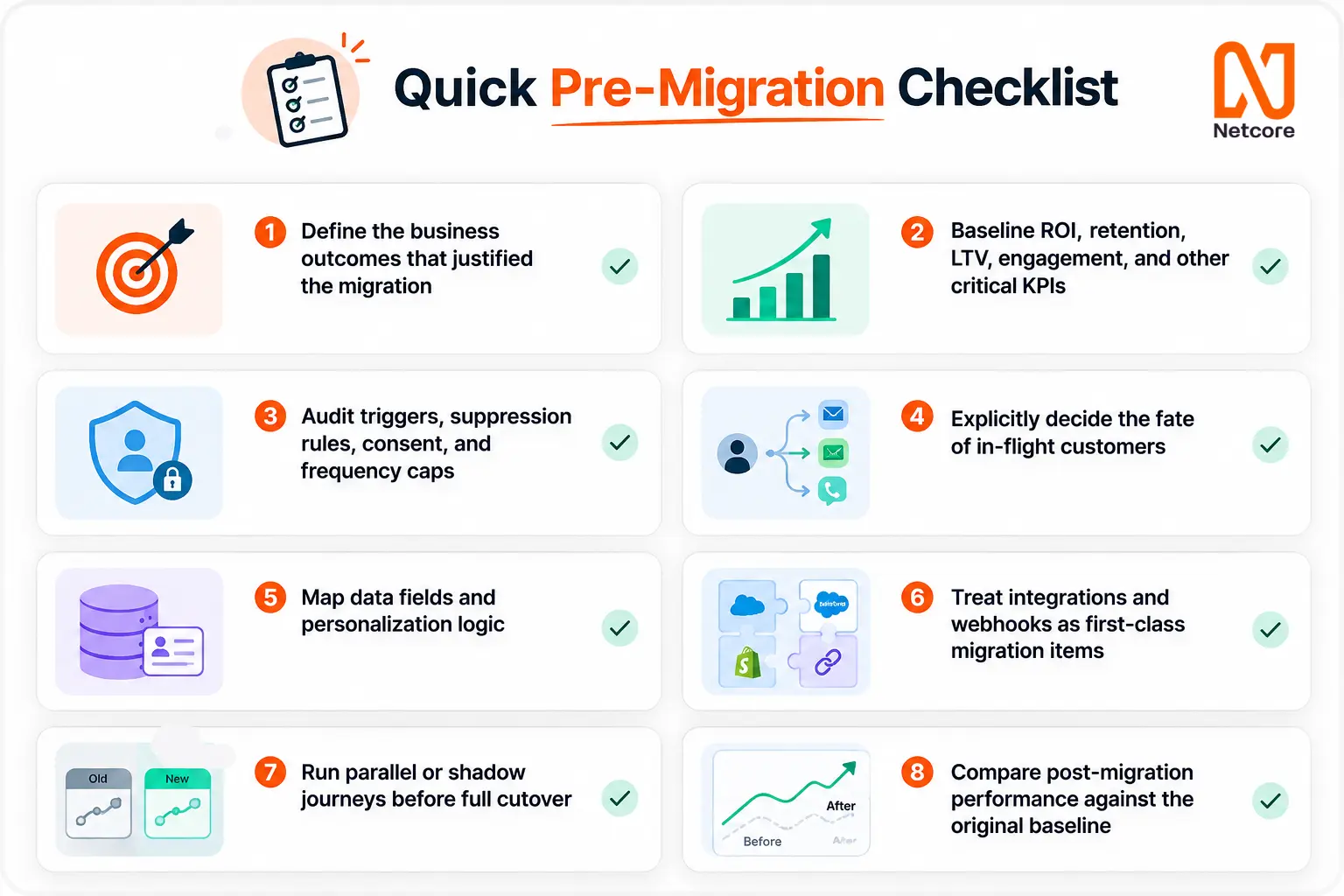
Understanding the Objective of Migration
This is where migration conversations need to change.
Migration shouldn’t be considered successful simply because every journey has been rebuilt and switched on.
You chose a new platform for a reason.
Maybe you wanted to improve campaign ROI.
Maybe personalization wasn’t scaling.
Maybe retention had plateaued.
Maybe your teams were spending too much time managing disconnected tools.
Maybe you wanted better omnichannel orchestration or more intelligent decisioning.
Those objectives should become part of the migration plan, not something you measure months after migration.
The right partner therefore doesn’t just ask: “Did we migrate your journeys?”
They ask: “Are your journeys now performing better than they did before?”
How the Right Migration Partner Reduces the Risk
At Netcore, we understand that migrating your MarTech stack can feel like a high-stakes transition. Your team still has campaigns to run, customers to engage, and revenue targets to hit while the migration is happening in the background.
That’s why our approach is designed around business continuity and business outcomes, not just technical migration. Check out this article on Ways to make Martech migration easier.
Human-led journey migration
Our teams manage the heavy lifting of rebuilding journeys, mapping data, validating integrations, and testing workflows. Prebuilt templates and 100+ integrations help accelerate implementation, while parallel execution allows you to stay live during the transition.
Outcome-based accountability
Migration shouldn’t end when the platform goes live. 30% of our fee is tied to the KPIs agreed upon at kickoff, such as revenue, retention, LTV, or cost per lead. This creates shared accountability for the outcomes that made you consider switching in the first place.
MarTech Engineers, not a support queue
You get a dedicated MarTech Engineer who works alongside your team, not just a support ticket number. They help migrate campaigns, identify optimization opportunities, apply industry playbooks, and continuously work toward the KPIs defined at the start.
AI agents that optimize beyond the migration
Netcore’s AI agents help move your marketing from manually configured campaigns toward autonomous optimization across audience, content, scheduling, insights, decisioning, and shopping. Your team sets the goals and guardrails; the agents help execute and optimize toward them.
Get a migration strategy designed around your business case
If you migrated to improve personalization, we focus on personalization outcomes.
If retention was the goal, we track retention.
If ROI was the reason, ROI becomes part of the migration conversation.
The technology changes. Your business objectives shouldn’t get lost in the transition. Book consultation today.
The Bottom Line
The hardest part of a MarTech migration isn’t rebuilding journeys.
It’s protecting the customer experience while making sure the new platform delivers the improvement you promised your business.
You shouldn’t have to choose between keeping your existing marketing running and transforming what comes next.
The right migration partner takes responsibility for both, moving your technology without losing your customers, your data, your institutional knowledge, or the business outcomes that made you migrate in the first place.
Because a successful migration isn’t: “Everything moved to the new platform.”
It’s: “We moved, and we’re performing better because of it.”