Diwali Engagement Playbook is now


Built from real repeat-purchase journeys across large-scale FMCG and D2C ecosystems.
TL;DR
A repeat customer is the easiest sale a brand will ever get, until the journey gets in the way. Across FMCG D2C and app experiences, the same five leaks quietly cost brands returning buyers: search that can’t handle a typo, a stock-out with no alternative offered, a second visit that feels anonymous, a cart that dies on broken offer logic, and a moment of intent that closes with no urgency. Each leak maps to a stage of the return-visit journey, and each has a specific fix. This piece walks through all five, with the benchmarks behind each.Why Do Brands Lose Customers Who Were Already Coming Back to Buy?
A repeat customer has already done the hardest part: they liked the product enough to look for it again. That should make the second purchase the easiest one a brand ever closes. Instead, in most FMCG D2C journeys, the returning customer hits the exact same friction a first-time visitor would, an unhelpful search bar, a stock-out with no next step, a homepage that doesn’t remember them, because most journeys aren’t built to recognize intent, only to process a transaction.
None of these five leaks are demand problems. The customer showed up wanting to buy. Every one of them is a data and orchestration gap, the system not knowing, or not acting on, what it already knows about that customer. Closing that gap is exactly what Netcore’s Customer Engagement platform is built to do: unify the signals a returning buyer is already giving off, and act on them in the moment they matter.
The 5 Leaks, and What Seals Each One
Picture a returning customer trying to restock a favourite product discovered in-store. Here’s where that journey typically breaks, and the capability that closes each gap.
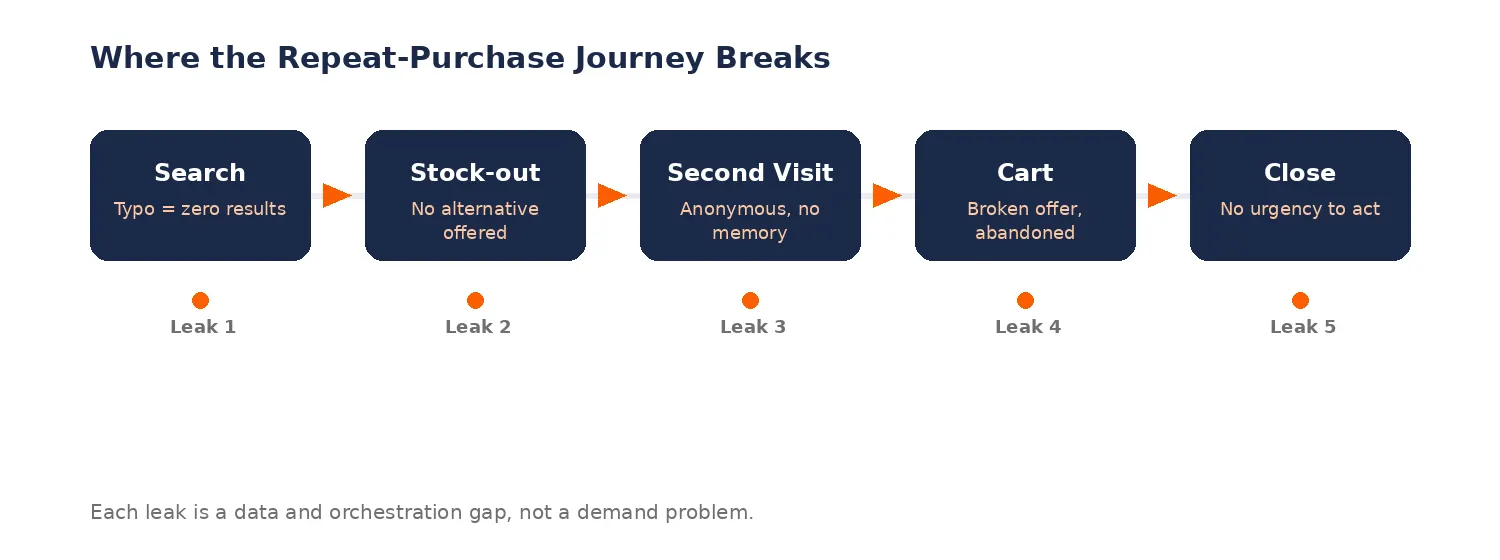
1. Discovery Breaks Before It Starts
SEARCH A single typo ends the journey
The visitor opens the website and searches for the product, but a small typo in the query returns zero results. Rather than correcting it for them, the search bar simply fails, so they leave the site altogether and find the same product, typo and all, on a marketplace within seconds.
Where Netcore fits: AI-powered search with autocorrect, spellcheck, and query suggestions catches the same typo instantly and surfaces the right product before the customer ever thinks about leaving. Pepperfry saw a 54% increase in search conversions after implementing this. A leading UK grocery brand saw a 78% reduction in zero-result queries and a 25% uplift in revenue per search session on the same capability.
2. The Out-of-Stock Dead End
STOCK-OUT No alternative, no follow-up, no sale
The visitor finds the product, but it’s out of stock. There’s no suggested alternative, no confirmation email, no WhatsApp or SMS update, nothing. They submit a stock-notification request and leave with no reason to expect a response before buying elsewhere.
Where Netcore fits: An automated, real-time back-in-stock journey does two things a manual process can’t: it recommends a similar in-stock alternative on the spot, and it fires an interactive AMP email confirmation the moment stock returns, so the brand stays in the conversation instead of going silent. AMP-driven engagement of this kind has driven form-submission increases as high as 116% for comparable brands using the format.
3. Anonymous on the Second Visit
PERSONALIZATION Coming back means nothing if nothing remembers you
The audience returns to the site later the same day, this time with clear intent, but the experience is identical to the first visit. No banner references what was browsed earlier, no pop-up nudges toward checkout, nothing signals that the brand has any memory of the visit at all.
Where Netcore fits: Personalized banners and on-site nudges tied to browsing history turn a returning visit into a guided one, showing the exact product or category the audience was already interested in. Reliance General Insurance saw a 4x increase in conversions among repeat visitors using banner personalization alone, and Borosil saw a 5x increase in new sign-ups from contextual nudges and spotlights.
4. The Cart That Almost Converts
CART RECOVERY One broken offer is enough to lose the sale
The visitor adds the product to cart and applies a coupon, only to find it doesn’t apply to that particular item. Frustrated and distracted, the cart gets abandoned. In a typical journey, that’s where it ends: no cross-channel nudge, no corrected offer, nothing bringing the visitor back.
Where Netcore fits: Cross-channel cart-recovery journeys, triggered the moment a cart is abandoned, can correct the offer and re-engage on whichever channel the customer is most responsive on. Flipkart Walmart increased conversions 3.5x running WhatsApp-based recovery journeys of this kind using the Netcore Customer Engagement Platform.
5. No Urgency, No Return
URGENCY Intent fades fast without a reason to act now
Even when a customer makes it back to complete a purchase, nothing signals that the moment is time-limited. Without urgency, intent quietly decays, and a purchase that was one tap away gets deferred, then forgotten.
Where Netcore fits: A real-time, timer-based nudge, an app push or web message signalling an offer is about to expire, converts lingering intent into a completed purchase before it fades. Brands running this kind of real-time orchestration have seen revenue uplifts as high as 28x on the affected digital channels, with AI-led journey orchestration platforms overall reporting up to 81x ROI on comparable campaigns.
Final Take
- A repeat customer is the easiest sale a brand can make, which is exactly why losing one at a journey leak is the most avoidable kind of churn.
- Search that can’t handle a typo sends a ready-to-buy customer straight to a competitor within seconds.
- A stock-out without an alternative or a follow-up is a dead end dressed up as a notification form.
- A second visit that looks identical to the first tells a returning customer the brand wasn’t paying attention.
- Cart recovery has to correct the problem, not just remind the customer it exists.
- Intent fades without urgency; a well-timed nudge is often the only thing standing between a cart and a checkout.