


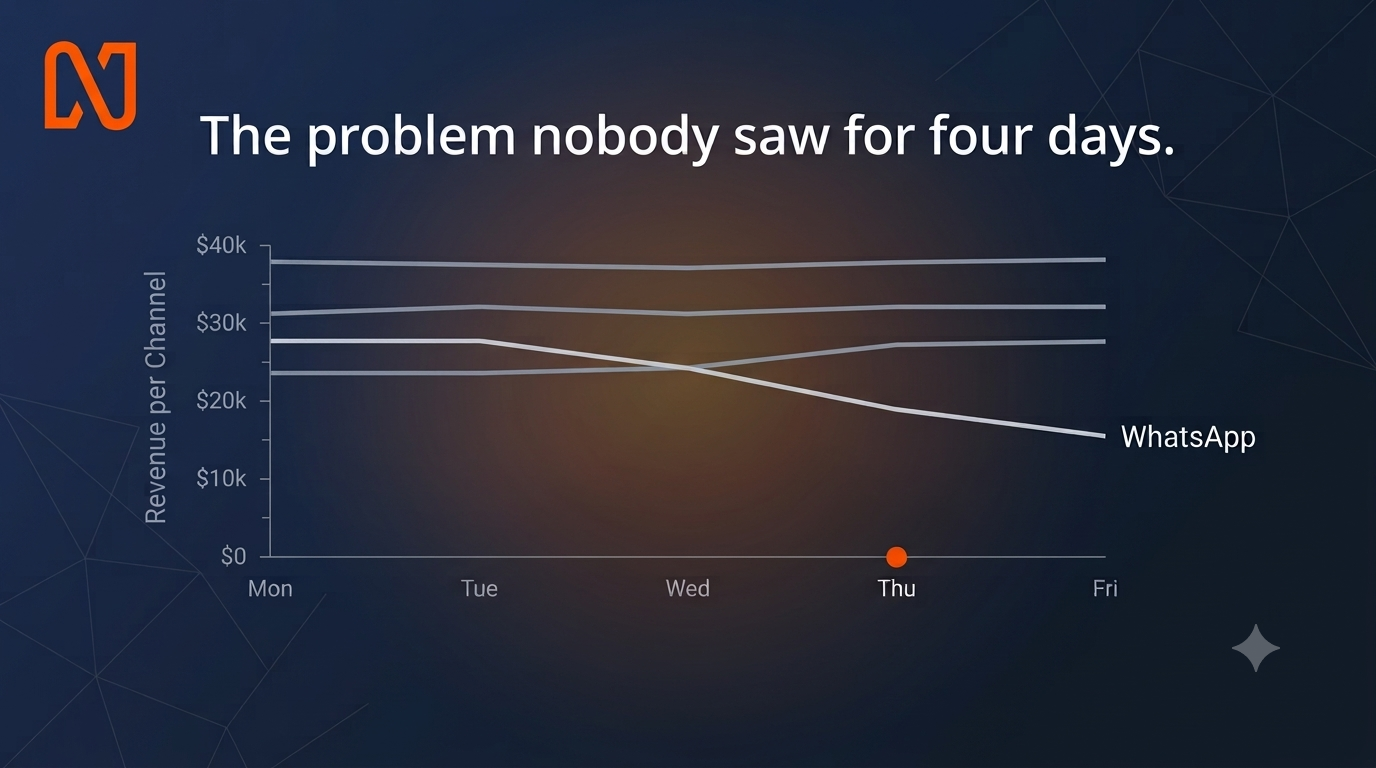
Last Tuesday, WhatsApp revenue dropped 10% overnight. Nobody noticed for four days.
Nobody dropped the ball either. Watching every channel against its usual numbers, every single morning, is more than any person can keep up with by hand. So when a rejected message template quietly slowed delivery, the first real sign was a weak week in the numbers. By then the campaign was over.
And what counts as a problem is specific to you. A 10% drop on WhatsApp can be an alarm. The same dip on another channel might be nothing at all. An off the shelf alert cannot tell the two apart, so the watching falls to a person, and that person has a hundred other things to do.
That is the kind of job a custom agent takes on. You describe the check once in plain words, point it at your data, and it runs every morning on its own, flagging only what matters to you, before it costs you a week.
What Is a Custom Agent?
A custom agent is an AI agent that a marketer builds for a specific job their team does over and over.
You describe the work in plain language, the way you would brief a colleague. You attach your own templates, definitions and benchmarks. You choose what the agent can see and work on. You set when it runs and who it runs for.
Then it does that job, the way you described it, on the cadence you picked, without ever being briefed again.
It handles the work shaped by how your team operates. The report you rebuild every Monday. The audience you refresh every few weeks. The journey you check every Thursday. The numbers you watch each morning. Not the generic work every marketing team shares, but the work that only makes sense in your setup.
This is different from the AI most marketing teams already have:
Built for your job, not the industry’s. A pre-built agent covers what is common across every customer. A custom agent covers what is specific to your team, which is usually where the manual work sits.
Briefed once, not prompted every time. You are not retyping instructions into a chat box each week. The brief is saved and the agent runs against it.
Runs on a schedule, also on demand. The output is waiting when you log in, and you can also get it on demand when needed.
Why a Pre-Built Agent Cannot Do It Your Way
There is a wave of pre-built agents arriving right now, and most of them are genuinely useful. They read campaign performance, build a segment, draft the copy. Netcore builds those too and they earn their place.
The shared work was never the part that ate your week though. The specific work was, and specificity is exactly what a pre-built agent cannot have.
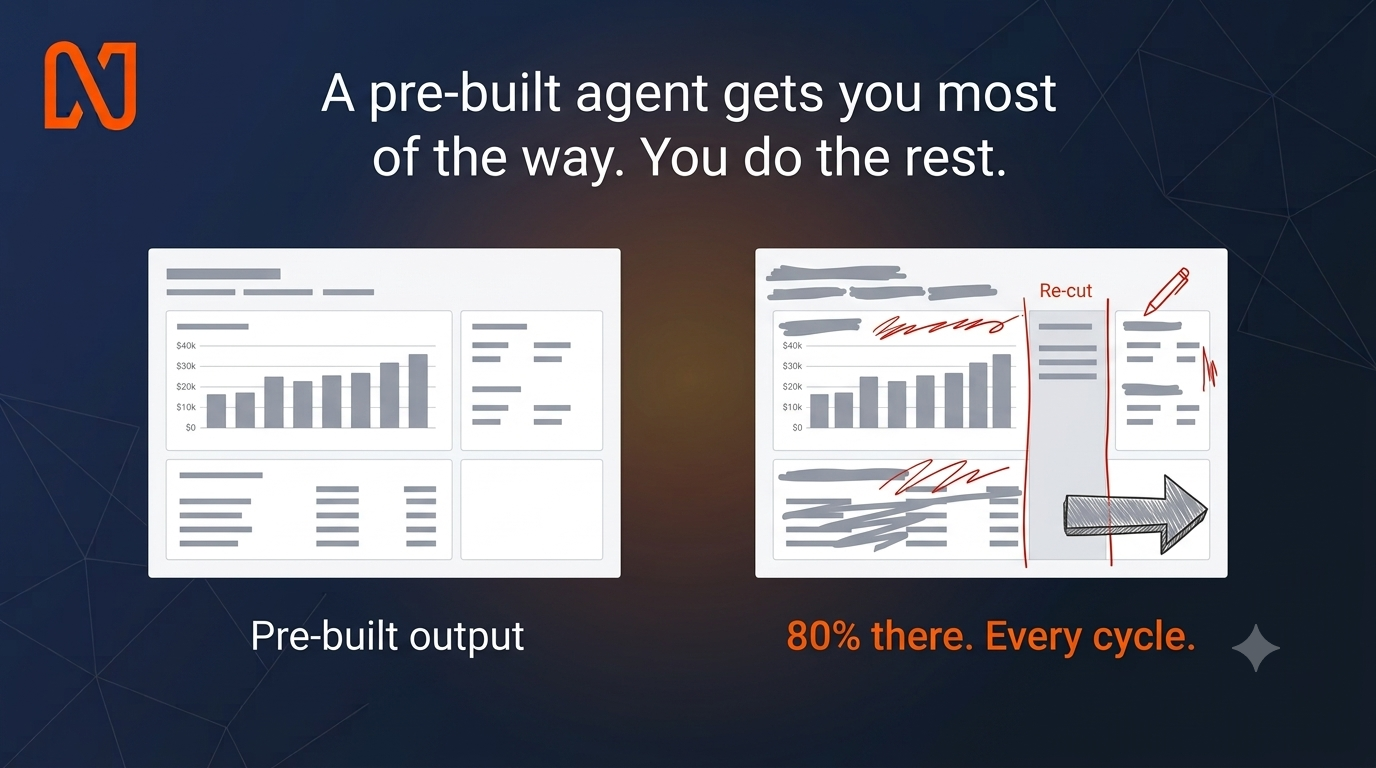
A pre-built agent is made for thousands of teams at once, so it can only encode an average version of your category. It cannot know that your review cuts by customer tier, that a 15% move matters to your team and a 10% move does not, or which of your channels everyone quietly agrees is noise. Ship you that agent and the output still needs fixing before anyone can use it.
Four more reasons the tools you already own never quite close this:
Your analysis logic is not the industry’s. How you slice performance, what dimensions you review by, which cuts your leadership trusts. None of that is standard.
The last mile always comes back to a person. Tools get you most of the way there. The final cut, the right format, the checklist your team uses. That falls to a human, every cycle.
Generic output does not reach leadership. A report that does not match the shape your board pack takes gets reformatted by somebody, or it gets dropped.
Nobody is watching the quiet failures. The journey that stopped converting. The channel drifting from its baseline. Nothing breaks loudly enough to catch in week one.
The gap was never capability. It was that nobody could build for a market of one.
Why This Is Possible Now and Was Not Before
For years, turning a recurring task into software meant writing a spec, joining a dev queue, and waiting a quarter. For a task that costs you two hours a week, the maths never worked. So it stayed manual, and the time it took never came back.
That constraint is gone.
Describing a job carefully is now enough to create something that does it. You do not file a request. You build the specialist yourself, in plain words, for the exact task your team runs.
The Catch With Generic AI
You could describe your Monday report to a general AI tool today and it would write you a decent template.
It could not pull last week’s numbers from your data. It could not compare them to the trailing month, size the segment that moved, or send anything on your channels. You would still be the one fetching, checking and doing.
Netcore Custom Agents run inside the platform that already holds your customer data, your campaign history, and your email, push and WhatsApp delivery. That is the difference between something that drafts the work and something that finishes it.
How Custom Agents Work Behind the Scenes
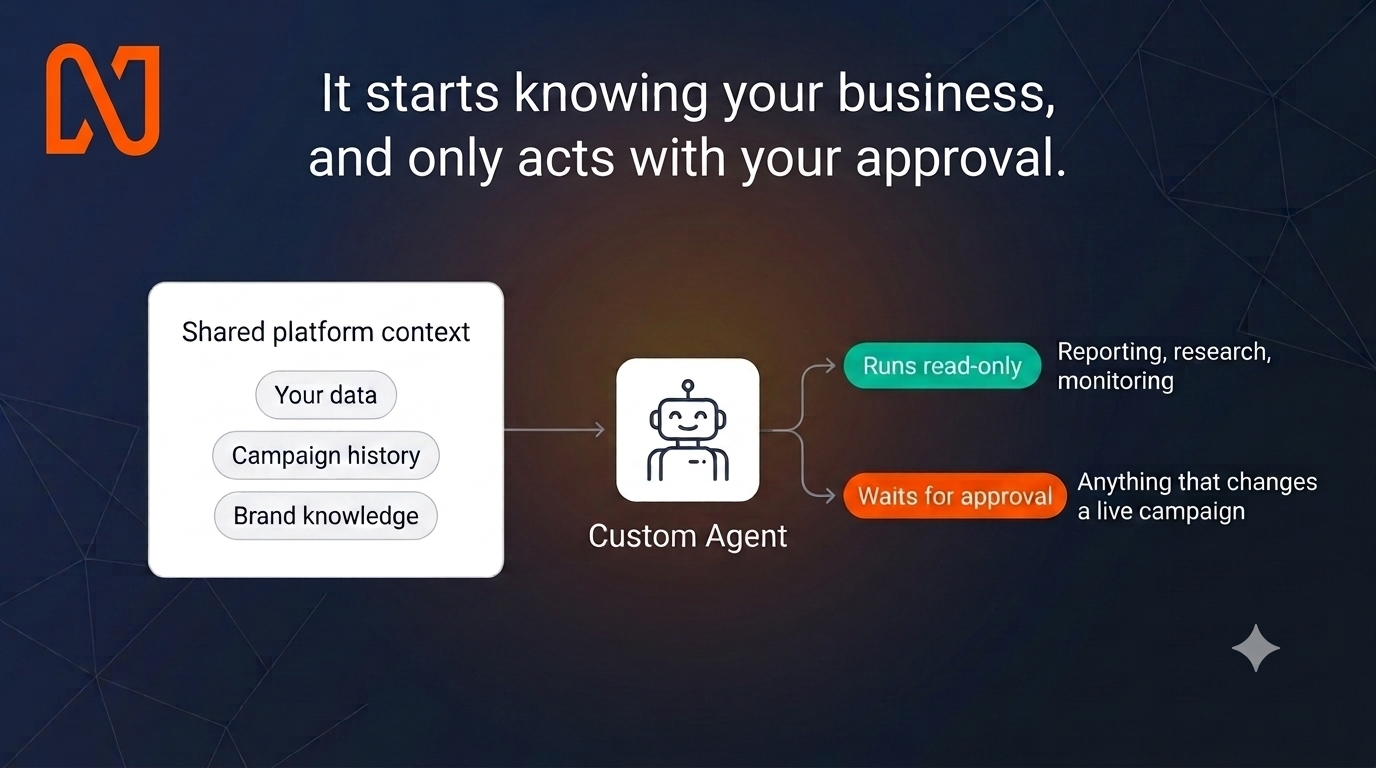
A marketer names the agent, describes the job in plain language, attaches the reference documents their team works from, and sets a cadence and an audience.
From there it runs on its own. It reads from the same data, campaign history and brand knowledge that Cori uses, so it is not starting from a blank slate. Your brand context is already there. What you are adding on top is your specific way of working.
Reporting, research and monitoring run unattended because they are read only. Anything that would change something live in the platform waits for a marketer to approve it.
This gives teams three things manual work cannot:
Consistency. The job gets done the same way every time, in the same format, regardless of who is on leave that week.
Coverage. Checks that used to get skipped when the week filled up now happen anyway.
Time back. Two hours a week, handed off for good.
The Six Types of Custom Agents Marketing Teams Build
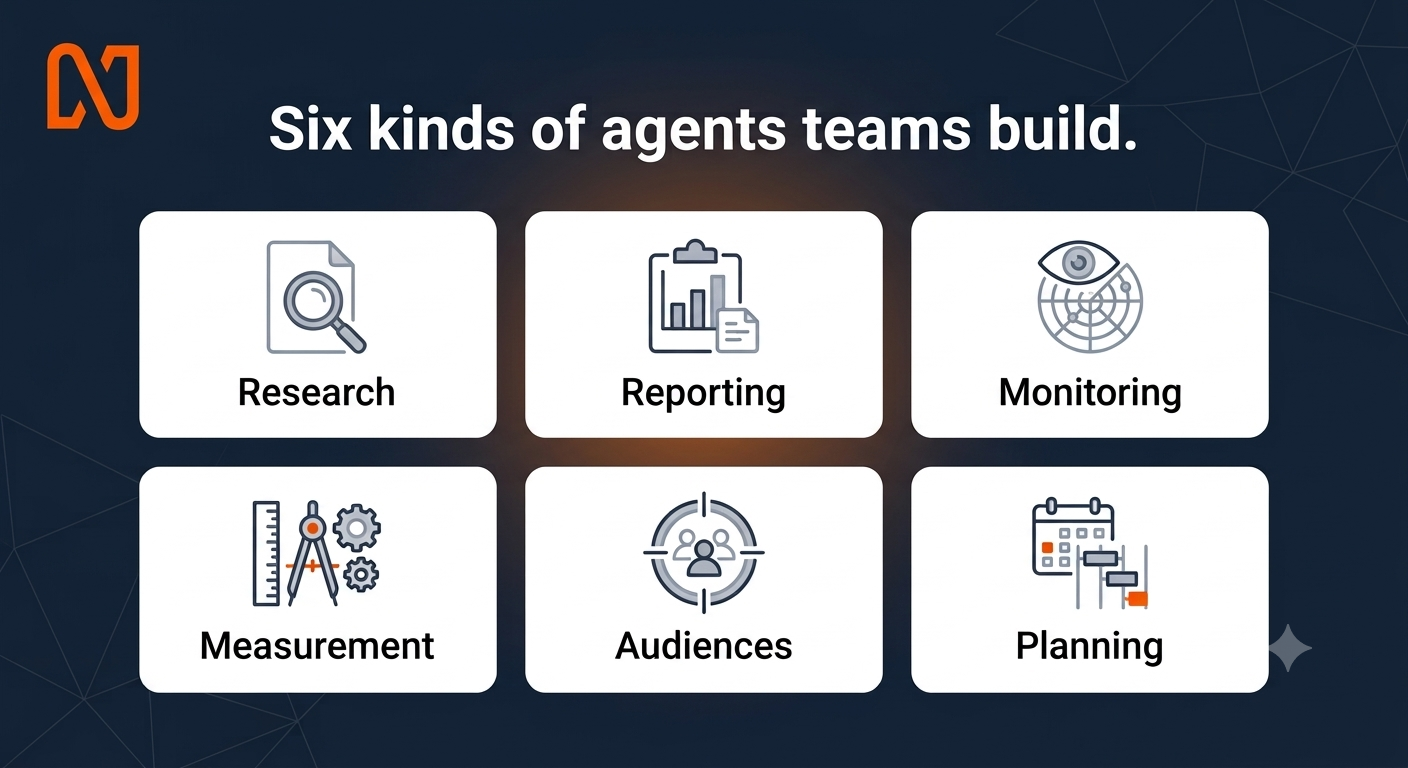
Custom agents are not only for reporting. That is where most teams start, and it is a fraction of what they cover.
1. Research Agents
When a question is too large for one conversation, a research agent investigates in the background and comes back with a report and the evidence behind it.
For example: a marketer asks why repeat purchase rate has slipped in one market over two quarters. The agent works across campaigns, journeys and segments, builds the picture, and returns a branded report with its sources shown. What would have been an analyst ticket and a week of waiting becomes a single run.
2. Reporting Agents
The recurring report, produced in your own format, on your own breakdowns, delivered to the people who need it.
For example: Daniel is a marketing manager at a lending business. His campaigns go out by product, but the business reviews by territory and age band, so every Monday he takes a product level report and reshapes it into the view his leadership reads. Two hours, roughly a hundred and forty times.
The agent is briefed once on his territory and age band view, given his reporting template, and set to run at 9am. The report is assembled and waiting before he opens his laptop.
3. Monitoring Agents
Agents that watch journeys, channels and campaigns for anything drifting, measured against your definition of normal rather than a generic threshold.
For example: a marketplace runs too many campaigns to eyeball daily. The agent checks every channel each morning against the trailing four week baseline and flags only what breaks the team’s definition of normal. WhatsApp delivery down 30% because a template was rejected overnight. A revenue spike that traces to a single product rather than a broad lift. The problem surfaces the same morning rather than after the weekend.
4. Measurement Agents
Agents that score performance on your own value framework rather than the platform’s default attribution.
For example: a direct to consumer brand spends across paid social, search, email and WhatsApp, and last-click reporting keeps crediting the cheapest channel. The agent ties each channel’s spend to real revenue on the brand’s own framework, where new-customer revenue counts for more than a repeat order, and recalculates it weekly. The team shifts budget toward the channels bringing profitable new customers instead of the ones that merely look efficient.
5. Audience Agents
Agents that find cohorts worth acting on, ranked on your own value logic, then draft and size the segment.
For example: a retail brand runs a monthly agent that identifies lapsed customer cohorts with the highest reactivation potential, scored on their own recency and value definitions. It returns a ranked shortlist with reasoning, then takes the top cohort, writes the segment rule, translates it into plain English and sizes it against the live count. The marketer reviews and approves rather than building from scratch.
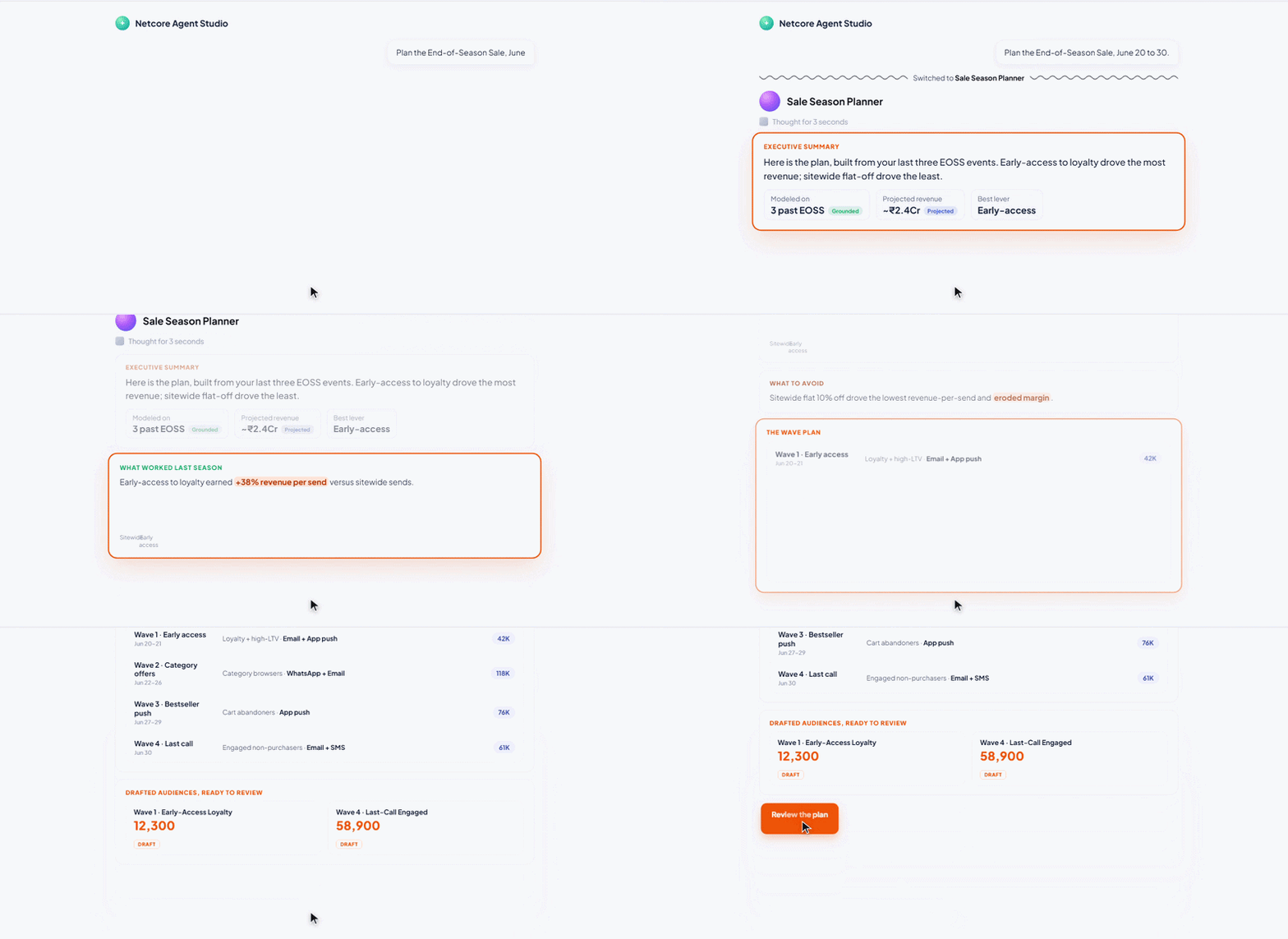
6. Planning Agents
Agents that build the plan from what worked last time, rather than from a blank page in a meeting room.
For example: ahead of each sale season, a marketer runs a planner agent. The plan they would build by hand comes from what drove revenue last season, lessons that usually live in a deck nobody can find. The agent returns a day by day wave plan with the opening and closing audiences drafted, ready to review. Days of planning become minutes.
Setting Up a Custom Agent in Four Steps
No implementation project, no developer time, no configuration screen to learn.
1. Brief it. Describe the job in plain language, the way you would brief a colleague joining your team. No syntax.
2. Add your files. Your reporting template, your definitions, your benchmarks, your brand rules. This is what turns generic output into yours.
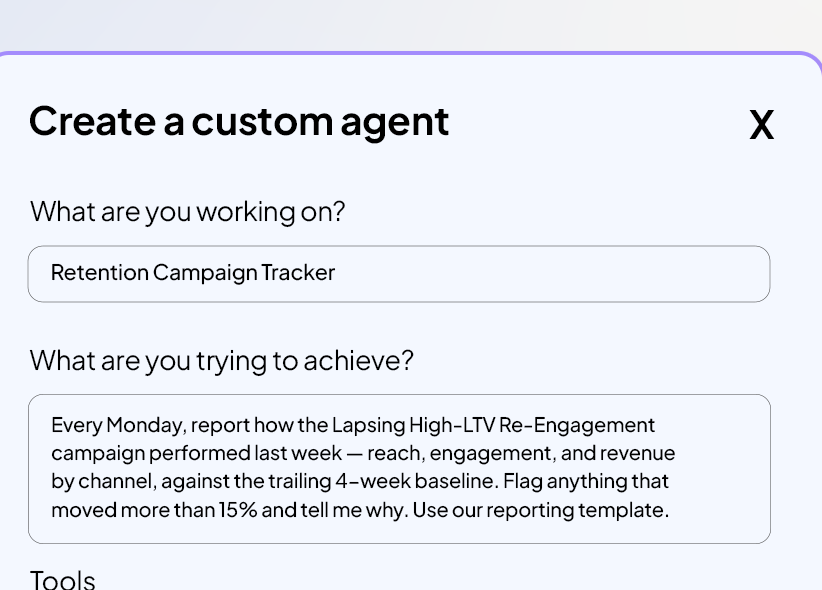
3. Choose what it can do. Campaigns, journeys, segments, reports, research. You scope what it can reach and what it can work on.
4. Set the cadence and the audience. Daily, weekly, monthly or on demand. Private to you, shared with the team, or assigned to specific people.
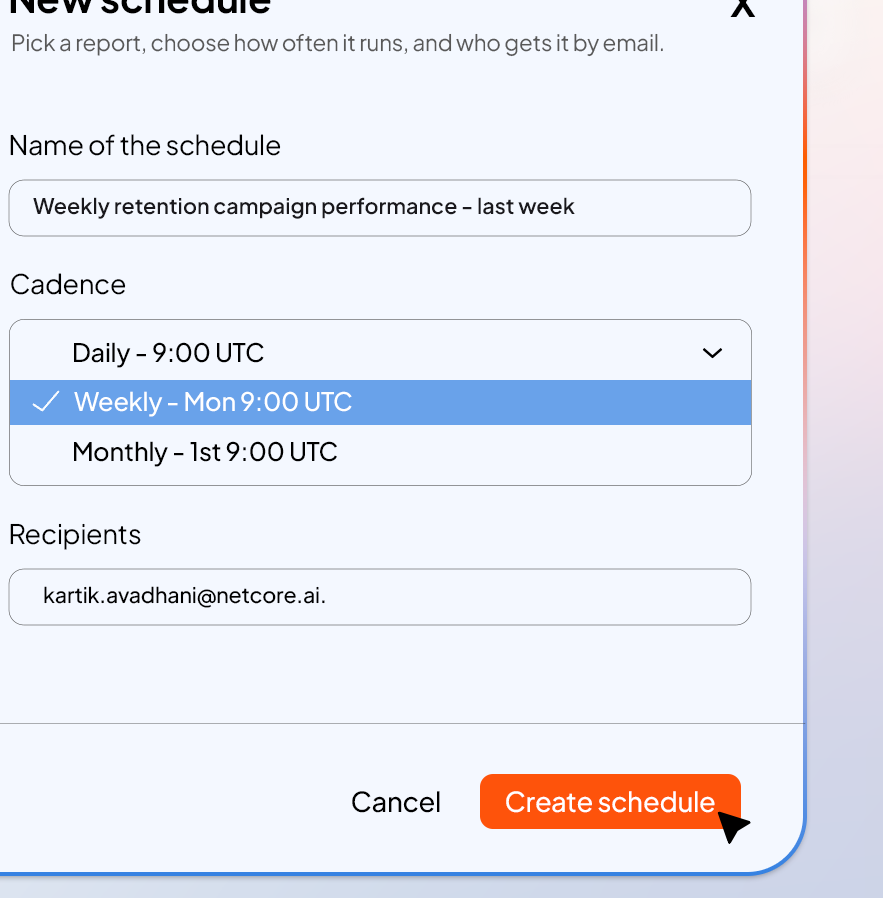
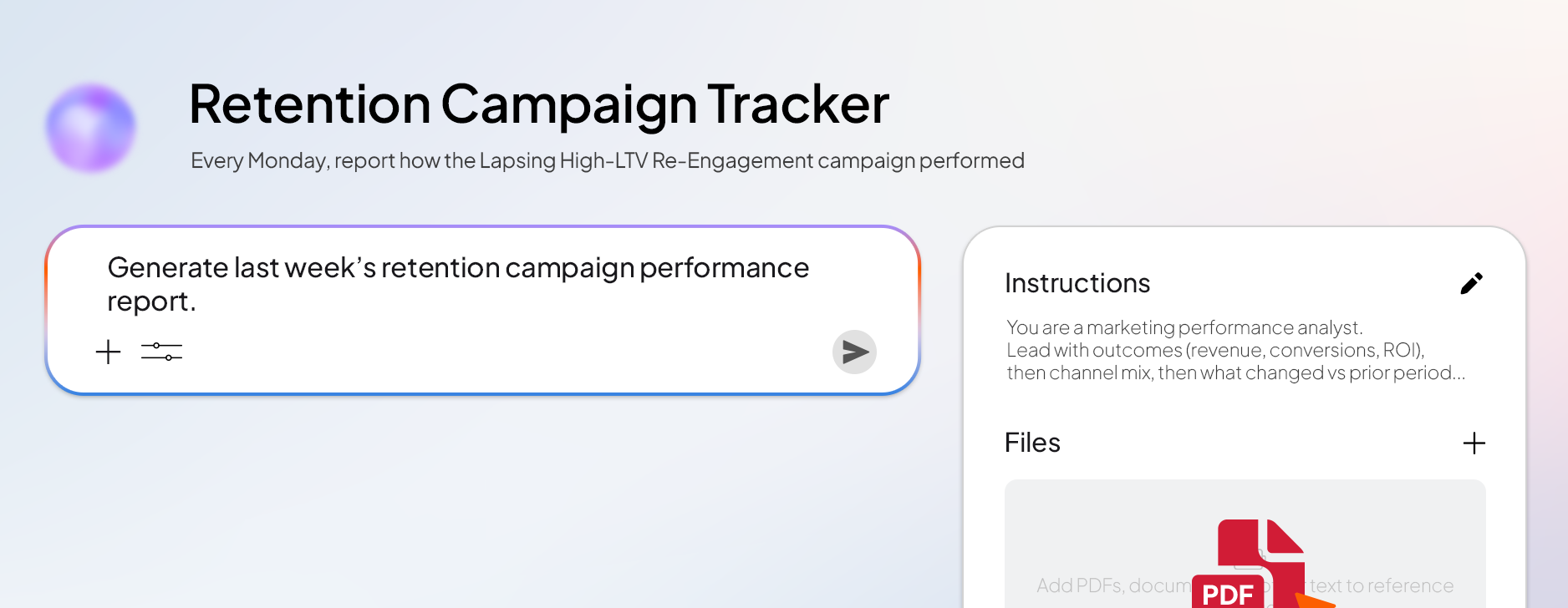
Or start from one of the ready made agents in the gallery and adjust it, which is how most teams build their first one.
What Marketing Teams Build First
A pattern has emerged across the teams building these.
Custom analytics. A large retail bank built an agent that reports performance by territory, age band and risk tier, so the monthly review starts from a finished cut instead of an analyst rebuilding it by hand.
ROI calculation. A fashion retailer built one that ties channel spend to real revenue on their own value framework, replacing a monthly exercise that took two days.
Anomaly detection. An online grocery brand built an agent that knows what a normal week looks like for them specifically, so problems surface in hours rather than at month end.
Compliance and audit prep. A consumer lender put audit preparation on an agent. What used to be a two week scramble now runs on demand against their own checklist, with gaps stated plainly rather than zeroed to look complete.
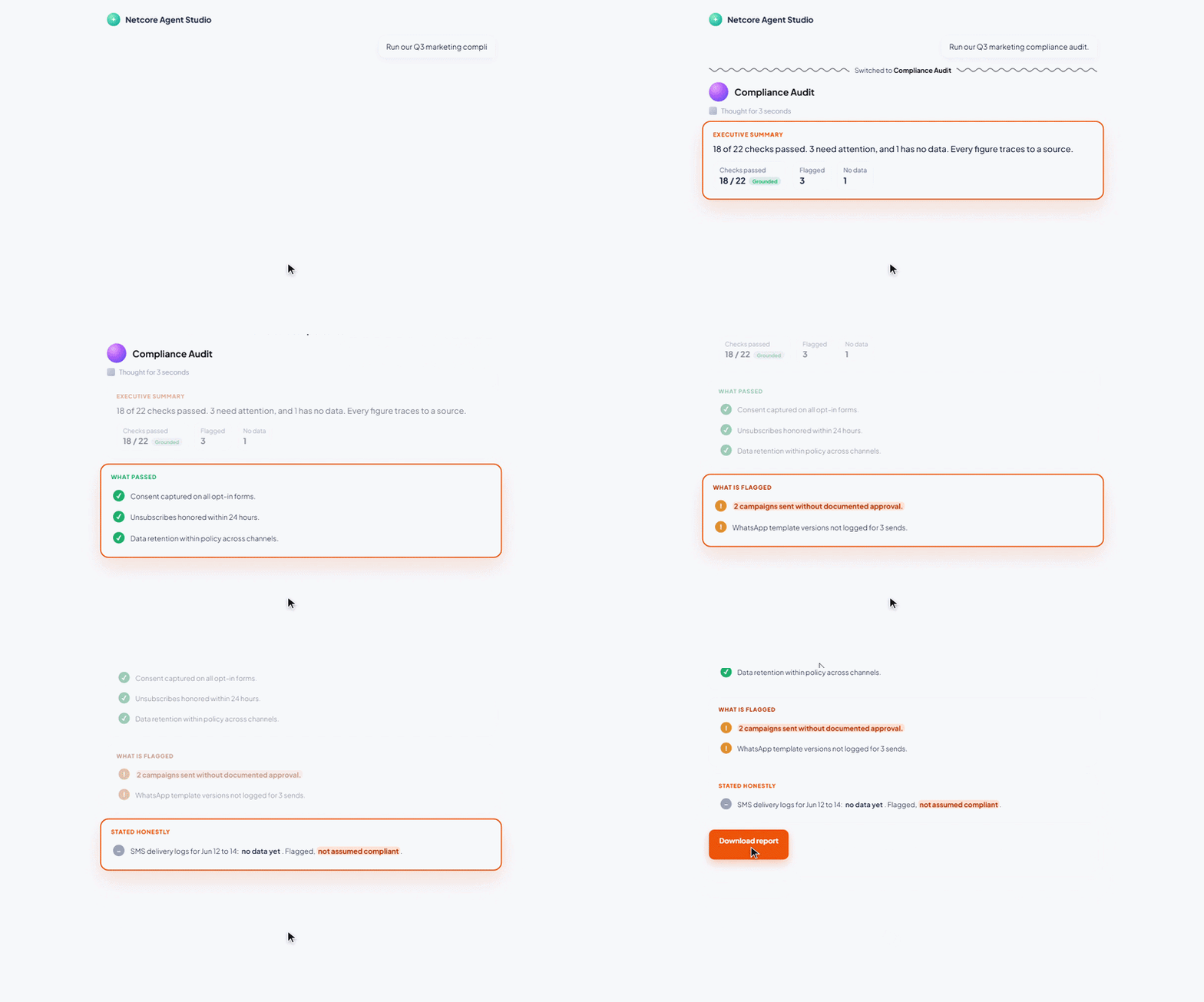
Budget tracking. A bank splits its marketing budget across products and regions, and overspend used to surface at month end. The agent tracks actual spend against each allocation in real time and flags a line pacing over while there is still time to correct it.
Executive reporting. An insurance brand generates the exact format leadership expects on a schedule, so the board pack stops being a fire drill every quarter.
One agent tends to lead to the next. Once one part of your workflow runs itself, the next one becomes obvious.
Getting Your First Agent Right
Start with the job you already do by hand. Almost always the report somebody on your team is rebuilding every week. You already know which one it is.
Brief it the way you would brief a person. Write the instructions as though you are explaining the job to someone joining the team, including the bits that feel obvious to you.
Attach the template, not a description of the template. The reference file is the biggest single difference between generic output and yours.
Pick a cadence that matches the decision. A monthly review agent does not need to run weekly. A channel monitor does not work monthly.
Share it once it works. Good agents spread. A reporting agent one person built usually ends up serving the whole team.
Mistakes to Avoid
Building for a job that does not repeat. Custom agents earn their value through repetition. A one off analysis is a conversation with Cori.
Briefing too vaguely. “Send me a weekly report” produces a generic weekly report. Name the metrics, the comparison period and the format.
Forgetting the reference files. An agent without your template produces platform shaped output, which is the problem you were trying to solve.
Setting it and never refining it. If the first two outputs are not right, change the brief. Most abandoned agents were never adjusted after the first run.
Expecting it to send. Anything that would touch a live campaign waits for approval. Worth telling your team up front so nobody is surprised.
Two Ways to Work, in Netcore Agent Hub
Netcore Custom Agents are one part of Netcore Agent Hub, Netcore’s home for agentic marketing.
Your recurring, specific tasks go to Custom Agents, done your way. Your everyday marketing goes to Cori, the agent you bring any problem to in the moment, which finds what you missed and takes it through to a campaign ready for your approval.
Two ways to work, one studio, one shared understanding of your business.
Stop Doing the Work Around the Work
The hours behind every campaign, the planning, the monitoring, the measurement, the reporting, are the hours nobody accounts for. None of it is difficult, all of it repeats, and it lands on the same two or three people until there is no room left for anything else.
Custom agents take that work, which leaves the part that needs a marketer.
Describe it once, and it is yours.

