


Open your app and look at the home screen. Every user sees the same banner, the same carousel, the same offer, whether they installed it this morning or have been a loyal customer for two years. That sameness quietly costs you customers and revenue.
Apps lose 77% of their users within three days of install, and tailoring the in-app experience to each person can cut that early drop-off by up to 40% and lift conversions by three to seven times.
The best part: you can do it yourself, from a dashboard, with no code and no app-store update. This guide shows you what app content personalization is, what it looks like across telecom, e-commerce and BFSI, and how to start.
What is app content personalization?
App content personalization means showing each user different content inside your app, chosen to fit what they like and need. Two people can open the exact same screen at the same moment and see a different banner, a different offer and a different set of recommendations, each picked for them.
It covers the content that lives on the screen itself: home banners, carousels, cards and offer strips. That is different from a pop-up that interrupts people, and different from a push notification or email that tries to pull them back in. This is about making the screen they are already looking at feel like it was built for them.
Why generic in-app content quietly costs you
Customers no longer treat personalization as a bonus. They expect it. McKinsey found that 71% of consumers expect companies to tailor their experience, and 76% get frustrated when that does not happen. The same research shows the brands that grow fastest earn 40% more of their revenue from personalization than their slower-growing rivals.
So a static screen is not neutral, it is a leak. Every generic banner is space you are paying for and getting little back from, and every irrelevant offer is a small nudge toward the exit.
Make Every In-App Experience More Relevant
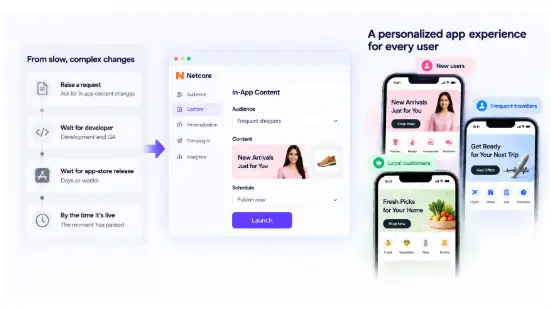
For years, marketers wanted to fix this and could not. Changing anything inside the app meant raising a ticket, waiting for a developer, then waiting again for an app-store release, often days or weeks. By the time the new content went live, the moment had passed.
App content personalization removes that bottleneck. You decide what each kind of customer sees, publish it in real time, and change it whenever you like, all without engineering help or a new app version. In practice, that means you can:
- Move at the speed of your campaigns, and react to what a customer is doing right now instead of last week.
- Test an idea in the morning and improve it by the afternoon, without a release cycle.
- Give every segment its own in-app experience, instead of settling for one average version that fits no one well.
The result is a screen that works harder for every customer, and a team that is no longer stuck in the engineering queue.
See How App Content Personalization Works
The easiest way to understand it is to see it. Here are ten everyday scenarios across three industries. Notice how each one meets the customer where they already are, with something useful rather than generic.
Telecom
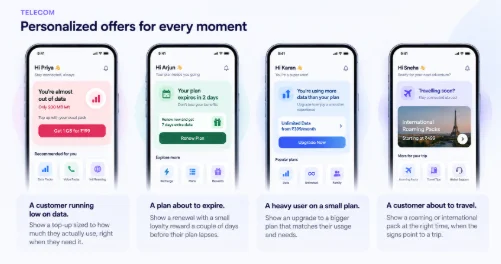
A customer running low on data. When someone is close to using up their data, their home screen shows a top-up sized to how much they actually use. It lands as helpful, because it solves a problem they can already feel.
A plan about to expire. A couple of days before a plan lapses, the customer sees a renewal with a small loyalty reward. You reach them at the decision moment, instead of chasing them after they have already drifted to a rival.
A heavy user on a small plan. Someone who keeps hitting their limit sees an upgrade to a bigger plan. The offer matches what they are clearly already doing, so it feels obvious rather than pushy.
A customer about to travel. When the signs point to a trip, the app surfaces a roaming or international pack at the right time. These well-timed offers convert strongly: one global operator saw a 336% jump in upsells from real-time, contextual offers.
E-commerce
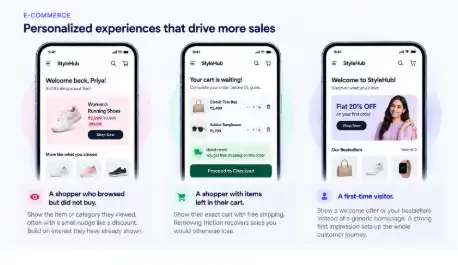
A shopper who browsed but did not buy. When they come back, the home screen leads with the item or category they were looking at, often with a small nudge like a discount. You are building on interest they have already shown.
A shopper with items left in their cart. They reopen the app and see their exact cart waiting, ideally with free shipping. Since most carts are abandoned, around 70% and higher in 2025, removing that last bit of friction recovers sales you would otherwise lose.
A first-time visitor. With no history to go on, a new user sees a welcome offer or your bestsellers instead of a cold, generic homepage. A strong first impression sets up the whole relationship.
BFSI
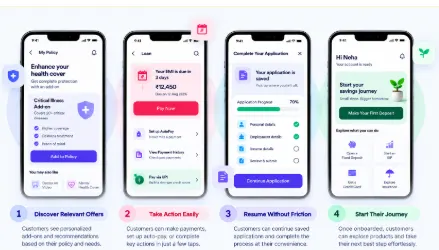
A policyholder without add-on cover. When someone opens their policy, they see a relevant add-on right there, at the moment they are already thinking about their cover.
A customer with a payment due. A few days before an EMI or loan payment, they get a friendly reminder with one-tap pay. It cuts missed payments and support calls, and being useful builds trust in a category where trust is everything.
Someone who started an application but did not finish. When they return, they see a simple prompt with their quote already filled in, so they do not have to start over. This speaks directly to the many customers, around 63%, who begin onboarding and never complete it.
A customer who signed up but never used the account. A dormant user sees a gentle nudge toward their first action, tailored to their profile. This is exactly where a lot of hard-won customers quietly slip away.
If you can, show one before-and-after mockup per industry. A single image of the personalized screen next to the generic one it replaces makes the idea click faster than any description.
How app content personalization works
None of this is guesswork. It draws on what you already know about each customer, which usually falls into four simple buckets:
- What they have done with you: purchases, payments, recharges, past activity.
- What is happening around them: time of day, location, weather, local events.
- What they are interested in: the categories, products or content they lean toward.
- Where they are in their journey: brand new, active, slipping away or dormant.
Netcore calls this the TWIN model, for Transactional, World, Interest and Individual signals. Together they let you show the right thing to the right person at the right moment.
Putting it to work is simple. You pick a spot on a screen, decide what different kinds of customers should see there, publish it live, and then compare it against a holdout group so you know the lift is real. No release cycle, no code.
App content personalization vs push and email
App content personalization does not replace push notifications or email. It does a different job, and the best programs use all three together. Here is the simple way to think about it:
| Channel | Where it shows up | Best for |
| App content personalization | On the app screen the user is already viewing | Making the in-app experience relevant in the moment |
| Push notification | On the phone’s lock screen or tray | Bringing people back who are not currently in the app |
| In the inbox, outside the app | Longer messages, receipts and considered offers |
The edge app content personalization has is timing. It reaches customers at the moment they are already in your app, already paying attention. That is the most valuable attention you get, and the most wasted when the screen is generic.
Common mistakes to avoid
Done badly, personalization can backfire. A few things to watch for:
- Not measuring. If you do not compare against a holdout group, you cannot tell what actually worked, and you will keep repeating things that only feel effective.
- Too many nudges. If every corner of the screen is selling something, people stop noticing all of it. Restraint is part of the craft.
- Too little to go on. Personalization built on one thin signal feels random and can chip away at trust. The more you know about a customer, the more relevant, and welcome, the content feels.
Proof it works: Telekom Malaysia’s Unifi app
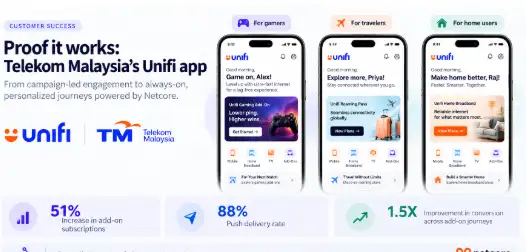
Telekom Malaysia’s Unifi app shows what happens when customer engagement moves beyond static campaigns. Using Netcore, Unifi shifted to personalized, behavior-led journeys across its digital channels using real-time customer signals to make engagement more relevant in the moment.
The impact was measurable:
- 51% increase in add-on subscriptions
- 1.5X improvement in conversion across add-on journeys
- 88% push delivery rate
Behind this shift was a move from campaign-led engagement to always-on personalization, with dynamic segmentation, real-time app and web personalization, and behavior-led journeys working together. Instead of showing every customer the same experience, Unifi could adapt offers, CTAs, and nudges based on what each customer was doing.
How to get started
You do not need a big program to see value. Start small:
- With app content personalization switched on, pick one high-traffic spot such as your home banner.
- Build one campaign, decide who sees what, and run it against a holdout group so you can measure the lift.
Once you can see what works, expand to more screens and more segments.
Make your busiest screen your most relevant one
App content personalization does not ask you to rebuild your app. It asks the app you already have to work harder for every person who opens it, turning your busiest screen into your most relevant one. If you would like to see what that could look like for your customers, that is a good next conversation to have.


