


TL;DR
Enterprise marketing automation helps large organizations move beyond disconnected campaigns and manual workflows to more personalized, data-driven customer engagement at scale. By unifying customer data, automating omnichannel journeys, and using predictive insights, businesses can improve conversions, increase customer retention, and maximize marketing ROI.
From recovering abandoned orders and personalizing product recommendations to reactivating inactive customers, brands across ecommerce, food, travel, and D2C are already seeing measurable results. The next evolution is Agentic AI, where specialized AI agents go beyond executing predefined workflows to analyze customer signals, make decisions, and continuously optimize marketing outcomes.
Enterprise marketing has become increasingly complex. Brands interact with millions of customers across websites, mobile apps, email, WhatsApp, SMS, and other digital channels. At the same time, customer expectations for personalized, timely, and consistent experiences continue to rise.
Managing these interactions through disconnected tools, manual campaigns, and predefined workflows makes it difficult for marketing teams to scale engagement and demonstrate business impact.
This is where enterprise marketing automation comes in. It helps businesses unify customer data, automate marketing operations, personalize customer experiences, and optimize engagement across the customer lifecycle.
But marketing automation is evolving. With AI agents entering the picture, enterprises can move beyond automating repetitive tasks to making intelligent, real-time marketing decisions that improve conversions, retention, and revenue.
Let’s understand how enterprise marketing automation works, its key uses and strategies, and how Agentic AI is shaping its future.
What Is Enterprise Marketing Automation?
Enterprise marketing automation is the use of advanced technology, integrated customer data, and AI-powered capabilities to automate, manage, and optimize marketing activities across multiple channels and customer touchpoints, usually for large enterprises.
Unlike basic marketing automation, which typically focuses on individual campaigns and predefined workflows, enterprise marketing automation supports complex customer journeys at scale.
For enterprises managing large customer bases, multiple product lines, and diverse markets, it creates a more connected approach to customer engagement.
Benefits of Enterprise Marketing Automation for Large Organizations
For large organizations managing millions of customer interactions across multiple markets, products, and channels, marketing automation offers more than operational efficiency. It helps businesses build connected customer experiences, improve marketing performance, and drive measurable revenue growth.
Here are seven key benefits of enterprise marketing automation:
1. Scales Personalized Customer Engagement
As customer databases grow, manually creating personalized campaigns for different audiences becomes increasingly difficult. Enterprise marketing automation uses customer data, behavioral signals, and predictive segmentation to deliver relevant messages, offers, and recommendations at scale.
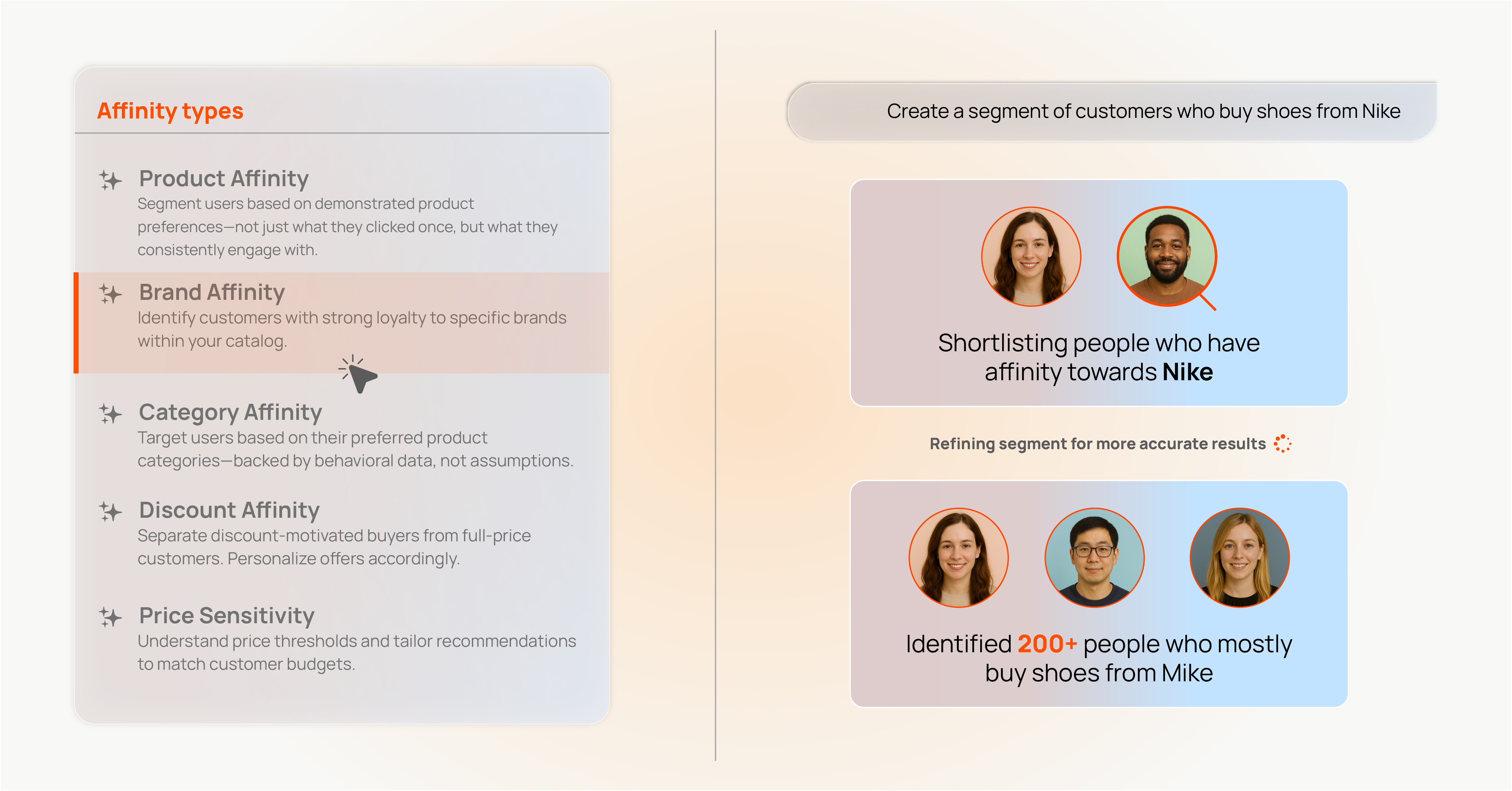
This allows brands to move beyond broad demographic segments and create more granular experiences based on individual preferences, purchase history, product affinity, and engagement patterns.
2. Improves Marketing Team Productivity
Managing multiple campaigns, audience lists, customer journeys, and communication channels requires significant marketing resources.
Automation reduces repetitive work such as audience selection, campaign scheduling, content deployment, and performance reporting. This allows marketing teams to spend less time on campaign operations and more time on strategy, experimentation, and growth initiatives.
3. Creates Consistent Omnichannel Customer Experiences
Customers interact with brands across websites, mobile apps, email, SMS, WhatsApp, and physical stores. Disconnected marketing systems can result in inconsistent messaging and fragmented experiences.
Enterprise marketing automation connects these touchpoints, allowing businesses to coordinate communication based on customer behavior, channel preferences, and lifecycle stages.
For example, a customer who abandons a cart on an ecommerce website can receive a relevant WhatsApp reminder instead of another generic promotional email.
4. Increases Conversion Rates and Revenue Opportunities
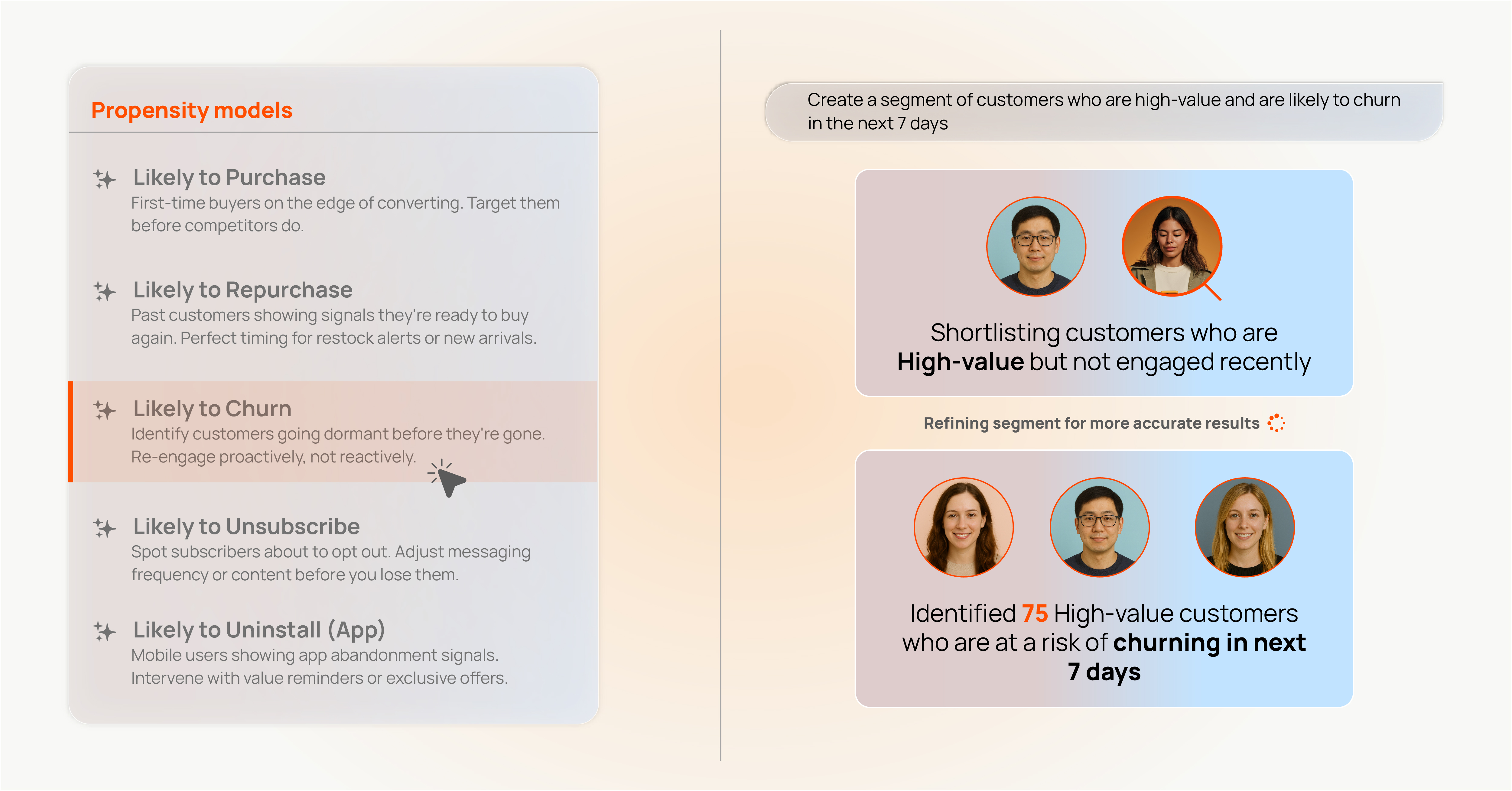
Not every customer interaction signals the same level of purchase intent. Enterprise marketing automation helps identify high-value opportunities through behavioral tracking, propensity models, and predictive analytics.
Brands can use these insights to trigger abandoned-cart reminders, personalized product recommendations, cross-sell campaigns, and time-sensitive offers when customers are more likely to convert.
This helps enterprises capture demand that might otherwise be lost between customer interactions.
5. Improves Customer Retention and Lifetime Value
Acquiring new customers is only one part of business growth. Large organizations also need to continuously engage existing customers and encourage repeat purchases.
Marketing automation helps identify inactive customers, declining engagement, churn signals, and repeat-purchase opportunities. Businesses can then trigger personalized retention campaigns, loyalty communications, replenishment reminders, and win-back journeys.
The result is a more proactive approach to customer retention and long-term customer value.
How to Build an Enterprise Marketing Automation Strategy
Implementing marketing automation requires more than investing in technology. Enterprises need a clear strategy that connects automation initiatives with business goals.
Here are seven steps to get started:
- Define business objectives: Identify priorities such as lead generation, customer acquisition, conversion, retention, or increasing customer lifetime value.
- Audit your marketing technology stack: Evaluate existing CRM, CDP, analytics, and engagement platforms to identify integration gaps.
- Unify customer data: Bring data from multiple touchpoints together to build a comprehensive understanding of customer behavior.
- Identify automation opportunities: Prioritize repetitive, high-volume, and revenue-critical marketing activities.
- Design customer journeys: Build lifecycle journeys with relevant triggers, audience segments, messages, and channel selection.
- Introduce AI-powered decisioning: Leverage predictive analytics, product recommendations, and send-time optimization to improve engagement.
- Measure and optimize: Track conversions, retention, revenue, and ROI to continuously improve marketing performance.
Traditional Marketing Automation Vs Enterprise Marketing Automation
Marketing automation has evolved significantly from its early days of rule-based campaign execution. Traditional marketing automation primarily focused on automating repetitive tasks such as email scheduling, lead nurturing, and predefined customer journeys.
Enterprise marketing automation, on the other hand, takes a more comprehensive approach. It connects customer data, marketing channels, advanced segmentation, AI-powered personalization, and analytics to manage complex customer interactions at scale.
The biggest difference lies in how these systems use customer data, make marketing decisions, and optimize outcomes.
| Parameter | Traditional Marketing Automation | Enterprise Marketing Automation |
| Primary focus | Automating repetitive marketing tasks | Optimizing customer engagement and business outcomes |
| Customer data | Relies on predefined lists and basic customer attributes | Integrates data across multiple customer touchpoints |
| Segmentation | Static, rule-based audience segments | Dynamic, behavioral, and predictive micro-segments |
| Campaign execution | Predefined triggers and workflows | Intelligent, automated customer journey orchestration |
| Personalization | Basic personalization using customer attributes | Individual-level personalization using behavior, affinity, and propensity |
| Channel management | Often operates through individual channels | Coordinates engagement across multiple channels |
| Scalability | Limited by manual campaign management | Designed to manage complex customer interactions at enterprise scale |
How Is Agentic AI Taking Enterprise Marketing Automation Further?
While enterprise marketing automation provides the foundation for connected, data-driven marketing, Agentic AI introduces a new layer of intelligence and autonomy.
AI agents can analyze customer behavior, identify audience opportunities, generate personalized content, recommend next-best actions, and optimize campaign delivery. Instead of relying entirely on marketers to configure every workflow and decision, agents can independently manage specific marketing responsibilities while working toward shared business objectives.
This shifts marketing automation from simply executing predefined campaigns to continuously learning, adapting, and optimizing customer engagement.
The distinction is important: Traditional automation helps marketers do repetitive tasks faster. Enterprise marketing automation helps them manage customer engagement at scale. Agentic AI takes it further by helping marketing teams make and execute smarter decisions that drive measurable business outcomes. How enterprise marketing automation is evolving with Agentic AI
Use Cases of Enterprise Marketing Automation Across Industries
Enterprise marketing automation looks different across industries, depending on customer behavior, buying cycles, and business objectives. While ecommerce brands focus on conversions and repeat purchases, BFSI businesses prioritize customer onboarding and cross-selling, and travel brands focus on loyalty and re-engagement.
Here are five real-world examples of how enterprises are using AI-powered marketing automation to drive measurable business outcomes.
1. Ecommerce & Retail: Recovering High-Intent Shoppers and Driving Repeat Purchases
Ecommerce and retail brands deal with millions of customer interactions, from product discovery and browsing to cart abandonment and repeat purchases. Marketing automation helps identify these behavioral signals and trigger relevant engagement before purchase intent fades.
Example: Mulmul Turns High-Intent Traffic into Revenue
Luxury fashion brand Mulmul connected Netcore’s AI-led lifecycle automation with LimeChat’s conversational support to convert customer interest into sales conversations.
- Automated browse, product-view, cart, and checkout journeys to engage shoppers at critical conversion moments.
- Used behavioral data and product affinity to build relevant customer segments.
- Connected WhatsApp campaign responses directly to live sales representatives, enabling customers to ask questions and get purchase assistance.
Business Impact:
- 676% WhatsApp revenue growth
- 3X Email revenue growth
- 24% → 28% Repeat purchase rate
- 143% Interactive email engagement growth
Another example: Crocs UAE automated catalog-triggered campaigns to reach shoppers interested in new arrivals, low-stock products, and price changes. By matching live product feed updates with recent browsing and cart activity, the brand generated 567 merchandising-triggered conversions and AED 478.66K in attributed revenue over 90 days.
2. Food & QSR: Automating Order Recovery and Increasing Conversions
Quick-service restaurants and food delivery brands operate in high-frequency, time-sensitive environments. A delayed notification or irrelevant offer can mean a lost order.
Marketing automation helps these businesses respond to real-time customer actions, recover incomplete orders, and deliver personalized offers based on ordering behavior.
Example: Domino’s Indonesia Recovered Abandoned Orders with AI
Domino’s Indonesia worked with Netcore to move beyond broadcast campaigns and introduce AI-led engagement across its customer journeys.
- Used predictive segmentation and propensity modelling to identify customers likely to convert.
- Triggered click and order drop-off recovery journeys to bring customers back.
- Applied send-time optimization to reach customers during relevant ordering windows.
- Used AI-powered creative variations to personalize offers across audience segments.
Business Impact:
- ~51% Recovery Journeys revenue contribution
- Reported contribution within the brand’s four AI-led engagement modes.
3. Travel & Hospitality: Driving Loyalty and Repeat Engagement
Travel brands often have long gaps between customer transactions. Marketing automation helps maintain engagement between bookings through personalized offers, loyalty rewards, and timely reactivation campaigns.
Example: AirAsia Rewards Re-engages Inactive Loyalty Members
AirAsia Rewards used targeted lifecycle campaigns to encourage inactive members to rediscover the value of their loyalty points and engage beyond flight bookings.
- Launched win-back campaigns featuring rewards redeemable from just five points.
- Used birthday-triggered lifestyle vouchers to create personalized engagement opportunities.
- Promoted digital member content to maintain communication between trips.
Business Impact:
- 18X Uplift in lifestyle voucher redemptions
- 23% targeted inactive members reactivated
- 76% Digital magazine email open rate
- 2.2X–3X Win-back open and click rates versus industry benchmarks
4. D2C & Consumer Brands: Improving Campaign ROI Through Predictive Segmentation
For D2C brands, running promotional campaigns across a large customer database can quickly increase marketing costs without guaranteeing conversions. The challenge is identifying customers most likely to purchase and tailoring campaigns accordingly.
Example: Bacca Bucci Uses AI to Target High-Intent Buyers
During its June 2026 BOGO sale, Bacca Bucci used Netcore’s AI-powered affinity and propensity models to identify customers most likely to respond to promotional offers.
- Used discount affinity scores to identify customers responsive to value-driven offers.
- Applied purchase propensity models to identify customers likely to purchase within 7 or 14 days.
- Combined predictive customer lifetime value and repeat-purchase likelihood to prioritize valuable audiences.
- Coordinated personalized WhatsApp and email campaigns for qualified customer segments.
Business Impact:
- 15X ROI on BOGO sale campaign
- 3X Growth in CRM revenue contribution
- 91% Higher WhatsApp click rate
What these use cases tell us: Enterprise marketing automation is moving beyond scheduled campaigns and basic workflow triggers. Whether it’s recovering an abandoned order, identifying high-propensity shoppers, or reactivating loyalty members, the opportunity lies in using customer data to determine who to engage, when to engage, what to communicate, and which action is most likely to drive business outcomes. Agentic AI takes this further by helping enterprises automate these decisions and continuously optimize customer journeys.
How to Choose the Right Enterprise Marketing Automation Platform
When evaluating enterprise marketing automation platforms, businesses should look beyond basic campaign automation. Consider these capabilities:
- Unified customer data integration and customer profiles.
- Advanced behavioral and predictive segmentation.
- Omnichannel campaign orchestration.
- AI-powered personalization and product recommendations.
- Automated customer journey management.
- Predictive analytics and real-time decisioning.
- Agentic AI capabilities and autonomous optimization.
- Scalability, security, and enterprise-grade integrations.
- Customer Success Support to help you grow your business and achieve ROI.
The right platform should connect customer data, marketing execution, intelligence, and analytics rather than operate as another disconnected tool in your technology stack.
Enterprise marketing automation is moving beyond automating repetitive marketing activities. The next generation is about understanding customer behavior, making intelligent decisions, and continuously optimizing engagement across the customer lifecycle.
As AI agents become part of enterprise marketing operations, marketers can spend less time managing workflows and more time focusing on customer strategy, experimentation, and business growth.
The real opportunity is not simply to automate more marketing. It is to make every marketing decision smarter, every customer interaction more relevant, and every engagement more accountable for business outcomes.


