Luxury fashion has never competed on product alone. Craftsmanship, design, brand heritage, and exclusivity have traditionally defined the category. But as premium menswear moves increasingly online, another differentiator is becoming harder to ignore: the quality of the customer experience.
For a fast-growing Indian menswear brand positioned at the bridge between premium and luxury, this meant rethinking how customers were engaged across their digital journey. The brand combines Indian sensibility with global craftsmanship and a strong emphasis on sustainable fashion. As its digital-first customer base expanded, however, engagement across channels remained fragmented.
The strategy adopted by the brand was clear: move from campaign-led communication to a connected, personalized customer journey using AI-powered customer engagement platform.
The transformation delivered significant commercial impact for example, a 30% increase in overall revenue, 800% ROI on the engagement platform investment, and 9% of total brand revenue directly attributable to Netcore-driven engagement.
How Fragmented Campaigns Were Transformed into Connected Experiences
The brand’s challenge was not a lack of customer data or communication channels. It was the absence of a unified approach to using them.
Email, SMS, WhatsApp, and web engagement were increasingly important, but communications could still operate as individual campaigns rather than coordinated interactions. This made it difficult to consistently recognize where a customer was in their journey and respond with the right message.
The brand set out to address three priorities:
- Improve customer experience by making every interaction more relevant.
- Create a true omnichannel engagement strategy built around a unified understanding of customer behavior.
- Increase repeat purchases through automated cross-sell and upsell journeys.
The answer was not simply to send more messages. It was to make each interaction more contextual.
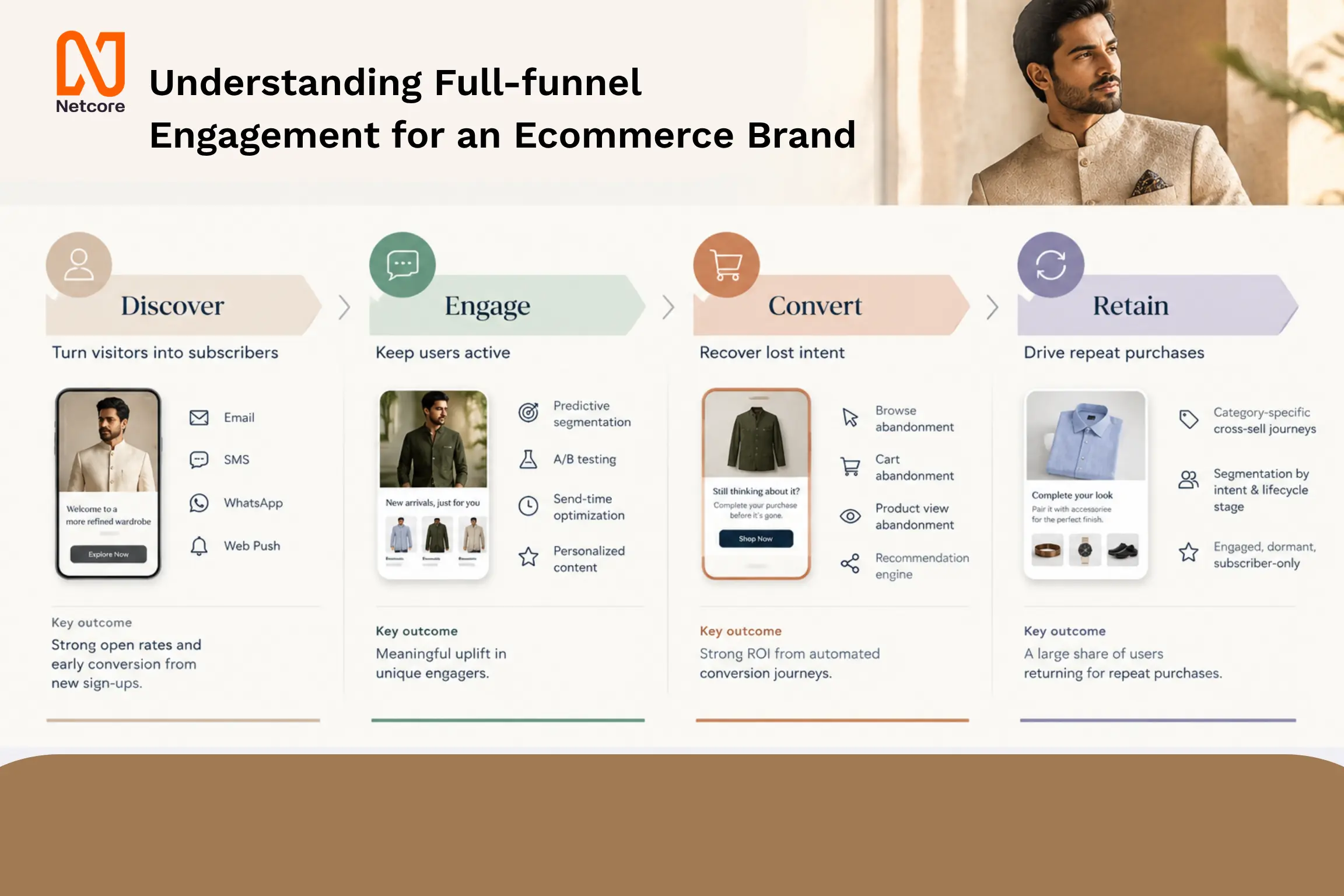
The Strategy: A Full-Funnel Engagement Model
Instead of treating acquisition, conversion, and retention as separate marketing activities, the brand mapped engagement across the entire customer lifecycle.
The operating model followed a simple framework:
KPI → Innovation → Strategy → Result
Each stage began with a measurable business objective, introduced the relevant engagement capability, translated it into an automated strategy, and then measured its commercial impact.
- Acquisition: Turning Sign-Ups Into Relationships
The first opportunity was the moment a customer entered the brand’s ecosystem.
Rather than relying on a single welcome email, the brand implemented automated, multi-channel welcome journeys spanning email, SMS, WhatsApp, and web push. The objective was to introduce the brand, establish relevance, and create an early path toward conversion.
The result was strong engagement and early conversion from newly acquired users creating a foundation for deeper lifecycle engagement.
- Engagement: Making Every Interaction More Relevant
The next challenge was keeping customers engaged after the initial interaction.
Predictive segmentation and A/B testing enabled the brand to differentiate audiences based on recent activity and intent. Send-time optimization helped determine when individual users were most likely to engage, while content personalization ensured communications reflected their interests and behavior.
This shifted the model from asking, “What campaign should we send?” to a more valuable question: “What does this customer need to see next?”
The outcome was a meaningful increase in unique engagers and stronger ongoing interaction with the brand.
- Conversion: Recovering Lost Intent
High-intent shoppers often leave without purchasing. For premium fashion brands, where consideration can be longer and product discovery more careful, recovering that intent can be particularly valuable.
The brand deployed behavior-triggered journeys covering page-browse abandonment, product-view abandonment, and cart abandonment.
These journeys were informed by product recommendation engines, funnel analysis, and cohort-level insights. Instead of treating every abandoned session equally, the engagement strategy could respond according to the customer’s demonstrated intent.
The result was a strong, measurable ROI contribution from automated conversion journeys.
- Retention: Turning Purchases Into the Next Opportunity
The relationship did not end at checkout.
The brand introduced category-specific cross-sell journeys based on previous purchase behavior, for example, recommending relevant seasonal or complementary categories to existing customers. Customers were also segmented according to lifecycle and intent, including engaged users, dormant users, and subscribers who had not yet purchased.
This created a systematic mechanism for bringing customers back rather than relying exclusively on new customer acquisition.
Building Continous Customer Journeys
The transformation became most visible in the brand’s automated journeys.
A new customer could enter a welcome journey spanning multiple channels. A shopper who added an item to their cart could receive a timely reminder. A customer who had purchased from one category could subsequently receive recommendations from another relevant category.
These journeys operated continuously, responding to customer behavior rather than campaign calendars.
That distinction matters. Manual campaigns are inherently episodic. Automated journeys create an always-on engagement layer that can respond to thousands of individual customer signals without requiring marketers to manually orchestrate every interaction.
The Innovation Layer: Making Every Message Work Harder
Automation provided the foundation. Innovation increased the value of each interaction.
The brand leveraged WhatsApp carousels to create immersive, swipeable product experiences and used AMP-powered emails to make product discovery and recommendations more interactive.
On-site personalization widgets extended the experience beyond outbound communication. Product recommendations, exit-intent experiences, and cart-page cross-sells allowed the website itself to adapt to customer intent.
Behind these experiences, advanced capabilities including send-time optimization, AI-driven insights, automated subject-line generation, and cohort analysis helped marketers continuously improve engagement.
The result was not simply more personalized messaging. It was a more intelligent engagement system.
The Results: Engagement Translated Into Revenue
The business impact demonstrated why moving from campaign execution to full-funnel engagement matters.
The brand achieved:
- 30% increase in overall revenue
- 800% ROI on its customer engagement platform investment
- 9% of total brand revenue directly attributable to Netcore-driven engagement
The partnership also evolved beyond a conventional technology relationship. Instead of functioning simply as a platform vendor, Netcore became a strategic collaborator in helping the brand identify opportunities, translate customer signals into journeys, and continuously improve outcomes.
What Premium Brands Can Learn
First, personalization beats generic reach. Luxury customers expect relevance. Personalization does not have to compromise brand tone; it can strengthen it by making the experience feel more considered.
Second, omnichannel is becoming table stakes. Customers do not experience brands in channels. They experience brands through journeys. Email, WhatsApp, SMS, and web experiences therefore need to work as parts of one system.
Third, automation compounds. A single campaign has a finite impact. A well-designed behavioral journey can influence every eligible customer, every day, without requiring proportional increases in marketing effort.
Finally, retention deserves the same strategic attention as acquisition. Cross-sell and post-purchase journeys can turn a transaction into an ongoing relationship and create incremental revenue from customers the brand has already won.
Biggest Takeaway
For premium and luxury fashion brands, the next phase of digital growth will not be defined simply by acquiring more customers or sending more campaigns.
It will be defined by how intelligently brands respond to every customer signal from the first website visit to the next purchase.
A full-stack customer engagement platform provides the infrastructure to make that possible: unified data, omnichannel activation, AI-powered intelligence, personalization, and automated journeys working together.
For this luxury menswear brand, that shift translated into 30% higher revenue and 800% ROI.
For other premium brands, the question is no longer whether personalization matters. It is whether their engagement infrastructure is capable of delivering it at scale. Book a consultation with our experts today and get started with your growth journey.