



Picture a Monday morning that most marketers will recognise.
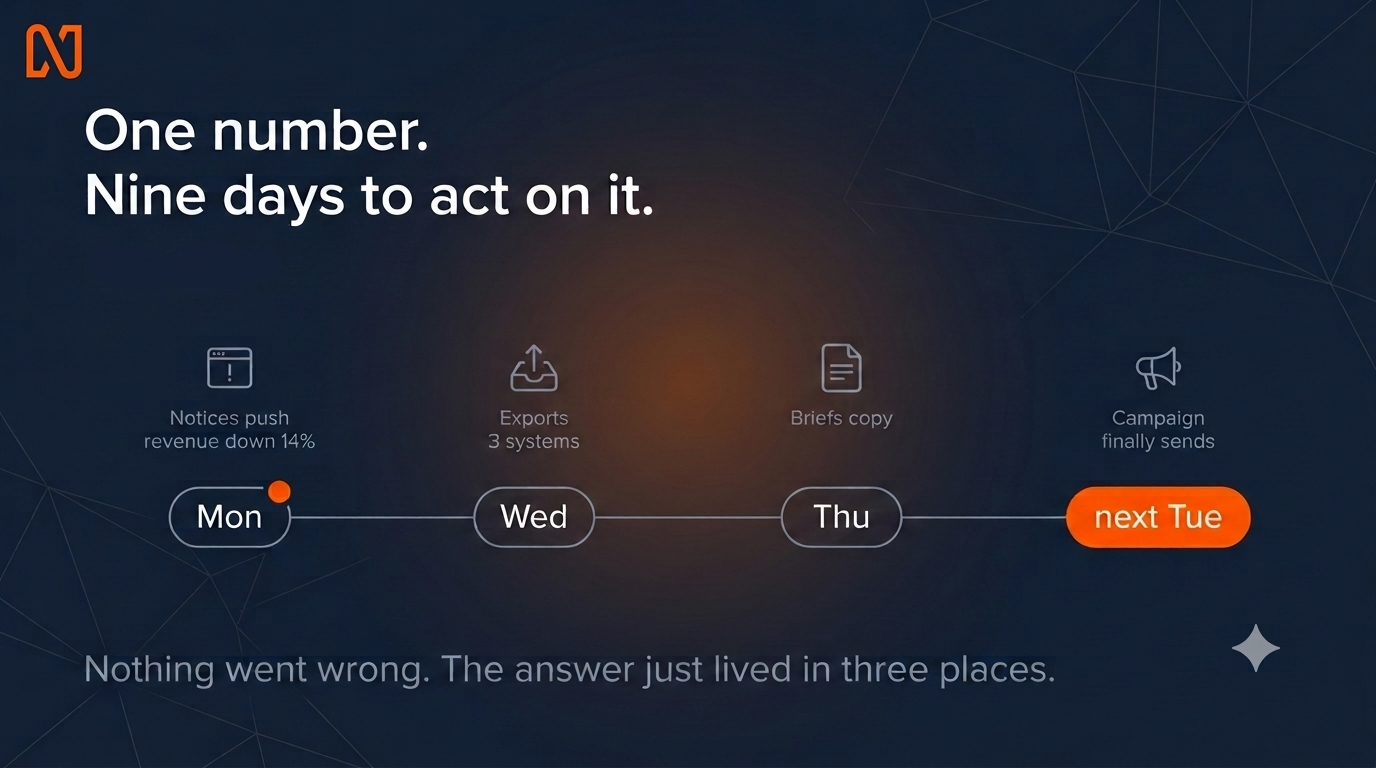
Maya runs lifecycle marketing at a fashion brand. She opens her laptop, pulls up the weekly dashboard, and sees that revenue from app push notifications is down 14%. Not dramatically. Just enough to notice.
She wants to know why. So she exports the campaign data. Then she pulls the segment list. Then she opens a third tab to check what was actually sent last month. By lunchtime she has a spreadsheet with three sheets in it and a growing suspicion that the answer sits somewhere between them.
By Wednesday she has it figured out. By Thursday she has briefed the copy. The campaign goes out the following Tuesday, nine days after she first noticed the number.
Nothing went wrong here. Maya is good at her job. The answer she needed lived across three different systems, and joining them together was a job only a person could do.
“Push revenue is down 14%” is a number. “Your highest value repeat buyers are lapsing, and the last three campaigns you sent them were discounts they have never once responded to” is a decision.
Only one of those is something Maya can act on, and getting from the first to the second was four days of her week.
Who Is Cori?
Cori is your marketing agent that works inside the Netcore platform.
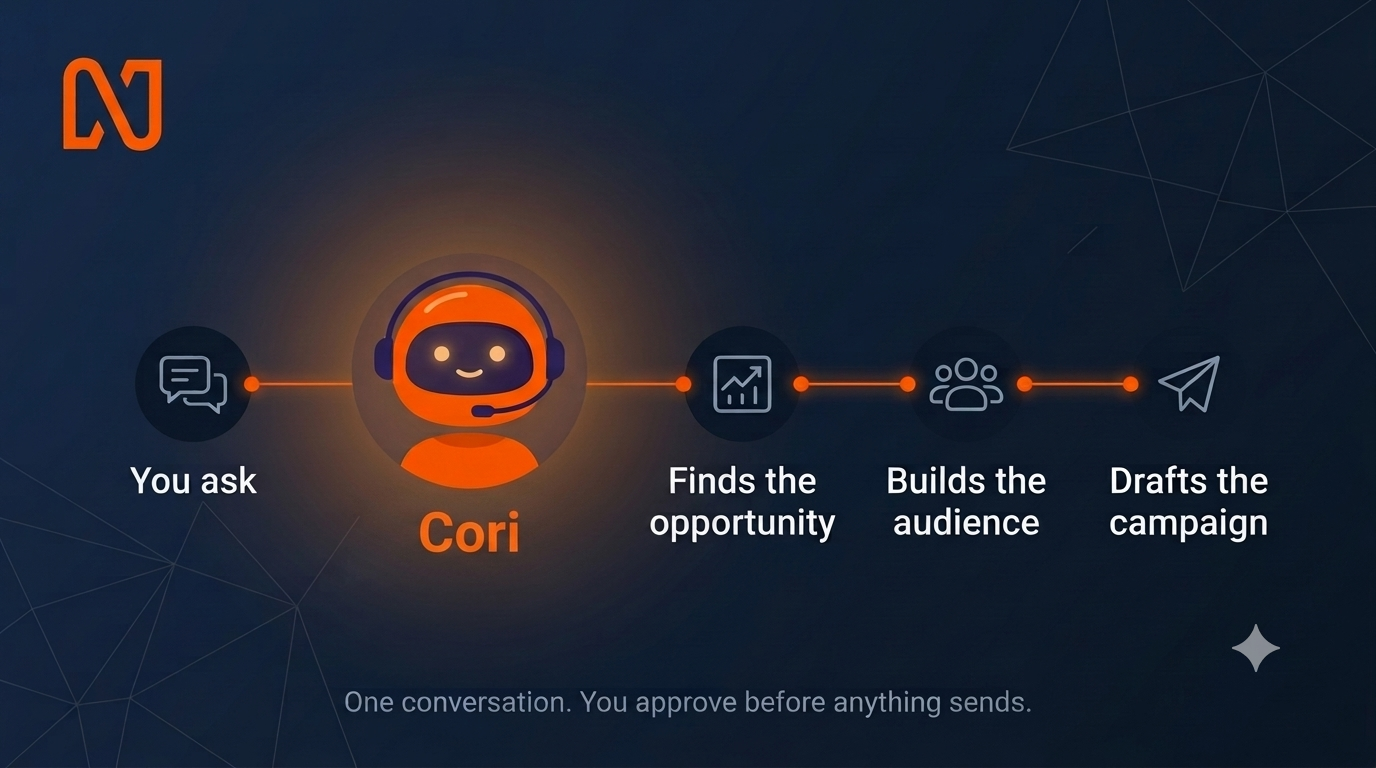
You ask it something in plain language, the way you would ask a colleague. It runs the analysis, finds what is worth acting on, builds the audience, writes the content and drafts the campaign. All of it happens in one conversation, in minutes, and you approve before anything reaches a customer.
Marketers who have been using Netcore’s Co-Marketer will recognise it. Cori is the same product, with a much deeper understanding of the business it works inside.
What makes it different from a general purpose AI assistant comes down to three things:
It knows your business, not marketing in general. Cori works from a knowledge base built out of your own data. Your audience makeup, your channel behaviour, your segment logic, your seasonal patterns. When it tells you something about your repeat buyers, it is reading your repeat buyers.
It works across systems in one turn. Campaigns, journeys and segments are separate places in most platforms. Cori reads across all of them to answer a single question, which is why it can find things a single dashboard cannot.
It finishes the work, not just the answer. Most tools hand you a chart. Cori takes the finding through to a drafted audience, drafted content and an assembled campaign, ready for your review.
Why Marketers Have More AI Than Ever and Less Time Than Ever
Almost every marketing team now has some form of AI. A copilot in the dashboard, a generator for subject lines, something that summarises reports. Very few of those teams would tell you the week got easier.
There are four reasons this happens, and they compound.
The tools do not know your business. An agent that has never studied your audiences, your channel behaviour or how your last festive campaign performed can only give you generic answers. So you get “engagement is down, try refreshing your creative,” which is true and gets you nowhere.
Sometimes it points you the wrong way entirely. A tool tells you sign-ups are up this month, which sounds like good news. What it cannot tell you is that the jump came from a channel that has always brought low-intent users who never activate, so what looks like growth is actually noise. Shallow context does not just give you a shallow answer. It gives you a campaign built on the wrong read, one that ships and still misses.
The questions that matter cross boundaries. Which segments feed your best campaigns, and are your best campaigns even using them. Why revenue from a channel dropped. Whether the journeys you built in March are still converting. Each of these spans campaigns, journeys and audiences at once, and no dashboard answers them in one click.
The answer arrives after the moment has passed. Three exports and a spreadsheet, or an analyst ticket and a five day wait. Audience behaviour changes every minute, so by the time the answer lands it describes something that already finished happening.
Knowing is not doing. Even with the right insight, the audience still has to be built, the copy written, the campaign assembled. Usually by different people in different tools across another week. This is how a good finding quietly dies.
And because each agent only sees its own slice, nobody holds the full picture of your business. That job falls to you. You gather the findings from each tool and piece them together yourself, because none of them can. The tools multiplied. The work of joining them up stayed where it was.
Why Most Agents Cannot See Your Whole Business
Every marketing platform has agents now. They can all write a subject line, build a segment, draft a journey. Capability is no longer the thing that separates them.
What separates them is what the agent can actually see. And that is not a roadmap decision, it is an architecture one. An agent can only reason over the data its platform holds. If your customer profiles live in one system, your campaign history in another, and your channel delivery in a third, the agent sees three slices and reasons over none of them. No amount of model quality fixes that.
Netcore built its own email, push and WhatsApp infrastructure rather than stitching it together from other providers. Your customer data, every campaign you have run, and the delivery of every message sit in one platform.
An agent inside it does not need you to explain your business, because it has been reading it since the day you switched on.
That is what Cori is built on, and it is why the answers go deeper than a tool reasoning over one report can reach.
How Cori Works Behind the Scenes
There is no setup step and no training run for a marketer to complete.
Cori starts from a per brand knowledge base built out of data already in your Netcore platform. It holds who your audiences are and how they cluster, how each channel behaves for your brand specifically, the segment logic your team uses, and what your seasons look like.
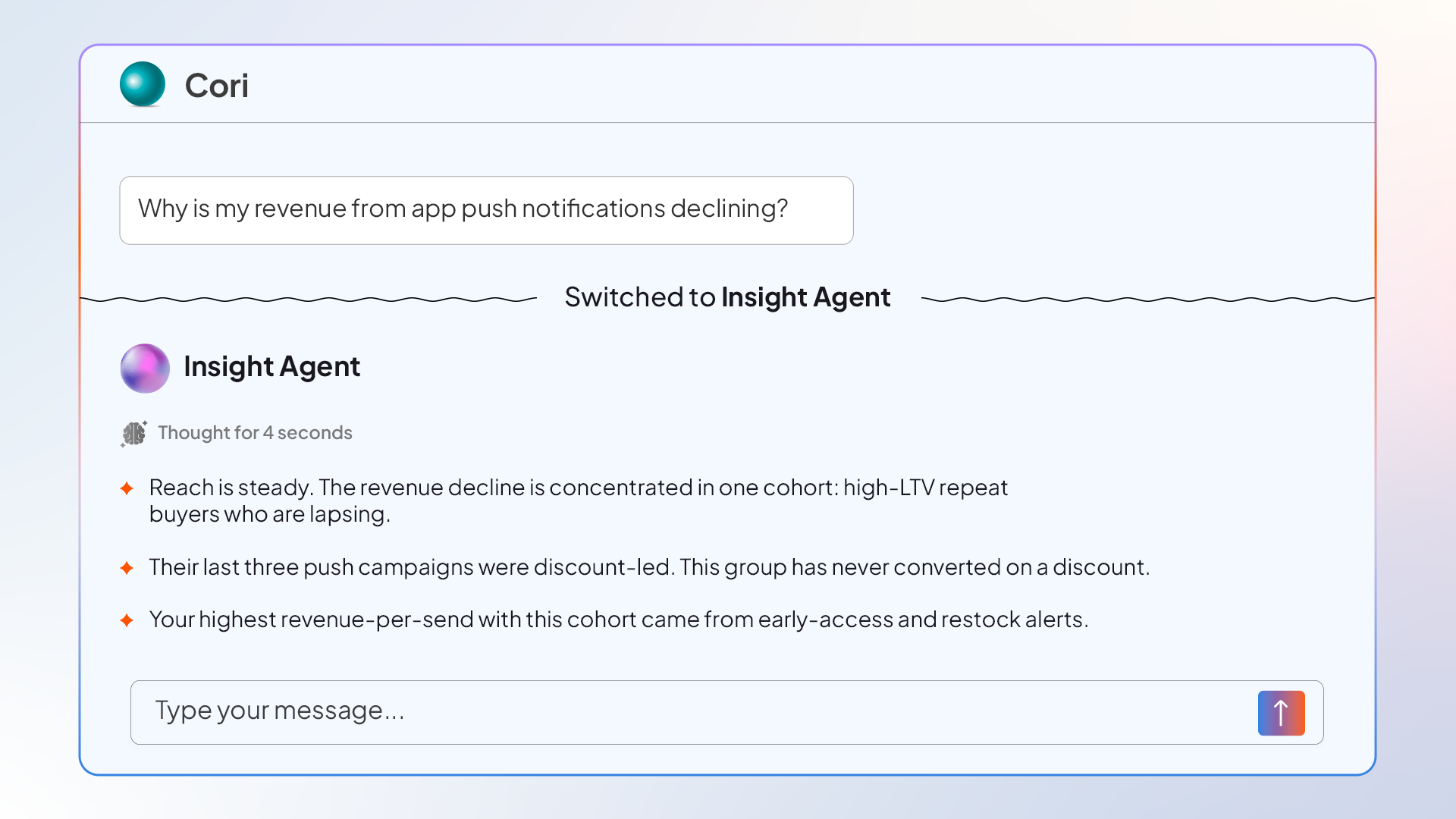
When you ask a question, Cori works out which specialist the task needs, brings it in, and tells you which one it used. You never pick. Ask about performance and the insight specialist answers. Act on what it finds and the audience specialist steps in. Move to outreach and the content specialist takes over. Everything happens in the same conversation with nothing re-briefed along the way.
For work too large for a single exchange, a research run investigates in the background and comes back with a branded report and its evidence cited.
This gives marketers three practical advantages over doing the same work by hand:
Speed that matches the window. Minutes from question to drafted campaign, rather than the week or more it takes when the analysis, the audience, the copy and the setup sit with different people.
Depth that a dashboard cannot reach. Because Cori joins data across campaigns, journeys and segments, it can surface things nobody thought to look for.
Consistency across every conversation. Tell Cori once how you want your numbers presented, what your definitions are, which format you use. It holds that across every conversation and into every report.
The Four Things Marketers Ask Cori to Do
Most conversations with Cori fall into one of four jobs. In practice they run into each other, because one naturally leads to the next.
1. Find Out Why a Number Moved
When a metric shifts and you need the reason rather than the number, Cori works across campaigns, journeys and segments in one turn and tells you what is happening underneath.
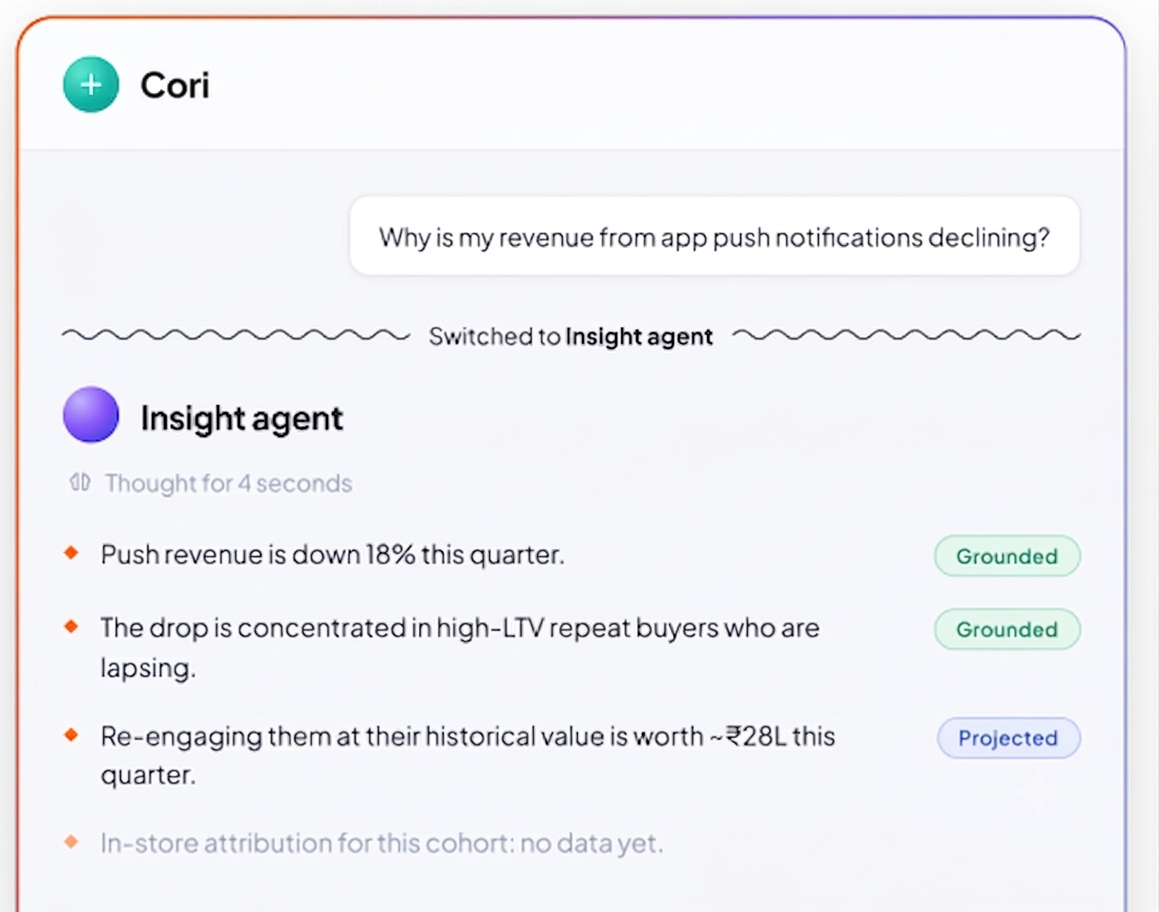
For example: Maya asks why revenue from app push is declining. Cori checks reach first and finds it held steady, so this is not a delivery problem. It locates the decline inside one cohort of high value repeat buyers who have started to lapse. It then looks at what those customers were sent and finds three consecutive discount led campaigns. Checking history, it finds this cohort has never once converted on a discount. What did work with them was early access and restock alerts, which earned the highest revenue per send this group has ever produced.
Nobody asked about discounts. Nobody asked about that cohort. The question was about push revenue.
Cori also brings you what you did not think to ask at all. Because it watches the cohorts, journeys and segments you do not have time to, it will surface the loyalty segment going quiet or the journey quietly losing people before either shows up in your numbers.
2. Build the Audience
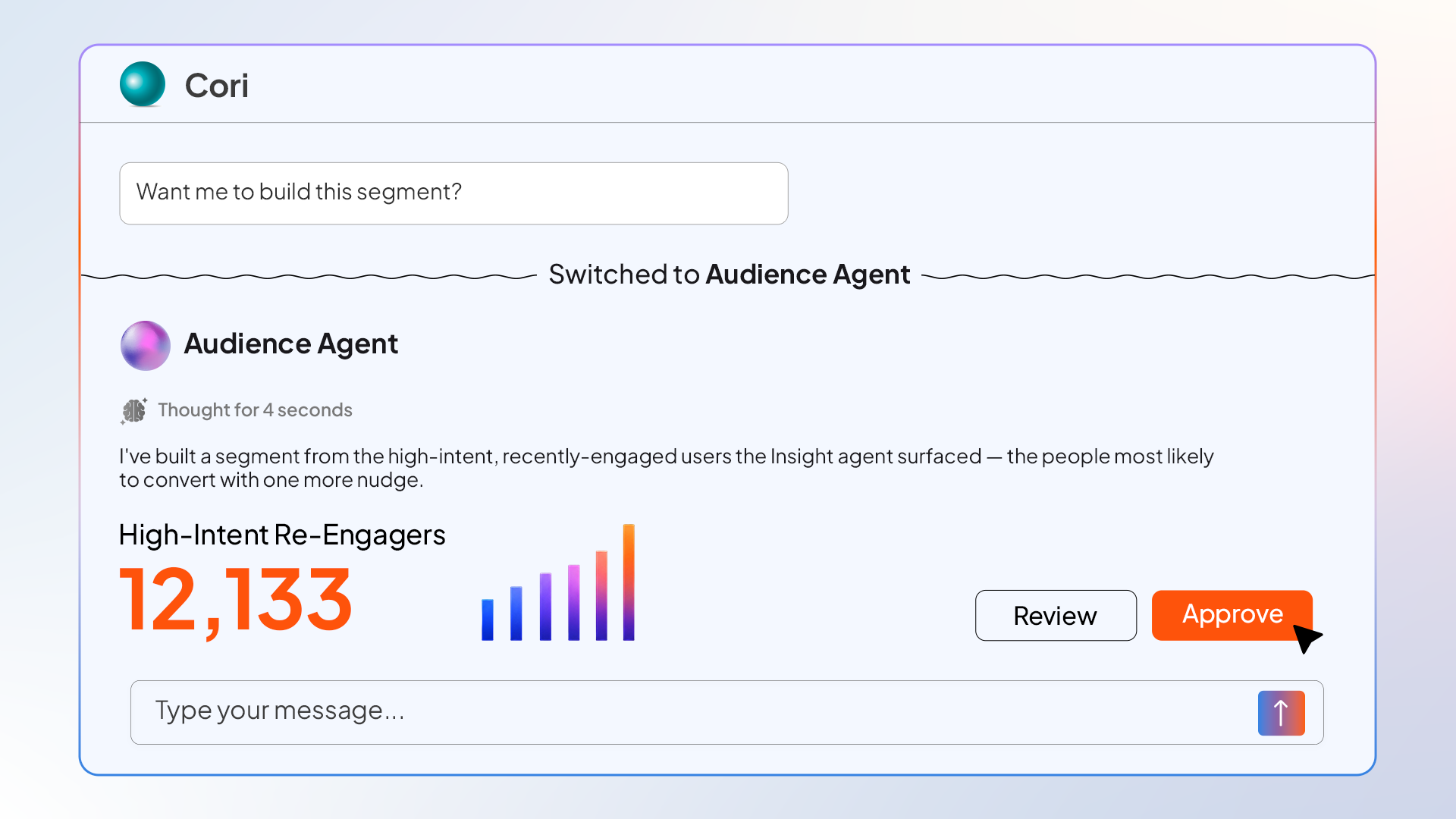
Once a finding points at a group worth targeting, Cori offers to build the segment rather than leaving it to you.
For example: Maya says yes. Cori writes the segment rule in the platform’s real grammar, translates it into plain English so she can check it, and sizes it against the live count. Purchased three or more times, high LTV band, declining frequency, zero conversions on discount campaigns. Twelve thousand one hundred and thirty three customers. Same cohort the analysis found, with nothing retyped.
3. Create the Content
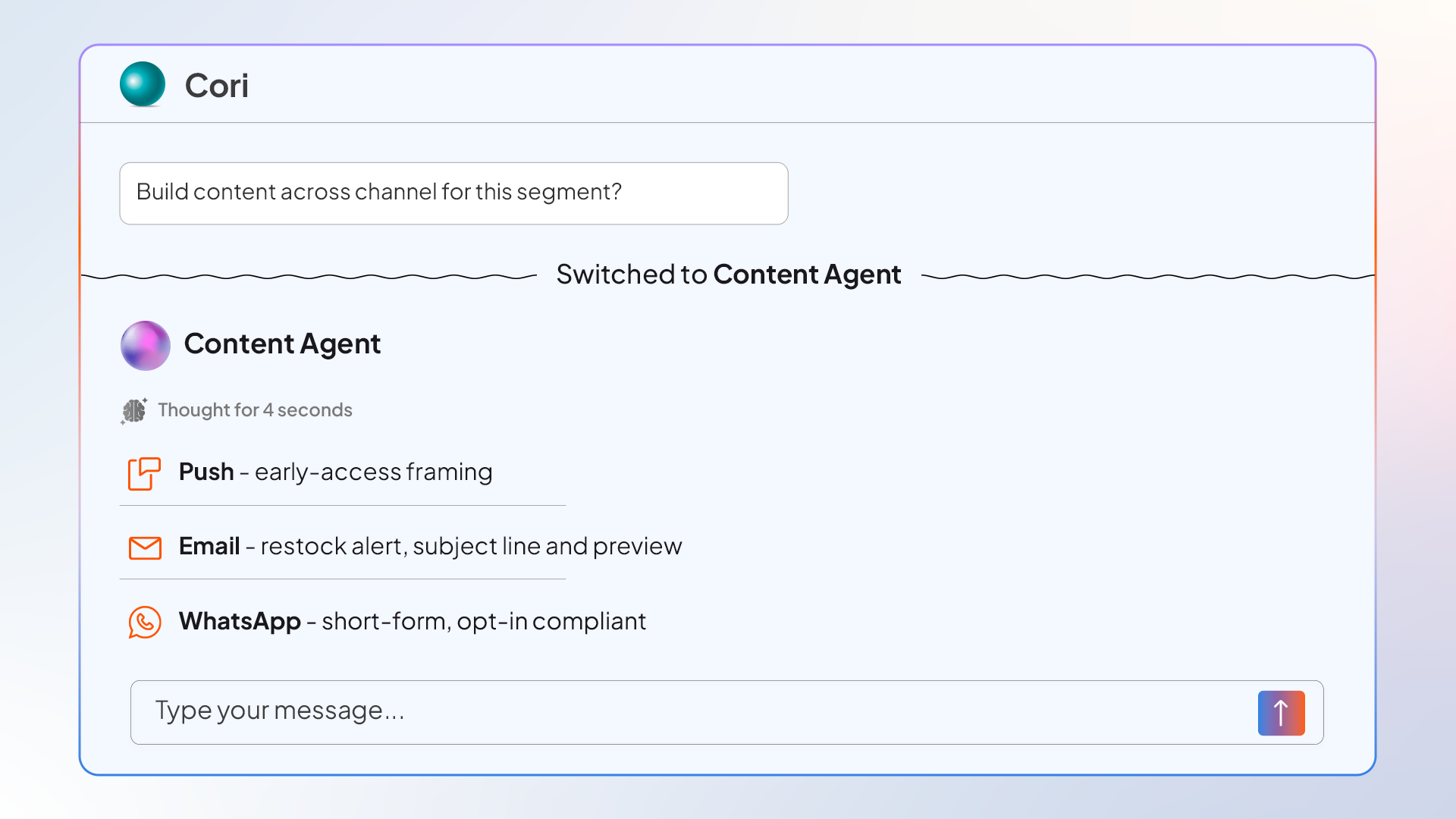
Ask Cori to write and it drafts for each channel in your brand voice, personalised to the audience it just built.
For example: push gets early access framing with no discount, because the analysis proved discounts do not work with this group. Email gets a restock alert with subject line and preview text. WhatsApp gets a short form version that stays opt in compliant. All three in the brand’s own voice, because Cori is working from the same brand knowledge it used to answer the original question.
4. Draft the Campaign
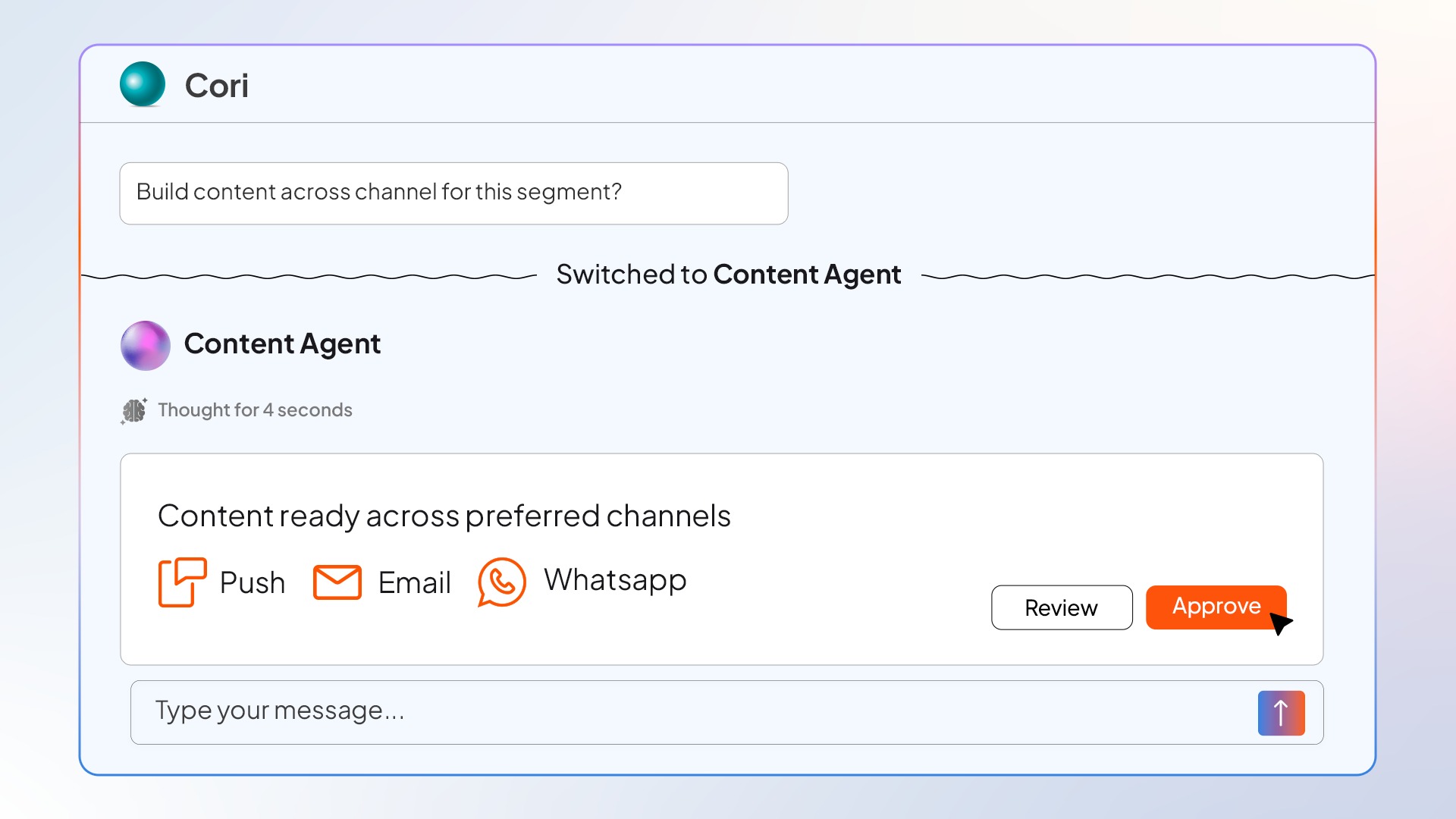
Finally, the Cori assembles the whole thing. Audience, content, channels and a send schedule timed to when each individual customer is most likely to open.
For example: what lands on Maya’s screen is a complete campaign in draft. She reviews it, changes one line of the email copy, and approves. The nine day version of this took nine days. This one took a conversation.
Numbers You Can Defend in a Room
Marketers who do not trust AI output end up checking it anyway, which costs back the time the tool saved.
Cori handles this differently. Every figure it reports carries a tag.
Grounded means the number traces to specific evidence in your data, and you can see exactly what.
Projected means it is a labelled estimate, and Unified Co-Marketer tells you so up front rather than presenting a guess as a fact.
Where the data does not exist at all, Cori says the data does not exist. There is no zero filled report and no invented baseline to make a slide look complete. Reports carry a grounding coverage stamp so you know how much of what you are reading is traced.
So when Cori tells you that re-engaging those 12,133 buyers is worth a certain amount this quarter, that figure is marked as a projection. When it traces the 14% revenue drop, it shows you the data it came from. You get an answer you can put in front of leadership and act on the same day, rather than one you quietly go and verify first.
What This Looks Like in Practice
Growing revenue from the customers you already have

Ask Cori where your biggest untapped revenue sits. It finds high value buyers who own your core product but have never been shown the one that pairs with it, sizes that segment, and drafts a cross-sell campaign across email, WhatsApp and onsite, ready to approve.
Recovering applicants who stall in a credit card journey
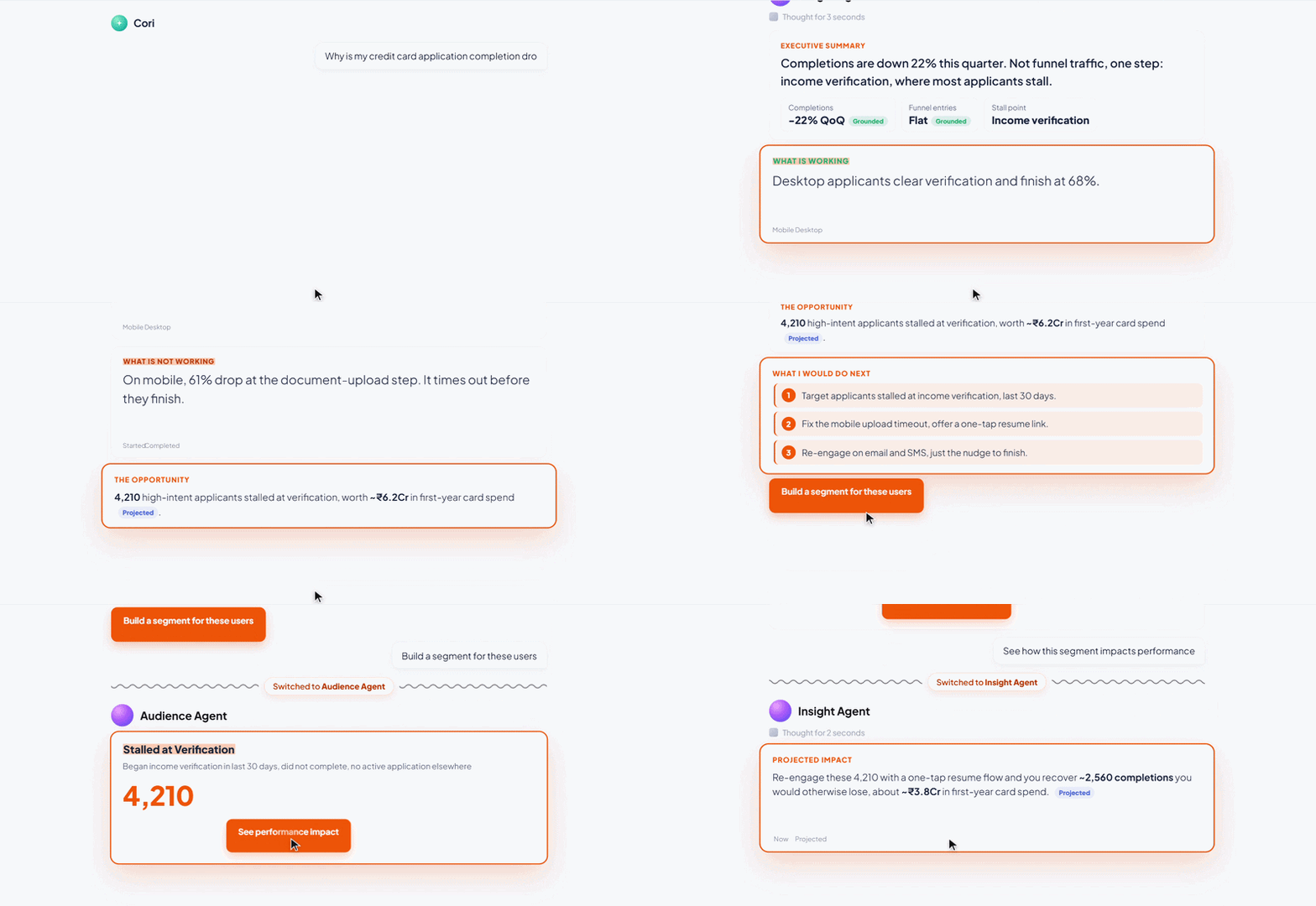
Ask where applicants drop out of the credit card application. Cori pinpoints the step with the biggest fall-off, with every figure traceable back to your data. It separates a genuine drop-off from a step that is simply waiting by design, which is the distinction that usually needs a senior person to make.
Then it drafts a segment of the applicants stalled at that step, sized and ready to re-engage, along with content that reflects what has historically moved this group.
For a regulated team that is two problems solved at once. The audience is ready to act on, and every number behind it traces back to source for a compliance review.
Two Ways to Work, in Netcore Agent Hub
Cori is one part of Netcore Agent Hub, Netcore’s home for agentic marketing.
Your everyday marketing runs through Cori, in one conversation with an agent that knows your business and does the work. Your recurring, specific work goes to Netcore Custom Agents, specialists you build for the jobs only your team runs. The monthly review in your own format, the weekly journey check, the audit prep.
Two ways to work, one studio, one shared understanding of your business.
Getting the Most Out of Cori
Ask the question you actually have. Not the question you think the tool can answer. Cori handles “why is repeat purchase slipping in our biggest market” better than “show me repeat purchase by region.”
Follow up in the same conversation. The context carries, so the second and third questions get better answers than the first. Treat it as a conversation rather than a search box.
Say how you like things once. Formats, definitions, how you want numbers presented. Cori holds it across every conversation afterwards.
Check the tags before you act. Grounded and Projected tell you how much weight a number can carry. A projected figure is still useful. It just needs to be read as an estimate.
Let it build, then edit. The draft is a starting point. Most marketers change something before approving, and that is the intended workflow.
Mistakes to Avoid
Treating it like a search bar. One word queries get shallow answers. Cori is built for questions with a why in them.
Approving without reading. The draft is usually good, which is what makes it easy to skim. Read the segment rule and the copy before you sign off.
Ignoring what it surfaces unprompted. Cori will often flag something adjacent to what you asked. That is usually the most valuable thing in the conversation.
Rebuilding what it already built. If Cori has drafted a segment, edit that segment rather than starting a fresh one. The whole point is that the context carries forward.
You Did Not Need More Agents. You Needed One That Knows the Business.
Maya’s answer lived across three systems, and joining them was a job only she could do.
That is the work Cori absorbs. The analysis that used to take two days, the audience that took an afternoon, the copy brief that took another, and the campaign setup that took the rest of the week.
What is left is deciding whether the finding is worth acting on, judging whether the copy sounds right, and choosing when to send.
Cori is the one place you bring any marketing problem. Because it knows your business, it finds what matters, does the work, and shows you where every number came from. You ask. It gets it done. You approve.
Cori is available to every Netcore customer inside the platform, with no setup required.
Request a demo of Cori, or try it on your platform today

