


Table of Contents
- Why KYC-to-activation is the real growth lever in fintech
- 3 things that quietly kill KYC drop-off recovery
- 5 ways fintech brands are lifting KYC-to-activation with Netcore journeys
- Turn your KYC drop-off into your highest-ROI recovery journey
17 out of every hundred fintech app installs, uninstall on day zero. By day 28, sixty are gone, the highest churn of any industry Netcore tracks. Most of it happens on one screen: KYC.
A user links her phone number, uploads her PAN, reaches the selfie step. A call comes in. She never comes back. The reminder that follows says exactly what every other app on her phone already said that week: “Complete your KYC to get started.” She never opens it. The app is gone within a week.
That gap between install and activation decides what the user is worth. Brands that treat every drop-off the same way lose her for good. Brands that treat it as three separate problems, distraction, friction, and doubt, recover a third of them or more. Here’s how.
Why KYC-to-activation is the real growth lever in fintech
Before the tactics, look at the economics. Most fintech marketing teams already track Cost Per Install and Cost Per Acquired Customer closely. KYC recovery deserves the same attention. It’s applied to a user you already paid to reach once.
A. Recovering a KYC drop-off costs far less than acquiring a new user. Global average CAC for fintech is $175. The average LTV: CAC ratio sits close to 1:3, short of the 3:1 considered healthy, meaning the typical fintech customer is worth less than what it costs to acquire them. Bain and Harvard Business Review put retention cost at 4 to 20% of acquisition cost, a 5 to 25X gap, across sectors. A user who dropped off mid-KYC already cost you the ad and the install. The phone number and PAN are already on file. Only the activation is missing.
B. A reason-matched nudge recovers accounts that looked lost. Fintech brands running signal-led, multi-touch recovery journeys, instead of one broadcast push, have moved KYC conversion from 18% to 33% inside 90 days, an 85% efficiency gain. At platform scale, one Southeast Asian bank using the same approach completed 300,000 KYC activations in 45 days.
C. Small gains at each step add up to real activation lift. Moving from a single push to a fallback-sequenced, signal-triggered journey typically adds double-digit percentage points to KYC-to-activation conversion, with no change to the product or the price. This isn’t limited to lending and broking apps. Early lifecycle orchestration lifted activation 75% within 75 days at a leading Indian bank. Activation, not signup, is the metric that moves revenue.
In short: the KYC recovery nudge isn’t an onboarding afterthought. It’s the highest-ROI campaign most fintech brands run, if the drop-off is actually diagnosed instead of blasted.
3 things that quietly kill KYC drop-off recovery
Drop-off volume isn’t the real problem. Every fintech app loses a share of installs somewhere in KYC. The real problem is what happens next, or doesn’t.
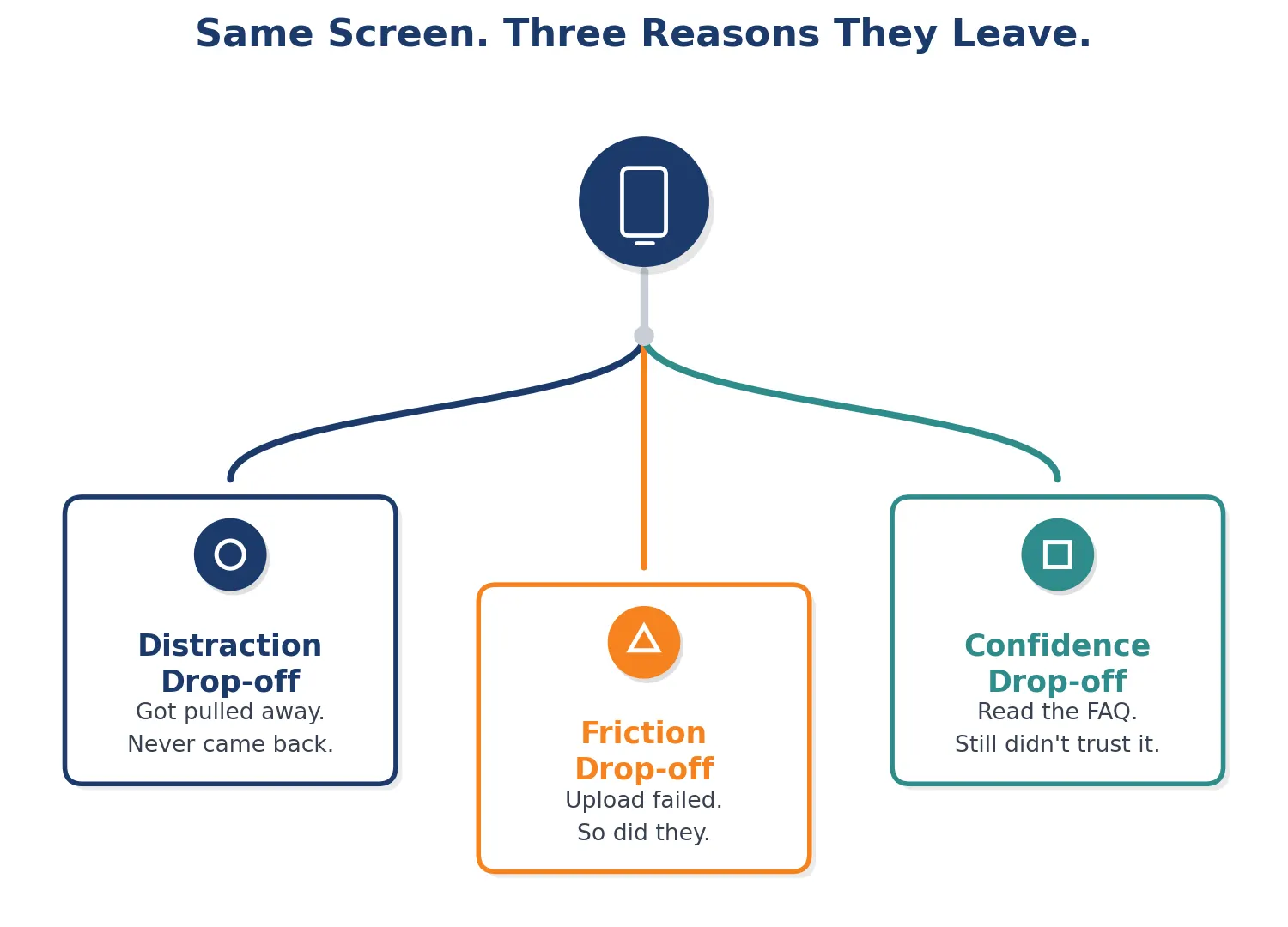
Netcore’s Insight Agent splits every KYC drop-off into one of three behavioural patterns.
1. One generic line for every drop-off reason. “Complete your KYC to get started” says the same thing to three different users: one who got distracted, one who hit a video KYC timeout or a PAN mismatch, one who stopped trusting the app. That gap matters more in fintech than most categories: 80% of users have deleted an app simply because they didn’t know how to use it. Netcore’s Insight Agent reads 500+ behavioural signals per user in real time. It sorts fintech KYC drop-off into three buckets: distraction (session ended, no error), friction (video KYC timeout, selfie upload failure, PAN mismatch), and confidence (repeat visits, FAQ reads, then silence). 40 to 50% of users drop off mid-KYC on the average fintech app, and most brands send one push, within the hour, worded the same way for all three.
2. Reminder fatigue with no fallback. Many recovery programs send the same message on the same channel to every stalled user, whether they already opened it, ignored it, or gave up entirely. Send enough of these and conversion doesn’t plateau; it drops. The user mutes notifications or uninstalls instead of finishing the one step left.
3. The KYC engine and the consent record don’t talk to each other. A user gives WhatsApp consent during onboarding, drops off at document upload, then gets messaged again on SMS as if that consent never happened, because the channels don’t share a consent record. Most BFSI teams can name three vendors in that chain. The real number is usually closer to eight, and under India’s Digital Personal Data Protection Act, every one of them is your liability, not theirs. A single violation carries a penalty of up to ₹250 crore, and a breach has to be reported within 72 hours, in public. A recovery journey running through five or six disconnected vendors multiplies both the compliance surface and the odds a user gets messaged on a channel they never agreed to.
5 ways fintech brands are lifting KYC-to-activation with Netcore journeys
Netcore’s fintech practice has a name for this exact problem: App Onboarding & KYC Activation, closing the drop-off between install and activated account with behaviour-triggered nudges at every friction point. Every tactic below runs on channels you already have: App Push, Email, SMS, WhatsApp, RCS, and in-app messaging. The lift doesn’t come from a new channel. It comes from diagnosing the drop-off correctly, then sequencing the channels you already have around that diagnosis. One engine sits underneath all five: it classifies the reason, writes the fix, and times the send for every user.
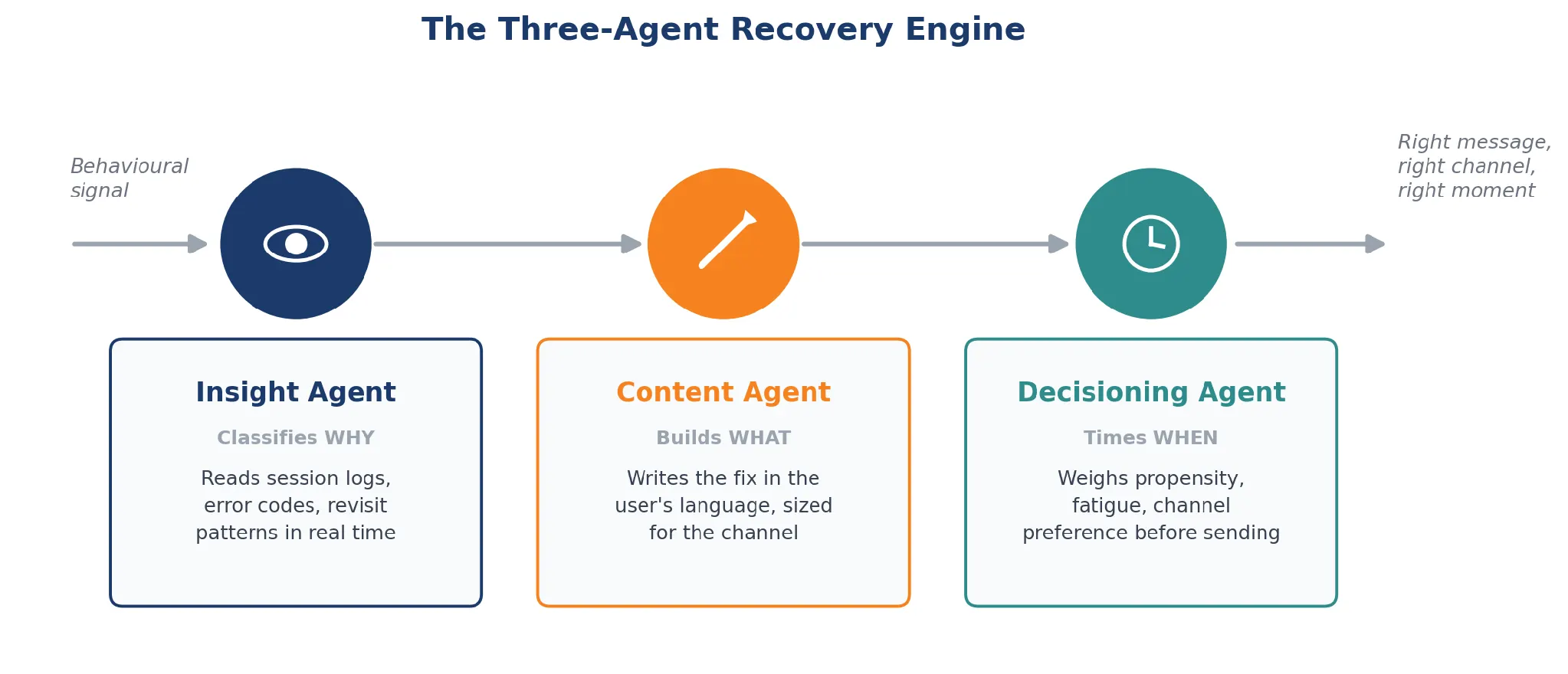
One engine runs behind all five tactics below: diagnose, write, then time the send.
1. Build a reason-differentiated, fallback-sequenced recovery journey, not a single blast
Best-in-class recovery programs route each drop-off by its Insight Agent classification, instead of firing one push to everyone. The Content Agent writes the specific fix, a resume link, a corrected upload flow, or reassurance, in the right language for the channel it lands on. A customer engagement platform that holds journey state across App Push, WhatsApp, Email, SMS, and in-app messaging means a distraction drop-off gets one well-timed nudge, a friction drop-off gets the fix itself, and a confidence drop-off gets reassurance. If the first channel goes unopened, it falls back to the next one automatically.
Navia Markets built its engagement strategy around one idea: every pause is a request for help, not a chance to broadcast. Using customer engagement for fintech built on Netcore’s Agentic Marketing platform, Navia read behavioural signals and responded to hesitation across Email, WhatsApp, SMS, App Push, in-app messages, and RCS. KYC went from a solo task to a guided one. Inside 90 days: KYC conversion rose from 18% to 33%, an 85% efficiency gain. Referrals grew 2.8X. MAUs grew from 28,000 to 39,000, up 11,000 in one quarter. DAUs rose 15%.
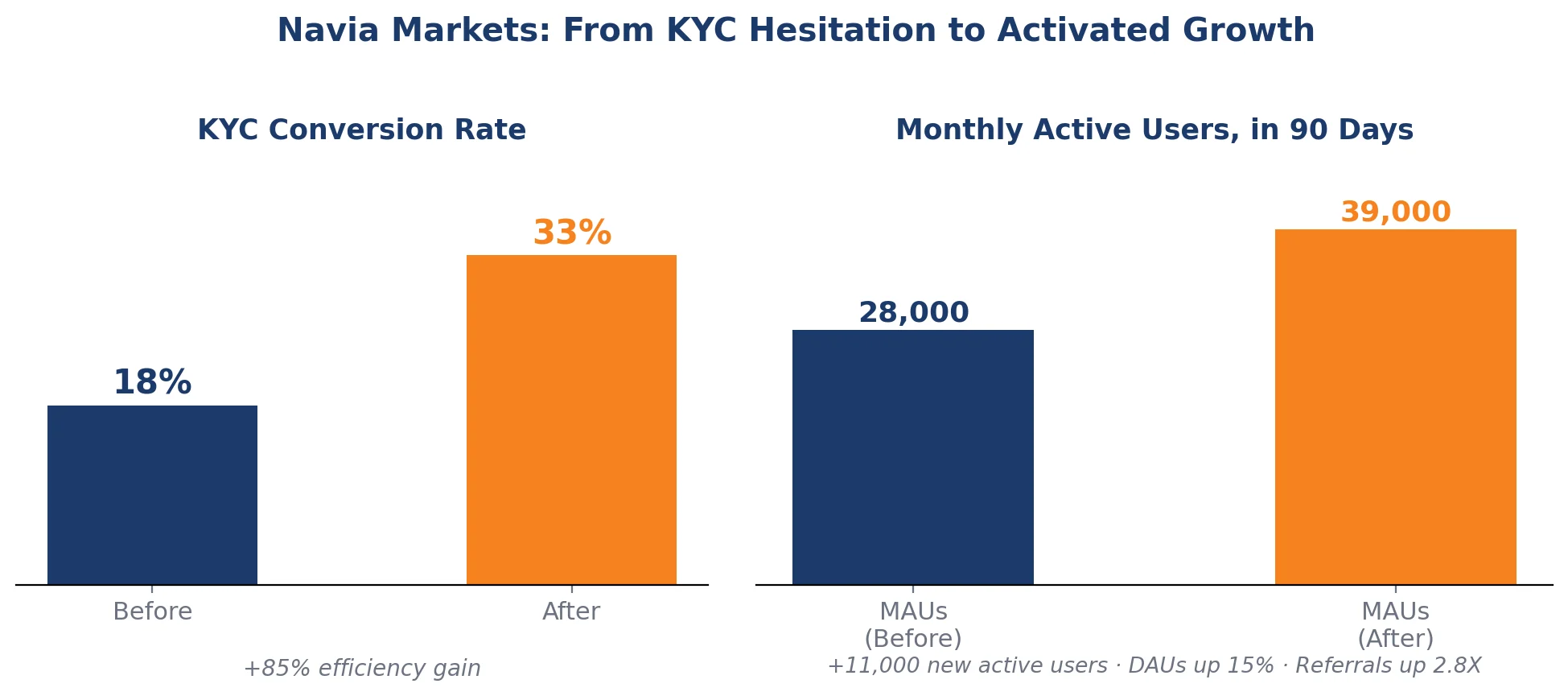
Navia Markets’ KYC and activation results after moving from broadcast messaging to signal-led, guided onboarding.
The same resume-don’t-restart idea works outside lending apps too. Reliance General Insurance found repeat website visitors dropped off because they had to refill an entire lead form from scratch. Letting them pick up exactly where they left off, with a personalised banner showing their own details, lifted conversion from repeat visitors 400%, cut bounce rate 57%, and raised average session length 204%.
2. Make the click actionable: embed the fix inside the message, skip the redirect
A recovery message that sends a stalled user back to a login screen loses them a second time. The click only works if it lands somewhere the user can finish the step right there, a document re-upload, an e-sign, a resumed application, inside the message itself. No app re-login. No redirect.
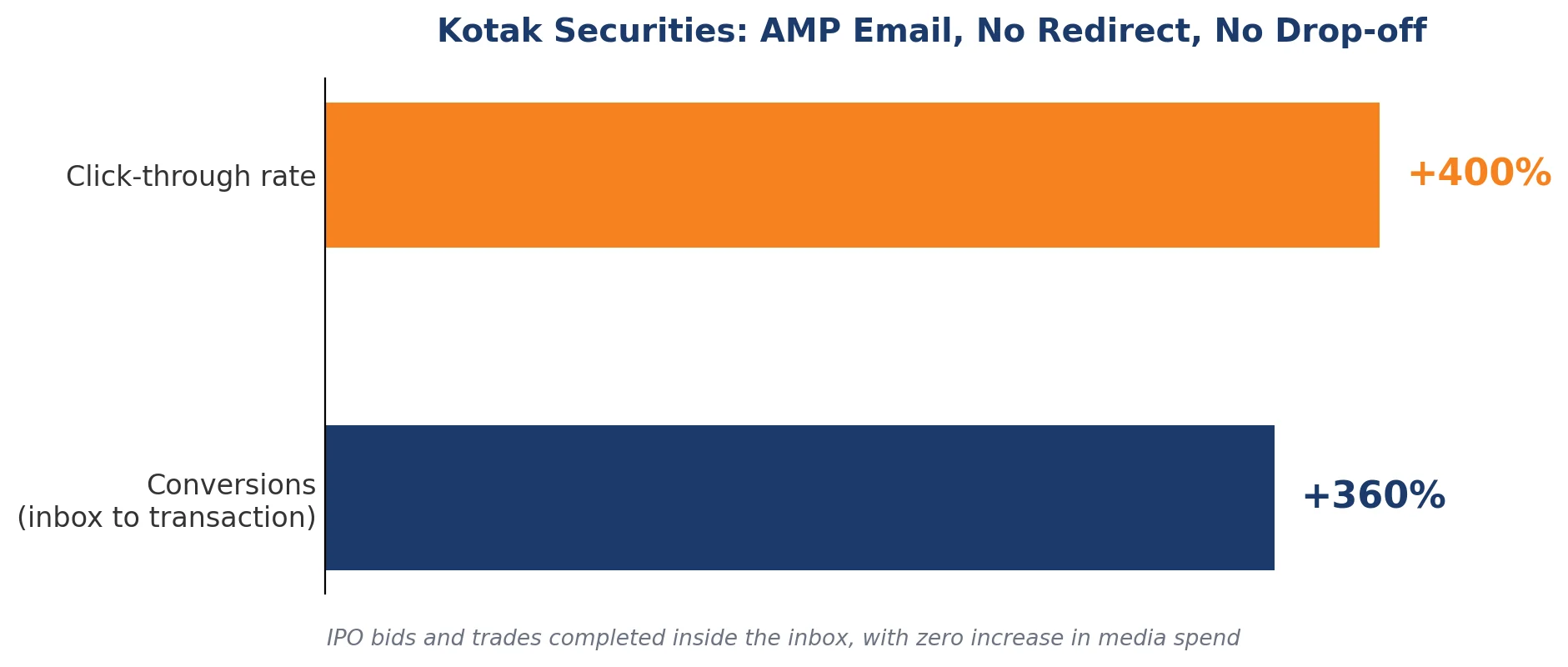
Kotak Securities used AMP Interactive Email to bring IPO bids and trade completions directly inside the inbox. No redirect. No drop-off between click and completion. The result: conversions up 360%, click-through rate up 400%, with no increase in media spend.
3. Guide KYC-complete but hesitant users to activation with contextual in-app nudges
Completing KYC doesn’t guarantee activation. Netcore’s own BFSI playbook calls this moment Activate First Spend: moving every KYC-complete but dormant user to their first spend by meeting them at the moment- a bill due, a cashback offer, a spend nudge- that makes acting easier than waiting. Contextual, no-code nudges, tooltips, spotlights, banners, placed at that exact moment do exactly that.
TVS Credit used Netcore’s Product Experience platform to place contextual in-app nudges on its InstaCard page, a pre-approved credit facility, guiding eligible users to activate their credit limit. Paired with AI-driven channel prediction through Netcore’s Raman engine, TVS Credit saw user engagement rise 5.4X, lead generation rise 80%, feature adoption rise 63% through no-code nudges, and campaign costs fall 15%. Khatabook saw a similar pattern: lifecycle-stage nudges guiding merchants to a different action, adding staff details, lifted completion 26%.
4. Time the nudge to the moment of intent, not a fixed timer
A push fired the instant a user drops off, or on a flat one-hour timer, competes with everything else happening on that phone right then. A marketing automation platform for fintech that waits for the right signal, a returning session, a typical return window, an idle period ending, competes with almost nothing.
Bajaj Markets used agentic content decisioning to deliver the right offer to the right user, at the right moment, on the right channel, instead of firing on a fixed schedule. The result: a 17% month-on-month rise in app lead conversions, notably in the Demat category, and a roughly 10% rise in click-through rates across campaigns.
5. Let AI decide cadence, channel, and whether to send at all
Not every stalled user needs the same number of nudges on the same channel. An agentic marketing platform for fintech built on a Decisioning Agent weighs propensity, channel preference, and message fatigue before every send. It makes millions of real-time send or no-send decisions a day, so no one gets chased across five channels for one unfinished form.
Shriram Finance unified its data and closed drop-off points across app, SMS, and email using Netcore’s Agentic Marketing platform. Disconnected, manually sequenced campaigns became continuous, context-led journeys. The result: 171X ROI, with measurable uplift across every funnel stage and no increase in media spend.
Turn your KYC drop-off into your highest-ROI recovery journey
Put together, the pattern is the same across every fintech brand above: KYC-to-activation doesn’t move because of a new channel. It moves when the drop-off reason, the channel, the content, and the timing are built around what one user actually did, not what a fixed calendar assumes everyone will do.
| Layer | Industry benchmark (2026) | Best-in-class with Netcore journeys |
| KYC-to-activation conversion | 40–60% drop-off industry-wide* | Navia: 18% → 33% (+85% efficiency gain) |
| Time to first live recovery journey | Weeks to months of manual campaign builds | 2–4 weeks live · SEA bank: 300,000 activations in 45 days |
| Inbox-to-transaction conversion (no redirect) | Typical email CTR ~2–5%** | Kotak Securities: 360% ↑ conversions, 400% ↑ CTR |
| Feature/activation adoption via in-app nudges | Manual, one-size onboarding flows | TVS Credit: 63% ↑ feature adoption, 5.4X engagement |
| Funnel ROI from unifying data and closing drop-off points | Fragmented martech, manually sequenced campaigns | Shriram Finance: 171X ROI |
*Fintech customer experience research, 2026, on digital KYC abandonment benchmarks. **General industry email marketing benchmarks.
If your KYC recovery program still looks like a single push at the one-hour mark, don’t start with a new channel. Start by diagnosing the drop-off reason and sequencing the channels you already have. Embedded actions, contextual nudges, and AI-tuned cadence compound on top of that.
KYC recovery is one moment in a much longer relationship. For the full playbook, covering acquisition, activation, retention, referral, and revenue for fintech apps, see Netcore’s FinTech Customer Lifecycle Marketing Guide.
Ready to see what a reason-matched KYC recovery journey could do for your numbers? Request a demo with Netcore’s fintech expert, or see how the same approach applies across banking, insurance, NBFC, and AMC on the BFSI industry page.


